Setting up a primer manufacturing plant in India presents a compelling investment case driven by surging demand from the construction, automotive, industrial coatings, and aerospace sectors. As one of the fastest-growing economies in Asia-Pacific, India’s expanding urban infrastructure, rising vehicle ownership, and an active manufacturing base are creating sustained demand for high-performance surface preparation products. Primers preparatory coatings essential for adhesion, corrosion resistance, and finish quality sit at the heart of multiple high-growth value chains, making a dedicated manufacturing unit both strategically sound and commercially viable.
India’s structural advantages further strengthen the investment rationale. The country’s Make in India initiative actively incentivises domestic production of industrial chemicals and specialty coatings, reducing import dependency and creating a competitive cost base. States like Gujarat and Maharashtra, with their well-developed chemical processing zones, SEZ infrastructure, and proximity to port logistics, offer ideal locations for primer manufacturing. With the India primer market valued at USD 736.26 Million in 2025 and projected to reach USD 1,238.62 Million by 2034 at a CAGR of 6.0%, the commercial opportunity is clear and time sensitive.
India’s primer manufacturing sector sits at the intersection of policy support, a cost-competitive production environment, and multi-sector demand growth. With gross profit margins of 35–45% and a well-defined break-even trajectory, a primer manufacturing plant in India represents a financially robust and strategically well-timed investment for entrepreneurs and institutional investors alike.
What is Primer?
A primer is a preparatory coating applied to a surface before the application of a topcoat or finish coat. Its primary function is to improve adhesion of subsequent coating layers, enhance the overall durability of the treated surface, and provide a smooth, even base for the final application. Primers are formulated from a range of materials including acrylic, epoxy, urethane, and oil-based compounds, each tailored for compatibility with specific substrates such as wood, metal, concrete, or plastics. Beyond adhesion, primers deliver additional functional benefits including corrosion resistance, moisture protection, stain blocking, and UV protection.
The production process involves raw material selection, mixing and blending, quality control, packaging, and distribution. End-use industries served by primer manufacturers include construction, automotive, industrial coatings, aerospace, marine applications covering boats and ships, and consumer goods. The diversity of applications from surface preparation for painting and coating, rust prevention in metal applications, and moisture resistance for wood and concrete surfaces, to UV protection in outdoor applications gives primer manufacturing a resilient, multi-channel revenue base.
Cost of Setting Up a Primer Manufacturing Plant in India
The total cost of establishing a primer manufacturing plant in India depends on several variables including plant capacity, technology selected, geographic location, level of automation, and regulatory compliance requirements. A thorough feasibility assessment covering all CapEx and OpEx components is essential before committing capital.
1. Capital Expenditure (CapEx)
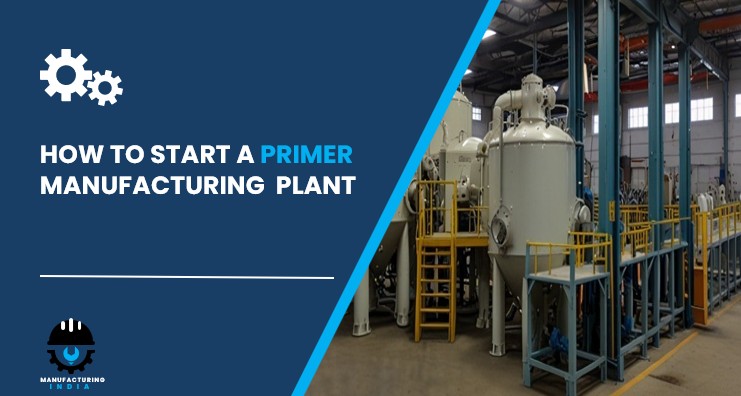
Capital investment for a primer manufacturing plant covers several broad cost heads. Land and site development forms a substantial part of the overall investment, encompassing land registration charges, boundary development, and related site preparation expenses. Investors may consider locating the facility within an SEZ or established industrial estate in states such as Gujarat or Maharashtra to benefit from land cost efficiencies and infrastructure readiness. Civil works and construction costs cover the manufacturing shed, quality control laboratory, raw material and finished goods storage, effluent treatment infrastructure, and the administrative block.
Machinery and equipment costs represent the largest single portion of total capital expenditure for a primer plant. Key machinery required includes:
- Mixing equipment
- Dispensing systems
- Testing equipment
- Packaging machines
Other capital costs include the effluent treatment plant (ETP), pre-operative expenses, commissioning costs, and any applicable import duties on specialised machinery not manufactured domestically.
Request a Sample Report for In-Depth Market Insights: https://www.imarcgroup.com/primer-manufacturing-plant-project-report/requestsample
2. Operational Expenditure (OpEx)
The operating cost structure of a primer plant is heavily weighted towards raw materials. Raw material cost accounts for 65–75% of total OpEx, with the primary inputs being resins (acrylic, epoxy), pigments (zinc phosphate, titanium dioxide), solvents, and additives. Entering long-term procurement contracts with reliable domestic and international suppliers is essential to mitigate price volatility and ensure supply continuity. Utility cost, covering electricity, water, and steam, accounts for 5–10% of OpEx. Additional operating costs include transportation, packaging, salaries and wages, maintenance, depreciation, and applicable taxes. Operational expenditure is projected to increase substantially by year five of operations, driven by inflation, market fluctuations, and potential rises in key raw material prices, as well as supply chain disruptions and rising consumer demand.
3. Plant Capacity
The proposed primer manufacturing facility is typically designed with an annual production capacity ranging between 10,000 and 20,000 KL, enabling meaningful economies of scale while preserving operational flexibility. Plant capacity can be customised based on the investor’s specific capital availability and target market scale. Profitability improves considerably at higher capacity utilisation levels, making early market development and long-term off-take agreements strategically important.
4. Profit Margins and Financial Projections
A primer plant in India demonstrates healthy profitability potential under normal operating conditions. Gross profit margins typically range between 35–45%, supported by stable demand across multiple end-use sectors and the value-added nature of specialty primer formulations. Net profit margins range between 15–20%. Financial projections incorporate NPV analysis, IRR calculations, payback period modelling, and sensitivity analysis across production capacity and pricing scenarios. These projections are developed based on realistic assumptions related to capital investment, operating costs, capacity utilisation, and demand outlook, providing investors with a comprehensive view of long-term financial viability.
Why Set Up a Primer Plant in India?
Demand for High-Performance Coatings:
As industries across construction, automotive, aerospace, and manufacturing seek to enhance both durability and aesthetic appeal, demand for high-performance primers is rising. India’s infrastructure pipeline encompassing roads, metro rail, industrial parks, and residential housing is a sustained long-term driver for surface preparation products.
Increasing Focus on Eco-Friendly Products:
With growing concern over VOC emissions and the environmental impact of chemical coatings, the market is witnessing a clear shift towards water-based primers and low-VOC formulations. Indian manufacturers who invest in eco-compliant production technology will be positioned to capture both domestic regulatory-driven demand and export market opportunities.
Growth of Emerging Markets:
As construction and manufacturing activities expand in emerging markets, particularly across Asia-Pacific, the demand for primers is increasing at a pace that domestic Indian production is well-positioned to serve. India’s own rapid urbanisation and industrial expansion represent the most immediate demand pool.
Technological Advancements:
The development of advanced primers including multi-purpose, quick-drying, and specialty variants is creating new market segments and improving margins for technically capable manufacturers. Indian plants that adopt modern formulation technology will be able to address these higher-value market niches.
Active Industry Investment:
The global primer industry continues to attract significant R&D and product development investment. In September 2025, Sun Chemical unveiled its first HP Indigo-approved primer for label applications. In February 2024, AkzoNobel introduced a new 2K solvent-borne primer specifically designed for automotive OEM exterior plastic parts, addressing adhesion challenges on low-polarity plastics like polypropylene. These developments illustrate the innovation momentum driving premiumisation across primer end-use segments.
Local Supply Chain Preference:
Construction companies, automotive OEMs, furniture manufacturers, and industrial equipment producers are increasingly prioritising domestically sourced primers to reduce lead times, manage import duties, and ensure consistent quality. An Indian primer plant with established supply relationships is ideally positioned to serve this preference.
Manufacturing Process Step by Step
The primer manufacturing process uses raw material selection, mixing and blending, quality control, packaging, and distribution as the core stages of the production method. Each stage involves specific unit operations, material handling protocols, and quality assurance checkpoints.
- Raw Material Selection: Resins (acrylic, epoxy), pigments (zinc phosphate, titanium dioxide), solvents, and additives are sourced, inspected, and approved against specification before entering the production sequence.
- Mixing and Blending: Approved raw materials are combined using mixing equipment under controlled conditions to achieve the required formulation consistency, viscosity, and chemical properties.
- Quality Control: Analytical instruments are used throughout blending and post-production to monitor product concentration, purity, and stability. Technical tests and quality assurance criteria are applied at this stage.
- Packaging: Finished primer is filled, sealed, and labelled using packaging machines, prepared for dispatch in appropriate containers suited to the end-use application and customer specification.
- Distribution: Packaged product is dispatched to end-use industries including construction, automotive, industrial, aerospace, marine, and consumer goods customers.
Key Applications
Primers manufactured at an Indian production facility serve a broad range of industries, each with specific performance and regulatory requirements.
- Construction: Used to prepare concrete, drywall, and wooden surfaces for painting and coating, ensuring topcoat adhesion and long-term surface durability.
- Automotive: Applied as part of the multi-step finishing process for vehicle bodies, protecting against corrosion, UV damage, and wear while enhancing paint adhesion.
- Industrial Coatings: Essential for protecting machinery, metal structures, and equipment from corrosion, abrasion, and harsh environmental conditions.
- Aerospace: Used to prepare aircraft surfaces for painting and coating, with primer thicknesses of approximately 25 μm providing corrosion resistance and adhesion under extreme operating conditions.
- Marine: Applied to boats and ships to protect against saltwater corrosion, UV degradation, and other environmental exposure factors.
- Consumer Goods: Supports surface preparation and finishing across a range of consumer-facing products.
Leading Manufacturers
The global primer industry is served by several multinational companies with extensive production capacities and diverse application portfolios. Key players active across construction, automotive, industrial, aerospace, marine, and consumer goods end-use sectors include:
- AkzoNobel N.V.
- The Sherwin-Williams Company
- Axalta Coating Systems, LLC
- PPG Industries, Inc.
- BASF SE
Timeline to Start the Plant
Investors planning a primer manufacturing plant in India should anticipate the following phased development timeline:
- Feasibility study and project report preparation
- Land acquisition and site development
- Regulatory approvals and environmental clearances
- Factory licence and fire safety compliance
- Machinery procurement and installation
- Raw material supplier agreements and supply chain setup
- Trial production and quality testing
- Commercial production launch
Licences and Regulatory Requirements
Starting a primer manufacturing unit in India requires several approvals:
- Business registration (Proprietorship, LLP, or Pvt Ltd)
- Factory Licence under the Factories Act
- Environmental Clearance from State Pollution Control Board
- GST Registration
- Fire Safety NOC
- Hazardous and chemical compliance certifications applicable to solvent-based and reactive primer formulations
- Effluent Treatment Plant (ETP) operational clearance
- Occupational Health and Safety compliance
Key Challenges to Consider
High Capital Requirements. The machinery and civil infrastructure investment for a primer plant represents a significant initial commitment, particularly for small and mid-scale entrepreneurs entering the market for the first time.
Raw Material Price Volatility. Key inputs resins (acrylic, epoxy), pigments (zinc phosphate, titanium dioxide), solvents, and additives are subject to global commodity and petrochemical price cycles. Long-term supplier contracts can partially mitigate this risk but cannot eliminate it entirely.
Regulatory Compliance. Environmental clearances, ETP operational requirements, and chemical handling regulations add complexity and cost to the establishment and ongoing operation of the facility. Non-compliance carries both financial and reputational risk.
Technology and Innovation Pressure. The rapid development of multi-purpose, quick-drying, and eco-friendly low-VOC primer variants means that manufacturers must invest continuously in formulation capability to remain competitive in higher-margin segments.
Competition. The global primer market is dominated by well-capitalised players including AkzoNobel N.V., The Sherwin-Williams Company, Axalta Coating Systems, PPG Industries, and BASF SE. Indian manufacturers must establish clear differentiation on quality, service, and price to compete effectively.
Skilled Manpower. Operating mixing, dispensing, testing, and quality assurance systems at commercial scale requires technically trained personnel, and attracting and retaining this talent in a growing sector adds an ongoing cost and HR management dimension.
Frequently Asked Questions
1. How much does it cost to set up a primer manufacturing plant in India? Total setup cost depends on plant capacity, technology, location, and automation level. The capital investment covers land and site development, civil works, machinery (mixing equipment, dispensing systems, testing equipment, packaging machines), and other pre-operative costs. A detailed project report provides capacity-specific cost estimates.
2. Is primer manufacturing profitable in India in 2026? Yes. Gross profit margins typically range between 35–45% and net margins between 15–20%, supported by stable multi-sector demand across construction, automotive, industrial, and aerospace applications.
3. What machinery is required for a primer plant in India? Essential machinery includes mixing equipment, dispensing systems, testing equipment, and packaging machines. All machinery should comply with industry standards for safety, efficiency, and reliability.
4. What licences and approvals are required to start a primer plant in India? Required approvals include business registration, a Factory Licence, Environmental Clearance from the State Pollution Control Board, GST Registration, Fire Safety NOC, ETP operational clearance, chemical compliance certification, and Occupational Health and Safety compliance.
5. What raw materials are needed for primer manufacturing? Core raw materials include resins (acrylic, epoxy), pigments (zinc phosphate, titanium dioxide), solvents, and additives.
6. What are the environmental compliance requirements for a primer plant in India? Operators must obtain Environmental Clearance from the State Pollution Control Board, install and maintain an operational Effluent Treatment Plant, and ensure compliance with emission standards. Solvent-based formulations require specific chemical handling compliance.
7. What is the best location to set up a primer plant in India? Ideal locations offer proximity to raw material suppliers, access to reliable transportation and utilities, robust waste management infrastructure, and compliance with local zoning regulations. Gujarat and Maharashtra, with established chemical processing zones and SEZ infrastructure, are strong candidate states.
8. What is the break-even period for this type of plant in India? The break-even period depends on plant capacity, production utilisation rates, pricing realisation, and operating cost management. A detailed financial analysis including payback period, NPV, and IRR modelling is available through the project feasibility report.
9. What government incentives are available for manufacturers in India? The Make in India initiative, state-level industrial incentives, SEZ benefits, and subsidies available through government schemes for chemical manufacturing and green production provide meaningful support to new investors in this sector.
Key Takeaways for Investors
The primer manufacturing plant opportunity in India is underpinned by sustained demand across construction, automotive, industrial coatings, aerospace, and marine sectors all of which are on growth trajectories aligned with India’s broader economic expansion. The investment demonstrates strong financial viability across a range of plant capacities, with gross margins of 35–45% and net margins of 15–20% providing a compelling return profile. The India primer market, valued at USD 736.26 Million in 2025, is projected to reach USD 1,238.62 Million by 2034 at a CAGR of 6.0%, confirming a long demand runway for domestic producers. With policy tailwinds from Make in India, a cost-competitive manufacturing environment, and the shift towards eco-friendly low-VOC formulations creating new product opportunities, primer production in India offers both near-term profitability and long-term demand sustainability.
About the Author