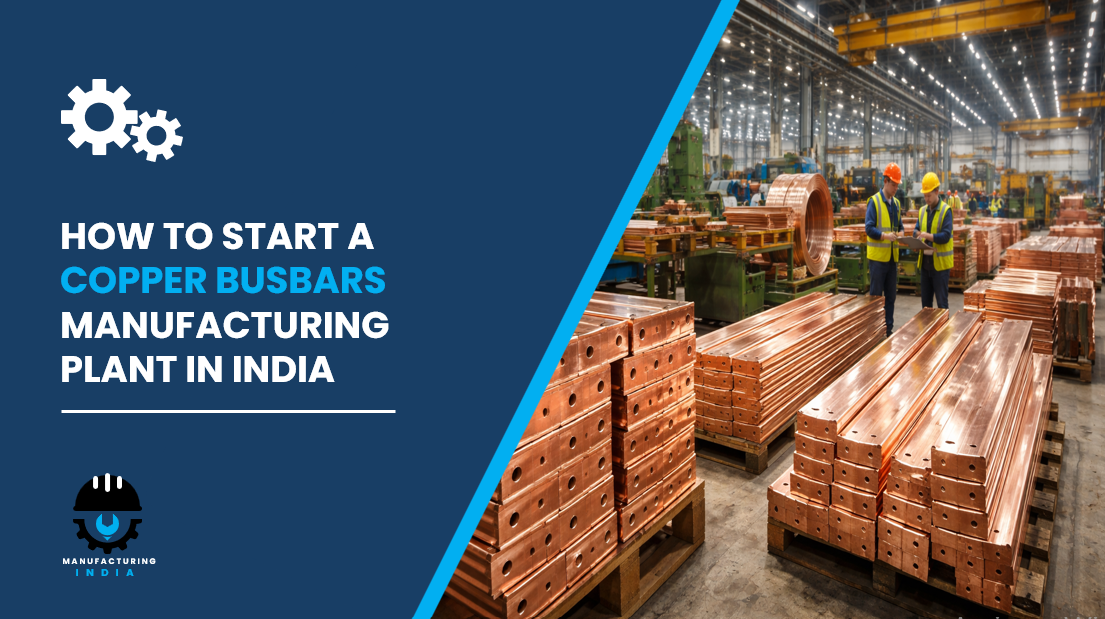
Setting up a copper busbars manufacturing plant in India presents a compelling investment case driven by the country’s accelerating power infrastructure expansion, rapid growth of renewable energy installations, booming electric vehicle charging ecosystem, surging data centre construction, and large-scale industrial automation adoption. Copper busbars – conductive bars made from high-purity copper used to distribute electrical power across switchgear, transformers, electrical panels, and distribution systems – are a mission-critical component in every modern power distribution network. Copper’s superior electrical conductivity, corrosion resistance, and ability to handle high current loads make it the material of choice for busbar manufacturing, and as India’s grid modernisation, green energy transition, and EV charging infrastructure scale up simultaneously, the domestic demand for reliable, high-quality copper busbars is expanding at an accelerating pace.
India’s strategic advantages for this investment are clearly established. The country’s large and growing power sector – backed by ambitious renewable energy targets, National Infrastructure Pipeline projects, and smart grid modernisation programmes – creates a vast and expanding institutional buyer base for copper busbars. States such as Gujarat, Maharashtra, Rajasthan, and Tamil Nadu offer well-developed metal and electrical component manufacturing ecosystems, established copper cathode procurement channels, and strong logistics connectivity to power sector buyers across the country. The Make in India initiative and PLI scheme for advanced chemistry cells and related manufacturing provide additional policy support. With the global copper busbars market valued at USD 5.51 billion in 2025 and projected to reach USD 9.01 billion by 2034 at a CAGR of 5.6%, and with India at the heart of multiple converging demand megatrends, the timing for establishing a copper busbars manufacturing plant in India has rarely been more favourable.
A copper busbars manufacturing plant in India captures demand from power generation and distribution, renewable energy, electric vehicle charging, industrial equipment, data centres, and construction infrastructure — all expanding simultaneously in one of the world’s fastest-growing economies. With gross margins of 15–25% and net margins of 5–12%, and a global market projected to nearly double to USD 9.01 billion by 2034, this investment offers stable financial returns and structurally secured multi-sector demand.
What are Copper Busbars?
Copper busbars are conductive materials used to distribute electrical power across various systems. Made from high-purity copper, they serve as central electrical conductors in power distribution panels, switchgear, and transformers. Copper’s superior electrical conductivity, resistance to corrosion, and ability to handle high current loads make it the material of choice for busbar manufacturing. These copper busbars come in various shapes and sizes — including flat, hollow, and cylindrical configurations – depending on the application and power distribution requirement.
Copper busbars are widely used in the construction of electrical distribution systems, industrial machinery, and renewable energy systems to ensure efficient and reliable power transmission. The primary production method spans raw material selection, shaping and forming, annealing, cutting and machining, surface treatment, inspection and testing, and packaging. The product serves end-use industries including power generation and distribution, renewable energy, electric vehicle charging stations, industrial equipment, data centres, and construction and infrastructure.
Cost of Setting Up a Copper Busbars Manufacturing Plant in India
The total cost of establishing a copper busbars manufacturing plant in India depends on production capacity, shaping and forming technology, plant location, degree of automation, and regulatory compliance requirements.
1. Capital Expenditure (CapEx)
The capital investment required to set up this facility covers several major cost heads. Land and site development – including land registration, boundary development, heavy-duty industrial flooring, and related site infrastructure – forms a substantial portion of total CapEx. Investors should consider locating the unit within metal processing or electrical component manufacturing industrial estates in Gujarat (Rajkot, Ahmedabad, Mundra), Maharashtra (Pune, Nagpur), or Tamil Nadu, where proximity to copper cathode procurement networks, established power sector equipment buyer clusters, and state investment incentives create a favourable operating environment. Access to reliable high-voltage power supply is a critical site selection criterion given the energy demands of extrusion and annealing operations.
Civil works and construction costs cover the raw material receiving and copper cathode storage yard, extrusion and rolling hall, annealing furnace building, cutting and machining zone, surface treatment area, quality control and testing laboratory, finished goods warehouse, and administrative block. Industrial-grade foundations for heavy extrusion machinery and annealing furnaces, along with appropriate fume extraction and ventilation systems, add specificity to the civil works scope.
Machinery and equipment represent the largest component of total capital expenditure for this copper busbars manufacturing plant. Key machinery required includes:
- Extrusion machines
- Rolling mills
- Annealing furnaces
- Cutting machines
- Surface treatment units
- CNC machines
- Testing and quality control systems
Other capital costs include effluent treatment plant (ETP) installation for surface treatment chemical waste, pre-operative and commissioning expenses, and any applicable import duties on specialised extrusion and rolling equipment not manufactured domestically.
Request a Sample Report for In-Depth Market Insights: https://www.imarcgroup.com/copper-busbars-manufacturing-plant-project-report/requestsample
2. Operational Expenditure (OpEx)
The operating cost structure of a copper busbars manufacturing plant is almost entirely dominated by raw material procurement. Raw material cost — covering copper cathode as the primary and effectively sole material input — accounts for approximately 85–90% of total OpEx, making copper cathode price management the single most critical strategic and operational lever for plant-level profitability. Copper cathode prices are directly linked to London Metal Exchange (LME) copper pricing, creating significant input cost exposure to global commodity market movements. Investors should establish long-term procurement agreements with domestic copper cathode producers and authorised distributors, and consider hedging strategies to manage LME price exposure across production planning horizons.
Utility costs, covering electricity for extrusion, rolling, annealing, and CNC machining operations, along with water for surface treatment processes, account for 5–10% of OpEx — a relatively low share reflecting the predominantly mechanical forming nature of busbar production. Other operating costs include transportation and logistics for copper cathode procurement and finished busbar dispatch to switchgear manufacturers, power sector contractors, EV charging infrastructure developers, and data centre builders, packaging materials, salaries and wages, maintenance and calibration of precision forming and testing equipment, depreciation of fixed assets, and applicable taxes. By the fifth year of operations, total operational costs are projected to increase substantially due to inflation, copper cathode price escalation, market fluctuations, supply chain disruptions, and rising industrial demand dynamics.
3. Plant Capacity
The proposed manufacturing facility is designed with an annual production capacity ranging between 5,000–20,000 MT, enabling economies of scale while maintaining operational flexibility. Capacity can be customised based on specific investor requirements, target market segment mix across power distribution, renewable energy, EV charging, and industrial buyers, and capital availability. Profitability and unit economics improve meaningfully with higher capacity utilisation, and the capital-intensive nature of extrusion and rolling infrastructure makes maximising throughput a central operational priority.
4. Profit Margins and Financial Projections
The copper busbars manufacturing plant demonstrates solid profitability potential under normal operating conditions. Gross profit margins typically range between 15–25%, supported by stable and growing multi-sector demand and the value-added nature of shaped, annealed, and surface-treated busbar products relative to raw copper cathode inputs. Net profit margins are projected in the range of 5–12%. Key financial indicators including NPV, IRR, payback period, liquidity analysis, and sensitivity analysis are covered comprehensively in the full project report.
Why Set Up a Copper Busbars Manufacturing Plant in India?
High Demand for Efficient Power Distribution Systems. With global infrastructure expansion and India’s rapidly rising energy needs, copper busbars are in high demand for power distribution networks across residential, commercial, and industrial sectors. India’s National Infrastructure Pipeline, grid modernisation programme, and expanding power generation capacity are all creating sustained institutional demand for copper busbars in switchgear, transformers, and distribution panels.
Growth in Renewable Energy Sector Driving Connection Demand. As the renewable energy sector expands, copper busbars play a crucial role in enabling the connection of solar panels and wind turbines to the grid. India’s ambitious solar and wind capacity targets require large-scale deployment of electrical connection and distribution components across utility-scale solar parks, wind farms, and the associated grid infrastructure, creating a growing and policy-supported demand channel for domestic busbar producers.
Electrification of Transportation Creating New Demand. The growth of electric vehicles — including the development of fast-charging infrastructure – is boosting demand for copper busbars significantly. The addition of over 1.3 million public charging points globally in 2024, marking a 30% increase from 2023, is driving demand for high-capacity electrical components such as copper busbars to efficiently handle the increased power requirements of fast-charging stations. India’s own EV adoption trajectory and charging infrastructure rollout are creating a rapidly expanding domestic demand channel.
Smart Grids, Data Centres, and Industrial Automation. The growing focus on smart grids and industrial automation technologies, along with advancements in data centres, is contributing to the consistent need for reliable and durable power distribution systems. Data centres require uninterrupted power, and copper busbars distribute electrical power across servers, cooling systems, and other infrastructure components. India’s rapidly expanding data centre capacity — driven by digital economy growth and cloud adoption – is creating a new and fast-growing institutional buyer segment for copper busbar producers.
Active Global Industry Investment and Innovation. In February 2026, Uzbekistan launched a USD 60 million high-voltage cable production project in collaboration with Energokomplekt, with Uzbekistan having imported high-voltage cable products and insulated copper busbars valued at approximately USD 400 million the previous year – demonstrating strong global import demand that India-based producers are positioned to serve. In May 2025, ENNOVI introduced ENNOVI-SealTech, designed to seal busbars and prevent coolant leakage in hybrid and electric vehicle drivetrain applications, including motors, inverters, and oil pump interfaces – illustrating the expanding technical innovation and product diversification occurring across the copper busbars industry.
Sustainability and Green Initiatives Reinforcing Copper’s Position. As industries push for greener, more energy-efficient solutions, copper’s recyclability and low environmental impact further drive its use in modern electrical systems, positioning copper busbars as a sustainable choice for power infrastructure developers and industrial buyers with ESG commitments. This sustainability positioning is increasingly valued by institutional buyers in India’s power sector, real estate, and industrial segments.
Manufacturing Process — Step by Step
The copper busbars manufacturing process uses raw material selection, shaping and forming, annealing, cutting and machining, surface treatment, inspection and testing, and packaging as the primary production method. The process involves multiple precision unit operations, material handling stages, and quality verification checkpoints throughout.
- Raw Material Selection and Receipt: High-purity copper cathode is received from suppliers, inspected for chemical composition and purity grade, and stored in the raw material area before entering the forming process. Copper cathode quality directly determines the electrical conductivity and mechanical properties of the finished busbar.
- Melting and Billet Casting: Copper cathode is melted in furnaces and cast into billets or rods of the required cross-section for downstream extrusion or rolling operations.
- Shaping and Forming (Extrusion or Rolling): Copper billets are shaped into flat, hollow, or cylindrical busbar profiles using extrusion machines or rolling mills. The shaping process determines the cross-sectional geometry, dimensional accuracy, and surface quality of the busbar profile.
- Annealing: Formed copper busbars are passed through annealing furnaces at controlled temperatures to relieve internal stresses from the forming process, restore ductility, and optimise the electrical conductivity and mechanical properties of the finished product.
- Cutting and Machining: Annealed busbars are precision-cut to the required lengths using cutting machines and machined using CNC machines for holes, slots, bends, and custom dimensional features specified by switchgear, transformer, and industrial equipment manufacturers.
- Surface Treatment: Busbars undergo surface treatment – including cleaning, tinning, silver plating, or protective coating application – using surface treatment units to enhance corrosion resistance, improve contact performance, and meet application-specific surface quality specifications.
- Inspection and Testing: Finished copper busbars are tested using quality control and testing systems for electrical conductivity, dimensional accuracy, surface quality, mechanical properties, and coating adhesion against applicable IS, IEC, and customer-specific specifications.
- Packaging and Dispatch: Approved busbars are packaged in protective materials to prevent surface damage during transit and dispatched to power distribution panel manufacturers, switchgear producers, transformer manufacturers, renewable energy EPC contractors, EV charging infrastructure developers, data centre builders, and industrial equipment manufacturers.
Key Applications
The copper busbars manufacturing plant serves multiple high-volume industries with consistent and growing demand for reliable, high-conductivity power distribution components:
- Power Generation and Distribution: Essential in power distribution systems where they ensure efficient current flow from generators to various sub-systems across grid infrastructure, substations, and industrial facilities.
- Renewable Energy: Connect various electrical components in solar and wind power installations, ensuring safe and effective power transmission from generation assets to the grid.
- Electric Vehicle Charging Stations: Play a critical role in fast-charging infrastructure, handling the increased power requirements of high-capacity EV charging stations efficiently and reliably.
- Industrial Equipment: Used in the manufacturing of machinery and electrical equipment including industrial robots, heating systems, and automated production systems.
- Data Centers: Distribute electrical power across servers, cooling systems, and other infrastructure components requiring uninterrupted, reliable power supply.
- Construction and Infrastructure: Used in HVAC systems, electrical panels, and building services infrastructure across commercial, residential, and institutional construction projects.
Leading Manufacturers
The global copper busbars industry is served by several multinational companies with extensive production capacities and diverse application portfolios. Key players include:
- Oriental Copper
- Pentair
- Gindre
- Schneider
- Watteredge
- Luvata
- Gonda Metal
- Metal Gems
Timeline to Start the Plant
- Feasibility study and project report preparation
- Land acquisition and site development
- Regulatory approvals and environmental clearances
- Factory licence and fire safety compliance
- Machinery procurement and installation
- Raw material supplier agreements and supply chain setup
- Trial production and quality testing
- Commercial production launch
Licences and Regulatory Requirements
Starting a copper busbars manufacturing unit in India requires several approvals:
- Business registration (Proprietorship, LLP, or Pvt Ltd)
- Factory Licence under the Factories Act
- Environmental Clearance from State Pollution Control Board
- GST Registration
- Fire Safety NOC
- Bureau of Indian Standards (BIS) certification – applicable for copper busbars supplied to power sector and switchgear manufacturers under relevant IS standards
- Air emission compliance for annealing furnace operations
- Effluent Treatment Plant (ETP) operational clearance for surface treatment chemical wastewater management
- Occupational Health and Safety compliance
Key Challenges to Consider
Copper Cathode Price Volatility. Copper cathode – accounting for 85–90% of total OpEx – is priced directly on the LME, creating significant raw material cost exposure to global commodity market movements. LME copper price management through procurement contracts, inventory optimisation, and hedging strategies is the primary financial risk management requirement for this type of plant.
High Capital Requirements. Industrial extrusion machines, rolling mills, annealing furnaces, precision CNC machines, surface treatment units, and comprehensive quality testing systems constitute significant CapEx commitments requiring careful financial structuring and access to institutional or government-backed metal sector investment support.
Regulatory Compliance. Meeting BIS certification requirements for power sector supply, surface treatment chemical waste management under State Pollution Control Board norms, annealing furnace emission standards, and ETP operational requirements involves multi-layered compliance investment and ongoing environmental monitoring obligations.
Technology and Innovation Pressure. Expanding technical applications for copper busbars in EV drivetrains — as illustrated by ENNOVI’s May 2025 launch of ENNOVI-SealTech for busbar sealing in hybrid and electric vehicle applications — require producers to invest in precision machining, advanced surface treatment capabilities, and application-specific product development to access premium EV and data centre market segments.
Competition. Global players such as Oriental Copper, Gindre, Luvata, and Schneider maintain strong market positions with established supply relationships across power sector, switchgear, and industrial equipment buyers. Domestic Indian producers must differentiate on quality certification, dimensional precision, surface treatment capability, supply reliability, and competitive pricing to win and retain institutional accounts.
Skilled Manpower. Operating precision extrusion lines, CNC machining centres, annealing furnaces, and quality testing systems to IS and IEC certification standards requires metallurgically trained engineers and process operators – a workforce category that presents sourcing and retention challenges outside established metal processing industrial clusters.
Frequently Asked Questions
1. How much does it cost to set up a copper busbars manufacturing plant in India? Total investment depends on production capacity (5,000-20,000 MT annually), shaping technology, location, and automation level. Key cost components include land and site development, civil construction including heavy-duty foundations for extrusion machinery, machinery (extrusion machines, rolling mills, annealing furnaces, cutting machines, surface treatment units, CNC machines, testing systems), ETP infrastructure, and working capital for copper cathode procurement. A detailed project report provides capacity-specific CapEx and OpEx estimates.
2. Is copper busbars manufacturing profitable in India in 2026? Yes. The facility demonstrates gross profit margins of 15-25% and net profit margins of 5-12% under normal operating conditions. Profitability is driven by the value-added nature of shaped, annealed, and surface-treated busbar products relative to raw copper cathode inputs, and improves with higher capacity utilisation and effective LME copper price management.
3. What machinery is required for a copper busbars manufacturing plant in India? Key equipment includes extrusion machines, rolling mills, annealing furnaces, cutting machines, surface treatment units, CNC machines, and testing and quality control systems.
4. What licences and approvals are required to start a copper busbars manufacturing plant in India? Required approvals include business registration, Factory Licence under the Factories Act, Environmental Clearance from the State Pollution Control Board, GST registration, BIS certification for power sector supply under applicable IS standards, air emission compliance for annealing operations, ETP operational clearance for surface treatment chemical waste, Fire Safety NOC, and Occupational Health and Safety certification.
5. What raw materials are needed for copper busbars manufacturing? The primary raw material is high-purity copper cathode. Supporting process inputs include surface treatment chemicals — including tinning, silver plating, or protective coating materials – used in the surface treatment stage to enhance corrosion resistance and contact performance.
6. What are the environmental compliance requirements for a copper busbars manufacturing plant in India? Operators must obtain Environmental Clearance, maintain an operational Effluent Treatment Plant for surface treatment chemical wastewater management, comply with air emission standards for annealing furnace stack emissions, and meet State Pollution Control Board guidelines on effluent quality and hazardous chemical handling for surface treatment operations.
7. What is the best location to set up a copper busbars manufacturing plant in India? Ideal locations offer proximity to copper cathode procurement networks, established power sector equipment buyer clusters, reliable high-voltage power supply, and access to metal processing or electrical component manufacturing industrial estates. Gujarat (Rajkot, Ahmedabad, Mundra), Maharashtra (Pune, Nagpur), Tamil Nadu, and Rajasthan are well-positioned given their metal processing infrastructure, state investment incentives, and proximity to power sector and industrial equipment manufacturers.
8. What is the break-even period for this type of plant in India? Break-even depends on production scale, copper cathode procurement cost management, capacity utilisation, and prevailing copper busbar market pricing across power sector, renewable energy, EV charging, and industrial equipment buyer segments. A detailed feasibility study provides project-specific break-even, NPV, and IRR projections.
9. What government incentives are available for manufacturers in India? Copper busbars manufacturers in India can benefit from capital subsidies under state-level metal and electrical component manufacturing investment schemes in Gujarat and Maharashtra, tax exemptions under state industrial promotion policies, concessional land and utility rates in metal processing industrial estates, PLI scheme benefits where applicable for electrical component manufacturing, and export-linked benefits for busbars supplied to international power sector, renewable energy, and industrial equipment buyers. Make in India policies support electrical component manufacturing localisation.
Key Takeaways for Investors
The copper busbars manufacturing plant opportunity in India is underpinned by powerful, simultaneous demand growth from power generation and distribution, renewable energy, electric vehicle charging infrastructure, industrial automation, data centres, and construction infrastructure – all scaling rapidly as India’s economy industrialises, electrifies, and transitions toward clean energy. The financial profile is solid across the 5,000-20,000 MT annual capacity range, with gross margins of 15-25% and net margins of 5-12%, supported by the value-added transformation of copper cathode into precision-formed, annealed, and surface-treated busbar products that command a meaningful premium over raw input costs. The global copper busbars market, valued at USD 5.51 billion in 2025, is projected to reach USD 9.01 billion by 2034 at a CAGR of 5.6%, confirming a durable decade-long demand growth trajectory. As India’s EV charging infrastructure expands – tracking the global trend of over 1.3 million public charging points added in 2024 alone – and as renewable energy and smart grid investment accelerates, domestically produced copper busbars are positioned for sustained, multi-decade demand across every sector of India’s electrical infrastructure build-out.
About the Author