Children's Toys Manufacturing Plant
Setting up a children’s toys manufacturing plant in India presents a compelling investment case anchored in the country’s large and young population base, rapid urbanisation, rising disposable incomes among middle-class households, growing parental awareness of child development, and an expanding national toy manufacturing ecosystem actively supported by government policy. Children’s toys — objects and tools designed specifically for play, entertainment, creative development, and learning — span an enormous range of product categories from traditional dolls, action figures, and building blocks to modern electronic gadgets, educational STEM games, and interactive robots. As India’s toy manufacturing ambitions deepen under the Make in India initiative and the national toy cluster policy, and as parents increasingly invest in high-quality, safe, and educational toys, the opportunity for domestic toy manufacturers to serve both the fast-growing domestic retail market and international export buyers is expanding at a meaningful pace.
India’s strategic advantages for this investment are well established. A large domestic consumer base of children across diverse age groups and developmental stages, cost-competitive labour for assembly-intensive toy production, growing plastic and electronic component supplier ecosystems in states such as Gujarat, Maharashtra, Uttar Pradesh, and Tamil Nadu, and a policy environment that has actively promoted toy manufacturing through Quality Control Orders, import restrictions, and dedicated toy industrial parks all create a favourable backdrop for investors. The global shift toward innovative, safe, and educational toys — particularly those promoting STEM learning — is driving market demand across both developed and emerging economies. With trade liberalisation and expanding global markets, the outlook for children’s toys manufacturing in India remains strongly positive.
A children’s toys manufacturing plant in India sits at the intersection of India’s demographic dividend, rising parental investment in child development, and a policy environment actively redirecting global toy sourcing toward domestic producers. Backed by demand from the retail, education, entertainment, and childcare sectors, and supported by growing STEM toy adoption and sustainability-driven consumer preferences, this investment delivers multi-channel demand visibility and commercially sound returns for manufacturers committed to quality and child safety.
What are Children’s Toys?
Children’s toys are objects or tools designed specifically for play and entertainment, fostering learning, creativity, and development in young children. They come in various forms — from traditional toys like dolls, action figures, and building blocks to modern toys such as electronic gadgets, educational games, and interactive robots. Toys stimulate a child’s imagination, helping them develop cognitive, motor, and social skills, and encourage problem-solving, teamwork, and emotional expression.
In addition to being fun, toys have educational purposes — introducing children to concepts like numbers, letters, and colours, or helping them explore science and technology. The toy industry offers products tailored to different age groups and developmental stages, making playtime both enjoyable and beneficial for children’s growth. The primary production method spans mold design, injection moulding, assembly, and packaging. The product serves end-use industries including retail, education, entertainment, and childcare, with applications covering creative play, educational development, motor skill enhancement, and recreational activities in homes, schools, and play centres.
Cost of Setting Up a Children’s Toys Manufacturing Plant in India
The total cost of establishing a children’s toys manufacturing plant in India depends on production capacity, product range and complexity, automation level, plant location, and regulatory compliance requirements.
1. Capital Expenditure (CapEx)
The capital investment required to set up this facility covers several major cost heads. Land and site development — including land registration, boundary development, clean-room requirements for toy safety compliance, and related site infrastructure — forms a substantial portion of total CapEx. Investors should consider locating the unit within toy manufacturing clusters or industrial estates in Uttar Pradesh (Noida, Agra), Maharashtra (Pune, Mumbai), Gujarat (Vadodara), or Tamil Nadu, where proximity to plastic resin and electronic component supplier networks, established retail and export logistics, and state government investment incentives create a favourable operating environment. The government’s designated toy cluster at Koppal, Karnataka — developed under the Make in India initiative — is also a strategic location option for investors targeting domestic production scale-up with infrastructure support.
Civil works and construction costs cover the mold design and tooling room, injection moulding hall, assembly and painting area, printing and decoration zone, quality testing laboratory, finished goods warehouse and packaging area, and administrative block. Child safety regulations require dedicated product testing laboratory infrastructure as a mandatory operational facility rather than an optional quality investment.
Machinery and equipment represent the largest component of total capital expenditure for this children’s toys manufacturing plant. Key machinery required includes:
- Injection moulding machines
- Assembly stations
- Painting lines
- Printing systems
- Quality testing units
- Automated packaging machines
Other capital costs include effluent and chemical waste management systems for paint and colorant handling, pre-operative and commissioning expenses, mould tooling investment for initial product range, and any applicable import duties on specialised injection moulding or electronic assembly equipment.
Request a Sample Report for In-Depth Market Insights: https://www.imarcgroup.com/childrens-toys-manufacturing-plant-project-report/requestsample
2. Operational Expenditure (OpEx)
The operating cost structure of a children’s toys manufacturing plant is primarily driven by raw material procurement. Raw material cost — covering polymer pellets as the dominant injection moulding input, along with food-grade colorants, safe plasticisers, electronic components, and packaging materials — represents the largest share of total OpEx. Polymer pellet pricing is tied to petrochemical market cycles, creating input cost exposure that investors should manage through long-term supply contracts with domestic polymer producers. The requirement for food-grade colorants and safe plasticisers — which command price premiums over standard industrial-grade alternatives — reflects the safety-first sourcing philosophy that is non-negotiable in children’s toy production.
Utility costs, covering electricity for injection moulding, painting, and assembly operations, represent a meaningful share of OpEx given the energy demands of the moulding process. Other operating costs include transportation and logistics for raw material procurement and finished toy dispatch to retail chains, e-commerce platforms, schools, and export buyers, packaging materials, salaries and wages for assembly and quality assurance staff, maintenance and calibration of moulding and testing equipment, depreciation of fixed assets, and applicable taxes. By the fifth year of operations, total operational costs are projected to increase substantially due to inflation, raw material price escalation, market fluctuations, supply chain disruptions, and growing demand dynamics.
3. Plant Capacity
Plant capacity for a children’s toys manufacturing unit can be customised based on specific investor requirements, target product category mix, retail and export channel strategy, and capital availability. Profitability and unit economics improve with higher capacity utilisation, and the assembly-intensive nature of toy manufacturing enables incremental capacity additions through additional assembly stations and moulding machines as market demand grows.
4. Profit Margins and Financial Projections
The children’s toys manufacturing plant demonstrates healthy profitability potential under normal operating conditions. Financial projections for the proposed project are based on realistic assumptions related to capital investment, operating costs, production capacity utilisation, pricing trends, and demand outlook — providing a comprehensive view of the project’s financial viability, ROI, profitability, and long-term sustainability. Key financial indicators including NPV, IRR, payback period, liquidity analysis, and sensitivity analysis are covered comprehensively in the full project report, enabling investors to assess break-even timelines and long-term return profiles specific to their chosen product range, capacity, and market strategy.
Why Set Up a Children’s Toys Manufacturing Plant in India?
Rising Demand for Innovative, Safe, and Educational Toys. The growing demand for innovative, safe, and educational toys — especially those promoting STEM learning — is fuelled by rising parental awareness and the increasing emphasis on child development. India’s expanding and increasingly education-conscious middle class is actively investing in quality toys that combine entertainment with developmental benefit, creating a deepening domestic demand base for manufacturers offering certified, high-quality products.
Population Growth, Urbanisation, and Changing Consumer Preferences. The increase in global demand for children’s toys, driven by population growth, urbanisation, and changing consumer preferences, continues to boost the market. India’s young demographic profile — with a large and growing population of children across diverse age groups — combined with rapid urbanisation and rising disposable incomes, positions the domestic market as one of the most significant growth opportunities in the global toy industry.
Rise of Kidults and Nostalgic Collectibles Expanding the Market. The resurgence of adult consumers — termed kidults — is significantly influencing the toy market. Adults are increasingly purchasing toys for themselves, driven by nostalgia and the desire for collectible items. This demographic shift is evident in the performance of brands like LEGO, which reported record sales of USD 5.4 billion in the first half of 2025, partly due to adult-targeted sets. This trend is expanding the addressable market beyond traditional children’s toys, influencing product design and marketing strategies in ways that domestic Indian manufacturers can leverage for both retail and export channels.
Sustainability and Ethical Manufacturing as a Competitive Differentiator. Environmental consciousness is influencing consumer choices in the toy industry. There is a growing demand for eco-friendly toys made from sustainable materials and produced through ethical manufacturing processes. Companies are responding by incorporating recycled materials, reducing plastic usage, and ensuring fair labour practices. India-based manufacturers with verifiable sustainability credentials and ethical production practices are well-positioned to access the premium export market segments in Europe and North America where these attributes command price premiums.
Active Global Industry Investment and Consolidation. In June 2025, Mattel consolidated its film and television divisions into a unified entity named Mattel Studios, aiming to leverage the success of brand-based entertainment following the 2023 Barbie film — demonstrating the growing commercial integration of toys with media and entertainment that creates new product licensing and manufacturing opportunities. In January 2024, Spin Master completed the acquisition of Melissa & Doug for USD 950 million — its largest acquisition to date — reflecting strong global investor confidence in the toy industry’s long-term commercial potential.
Advancements in Manufacturing Technology. Advancements in manufacturing technologies — including automation and 3D printing — are enhancing production efficiencies, reducing costs, and improving product quality in children’s toy manufacturing. India-based producers who invest in automated injection moulding, precision assembly, and digital printing technologies can achieve quality and cost structures competitive with established global manufacturers, improving their position in both domestic retail and export supply chains.
Manufacturing Process — Step by Step
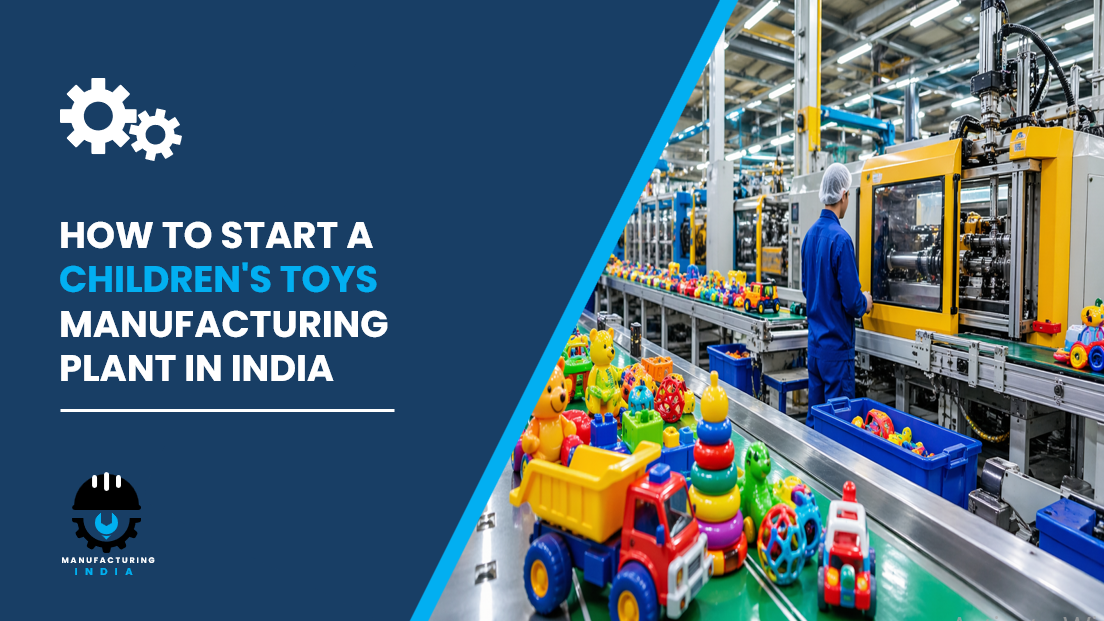
The children’s toys manufacturing process uses mold design, injection moulding, assembly, and packaging as the primary production method. The process involves multiple unit operations, material handling stages, quality checks, and safety testing checkpoints throughout.
- Product Design and Mould Design: Product design specifications are finalised based on target age group, safety standards, and developmental intent. Mould tools are designed and fabricated for each toy component to be injection moulded, with dimensional accuracy and surface quality specifications built into the tooling design.
- Raw Material Receipt and Inspection: Polymer pellets, food-grade colorants, safe plasticisers, electronic components, and packaging materials are received, inspected for specification compliance, and staged in designated storage areas before entering the production line.
- Injection Moulding: Polymer pellets are blended with food-grade colorants and plasticisers and processed through injection moulding machines to produce individual toy components — bodies, limbs, shells, and structural parts — in the required colours and dimensions.
- Assembly: Moulded components are assembled at assembly stations, integrating plastic parts, fabric elements, electronic components (for electronic or interactive toys), and mechanical sub-assemblies into complete toy units. Assembly is performed by trained operators following standardised assembly sequences and safety protocols.
- Painting and Decoration: Assembled toys undergo surface painting on painting lines and decorative printing using printing systems to apply branding, character graphics, and safety labelling as required by the product specification.
- Quality Testing: Finished toys are subjected to comprehensive safety and quality testing using quality testing units — covering mechanical and physical tests (drop, bite, tension, compression), chemical safety tests for heavy metals and restricted substances, flammability testing, and age-appropriateness verification against Bureau of Indian Standards (BIS) IS 9873 requirements and applicable international toy safety standards.
- Packaging: Approved toys are packaged using automated packaging machines in retail packaging that meets BIS labelling requirements, age grading, choking hazard warnings, and material content disclosures for the domestic market, along with applicable export market packaging standards.
- Dispatch: Packaged toys are dispatched to retail chains, e-commerce platforms, schools, play centres, childcare facilities, and international export buyers.
Key Applications
The children’s toys manufacturing plant serves multiple end-use segments with distinct demand characteristics and product requirements:
- Retail: Toys distributed through supermarkets, toy specialty chains, department stores, and e-commerce platforms for household purchase — the dominant volume channel for children’s toy sales.
- Education: Educational toys and STEM learning kits supplied to schools, educational institutions, and tutoring centres for classroom and developmental programme use.
- Entertainment: Licensed character toys, action figures, and collectibles linked to film, television, and gaming franchises supplied to entertainment retail channels.
- Childcare: Toys supplied to nurseries, play centres, crèches, and childcare facilities for supervised play environments designed around developmental stage appropriateness.
Leading Manufacturers
The global children’s toys industry is served by major entertainment and consumer goods companies with large-scale, vertically integrated operations covering product design, mould fabrication, injection moulding, assembly, and safety certification. Key players include:
- The Lego Group
- Mattel
- Hasbro
- Bandai Namco
- Spin Master
Timeline to Start the Plant
- Feasibility study and project report preparation
- Land acquisition and site development
- Regulatory approvals and environmental clearances
- Factory licence and fire safety compliance
- Machinery procurement and installation
- Raw material supplier agreements and supply chain setup
- Trial production and quality testing
- Commercial production launch
Licences and Regulatory Requirements
Starting a children’s toys manufacturing unit in India requires several approvals:
- Business registration (Proprietorship, LLP, or Pvt Ltd)
- Factory Licence under the Factories Act
- Environmental Clearance from State Pollution Control Board
- GST Registration
- Fire Safety NOC
- Bureau of Indian Standards (BIS) certification under IS 9873 — mandatory for toys sold in India under the Toys (Quality Control) Order, which requires all toys to comply with BIS safety standards before retail sale
- Chemical compliance certification for restricted substances — including heavy metals, phthalates, and other hazardous substances banned under toy safety regulations
- Export certification compliance — including EN 71 (Europe), ASTM F963 (USA), and other market-specific toy safety standards for international buyers
- Effluent Treatment Plant (ETP) operational clearance for paint and chemical process waste
- Occupational Health and Safety compliance
Key Challenges to Consider
Stringent Child Safety Compliance Requirements. Toy manufacturing is one of the most heavily regulated consumer product categories globally. Meeting BIS IS 9873 requirements for domestic sale, EN 71 for European export, ASTM F963 for US export, and chemical restriction requirements for heavy metals and phthalates requires ongoing investment in laboratory testing, third-party certification, and product development discipline — adding compliance costs that smaller manufacturers must plan for carefully.
Raw Material Price Volatility and Sourcing Complexity. Polymer pellets — the primary injection moulding input — are subject to petrochemical market price cycles. Food-grade colorants and safe plasticisers, required by child safety regulations, carry cost premiums over standard industrial alternatives. Electronic components for smart and interactive toys add supply chain complexity and semiconductor availability risk. Long-term supplier contracts and diversified sourcing are essential risk management strategies.
High Capital Requirements. Injection moulding machines, mould tooling investment for the initial product range, painting and printing systems, quality testing units, and automated packaging machines constitute significant CapEx commitments, particularly for manufacturers targeting multiple toy categories requiring dedicated mould tools for each product.
Technology and Innovation Pressure. Growing demand for smart toys, interactive robots, and STEM-focused educational products — alongside advancements in manufacturing technologies including automation and 3D printing — requires continuous product development investment to remain competitive with established global brands and to meet the innovation expectations of increasingly sophisticated parental buyers.
Competition. Global players such as The Lego Group — which reported record sales of USD 5.4 billion in the first half of 2025 — along with Mattel, Hasbro, Bandai Namco, and Spin Master maintain powerful brand positions and large-scale manufacturing advantages. Domestic Indian producers must differentiate on safety certification, educational product innovation, competitive pricing, and India-relevant product localisation to build retail and export market share.
Skilled Manpower for Safety-Critical Assembly. Assembling toys to child safety specifications — particularly for toys with small parts, electronic components, or complex mechanical features — requires trained assembly and quality control personnel who understand safety compliance protocols. Recruiting and retaining this workforce presents challenges in locations outside established toy or electronics manufacturing clusters.
Frequently Asked Questions
1. How much does it cost to set up a children’s toys manufacturing plant in India? Total investment depends on production capacity, product category complexity, mould tooling investment, automation level, and location. Key cost components include land and site development, civil construction, machinery (injection moulding machines, assembly stations, painting lines, printing systems, quality testing units, automated packaging machines), mould tooling, compliance laboratory equipment, and working capital. A detailed project report provides capacity-specific CapEx and OpEx estimates.
2. Is children’s toys manufacturing profitable in India in 2026? Yes. The children’s toys manufacturing plant demonstrates healthy profitability potential, supported by growing domestic demand driven by population growth, urbanisation, rising parental investment in child development, and expanding STEM toy adoption. Export opportunities to international retail buyers add revenue diversification. Full financial projections including NPV, IRR, gross margin, and net margin are detailed in the project report.
3. What machinery is required for a children’s toys manufacturing plant in India? Key equipment includes injection moulding machines, assembly stations, painting lines, printing systems, quality testing units, and automated packaging machines.
4. What licences and approvals are required to start a children’s toys manufacturing plant in India? Required approvals include business registration, Factory Licence under the Factories Act, Environmental Clearance from the State Pollution Control Board, GST registration, BIS certification under IS 9873 (mandatory under the Toys Quality Control Order for domestic sale), chemical compliance certification for restricted substances, export market toy safety certifications (EN 71, ASTM F963) for international buyers, ETP operational clearance, Fire Safety NOC, and Occupational Health and Safety certification.
5. What raw materials are needed for children’s toys manufacturing? Key raw materials include polymer pellets as the primary injection moulding input, food-grade colorants, safe plasticisers, electronic components (for electronic and interactive toy ranges), and packaging materials. All chemical inputs must meet the restricted substance requirements of applicable toy safety standards.
6. What are the environmental compliance requirements for a children’s toys manufacturing plant in India? Operators must obtain Environmental Clearance, maintain an operational Effluent Treatment Plant for chemical process waste from paint and colorant operations, comply with State Pollution Control Board guidelines on effluent quality and chemical waste disposal, and implement responsible management of polymer waste and packaging material offcuts generated in the production process.
7. What is the best location to set up a children’s toys manufacturing plant in India? Ideal locations offer proximity to plastic polymer and electronic component supplier networks, established retail and e-commerce logistics infrastructure, and access to toy manufacturing clusters with shared infrastructure support. Uttar Pradesh (Noida, Agra — traditionally India’s largest toy-producing belt), Maharashtra (Pune, Mumbai), Gujarat, Tamil Nadu, and the government-supported toy cluster at Koppal, Karnataka are all strong location options depending on target market focus and raw material sourcing priorities.
8. What is the break-even period for this type of plant in India? Break-even depends on production scale, product category complexity, capacity utilisation, retail channel penetration speed, and export market development. A detailed feasibility study provides project-specific break-even, NPV, and IRR projections aligned to investor capacity and target market strategy.
9. What government incentives are available for manufacturers in India? Children’s toys manufacturers in India can benefit from the PLI scheme for toys, capital subsidies under state-level toy manufacturing investment schemes, tax exemptions under state industrial promotion policies, concessional land and infrastructure support in designated toy clusters, and export incentives for BIS-certified and internationally certified toys. The Toys Quality Control Order and import restrictions on non-compliant toys provide domestic manufacturers with a protected market opportunity. MSME development scheme funding may support smaller-scale producers.
Key Takeaways for Investors
The children’s toys manufacturing plant opportunity in India is underpinned by a powerful combination of India’s large and young demographic base, rising parental investment in educational and developmental toys, the growing STEM toy adoption trend, expanding retail and e-commerce toy distribution, and an active policy environment that is redirecting domestic and international toy sourcing toward India-based manufacturers through quality control orders and manufacturing cluster development. The financial profile is commercially sound across production scales, driven by healthy demand from retail, education, entertainment, and childcare sectors, with export channels to international buyers providing additional revenue diversification for manufacturers who achieve BIS and international toy safety certifications. The resurgence of kidult buying — evidenced by LEGO’s record USD 5.4 billion sales in the first half of 2025 — the global consolidation in toy companies illustrated by Spin Master’s USD 950 million acquisition of Melissa & Doug in January 2024, and the continued expansion of smart and STEM toys all confirm that the global children’s toys industry is in a phase of confident commercial expansion. India-based manufacturers who invest in safety compliance, educational product innovation, and sustainability credentials are positioned to capture a growing share of both the domestic market and the international toy supply chain for decades ahead.
About the Author