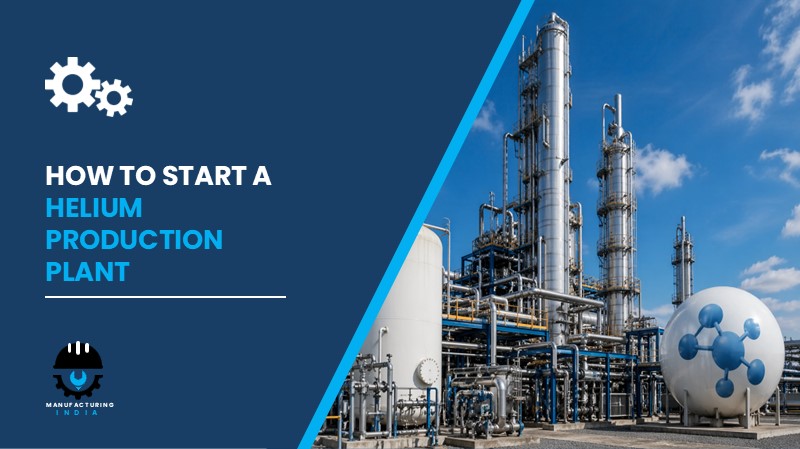
Setting up a helium production plant in India presents a compelling investment case driven by the country’s rapidly expanding semiconductor ecosystem, growing healthcare infrastructure, and ambitious space exploration programmes. Helium is a colorless, odorless noble gas that serves as the backbone of MRI scanner cooling systems, semiconductor wafer fabrication, and aerospace pressurization — industries that India is actively scaling through policy-backed initiatives. As domestic demand for ultra-high-purity industrial gases accelerates, helium production capacity represents a high-value, strategically critical segment of India’s industrial gas sector.
India’s structural advantages — including cost-competitive land and labour, improving logistics infrastructure, and the government’s Make in India initiative — make it a strategically sound destination for setting up helium production capacity. States such as Gujarat and Maharashtra, with established chemical and industrial clusters, offer strong supply chain proximity and port access for imported feedstock. With the India Semiconductor Mission backed by a ₹76,000 crore outlay and the government approving four additional semiconductor units on 12 August 2025 with an investment of ₹4,600 crore, the downstream demand for ultra-high-purity gases such as helium is set to rise significantly over the coming decade.
A helium production facility in India combines powerful policy tailwinds — from the India Semiconductor Mission to healthcare infrastructure expansion — with cost-competitive manufacturing conditions and structurally rising demand across MRI diagnostics, chip fabrication, and aerospace. With gross profit margins typically ranging between 45–55% and net margins of 20–35%, the investment case for a helium plant in India is both financially sound and strategically durable.
What is Helium?
Helium consists of a colorless and odorless noble gas that does not react with other elements and exists naturally within certain natural gas streams that contain small amounts of the gas. It serves as an essential component for applications that depend on cryogenic cooling systems, controlled atmospheric environments, and leak detection methods, owing to its extremely low boiling point and chemical inertness. The production of commercial helium requires cryogenic separation, purification, and liquefaction processes, which together yield ultra-high purity helium capable of meeting the rigorous standards demanded by medical, electronics, aerospace, and scientific sectors.
The primary production method is a multi-stage operation encompassing natural gas pretreatment, cryogenic separation, purification, liquefaction, and compression. End-use industries served by a helium production plant include healthcare, electronics and semiconductors, aerospace and defense, and scientific research — all of which require consistent supply of ultra-high-purity helium at scale.
Cost of Setting Up a Helium Production Plant in India
The cost of establishing a helium production plant in India depends on several interrelated variables, including plant capacity, the technology and level of automation chosen, site location, feedstock access, and regulatory compliance obligations.
1. Capital Expenditure (CapEx)
The capital investment required to establish a helium production facility covers multiple categories, each of which must be carefully planned and budgeted before ground is broken.
Land and Site Development costs include land registration charges, boundary development, and site preparation. Investors may consider Special Economic Zones (SEZs) or established industrial estates in states such as Gujarat or Maharashtra to benefit from tax incentives and pre-developed utility infrastructure, which can reduce site development timelines significantly.
Civil Works and Construction encompasses the construction of the processing shed, quality control laboratory, raw material and finished goods storage facilities, and the administrative block. These structures must meet fire safety codes and accommodate the cryogenic systems that form the core of helium production.
Machinery and Equipment represent the single largest share of capital expenditure for a helium manufacturing plant. Key machinery required includes:
- Cryogenic distillation columns
- Compressors
- Heat exchangers
- Purifiers
- Liquefiers
- Storage tanks
- Cylinder filling systems
Other Capital Costs include Effluent Treatment Plant (ETP) installation, pre-operative expenses such as licensing and regulatory clearances, commissioning costs, and — where applicable — import duties on specialized cryogenic equipment not manufactured domestically.
Request a Sample Report for In-Depth Market Insights: https://www.imarcgroup.com/helium-manufacturing-plant-project-report/requestsample
2. Operational Expenditure (OpEx)
Raw Material Cost constitutes 20–30% of total operating expenses. The primary feedstock is raw natural gas containing greater than 0.3% helium, sourced from specific helium-rich gas fields. Process materials include cryogenic refrigerants such as liquid nitrogen, molecular sieves, activated carbon for purification, and catalysts. Investors should pursue long-term supplier contracts to mitigate price volatility and ensure a consistent, uninterrupted supply of feedstock and process materials.
Utility Cost is the most significant operational cost component, accounting for 40–50% of total OpEx. This reflects the energy-intensive nature of cryogenic separation, liquefaction, and compression processes, all of which require substantial electricity, water, and process cooling capacity.
Other Operating Costs include transportation and logistics for finished product distribution, packaging of helium cylinders, salaries and wages for technical and operational staff, maintenance of high-specification cryogenic equipment, depreciation charges, and applicable taxes. By the fifth year of operations, total operational costs are projected to increase substantially due to inflation, market fluctuations, potential rises in the cost of key raw materials, supply chain pressures, and broader shifts in the global economy.
3. Plant Capacity
The proposed helium production facility described in the IMARC Group report is designed with an annual production capacity ranging between 100 and 200 million standard cubic feet, a scale that enables economies of scale while maintaining operational flexibility. Capacity can be customized based on investor requirements and the specific market segments targeted — whether medical-grade liquid helium, semiconductor-grade ultra-high-purity gas, or industrial-grade compressed helium. Profitability improves meaningfully with higher capacity utilisation, making scale planning a critical element of pre-investment feasibility analysis.
4. Profit Margins and Financial Projections
A helium production plant demonstrates healthy profitability potential under normal operating conditions. Gross profit margins typically range between 45–55%, supported by stable end-use demand and the value-added nature of ultra-high-purity applications. Net profit margins are projected at 20–35%. Investors should conduct a comprehensive financial analysis covering Net Present Value (NPV), Internal Rate of Return (IRR), payback period, liquidity analysis, sensitivity analysis, and a five-year income and expenditure projection to establish a complete picture of financial viability before committing capital.
Why Set Up a Helium Production Plant in India?
Growing MRI and Healthcare Infrastructure Demand. The deployment of MRI scanners across India’s expanding hospital networks — both public and private — represents the single largest demand driver for helium, as each MRI unit requires substantial quantities of liquid helium to cool its superconducting magnets. As India’s healthcare infrastructure scales to serve a growing and increasingly health-conscious population, this demand will compound steadily over time.
Semiconductor Manufacturing Expansion. The India Semiconductor Mission, with a total outlay of ₹76,000 crore, is actively strengthening domestic semiconductor manufacturing, chip design capabilities, and skilled talent development. With four additional semiconductor units approved on 12 August 2025 at an investment of ₹4,600 crore, the consumption of ultra-high-purity gases such as helium for wafer processing and controlled environments is set to rise sharply.
Aerospace and Space Exploration Activity. India’s growing space exploration ambitions, satellite launch programmes, and aerospace testing activities are contributing to rising helium usage for pressurization, fuel system inerting, and leak detection. This segment provides a structurally growing demand base beyond the healthcare and electronics sectors.
Policy and Regulatory Tailwinds. Government-led policy initiatives are playing a crucial role in strengthening high-tech and critical material ecosystems across India. Healthcare system expansion, domestic chip production incentives, and space exploration funding collectively create indirect but powerful helium demand. Make in India and the Production Linked Incentive (PLI) framework further reinforce the investment environment for industrial gas producers.
Active Global Industry Investment. The helium industry is witnessing significant long-term supply agreements and project development activity. In January 2026, QatarEnergy entered into a long-term agreement with Air Liquide to supply 300 million cubic feet of helium annually — a deal that underscores growing global supply security efforts and signals confidence in long-term demand. In October 2025, Halo Capital partnered with engineering consultancy Penspen to advance helium and hydrogen resource projects in Australia, further reflecting the sector’s investment momentum.
High Entry Barriers Protect Margins. Helium production requires advanced cryogenic technology, purification expertise, and substantial capital for specialized equipment. These high entry barriers limit new competition and help existing producers protect their pricing power and gross margin levels, which range between 45–55%.
Manufacturing Process – Step by Step
The helium manufacturing process uses cryogenic separation and purification as the primary production method, combined with liquefaction and compression to deliver commercial-grade helium at the required purity levels.
- Natural Gas Pretreatment: Raw natural gas containing greater than 0.3% helium from helium-rich gas fields is pretreated to remove impurities, moisture, and contaminants that would interfere with downstream cryogenic processing.
- Cryogenic Separation: The pretreated gas stream is cooled to cryogenic temperatures using cryogenic distillation columns and heat exchangers, causing heavier gases to condense and separate, leaving a helium-enriched stream.
- Purification: The helium-rich stream passes through purifiers using molecular sieves and activated carbon to remove residual impurities, achieving the ultra-high purity levels required for medical, semiconductor, and aerospace applications.
- Liquefaction: Liquefiers convert purified helium gas into liquid helium, which is required for MRI magnet cooling and certain scientific research applications.
- Compression: Compressors pressurize gaseous helium into high-pressure cylinders for storage and distribution to end-use customers.
- Quality Assurance and Testing: Analytical instruments monitor product concentration, purity, and stability at each stage, with documentation maintained for regulatory traceability.
- Storage and Dispatch: Finished helium — in liquid or compressed gaseous form — is stored in dedicated tanks and cylinders, then dispatched to end-use industries including healthcare, electronics and semiconductors, aerospace and defense, and scientific research facilities.
Key Applications
A helium production plant serves a diverse set of high-value, high-growth industries across India and global export markets:
- Healthcare: Helium is essential for cooling superconducting magnets in MRI scanners, ensuring stable and uninterrupted diagnostic imaging operations.
- Electronics and Semiconductors: Used as a carrier and cooling gas during chip fabrication and wafer processing to maintain precision and purity in controlled environments.
- Aerospace and Defense: Used for pressurization, leak detection, and inerting of fuel systems in rockets and aircraft.
- Scientific Research: Cryogenic helium supports low-temperature physics experiments and particle accelerator operations, where extremely stable temperatures are essential.
Leading Manufacturers
The global helium market is served by a concentrated group of large multinational industrial gas companies with extensive production capacities and diversified application portfolios. Key players in the global helium industry include:
- Air Liquide
- ExxonMobil Corporation
- Air Products and Chemicals, Inc.
- Gazprom
- Linde plc
All of these players serve end-use sectors spanning healthcare, electronics and semiconductors, and aerospace and research, setting the global benchmark for quality, purity, and supply reliability.
Timeline to Start the Plant
Establishing a helium production plant in India from initial planning to commercial operations typically involves the following phases:
- Feasibility study and project report preparation
- Land acquisition and site development
- Regulatory approvals and environmental clearances
- Factory licence and fire safety compliance
- Machinery procurement and installation
- Raw material supplier agreements and supply chain setup
- Trial production and quality testing
- Commercial production launch
Licences and Regulatory Requirements
Starting a helium manufacturing unit in India requires several approvals and compliance certifications before commercial production can commence:
- Business registration (Proprietorship, LLP, or Private Limited Company)
- Factory Licence under the Factories Act
- Environmental Clearance from the State Pollution Control Board
- GST Registration
- Fire Safety NOC
- Hazardous and chemical handling compliance (applicable given the use of cryogenic refrigerants and pressurized gases)
- Effluent Treatment Plant (ETP) operational clearance
- Occupational Health and Safety compliance
Key Challenges to Consider
High Capital Requirements. Establishing a helium production plant demands significant upfront investment in cryogenic distillation columns, liquefiers, compressors, and purification systems, which collectively represent the largest share of CapEx and create meaningful barriers for smaller investors.
Raw Material Price Volatility. The primary feedstock — raw natural gas containing greater than 0.3% helium — is sourced from specific helium-rich gas fields, and supply availability is structurally constrained by the limited number of such deposits globally. Cryogenic refrigerants, molecular sieves, and activated carbon are also subject to global price movements.
Regulatory Compliance. The use of cryogenic systems, high-pressure gas storage, and compressed cylinders places this industry under strict safety and environmental oversight. Maintaining continuous compliance with fire safety, pollution control, and occupational health regulations adds to operational complexity and cost.
Technology and Innovation Pressure. The semiconductor and medical imaging industries demand ever-higher purity specifications, requiring ongoing investment in purification technology and quality assurance systems to remain competitive.
Competition from Global Players. Established multinational producers — including Air Liquide, Linde plc, and Air Products and Chemicals — have significant advantages in scale, technology, and long-term supply contracts, making it essential for new entrants to differentiate on service, local supply reliability, or niche purity specifications.
Skilled Manpower. Operating cryogenic separation and purification systems requires highly trained chemical engineers and technicians with specialized expertise, which can be challenging to recruit and retain in India’s competitive industrial labour market.
Frequently Asked Questions
1. How much does it cost to set up a helium production plant in India?
The total cost depends on plant capacity, location, technology, and automation level. It covers land, civil works, cryogenic machinery such as distillation columns, liquefiers and compressors, and pre-operative costs. A detailed CapEx and OpEx breakdown is available via the IMARC Group sample report.
2. Is helium production profitable in India in 2026?
Yes. Helium production demonstrates healthy profitability with gross margins of 45–55% and net margins of 20–35%, supported by stable demand from healthcare, semiconductor, and aerospace sectors.
3. What machinery is required for a helium plant in India?
Key equipment includes cryogenic distillation columns, compressors, heat exchangers, purifiers, liquefiers, storage tanks, and cylinder filling systems.
4. What licences and approvals are required to start a helium plant in India?
Required approvals include business registration, Factory Licence, Environmental Clearance, GST Registration, Fire Safety NOC, hazardous chemical compliance, ETP clearance, and occupational health and safety certification.
5. What raw materials are needed for helium production?
The primary feedstock is raw natural gas containing greater than 0.3% helium from helium-rich gas fields. Process materials include cryogenic refrigerants such as liquid nitrogen, molecular sieves, activated carbon for purification, and catalysts.
6. What are the environmental compliance requirements for a helium plant in India?
Operators must obtain Environmental Clearance from the State Pollution Control Board, maintain an operational ETP, comply with emission standards, and implement advanced monitoring systems to detect process deviations or leaks.
7. What is the best location to set up a helium plant in India?
Locations near natural gas supply infrastructure, with reliable utilities, strong logistics connectivity, and access to industrial estates or SEZs — such as those in Gujarat or Maharashtra — are strategically advantageous.
8. What is the break-even period for this type of plant in India?
The break-even period depends on capacity utilisation, pricing achieved, and the financing structure. A detailed payback period analysis, NPV, and IRR assessment is provided in the comprehensive IMARC Group feasibility report.
9. What government incentives are available for manufacturers in India?
Investors may benefit from the Make in India initiative, PLI schemes, SEZ tax benefits, and infrastructure support under the India Semiconductor Mission, all of which indirectly strengthen the helium production investment environment.
Key Takeaways for Investors
A helium production plant in India presents a compelling long-term investment opportunity anchored in structurally growing demand from the healthcare, semiconductor, aerospace, and scientific research sectors. The investment demonstrates strong financial viability across a range of plant capacities, with gross profit margins of 45–55% and net margins of 20–35% under normal operating conditions. The global helium market stood at 175.27 million cubic meters in 2025 and is projected to reach 230.69 million cubic meters by 2034, growing at a CAGR of 3.0% from 2026 to 2034 — providing a clear and quantifiable runway for demand growth. With India’s semiconductor and healthcare infrastructure scaling rapidly under active government support, the long-term demand sustainability for ultra-high-purity helium production in India is among the strongest in the industrial gas sector.
About the Author