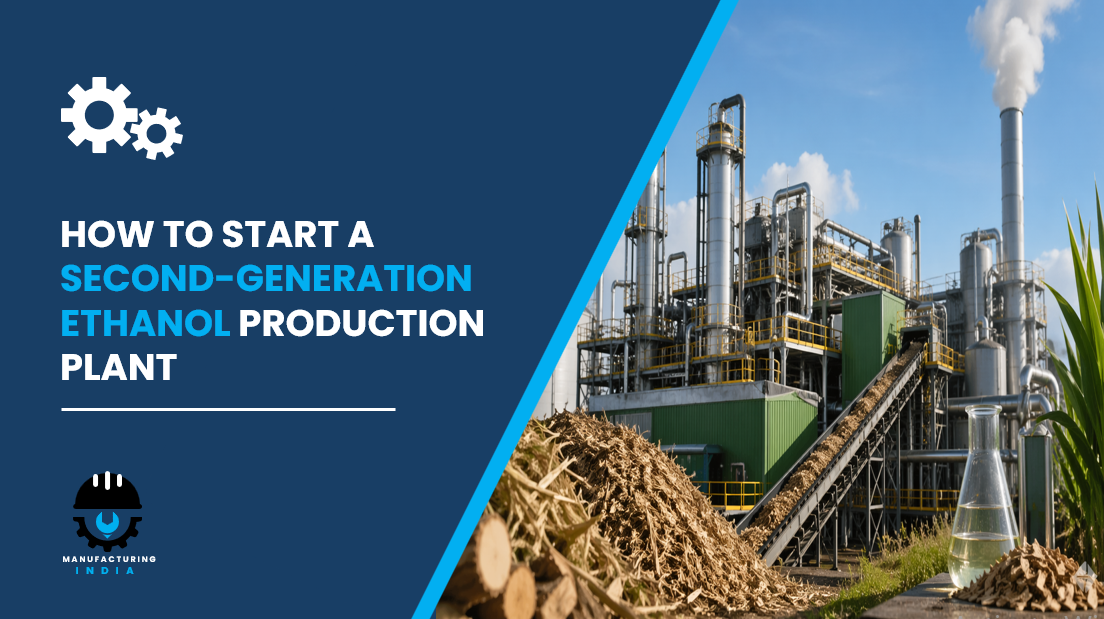
Setting up a second-generation ethanol production plant in India presents a compelling investment case at the convergence of the country’s ambitious biofuel blending programme, the vast agricultural residue base generated annually by its farming sector, and a rapidly maturing global policy environment mandating advanced biofuels in transport fuel supply chains. Second-generation ethanol (2G ethanol) — also called cellulosic ethanol — is bioethanol produced from non-food lignocellulosic biomass such as agricultural residues including rice straw, wheat straw, and sugarcane bagasse, as well as forestry residues and energy crops. Unlike first-generation ethanol produced from food crops, 2G ethanol converts cellulose and hemicellulose into fermentable sugars through pretreatment and enzymatic hydrolysis, followed by fermentation and purification — unlocking the energy value of agricultural waste streams that are currently burned in open fields, causing serious air quality and environmental problems across India’s farming belt.
India’s strategic position for this investment is exceptional. The country generates hundreds of millions of tonnes of agricultural residues annually — including rice straw in Punjab and Haryana, sugarcane bagasse in Uttar Pradesh and Maharashtra, and wheat straw across the Indo-Gangetic plains — providing an abundant, low-cost, and largely monetised feedstock base for 2G ethanol production. India’s national ethanol blending programme — which achieved 20% ethanol blending in petrol by mid-2025 — has already created a strong policy-supported domestic off-take market for ethanol, and 2G ethanol qualifies as an advanced biofuel eligible for preferential consideration within this framework. States such as Uttar Pradesh, Maharashtra, Punjab, and Haryana offer strong biomass availability, established sugar and distillery industry infrastructure, and state government support for bioenergy investments.
A second-generation ethanol manufacturing plant in India transforms low-value agricultural residues into a high-demand transport fuel, delivering gross margins of 25–35% and net margins of 10–20%. With the global 2G ethanol market projected to grow from USD 16.72 billion in 2025 to USD 141.66 billion by 2034 at a CAGR of 26.8% — the strongest growth trajectory among all manufacturing segments — this investment offers transformational financial returns and strategic alignment with India’s clean energy transition.
What is Second-Generation Ethanol?
Second-generation ethanol (2G ethanol), also referred to as cellulosic ethanol, is bioethanol produced from non-food lignocellulosic biomass such as agricultural residues — corn stover, wheat straw, rice straw — sugarcane bagasse, forestry residues, and energy crops. Unlike first-generation ethanol, 2G ethanol converts cellulose and hemicellulose into fermentable sugars through pretreatment and enzymatic hydrolysis, followed by fermentation and purification.
Key attributes include the potential for lower lifecycle greenhouse-gas emissions versus fossil gasoline. Manufacturing performance depends heavily on pretreatment efficiency, enzyme use, inhibitor management, and fermentation of both C6 and C5 sugars. The primary production method spans feedstock handling, pretreatment, enzymatic hydrolysis, fermentation, solid-liquid separation, distillation, dehydration, denaturing, and storage and dispatch. The product serves end-use industries including transportation fuels, oil and gas fuel distributors, chemical intermediates and industrial solvents, and sustainable fuels supply chains.
Cost of Setting Up a Second-Generation Ethanol Manufacturing Plant in India
The total cost of establishing a second-generation ethanol manufacturing plant in India depends on production capacity, pretreatment technology, plant location, biomass catchment logistics, and regulatory compliance requirements.
1. Capital Expenditure (CapEx)
The capital investment required to set up this facility covers several major cost heads. Land and site development — including land registration, boundary development, biomass receiving yard infrastructure, and related site works — forms a substantial portion of total CapEx. Investors should consider locating the unit in close proximity to biomass surplus zones — rice straw belts in Punjab and Haryana, sugarcane bagasse sources in Uttar Pradesh and Maharashtra — to minimise feedstock logistics costs. Co-location with existing sugar mills or distilleries that can supply bagasse directly reduces both raw material transport cost and capital expenditure on certain utility systems.
Civil works and construction costs cover the biomass storage and handling yard, pretreatment building, enzymatic hydrolysis hall, fermentation section, distillation and dehydration building, lignin residue handling and cogeneration area, quality control laboratory, effluent treatment zone, and administrative block. The scale and complexity of 2G ethanol civil works are substantially greater than conventional first-generation distilleries, reflecting the multi-stage biorefinery nature of the process.
Machinery and equipment represent the largest component of total capital expenditure for this second-generation ethanol manufacturing plant. Key machinery required includes:
- Feedstock processing machines
- Shredders and chippers
- Pretreatment reactor systems
- Enzymatic hydrolysis tanks
- Bioreactors (fermentation)
- Distillation units
- Evaporators
- Solid-liquid separation units
- Boilers and cogeneration systems
- Wastewater treatment facilities
Other capital costs include effluent treatment plant (ETP) installation, lignin combustion and power cogeneration infrastructure, pre-operative and commissioning expenses, and any applicable import duties on specialised pretreatment reactor and enzymatic hydrolysis equipment not manufactured domestically.
Request a Sample Report for In-Depth Market Insights: https://www.imarcgroup.com/second-generation-ethanol-manufacturing-plant-project-report/requestsample
2. Operational Expenditure (OpEx)
The operating cost structure of a second-generation ethanol manufacturing plant is primarily driven by raw material procurement. Raw material cost — covering lignocellulosic biomass (agricultural and forestry residues) as the primary feedstock, along with enzymes and yeast as critical process inputs — accounts for approximately 50–60% of total OpEx. Biomass procurement strategy — including farmgate collection agreements with farmer producer organisations, aggregation centres, and baling contractors — is a primary operational management challenge given the seasonal and geographically dispersed nature of agricultural residue availability. Enzymes represent a significant and technology-sensitive cost within the raw material budget, making enzyme sourcing strategy and dosage optimisation central to long-term margin improvement.
Utility costs, covering electricity, water, and steam required for pretreatment, enzymatic hydrolysis, fermentation, and distillation operations, account for 25–35% of OpEx — a notably high share reflecting the energy-intensive nature of the 2G ethanol biorefinery process. Lignin-rich solid residues from the process can be combusted in boilers to generate steam and electricity for self-consumption, significantly reducing net utility purchase costs and improving plant economics through cogeneration integration. Other operating costs include transportation for biomass procurement and ethanol dispatch to blending terminals and oil marketing companies, packaging, salaries and wages, maintenance and calibration of specialised pretreatment and biorefinery equipment, depreciation, and applicable taxes. By the fifth year, total operational costs are projected to increase substantially due to inflation, biomass price escalation, enzyme cost dynamics, and rising renewable fuel demand.
3. Plant Capacity
The proposed production facility is designed with an annual production capacity ranging between 50,000–200,000 KL, enabling economies of scale while maintaining operational flexibility. Capacity can be customised based on specific investor requirements, available biomass catchment volume, and capital availability. Profitability improves significantly with higher capacity utilisation, and the technology and quality barriers involved in 2G ethanol production — including pretreatment know-how, enzyme and fermentation optimisation, and stringent process control — create defensible competitive advantages for capable, engineered manufacturing setups.
4. Profit Margins and Financial Projections
The second-generation ethanol manufacturing plant demonstrates healthy profitability potential under normal operating conditions. Gross profit margins typically range between 25–35%, supported by policy-backed demand from India’s national ethanol blending programme, the low-cost agricultural residue feedstock base, and the value premium of advanced biofuels in transport fuel compliance frameworks. Net profit margins are projected in the range of 10–20%. Break-even for this type of plant typically ranges from 7 to 12 years, depending on plant capacity, market demand, and costs associated with specialised biorefinery infrastructure. Key financial indicators including NPV, IRR, payback period, liquidity analysis, and sensitivity analysis are covered comprehensively in the full project report.
Why Set Up a Second-Generation Ethanol Manufacturing Plant in India?
Residue-to-Value Pathway Solving India’s Agricultural Waste Challenge. Second-generation ethanol upgrades agricultural and forestry residues into a transport fuel, creating a monetisation route for low-value biomass while reducing open-field burning and residue disposal challenges. India’s annual agricultural residue burning — particularly paddy straw burning in Punjab and Haryana — is a major source of seasonal air quality crisis that government policy actively seeks to address, creating both incentive payments and regulatory drivers for biomass collection and utilisation programmes that directly benefit 2G ethanol feedstock supply chains.
Policy-Aligned Decarbonisation and Advanced Biofuel Mandates. Advanced biofuel targets and feedstock eligibility lists improve long-term off-take visibility, encouraging investment in large, compliant biorefineries that meet sustainability and traceability requirements. India’s national ethanol blending programme — which achieved 20% blending by mid-2025 — provides a government-guaranteed domestic demand channel for ethanol, with 2G ethanol qualifying as an advanced biofuel under preferential pricing frameworks.
Reduced Food-Crop Dependence Improving Policy Acceptability. By using lignocellulosic feedstocks, 2G ethanol mitigates direct competition with food starch and sugar markets — a critical political and policy advantage in India where food price stability is a national priority. This positions 2G ethanol as a politically durable and regulatory-friendly investment category compared to first-generation sugar or grain-based ethanol.
Platform for Biorefinery Co-Products Enhancing Economics. Facilities can integrate power generation from lignin-rich residues and explore co-products — including biochar for agriculture — improving overall plant economics beyond ethanol revenues alone. The January 2026 LanzaTech facility in Uttar Pradesh is specifically designed to generate nutrient-rich biochar from sugarcane bagasse processing alongside ethanol, demonstrating the commercial viability of the integrated biorefinery model.
Active India-Specific Industry Investment Confirming Market Confidence. In January 2026, LanzaTech Global was awarded a contract by Pray Engineering Devices Ltd. to build a second-generation ethanol facility in Uttar Pradesh, India, that will use sugarcane bagasse to produce sustainable 2G ethanol. The plant is designed to process up to 300 tons of bagasse per day and is expected to start operations within two years — a direct and current signal of commercial investment confidence in India’s 2G ethanol market. In June 2025, Toyota developed biomass-based bioethanol in Fukushima Prefecture, Japan, producing fuel from non-edible agricultural residues including rice straw and forestry by-products to support lower-carbon transportation, reinforcing the global momentum toward cellulosic biofuel commercialisation.
Rising Energy Security and Fossil Fuel Price Volatility Boosting Appeal. Rising concerns about energy security and fossil fuel price volatility further boost the appeal of locally produced cellulosic fuels. For a country that imports the majority of its crude oil requirements, domestically produced 2G ethanol from agricultural residues represents a strategically important energy security asset independent of global commodity market fluctuations.
Manufacturing Process — Step by Step
The second-generation ethanol manufacturing process uses feedstock handling, pretreatment, enzymatic hydrolysis, fermentation, solid-liquid separation, distillation, dehydration, denaturing, and storage and dispatch as the primary production method. The process involves multiple complex unit operations with material handling stages and quality verification checkpoints throughout.
- Biomass Collection, Storage, and Preprocessing: Lignocellulosic biomass — rice straw, wheat straw, sugarcane bagasse, or other agricultural residues — is collected from farm aggregation points, transported to the plant, and stored in weatherproof biomass yards. Feedstock processing machines and shredders and chippers reduce biomass particle size and improve handling characteristics before pretreatment.
- Pretreatment: Sized biomass enters pretreatment reactor systems where mechanical, chemical, or steam-based treatment disrupts the lignocellulosic structure — breaking down the lignin seal, disrupting crystalline cellulose, and improving enzyme accessibility to the carbohydrate fractions. Pretreatment technology selection is the most critical differentiating factor in 2G ethanol plant design.
- Enzymatic Hydrolysis: Pretreated biomass is transferred to enzymatic hydrolysis tanks where cellulase and hemicellulase enzyme cocktails hydrolyse cellulose and hemicellulose into fermentable C6 (glucose) and C5 (xylose) sugars over a controlled residence time.
- Fermentation: Hydrolysate sugar streams are fed into bioreactors inoculated with engineered yeast or bacteria capable of fermenting both C6 and C5 sugars into ethanol. Managing inhibitor compounds generated during pretreatment — including furfural, HMF, and acetic acid — is a critical fermentation performance challenge.
- Solid-Liquid Separation: Post-fermentation slurry undergoes solid-liquid separation in centrifuges or filter presses to separate the lignin-rich solid residue from the ethanol-containing liquid stream (beer). Lignin solids are directed to the cogeneration boiler.
- Distillation: The ethanol-water beer stream is concentrated through multi-effect distillation units to produce approximately 95% ethanol by volume.
- Dehydration: Concentrated ethanol is dehydrated using molecular sieves or other dehydration technologies to produce fuel-grade anhydrous ethanol at 99.5%+ purity.
- Denaturing: Anhydrous ethanol is denatured — blended with a small quantity of denaturant such as petrol — to make it unfit for human consumption as required by excise regulations for fuel ethanol.
- Quality Control and Testing: Finished denatured ethanol is tested for water content, purity, denaturant specification, and other parameters against Bureau of Indian Standards (BIS) specifications for fuel ethanol and oil marketing company supply contracts.
- Storage and Dispatch: Approved fuel-grade ethanol is stored in stainless steel or MS storage tanks and dispatched via tank trucks to blending terminals and oil marketing company depots for incorporation into petrol supply chains.
Key Applications
The second-generation ethanol manufacturing plant serves multiple end-use channels with growing and policy-supported demand for advanced biofuel supply:
- Transportation Fuels and Fuel Blending: Used as a renewable blending component to reduce fossil gasoline consumption and support emissions reduction targets and India’s renewable fuel mandate — the primary and dominant volume application.
- Oil and Gas Distribution and Fuel Marketing: Procured by oil marketing companies for compliance with renewable fuel obligations and supplied through blending terminals for integrated fuel distribution.
- Low-Carbon Fuel Programmes and Credits: Integrated into advanced biofuel compliance frameworks that reward the lower carbon intensity of 2G versus conventional ethanol, generating additional value through renewable fuel credit mechanisms.
- Industrial and Chemical Use: Used as a solvent or intermediate input where fuel-grade specifications and commercial economics support non-fuel diversion, representing a smaller but premium-priced application channel.
Leading Producers
The global second-generation ethanol industry is served by several major companies with extensive production capabilities and diverse application portfolios. Key players include:
- Novozymes A/S
- Clariant AG
- POET LLC
- Beta Renewables S.p.A.
- LanzaTech Inc.
- Abengoa S.A.
Timeline to Start the Plant
- Feasibility study and project report preparation
- Land acquisition and site development
- Regulatory approvals and environmental clearances
- Factory licence and fire safety compliance
- Machinery procurement and installation
- Raw material supplier agreements and supply chain setup
- Trial production and quality testing
- Commercial production launch
The overall timeline from project initiation to commercial production typically ranges from 24 to 48 months, depending on regulatory approvals, safety compliance requirements, and sourcing of specialised biorefinery equipment.
Licences and Regulatory Requirements
Starting a second-generation ethanol manufacturing unit in India requires several approvals:
- Business registration (Proprietorship, LLP, or Pvt Ltd)
- Factory Licence under the Factories Act
- Environmental Clearance from State Pollution Control Board
- GST Registration
- Fire Safety NOC
- Excise licence for ethanol production and storage under Central Excise Act
- Registration under the National Policy on Biofuels for advanced biofuel producer status and preferential pricing eligibility
- Biomass procurement and traceability certification for advanced biofuel sustainability compliance
- Effluent Treatment Plant (ETP) operational clearance for biorefinery process wastewater
- Occupational Health and Safety compliance
Key Challenges to Consider
High Capital Requirements and Long Break-Even Period. The multi-stage biorefinery infrastructure — including pretreatment reactor systems, enzymatic hydrolysis tanks, bioreactors, distillation units, and cogeneration systems — constitutes a very large CapEx commitment. Break-even typically ranges from 7 to 12 years, requiring long-horizon investment planning and access to patient capital through government-backed bioenergy funding schemes or strategic equity partnerships.
Biomass Feedstock Logistics and Seasonal Availability. Lignocellulosic agricultural residues are seasonally available, geographically dispersed, bulky, and prone to spoilage — creating complex year-round procurement, storage, and logistics challenges. Building a reliable biomass supply chain at the scale required for 50,000–200,000 KL annual production requires dedicated aggregation infrastructure, farmer relationship management, and covered storage capacity investment.
Enzyme Cost and Pretreatment Technology Performance. Enzymes — supplied by producers such as Novozymes A/S and Clariant AG — represent a significant and technology-sensitive OpEx component. Pretreatment technology selection directly determines enzymatic hydrolysis yields and overall ethanol recovery, making technology evaluation and licensing a critical pre-investment decision that shapes long-term plant economics.
Regulatory Complexity for Advanced Biofuel Status. Accessing preferential pricing under India’s biofuel policy and qualifying for advanced biofuel status in the national ethanol blending programme requires meeting sustainability and traceability requirements, feedstock eligibility criteria, and excise compliance obligations that add regulatory management complexity beyond conventional distillery operations.
Competition. Global players such as POET LLC, LanzaTech Inc., Clariant AG, and Beta Renewables S.p.A. bring established pretreatment technology, enzyme partnerships, and biorefinery operating experience. New Indian entrants benefit from feedstock cost advantage and domestic market access, but must invest in technology licensing or partnership to access proven pretreatment and fermentation process know-how.
Skilled Manpower for Complex Biorefinery Operations. Operating pretreatment reactor systems, enzymatic hydrolysis tanks, fermentation bioreactors, and molecular sieve dehydration units requires chemical engineers and biotechnologists with specialised bioenergy process experience — a workforce category that requires targeted recruitment, often from petrochemical or pharmaceutical process backgrounds, and ongoing training investment.
Frequently Asked Questions
1. How much does it cost to set up a second-generation ethanol manufacturing plant in India? Total investment depends on production capacity (50,000–200,000 KL annually), pretreatment technology, location relative to biomass supply zones, and automation level. Key cost components include land and biomass storage infrastructure, civil construction for multi-stage biorefinery, machinery (feedstock processors, pretreatment reactors, hydrolysis tanks, bioreactors, distillation units, cogeneration systems), ETP, and working capital for biomass and enzyme procurement. A detailed project report provides capacity-specific CapEx and OpEx estimates.
2. Is second-generation ethanol manufacturing profitable in India in 2026? Yes. The facility demonstrates gross profit margins of 25–35% and net profit margins of 10–20% under normal operating conditions. Profitability is supported by policy-guaranteed off-take through India’s ethanol blending programme, the low-cost agricultural residue feedstock base, and cogeneration income from lignin combustion. Break-even ranges from 7 to 12 years depending on scale and technology efficiency.
3. What machinery is required for a second-generation ethanol manufacturing plant in India? Key equipment includes feedstock processing machines, shredders and chippers, pretreatment reactor systems, enzymatic hydrolysis tanks, bioreactors, distillation units, evaporators, solid-liquid separation units, boilers and cogeneration systems, and wastewater treatment facilities.
4. What licences and approvals are required to start a second-generation ethanol manufacturing plant in India? Required approvals include business registration, Factory Licence under the Factories Act, Environmental Clearance from the State Pollution Control Board, GST registration, excise licence for ethanol production and storage, National Policy on Biofuels advanced biofuel producer registration, biomass sustainability certification, ETP operational clearance, Fire Safety NOC, and Occupational Health and Safety certification.
5. What raw materials are needed for second-generation ethanol manufacturing? Key raw materials include lignocellulosic biomass — agricultural residues such as rice straw, wheat straw, and sugarcane bagasse — as the primary feedstock, along with cellulase and hemicellulase enzymes for hydrolysis, and yeast or specialised microorganisms for fermentation of C6 and C5 sugars into ethanol.
6. What are the environmental compliance requirements for a second-generation ethanol manufacturing plant in India? Operators must obtain Environmental Clearance, maintain an operational ETP for high-organic-load biorefinery process wastewater, comply with State Pollution Control Board guidelines on effluent quality and boiler stack emissions from lignin combustion, and implement biomass sustainability and traceability documentation required for advanced biofuel programme participation.
7. What is the best location to set up a second-generation ethanol manufacturing plant in India? Ideal locations offer maximum proximity to biomass surplus zones to minimise feedstock logistics costs. Uttar Pradesh — for sugarcane bagasse from sugar mills — Punjab and Haryana — for paddy straw and wheat straw — and Maharashtra — for bagasse and agricultural residues — are the strongest options. Co-location with existing sugar mills provides immediate bagasse access and shared utility infrastructure benefits.
8. What is the break-even period for this type of plant in India? Break-even typically ranges from 7 to 12 years, depending on plant capacity, feedstock procurement efficiency, enzyme costs, pretreatment technology performance, capacity utilisation, and prevailing ethanol pricing under the national blending programme. Government preferential pricing for 2G ethanol and lignin cogeneration income both improve the payback trajectory relative to base case projections.
9. What government incentives are available for manufacturers in India? Second-generation ethanol producers in India can benefit from National Policy on Biofuels advanced biofuel preferential pricing (which offers a premium over first-generation ethanol rates), capital subsidies under the government’s 2G ethanol biorefinery support scheme administered through NABARD, interest subvention on term loans for advanced biofuel projects, state-level biomass energy investment incentives, and viability gap funding for eligible projects under the bioenergy mission framework.
Key Takeaways for Investors
The second-generation ethanol manufacturing plant opportunity in India is underpinned by an exceptional alignment of structural agricultural residue abundance, documented open-field burning problems creating both regulatory pressure and feedstock availability, India’s policy-guaranteed ethanol blending demand, and a global advanced biofuel market growing at the fastest CAGR of any manufacturing segment covered in this investment series. The financial profile is compelling across the 50,000–200,000 KL annual capacity range, with gross margins of 25–35% and net margins of 10–20%, supported by cogeneration income from lignin and government preferential pricing for 2G ethanol. The global second-generation ethanol market, valued at USD 16.72 billion in 2025, is projected to reach USD 141.66 billion by 2034 at a remarkable CAGR of 26.8% — confirming this as one of the highest-growth manufacturing investment categories available globally. The January 2026 LanzaTech facility award in Uttar Pradesh — designed to process up to 300 tons of bagasse per day and generate both ethanol and agricultural biochar — signals that commercial-scale 2G ethanol investment in India has moved decisively from demonstration to deployment, making this the right moment for technically capable investors to establish their position in India’s cellulosic biofuel industry.
About the Author