Setting up a PVC blister packaging manufacturing plant in India presents a compelling investment case, anchored by the country’s fast-expanding pharmaceutical sector, rising healthcare expenditure, and growing consumption of consumer goods across urban and semi-urban markets. This packaging format is dominant for solid oral dosage forms, offering unit-dose protection, tamper evidence, and compatibility with high-speed packaging lines — properties that make it indispensable to pharmaceutical manufacturers, healthcare companies, and consumer goods producers operating at scale.
India’s strategic advantages reinforce the investment logic. The Make in India initiative, robust pharmaceutical manufacturing clusters in Gujarat, Maharashtra, Himachal Pradesh, and Telangana, and a large domestic base of generic drug producers create a built-in, high-volume customer base for a PVC blister packaging plant in India. With cost-competitive land, skilled packaging technicians, and proximity to PVC resin and aluminium foil suppliers, the country offers a production environment that balances quality, speed, and margin.
The global PVC blister packaging market was valued at USD 28.11 Billion in 2025 and is projected to reach USD 43.24 Billion by 2034 at a CAGR of 4.9%. India’s dominant position in generic drug manufacturing, rising healthcare spending, and expanding consumer goods consumption make this a financially viable and strategically sound investment with gross margins of 30–40% and net margins of 12–18%.
What is PVC Blister Packaging?
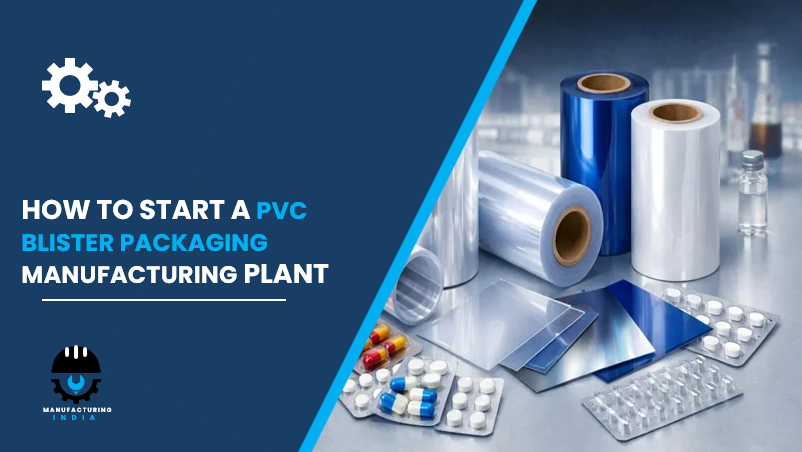
PVC blister packaging uses a thermoformed, clear polyvinyl chloride (PVC) plastic pocket to hold a product, sealed with a backing — often aluminium foil or card — to create a protective, visible, and tamper-resistant package. It is commonly used for pharmaceuticals such as tablets and capsules, as well as for small consumer goods, due to its clarity, low cost, and ability to shield contents from moisture and physical damage. The anodised layer is highly serviceable across demanding applications, ranging from pharmaceutical dispensing to retail consumer packaging.
The production method involves PVC compounding, sheet extrusion or calendaring, thermoforming, and trimming and finishing. Due to their cost-effectiveness, excellent thermoformability, and compatibility with high-speed packaging lines, these packs are highly preferred across pharmaceuticals, healthcare and medical devices, consumer goods, and food and nutraceuticals. Key applications include solid oral drug packaging, medical device containment, consumer product unit packs, and nutraceutical and supplement packaging.
Cost of Setting Up a PVC Blister Packaging Manufacturing Plant in India
The cost of establishing a PVC blister packaging manufacturing plant in India depends on plant capacity, technology level, degree of automation, geographic location, and the extent of regulatory compliance infrastructure required.
1. Capital Expenditure (CapEx)
Capital investment is structured across four primary components. Land and site development — covering land registration, boundary development, and infrastructure preparation — forms a substantial portion of the initial outlay. Investors can reduce this component by locating within established pharmaceutical or packaging industrial estates in Gujarat, Maharashtra, or Himachal Pradesh, where plug-and-play infrastructure and potential SEZ benefits are available.
Civil works encompass the manufacturing shed, quality-control laboratory, cleanroom or controlled-environment areas (critical for pharmaceutical-grade packaging), raw material storage, finished goods warehousing, and the administrative block. For pharmaceutical supply customers, cleanroom compliance may require additional civil investment above standard packaging norms.
Machinery and equipment costs represent the single largest share of capital expenditure. Key machinery required includes:
- PVC compounding mixers
- Sheet extrusion or calendaring lines
- Thermoforming machines
- Trimming and punching units
- Blister sealing machines
- Quality inspection systems
Other capital costs include effluent treatment plant (ETP) setup, pre-operative and commissioning expenses, and applicable import duties on specialised machinery not manufactured domestically.
Request a Sample Report for In-Depth Market Insights: https://www.imarcgroup.com/pvc-blister-packaging-manufacturing-plant-project-report/requestsample
2. Operational Expenditure (OpEx)
Raw material costs are the dominant driver of operational expenditure for this facility, accounting for approximately 65–75% of total OpEx. The primary inputs are PVC film and aluminium foil. PVC film in particular is the most cost-intensive input, and its price is influenced by global PVC resin markets, crude oil pricing, and domestic supply dynamics. Establishing long-term contracts with reliable domestic PVC film and aluminium foil suppliers is essential to mitigate price volatility and maintain production continuity.
Utility costs — electricity, water, and steam — account for 10–15% of total OpEx, reflecting the moderate but consistent energy requirements of thermoforming and sealing operations. Other operating costs include transportation, outward packaging, salaries and wages, maintenance, depreciation, and taxes. By the fifth year, total operational expenditure is projected to increase substantially due to inflation, market fluctuations, rising input material costs, supply chain disruptions, and the impact of growing consumer demand.
3. Plant Capacity
The proposed facility is designed with an annual production capacity of 4,000–6,000 tons, enabling economies of scale while maintaining operational flexibility to serve pharmaceutical, consumer goods, and nutraceutical customers simultaneously. Capacity can be customised per investor requirements and target market scale. Profitability improves materially with higher capacity utilisation, making early contract agreements with pharma manufacturers and healthcare companies a priority during the ramp-up phase.
4. Profit Margins and Financial Projections
The PVC blister packaging manufacturing plant demonstrates healthy profitability under normal operating conditions. Gross profit margins typically range between 30–40%, supported by stable demand from pharmaceutical and consumer goods sectors and value-added customisation capabilities. Net profit margins average 12–18% over a five-year projection horizon. Financial viability is assessed through net present value (NPV), internal rate of return (IRR), payback period, sensitivity analysis, and uncertainty modelling based on realistic assumptions for capacity utilisation, pricing trends, and demand outlook.
Why Set Up a PVC Blister Packaging Plant in India?
Essential Pharmaceutical Packaging Demand. PVC blister packs are a critical packaging solution for oral solid dosage forms, supporting patient compliance, safety, and regulatory labelling requirements. Around 85% of solid unit drug doses in Europe are packed in blister format — a penetration level that India’s pharma sector is approaching as domestic formulation manufacturers upgrade their packaging standards to meet both domestic and export market requirements.
Growing Generic Drug Manufacturing. The continued expansion of generic drug manufacturing — particularly in the Asia-Pacific, where India is a global leader — has reinforced large-scale adoption of PVC blister formats because of their cost efficiency and compatibility with high-speed filling lines. India’s generic pharmaceutical exports, combined with rising domestic medicine consumption, create a dual demand channel that any well-positioned PVC blister packaging plant in India can serve.
Rising Healthcare Expenditure and OTC Consumption. Rising healthcare expenditure, increasing medicine consumption, and an ageing population are sustaining stable demand for blister-packed pharmaceuticals. Growth in over-the-counter (OTC) medicine consumption and the expanding health supplement and nutraceutical segment add incremental volume demand that goes well beyond core prescription drug blister packs.
Cost-Effective and Scalable Production Model. PVC offers lower raw material and processing costs compared to alternative polymers, enabling large-scale production with consistent quality and competitive pricing. The material’s excellent thermoformability allows manufacturers to produce complex cavity shapes with minimal waste and high dimensional accuracy — properties that make this a scalable, cost-efficient production model well suited to India’s volume-driven manufacturing environment.
Active Industry Innovation. In December 2025, TOPPAN Holdings Inc. completed its acquisition of Asahi Kasei Corporation’s patented brittle lidding material technology used in push-through blister packs, covering 12 patents, with the intention of combining brittle film technology with barrier and printing solutions to develop eco-friendly, aluminium-free blister packs. In November 2025, Finetech introduced a wallet-style paper-PVC blister packaging upgrade pairing with blister packaging machines to offer easier carrying, improved protection, and better market presentation. These developments signal active innovation investment in the sector and growing appetite for premium, sustainable blister packaging formats.
Strong Supply Chain and Packaging Line Integration. Blister packs align well with automated filling and sealing lines used across pharmaceutical, healthcare, and consumer goods manufacturing, improving packaging efficiency and reducing operational downtime for customers. This compatibility strengthens long-term supply relationships and creates switching costs that support revenue retention.
Manufacturing Process – Step by Step
A PVC blister packaging manufacturing plant uses PVC compounding, sheet extrusion or calendaring, thermoforming, and trimming and finishing as the core production sequence, transforming raw PVC film and aluminium foil into finished, sealed blister packs across a structured multi-stage operation.
- PVC Compounding: PVC resin is blended with plasticisers, stabilisers, and additives in PVC compounding mixers to achieve the required film characteristics — flexibility, clarity, and thermal stability — for downstream processing.
- Sheet Extrusion or Calendaring: The compounded PVC mixture is processed through sheet extrusion or calendaring lines to produce uniform PVC film of the required gauge and width, ready for thermoforming.
- Thermoforming: PVC film is heated and drawn over precision moulds in thermoforming machines to form the characteristic blister cavities that hold tablets, capsules, medical devices, or consumer goods. The cavities are formed to exact dimensional specifications.
- Trimming and Finishing: Formed blister sheets are passed through trimming and punching units to cut individual packs to the required dimensions, with clean edges and precise cavity registration.
- Blister Sealing: PVC blister trays are aligned with aluminium foil or card backing and heat-sealed using blister sealing machines under controlled temperature and pressure to create tamper-resistant, moisture-protective packages.
- Quality Inspection: Finished blister packs are subjected to seal integrity testing, dimensional verification, and visual inspection through quality inspection systems to ensure compliance with pharmaceutical or consumer goods standards.
- Packaging and Dispatch: Approved blister packs are secondary-packaged and dispatched to pharmaceutical manufacturers, healthcare and medical device companies, consumer goods producers, and food and nutraceutical customers.
Key Applications
This packaging format serves a range of industries, each with specific performance, regulatory, and presentation requirements:
- Pharmaceuticals: Blister packs are used for tablets and capsules, ensuring dosage accuracy, tamper resistance, and protection during transportation and storage.
- Healthcare and Medical Devices: Used for packaging syringes, diagnostic kits, and small medical components, offering hygiene, visibility, and protection from contamination.
- Consumer Goods: Applied in packaging batteries, electronics accessories, and personal care items to enhance shelf visibility and prevent product loss.
- Food and Nutraceuticals: Used for single-serve and portion-controlled packaging of supplements and confectionery items requiring visual appeal and controlled handling.
Leading Manufacturers
The global industry is served by several multinational blister packaging companies with extensive production capacities and diverse application portfolios. Key players include:
- Amcor Limited
- Tekni-Plex, Inc.
- Constantia Flexibles GmbH
- Westrock Company
- Ruchika Group of Industries
- RENOLIT SE
These global manufacturers serve pharmaceutical, healthcare, consumer goods, and food and nutraceutical end markets, setting the quality, regulatory compliance, and customisation benchmarks that Indian market entrants must match to win and retain customer contracts.
Timeline to Start the Plant
- Feasibility study and project report preparation
- Land acquisition and site development
- Regulatory approvals and environmental clearances
- Factory licence and fire safety compliance
- Machinery procurement and installation
- Raw material supplier agreements and supply chain setup
- Trial production and quality testing
- Commercial production launch
Licences and Regulatory Requirements
Starting a PVC blister packaging manufacturing unit in India requires several approvals:
- Business registration (Proprietorship, LLP, or Pvt Ltd)
- Factory Licence under the Factories Act
- Environmental Clearance from State Pollution Control Board
- GST Registration
- Fire Safety NOC
- Effluent Treatment Plant (ETP) operational clearance
- Occupational Health and Safety compliance
- Drug Licence and Schedule M compliance (if supplying to pharmaceutical manufacturers)
- BIS certification and applicable packaging quality standards
Key Challenges to Consider
High Capital Requirements. Significant upfront investment in thermoforming machines, blister sealing machines, sheet extrusion or calendaring lines, and quality inspection systems — along with cleanroom civil works for pharma-grade operations — requires careful financial structuring and access to term lending.
Raw Material Price Volatility. PVC film and aluminium foil prices are exposed to global commodity price fluctuations tied to crude oil markets and aluminium LME pricing. Long-term supplier contracts and domestic sourcing strategies are essential to protect operating margins.
Regulatory Compliance. Serving pharmaceutical customers requires adherence to Schedule M (Good Manufacturing Practices), Drug Licence conditions, and traceability documentation systems. Compliance demands sustained investment in quality infrastructure and trained personnel.
Sustainability and Material Innovation Pressure. Sustainability pressures are prompting material optimisation and downgauging across the sector, with players such as TOPPAN Holdings developing eco-friendly, aluminium-free blister alternatives. Manufacturers must monitor and adapt to evolving material preferences to remain competitive in export markets.
Competition from Established Global Players. The presence of Amcor Limited, Tekni-Plex, Inc., Constantia Flexibles GmbH, Westrock Company, RENOLIT SE, and Ruchika Group of Industries means that new entrants must differentiate on lead times, customisation capability, and pharmaceutical compliance to build durable customer relationships.
Skilled Manpower. Operating thermoforming lines, maintaining blister sealing machine calibration, and managing pharma-grade quality systems requires trained packaging engineers and QA technicians who must be proactively recruited and retained.
Frequently Asked Questions
1. How much does it cost to set up this type of manufacturing plant in India?
The total investment depends on plant capacity, technology level, location, and automation. It covers land and site development, civil works (including cleanroom areas for pharmaceutical supply), machinery, and other capital costs. A detailed feasibility study is the recommended starting point.
2. Is PVC blister packaging manufacturing profitable in India in 2026?
Yes. The facility delivers gross profit margins of 30–40% and net profit margins of 12–18% over a five-year horizon, supported by stable demand from pharmaceutical, healthcare, and consumer goods sectors.
3. What machinery is required for a PVC blister packaging manufacturing plant?
Key equipment includes PVC compounding mixers, sheet extrusion or calendaring lines, thermoforming machines, trimming and punching units, blister sealing machines, and quality inspection systems.
4. What licences are required to start a PVC blister packaging manufacturing unit in India?
Required approvals include business registration, Factory Licence, Environmental Clearance, GST registration, Fire Safety NOC, ETP operational clearance, Occupational Health and Safety compliance, and Drug Licence or Schedule M compliance for pharmaceutical supply.
5. What raw materials are needed for PVC blister packaging manufacturing?
The primary inputs are PVC film and aluminium foil. Raw materials account for 65–75% of total OpEx, making supplier contract strategy the single most important cost management lever for this plant.
6. What are the environmental compliance requirements for a PVC blister packaging plant in India?
The facility must obtain Environmental Clearance from the State Pollution Control Board, operate an ETP, and meet PVC-related waste management and emissions standards under applicable environmental regulations.
7. What is the best location to set up a PVC blister packaging plant in India?
Pharmaceutical packaging clusters in Gujarat (Ahmedabad, Vadodara), Maharashtra (Pune, Nashik), Himachal Pradesh (Baddi), and Telangana (Hyderabad) offer the best proximity to pharma OEM customers, raw material suppliers, and skilled packaging labour.
8. What is the break-even period for this type of plant in India?
The break-even timeline is determined through detailed financial analysis covering payback period, NPV, and IRR calculations based on capacity utilisation rates, pricing trends, and demand outlook assumptions specific to the investor’s scale and product mix.
9. What government incentives are available for packaging manufacturers in India?
Manufacturers can explore Make in India incentives, state industrial policies, SEZ benefits, capital subsidy schemes for packaging units, and MSME support programmes. Pharma packaging suppliers may also benefit from PLI scheme linkages through their pharmaceutical customers.
Key Takeaways for Investors
This investment opportunity is anchored by the enduring strength of the PVC blister packaging market anchored by structural demand from pharmaceutical manufacturers, healthcare and medical device companies, consumer goods producers, and food and nutraceutical brands — all of which are expanding in scale and compliance sophistication within the domestic market. The facility demonstrates financial viability across plant capacities, with gross margins of 30–40% and net margins of 12–18%, providing a credible return profile for both first-time packaging investors and experienced industrial manufacturers. With the global market valued at USD 28.11 Billion in 2025 and projected to reach USD 43.24 Billion by 2034 at a CAGR of 4.9%, the demand trajectory for blister packs is steady and multi-sectoral. India’s dominant position in global generic drug production, combined with active industry innovation in eco-friendly and premium blister formats, further extends the long-term revenue sustainability of this investment.
About the Author