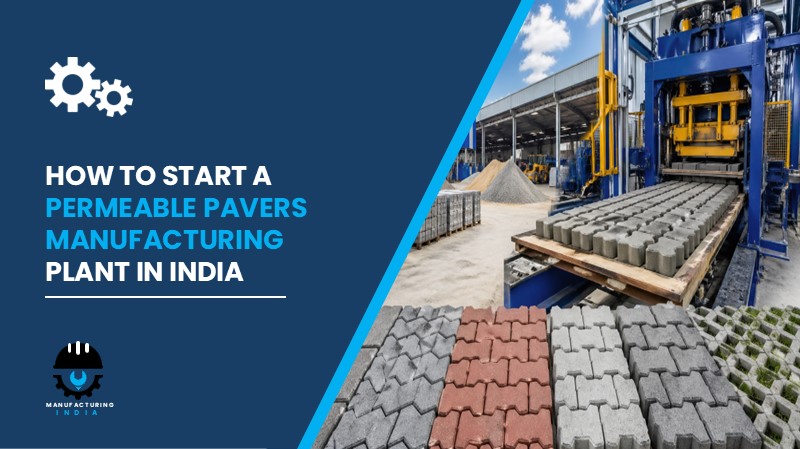
Setting up a permeable pavers manufacturing plant in India presents a compelling investment case driven by surging demand across construction and infrastructure, urban planning and development, stormwater management, landscaping, and residential and commercial real estate sectors. As India’s cities expand rapidly, the challenge of uncontrolled stormwater runoff, urban flooding, and groundwater depletion has become critical. Permeable pavers — specially designed paving blocks that allow water to pass through the surface and into the ground below — offer a proven, scalable solution to these challenges, making their domestic manufacture a strategically sound and commercially attractive venture.
India’s accelerating urbanisation, ambitious infrastructure programmes under national and state governments, and the growing emphasis on green building certifications and sustainable construction all create a strong, long-term demand environment for permeable paving solutions. States such as Gujarat, Maharashtra, Uttar Pradesh, and Tamil Nadu, with their established industrial estates, proximity to cement and aggregate supply chains, and dense construction markets, provide ideal locations for a new manufacturing unit. The Make in India initiative further supports domestic production by reducing import dependence, improving ease of doing business, and offering policy-backed incentives to manufacturing investors.
Setting up a permeable pavers plant in India combines policy tailwinds, cost-competitive manufacturing, and rising urban infrastructure demand to deliver gross profit margins of 35–45% and net margins of 18–25%, making it one of the more attractive greenfield opportunities in the sustainable construction materials segment.
What are Permeable Pavers?
Permeable pavers are specially designed paving stones or blocks that allow water to pass through the surface and into the ground below, promoting stormwater infiltration and groundwater recharge. Made from various materials such as concrete, plastic grids, and natural stone, these pavers create permeable surfaces that are ideal for driveways, walkways, parking lots, and roadways. By allowing water to permeate, permeable pavers help prevent flooding, reduce the urban heat island effect, and improve water quality.
As a sustainable alternative to traditional hardscapes, permeable pavers are increasingly utilised in green infrastructure and sustainable urban development projects. The primary production method is a multi-step operation that involves material selection, molding and shaping, curing, quality control, packaging, and distribution. End-use industries served include construction and infrastructure, landscaping, residential and commercial real estate, urban planning and development, stormwater management, and parks and recreational areas.
Cost of Setting Up a Permeable Pavers Manufacturing Plant in India
The total cost of establishing a permeable pavers manufacturing plant in India depends on plant capacity, technology choice, geographic location, level of automation, and regulatory compliance obligations. A structured understanding of both capital and operational expenditures is essential before committing to an investment.
1. Capital Expenditure (CapEx)
Land and Site Development constitutes a significant share of the initial investment. Investors may consider locating the unit within an SEZ or designated industrial estate to benefit from reduced land acquisition costs, shared infrastructure, and favourable regulatory conditions. Land registration charges, boundary development, and site grading are all part of this allocation.
Civil Works and Construction covers the manufacturing shed, laboratory space, raw material storage bays, finished goods warehouse, administrative block, and utilities infrastructure. A robust civil layout designed to accommodate future expansion is recommended.
Machinery and Equipment represent the largest single component of CapEx. Key machinery required includes:
- Molding and compression machines
- Curing ovens
- Grinding and finishing machines
- Packaging machines
- Quality control equipment
Other Capital Costs include effluent treatment plant (ETP) setup, pre-operative expenses, commissioning charges, and applicable import duties on specialised machinery not manufactured domestically.
Request a Sample Report for In-Depth Market Insights: https://www.imarcgroup.com/permeable-pavers-manufacturing-plant-project-report/requestsample
2. Operational Expenditure (OpEx)
Raw Material Cost is the dominant driver of operating expenditure, accounting for approximately 60–70% of total OpEx. The core raw materials required are cement, coarse aggregate, sand, and water. Given that cement alone contributes the largest share of material cost, investors are strongly advised to negotiate long-term supply contracts with regional suppliers to stabilise input pricing and ensure uninterrupted production.
Utility Cost — covering electricity, water, and steam — accounts for 10–15% of OpEx. Reliable and affordable power access is therefore an important site selection criterion. States with industrial power tariff subsidies or proximity to captive power sources offer a meaningful cost advantage.
Other Operating Costs include transportation and distribution, packaging materials, salaries and wages, routine maintenance and repairs, depreciation on plant and machinery, and applicable statutory taxes. By the fifth year of operations, total operational costs are expected to increase substantially due to inflation, market fluctuations, potential rises in the cost of key raw materials, supply chain disruptions, and shifts in broader demand conditions.
3. Plant Capacity
The proposed manufacturing facility is designed with an annual production capacity ranging between 1 and 5 million square metres, enabling economies of scale while maintaining operational flexibility. Plant capacity can be customised per investor requirements depending on target market size, available capital, and geographic demand catchment. Profitability improves progressively with higher capacity utilisation, making early-stage scale planning a critical investment decision.
4. Profit Margins and Financial Projections
The permeable pavers manufacturing plant project demonstrates healthy profitability potential under normal operating conditions. Gross profit margins typically range between 35–45%, supported by stable demand and value-added product applications. Net profit margins average 18–25% over the project lifecycle. A full financial analysis covering NPV (Net Present Value), IRR (Internal Rate of Return), payback period, gross margin trajectory, net margin evolution, liquidity ratios, sensitivity analysis, and break-even point is available in the detailed project report. These projections are based on realistic assumptions related to capital investment, operating costs, production capacity utilisation, pricing trends, and demand outlook.
Why Set Up a Permeable Pavers Plant in India?
Rising Urbanisation and Flood Management Pressure. As urbanisation continues to rise across Indian cities, local authorities are adopting more environmentally responsible surface solutions to address challenges like flooding and waterlogging. Permeable pavers help manage stormwater runoff by allowing water to permeate the surface, reducing pressure on drainage systems and promoting groundwater recharge — directly addressing one of India’s most pressing urban infrastructure problems.
Increased Demand for Sustainable Construction. With the growing emphasis on sustainable urban development and green building certifications, the demand for permeable paving solutions is increasing across residential, commercial, and municipal project categories. Landscaping and outdoor design trends favouring sustainable and aesthetic solutions are contributing to demand in gardens, parks, and public spaces across Indian metropolitan areas.
Environmental and Stormwater Management Compliance. The environmental benefits of permeable pavers — managing stormwater runoff, improving groundwater recharge, and reducing the urban heat island effect — are increasingly factored into infrastructure project specifications. As regulatory frameworks around urban drainage tighten, specifiers and contractors are increasingly mandating permeable surface solutions.
Cost-Competitive Manufacturing. India offers significant cost advantages in land acquisition, construction, and labour relative to developed markets. Proximity to abundant cement, aggregate, and sand suppliers across major manufacturing states further reduces raw material logistics costs, improving plant-level margins for domestic producers.
Active Industry Investment and Innovation. In October 2025, the City of Sydney upgraded cracked tree surrounds with Watersmart Porous Lane permeable pavement, demonstrating real-world municipal adoption of the category. In July 2025, Austral Masonry launched TriForm Max — permeable interlocking concrete pavers available in small-format sizes and modern colours — designed to support sustainable drainage in commercial and industrial environments. These global developments signal that both product innovation and municipal procurement of permeable pavers are accelerating, trends that Indian manufacturers can capitalise on for the domestic market.
Local Supply Chain Preference. Construction companies, infrastructure contractors, urban planners, and landscape designers across India increasingly prefer locally manufactured building materials to reduce lead times, lower procurement costs, and ensure supply chain continuity. A domestic permeable pavers plant is well positioned to capture this preference across all major end-use verticals.
Manufacturing Process – Step by Step
The permeable pavers manufacturing process uses material selection, molding and shaping, curing, quality control, packaging, and distribution as the primary production method. Each stage must be executed with precision to meet structural performance and permeability standards:
- Material Selection: Cement, coarse aggregate, sand, and water are sourced and tested for compliance with quality specifications before entering the production line.
- Molding and Shaping: Raw materials are batched, mixed, and fed into molding and compression machines to form pavers in specified dimensions, shapes, and void configurations.
- Curing: Freshly molded pavers are transferred to curing ovens where controlled temperature and humidity conditions allow cement hydration to reach the required compressive strength.
- Grinding and Finishing: Cured pavers are processed through grinding and finishing machines to achieve dimensional accuracy, surface texture, and aesthetic finish.
- Quality Control: Each batch undergoes technical testing using quality control equipment to verify permeability rates, load-bearing capacity, dimensional tolerances, and surface integrity.
- Packaging and Distribution: Approved finished pavers are packaged and dispatched to end-use industries including construction and infrastructure contractors, landscaping firms, residential and commercial real estate developers, urban planners, and stormwater management project operators.
Key Applications
Permeable pavers serve a wide range of industries and project types, making them one of the more versatile sustainable construction materials in the market:
- Construction and Infrastructure: Used extensively for driveways, sidewalks, and parking lots in large-scale civil and infrastructure projects.
- Landscaping: Applied in walkways, garden paths, and courtyards to combine permeability with aesthetic appeal.
- Residential and Commercial Real Estate: Used for driveways and parking areas in housing complexes and commercial premises.
- Urban Planning and Development: Incorporated into streetscapes and public areas to enhance sustainability and manage urban water cycles.
- Stormwater Management: Deployed as an effective solution in stormwater management systems, allowing rainwater to pass through the surface and substantially reduce runoff volumes.
- Parks and Recreational Areas: Used to create permeable, durable, and visually appealing surfaces in parks and public open spaces.
Leading Manufacturers
The global permeable pavers market is served by several multinational companies with extensive production capacities and diverse application portfolios. Key players in the industry include:
- Tensar International Corporation
- Belgard
- Pavestone, LLC
- Unilock
- Techo-Bloc, Inc.
- Bomanite Corporation
- Acker-Stone Industries
- TRUEGRID
Timeline to Start the Plant
Establishing a permeable pavers manufacturing unit in India typically involves the following sequential phases:
- Feasibility study and project report preparation
- Land acquisition and site development
- Regulatory approvals and environmental clearances
- Factory licence and fire safety compliance
- Machinery procurement and installation
- Raw material supplier agreements and supply chain setup
- Trial production and quality testing
- Commercial production launch
Licences and Regulatory Requirements
Starting a permeable pavers manufacturing unit in India requires several approvals:
- Business registration (Proprietorship, LLP, or Pvt Ltd)
- Factory Licence under the Factories Act
- Environmental Clearance from State Pollution Control Board
- GST Registration
- Fire Safety NOC
- Effluent Treatment Plant (ETP) operational clearance
- Occupational Health and Safety compliance
Key Challenges to Consider
High Capital Requirements. Setting up a permeable pavers plant with adequate capacity and automation involves substantial upfront investment in land, civil works, and machinery — particularly molding and compression machines and curing ovens — which can be a barrier for smaller investors.
Raw Material Price Volatility. Cement, coarse aggregate, sand, and water are the core input materials, and cement in particular accounts for 60–70% of total OpEx. Fluctuations in cement prices driven by fuel costs, logistical disruptions, or demand surges in the construction sector can significantly impact plant-level margins.
Regulatory Compliance. Obtaining environmental clearances, ETP approvals, and factory licences across Indian states can be time-consuming. Non-compliance with emission or effluent standards carries operational and financial risk that investors must plan for proactively.
Technology and Innovation Pressure. Product innovation — such as the TriForm Max launch by Austral Masonry in July 2025 offering new formats and colours — signals that the permeable pavers segment rewards continuous product development. Manufacturers who do not invest in product range expansion may face margin compression over time.
Competition from Global Players. Established global manufacturers such as Belgard, Unilock, Pavestone LLC, and TRUEGRID have strong brand equity and production scale. Domestic Indian producers will need to differentiate on price, local service, and supply chain responsiveness.
Skilled Manpower. Operating molding, compression, curing, and quality control equipment to consistent standards requires a trained technical workforce. Recruiting and retaining skilled plant operators and quality managers in semi-urban industrial locations can be challenging.
Frequently Asked Questions
1. How much does it cost to set up a permeable pavers manufacturing plant in India?
The setup cost depends on plant capacity, location, technology, and automation level. The detailed project report provides a full CapEx breakdown covering land, civil works, machinery, and other capital costs.
2. Is permeable pavers manufacturing profitable in India in 2026?
Yes. The project demonstrates gross profit margins of 35–45% and net profit margins of 18–25% under normal operating conditions, making it a commercially viable investment.
3. What machinery is required for a permeable pavers plant in India?
Key machinery includes molding and compression machines, curing ovens, grinding and finishing machines, packaging machines, and quality control equipment.
4. What licences and approvals are required to start a permeable pavers plant in India?
Required approvals include business registration, Factory Licence, Environmental Clearance from the State Pollution Control Board, GST Registration, Fire Safety NOC, ETP operational clearance, and occupational health and safety compliance.
5. What raw materials are needed for permeable pavers manufacturing?
The core raw materials are cement, coarse aggregate, sand, and water. Cement is the dominant input, accounting for the majority of raw material cost.
6. What are the environmental compliance requirements for a permeable pavers plant in India?
Investors must obtain Environmental Clearance from the State Pollution Control Board, ensure an operational Effluent Treatment Plant, and comply with emission and waste management standards under applicable environmental regulations.
7. What is the best location to set up a permeable pavers plant in India?
Ideal locations offer proximity to cement and aggregate suppliers, reliable transportation infrastructure, access to a skilled workforce, and established industrial estate infrastructure. States such as Gujarat, Maharashtra, Uttar Pradesh, and Tamil Nadu are strategically suited.
8. What is the break-even period for this type of plant in India?
Break-even timelines depend on plant scale, capacity utilisation, and market pricing. The full financial analysis including payback period, NPV, and IRR is covered in the detailed project report.
9. What government incentives are available for manufacturers in India?
Manufacturers can benefit from Make in India incentives, state-level industrial investment subsidies, SEZ tax benefits, capital subsidy schemes for MSMEs, and PLI-adjacent programmes relevant to construction materials.
Key Takeaways for Investors
A permeable pavers manufacturing plant in India presents a strong and multi-dimensional investment opportunity, with end-use demand anchored in construction and infrastructure, stormwater management, urban planning and development, landscaping, and residential and commercial real estate — all of which are growing rapidly in the Indian context. The project’s financial viability is well-supported across plant capacities of 1 to 5 million square metres annually, with gross margins of 35–45% and net margins of 18–25% offering investors a compelling return profile. The global permeable pavers market was valued at USD 11.46 billion in 2025 and is projected to reach USD 31.86 billion by 2034 at a CAGR of 12.0%, signalling a decade-long growth runway that Indian manufacturers are well positioned to capture. With urbanisation, green infrastructure investment, and stormwater management becoming permanent priorities for Indian cities and policymakers, demand for domestically manufactured permeable pavers is expected to remain structurally robust for the foreseeable future.
About the Author