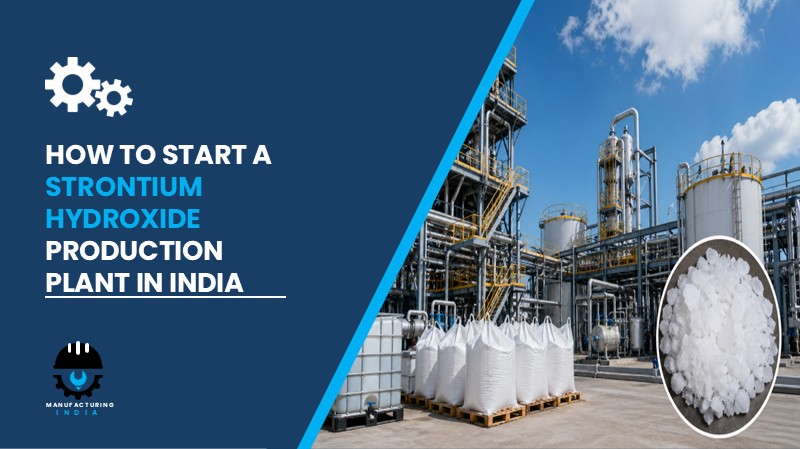
Setting up a strontium hydroxide production plant in India presents a compelling investment case at a time when the country’s expanding sugar refining sector, growing automotive and heavy machinery lubricant industry, surging electronics and appliance manufacturing base, and deepening specialty ceramics production are all generating converging demand for one of the most commercially versatile and industrially indispensable inorganic alkaline compounds in the specialty chemicals market. Strontium hydroxide — the white crystalline inorganic alkaline compound formed when strontium carbonate or strontium oxide reacts with water — serves as an essential input for sugar juice clarification, strontium-based lubricating grease manufacturing, ferrite magnet production, specialty ceramic formulations, and chemical intermediate synthesis across multiple industrial sectors simultaneously. As India’s food processing industry deepens, its industrial automation footprint expands, and its electronics manufacturing base grows under the PLI scheme, the domestic requirement for high-purity strontium hydroxide produced to consistent industrial specifications is building into a commercially significant and structurally durable opportunity for specialty inorganic chemical producers.
India’s positioning for strontium hydroxide production is well-supported and improving. The Asia-Pacific region holds the largest share of the global strontium hydroxide market, accounting for over 49% — a regional dominance that reflects both the concentration of sugar processing, electronics, and automotive manufacturing that constitutes the primary demand base for this compound. India, as an increasingly important hub within this dominant regional market, benefits from a large domestic sugar industry centred in Uttar Pradesh, Maharashtra, and Karnataka, a rapidly growing automotive sector across Pune, Chennai, and Manesar, and an expanding electronics manufacturing base across multiple PLI-supported states. Specialty chemical industrial estates in Gujarat, Maharashtra, and Rajasthan offer the strontium carbonate supply chain access, corrosion-resistant reactor infrastructure, analytical chemistry workforce, and regulatory frameworks that a strontium hydroxide production facility requires to operate commercially and serve customers across India’s diverse industrial end-use segments.
Investing in a strontium hydroxide production plant in India today aligns India’s growing sugar processing, lubricant manufacturing, ferrite magnet production, and ceramics industries with APAC’s dominant 49% global market share, robust industrial automation growth that exceeded 542,000 robot installations globally in 2024, and production technology advancements enabling better products at lower costs. With gross profit margins of 35–45% and net profit margins of 18–25%, the unit economics are commercially attractive across annual production capacities of 2,000 to 10,000 MT, supporting viable and financially sound returns across a well-defined specialty chemicals investment horizon.
What is Strontium Hydroxide?
Strontium hydroxide [Sr(OH)₂] is an inorganic alkaline substance which commonly appears as a white crystalline solid that usually exists in its octahydrate state. The compound is produced through the chemical reaction between strontium carbonate or strontium oxide and water under specific temperature and processing conditions. The production process includes purification steps which start with filtration to eliminate contaminants and continue with crystallisation and drying to reach the target purity and particle dimensions required for industrial applications.
Strontium hydroxide serves an essential function within sugar refining because it aids in the removal of contaminants while increasing product transparency during juice clarification — a process that has made it a preferred purification agent for sugar processors seeking higher product quality and processing efficiency. The compound serves as a key stabilising component which manufacturers use to produce lubricating grease, because it improves thermal stability and maintains product performance attributes at high operating temperatures encountered in automotive and heavy machinery applications. It is used to create ferrite magnets and special ceramics because of its ability to provide essential functions in magnetic flux density enhancement and ceramic strength improvement. The strong alkaline properties and chemical reactive capabilities of strontium hydroxide enable it to be used in various industrial and chemical processing applications across multiple sectors simultaneously.
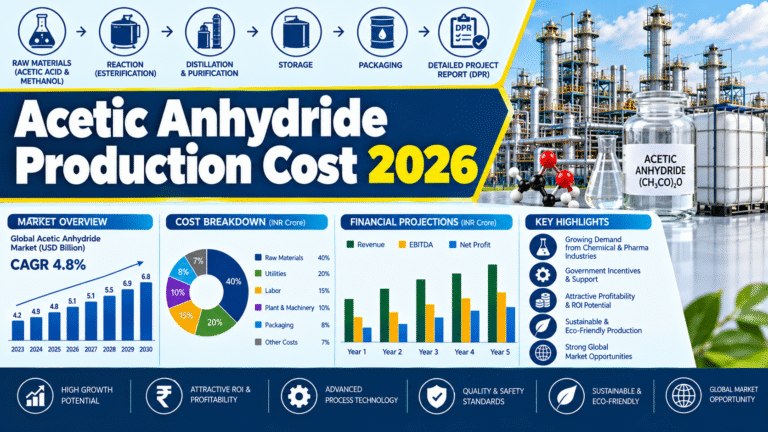
The primary production process covers calcination of strontium carbonate to form strontium oxide, hydration to produce strontium hydroxide, purification, crystallisation, filtration, drying, quality testing, and packaging. End-use industries served include sugar processing, lubricants, ceramics, ferrite magnet manufacturing, chemicals, and electronics. Applications span sugar purification and juice clarification, strontium grease manufacturing, ceramic formulations, ferrite magnet production, and chemical intermediate synthesis.
Cost of Setting Up a Strontium Hydroxide Production Plant in India
The cost of establishing a strontium hydroxide production plant in India depends on production capacity, target product grade and purity specification, calcination and hydration process technology, geographic location — particularly proximity to strontium carbonate supply sources — degree of automation, and the quality certification requirements applicable to strontium hydroxide supplied to sugar, lubricants, ceramics, and electronics customers across India’s diverse industrial market.
1. Capital Expenditure (CapEx)
Land and Site Development forms a foundational component of total capital investment, covering land acquisition charges, site registration, boundary development, chemical containment and acid-resistant drainage infrastructure, and site utilities. Investors may explore specialty chemicals industrial estates in Gujarat, Maharashtra, or Rajasthan, where established chemical handling infrastructure, strontium mineral supply chain access, regulatory expertise with inorganic compound manufacturing, and proximity to sugar processing and automotive lubricant customer clusters create a commercially advantaged operating environment for a strontium hydroxide producer.
Civil Works and Construction cover the main production building housing calcination kilns, hydration reactor systems with appropriate containment for alkaline solutions, crystallisation vessels, filtration and drying areas, a quality control laboratory equipped for purity analysis, pH measurement, and particle size characterisation, finished goods warehousing with humidity control for the hygroscopic octahydrate product form, an administrative block, and utilities infrastructure including steam supply for temperature-controlled hydration and drying operations.
Machinery and Equipment represent the largest single component of total CapEx for a strontium hydroxide production plant. Key machinery required includes:
- Rotary kilns for calcination
- Hydration reactors
- Crystallisers
- Filtration units
- Dryers
- Milling equipment
- Packaging systems
Other Capital Costs include an effluent treatment plant (ETP) for managing alkaline process effluents and strontium-containing waste streams, fume scrubbing systems for calcination kiln off-gas management, strontium recovery from process effluents to minimise material loss and environmental impact, pre-operative expenses, commissioning charges, and import duties on specialised rotary kiln systems or crystallisation equipment not available domestically at the required specification level.
Request a Sample Report for In-Depth Market Insights: https://www.imarcgroup.com/strontium-hydroxide-production-cost-analysis-report/requestsample
2. Operational Expenditure (OpEx)
Raw Material Cost is the dominant operational expense, accounting for approximately 65–75% of total OpEx. The primary raw materials are strontium carbonate and hydrochloric acid. Strontium carbonate — as the primary strontium feedstock consumed in the largest volumes — drives the majority of raw material cost and is sourced from celestite mineral processing operations. India’s domestic strontium mineral resources are limited, creating a dependence on imported strontium carbonate primarily from Chinese, Spanish, and Mexican producers — a supply channel whose cost and availability must be managed through long-term procurement contracts and strategic inventory positions. Hydrochloric acid serves as a process reagent in certain purification steps. Long-term supply agreements with reliable strontium carbonate suppliers are essential for production cost stability and supply continuity.
Utility Cost is the second-largest OpEx component, representing 15–20% of total operating expenses — a relatively high utility proportion that reflects the energy intensity of rotary kiln calcination operations at the elevated temperatures required to convert strontium carbonate to strontium oxide, and the steam requirements for temperature-controlled hydration and drying stages. Electricity for hydration reactors, crystallisers, filtration units, and milling equipment, steam for process heating, and water for hydration and washing operations constitute the primary utility inputs requiring careful site infrastructure planning.
Other Operating Costs include transportation and distribution to sugar processing companies, lubricant manufacturers, ceramics producers, ferrite magnet manufacturers, and specialty chemical and electronics customers, specialised moisture-resistant packaging materials for the hygroscopic octahydrate product form, salaries and wages for inorganic chemists and quality control analysts, routine machinery maintenance including rotary kiln refractory upkeep and crystalliser cleaning, depreciation on production equipment, and applicable taxes. By the fifth year of operations, total operational costs are projected to increase substantially due to inflation, strontium carbonate price movements, supply chain disruptions, rising consumer demand, and shifts in the global economy.
3. Plant Capacity
The proposed production facility for strontium hydroxide is designed with an annual production capacity ranging between 2,000 and 10,000 metric tonnes, enabling economies of scale while maintaining the operational flexibility to serve a diversified customer base across sugar processing, lubricants, ceramics, ferrite magnet manufacturing, chemicals, and electronics industries. Plant capacity can be customised per investor requirements and phased in line with secured customer purchase agreements and market penetration milestones across India’s distinct industrial customer segments. As with all specialty inorganic compound manufacturing, profitability improves with higher capacity utilisation and product portfolio diversification, making established commercial relationships with anchor customers across two or more end-use segments a strategic priority from the outset.
4. Profit Margins and Financial Projections
The financial projections for a strontium hydroxide production plant demonstrate healthy profitability potential under normal operating conditions. Gross profit margins typically range between 35–45%, supported by stable multi-sector demand from sugar processing, lubricant manufacturing, ceramics, and ferrite magnet production industries. Net profit margins are projected at 18–25%. A comprehensive financial analysis covering NPV (net present value), IRR (internal rate of return), payback period, gross margin progression, and net margin development across a five-year horizon is essential before committing capital. The project’s ROI profile and long-term sustainability are assessed against realistic assumptions on capital investment, production capacity utilisation, strontium carbonate pricing trends, and demand outlook from the sugar, lubricants, ceramics, ferrite magnets, chemicals, and electronics end-use sectors.
Why Set Up a Strontium Hydroxide Production Plant in India?
Expanding Sugar Processing Sector Sustaining Baseline Demand. Increasing global food consumption sustains steady demand for sugar refining chemicals, with strontium hydroxide playing a critical role in juice clarification and impurity removal during sugar processing. India’s sugar industry — one of the world’s largest by production volume, centred in Uttar Pradesh, Maharashtra, and Karnataka — provides an immediate, large, and structurally stable domestic demand base for strontium hydroxide that is independent of technology or innovation cycles, representing a reliable commercial anchor for a new production facility.
Rising Demand for Specialty Greases from Automotive and Industrial Automation Growth. Automotive and heavy machinery industries require high-performance lubricating greases with thermal stability at elevated operating temperatures — a performance profile that strontium-based greases provide due to the stabilising function of strontium hydroxide in the grease manufacturing process. According to World Robotics 2025, 542,000 industrial robots were installed in 2024, exceeding the installed base from ten years earlier, with annual installations reaching 500,000 for the fourth consecutive year and Asia accounting for 74% of installations. This industrial automation growth directly expands the machinery population requiring high-performance specialty lubricants — and by extension, the strontium hydroxide consumed in their manufacture.
Growth in Ferrite Magnet Production Linked to Electronics and Appliance Manufacturing. The production of ferrite magnets maintains its growth because electronics and appliance manufacturing requires more ferrite magnets, which in turn increases the demand for strontium compounds. India’s electronics manufacturing expansion under the PLI scheme — producing smartphones, consumer appliances, industrial electronics, and automotive electronics — is generating growing domestic demand for ferrite magnets, with each magnet requiring strontium hydroxide as a key production input. This indirect but structurally strong demand linkage from electronics PLI to strontium hydroxide creates a policy-driven demand driver alongside the traditional food and lubricant sectors.
Versatile Multi-Sector Chemical Applications Providing Demand Diversification. Broad industrial usability across sugar processing, lubricant manufacturing, ceramics, ferrite magnet production, and chemical intermediate applications ensures diversified revenue across multiple industrial sectors with different demand cycles — a commercial resilience advantage that insulates the investment from single-sector demand cyclicality. An Indian strontium hydroxide producer can simultaneously serve sugar mills in Uttar Pradesh, lubricant blenders in Gujarat, ferrite magnet manufacturers in Rajasthan, and ceramics producers in Maharashtra from a single production facility, distributing commercial risk across India’s diverse industrial landscape.
Stable Industrial Demand and Recurring Procurement Cycles. Mature end-use industries provide consistent and recurring product consumption patterns that support reliable revenue forecasting and production planning. Sugar refining, lubricant formulation, and ceramics manufacturing are all established industrial processes with predictable strontium hydroxide consumption rates per unit of output, enabling production scheduling and raw material procurement to be aligned with customer order cycles rather than speculative market projections.
Technological Advancements Improving Production Economics. The development of new technologies in calcination and crystallisation processes enables companies to produce better-quality strontium hydroxide products at lower production costs, which helps them compete in both local and global markets. New entrants who establish facilities using current state-of-the-art rotary kiln and crystallisation technology can benefit from these efficiency improvements from the first day of production, avoiding the cost disadvantage of older, less efficient legacy installations that established competitors may carry.
Production Process — Step by Step
The strontium hydroxide production process uses calcination of strontium carbonate to form strontium oxide, hydration to produce strontium hydroxide, purification, crystallisation, filtration, drying, quality testing, and packaging as the primary production method. Each stage requires precisely controlled temperature, reaction conditions, and purification parameters to produce strontium hydroxide of the target purity, crystal form, particle size, and moisture content required by sugar processing, lubricant manufacturing, ceramics, and ferrite magnet customer specifications.
- Strontium Carbonate Receipt and Preparation: High-purity strontium carbonate is received from certified suppliers, quality-inspected for purity and trace metal contamination, and prepared in the required particle form for efficient feed into the calcination kiln.
- Calcination in Rotary Kilns: Strontium carbonate is fed into rotary kilns operating at controlled elevated temperatures — typically 900–1,100°C — where thermal decomposition converts strontium carbonate (SrCO₃) to strontium oxide (SrO) and carbon dioxide. Kiln temperature, residence time, and feed rate are precisely controlled to achieve complete calcination while minimising sintering that would reduce subsequent reactivity in the hydration stage.
- Hydration Reaction: Calcined strontium oxide is discharged from the kiln and fed into hydration reactors where controlled addition of water under temperature-managed conditions produces the hydration reaction that converts strontium oxide to strontium hydroxide octahydrate [Sr(OH)₂·8H₂O]. Reaction temperature, water addition rate, and mixing intensity are controlled to achieve the target crystal size and product consistency.
- Purification: The crude strontium hydroxide slurry undergoes purification processing — including addition of appropriate reagents and controlled pH adjustment using hydrochloric acid where required — to precipitate and remove dissolved impurities including iron, barium, and other trace metals that would compromise product purity and customer specification compliance.
- Filtration: Purified strontium hydroxide slurry is processed through filtration units to separate the crystalline solid product from the mother liquor, with filtrate captured for effluent treatment and strontium recovery to minimise material loss and environmental impact.
- Crystallisation: Where premium crystal quality is required — particularly for sugar refining and pharmaceutical-adjacent applications — filtered product may be subjected to controlled crystallisation in crystallisers to produce uniform, well-formed crystals of specified morphology and size distribution.
- Drying: Filtered or crystallised strontium hydroxide is processed through dryers at controlled temperatures to achieve the target moisture content — whether as the monohydrate or octahydrate form depending on customer specification — while preventing dehydration that would alter the crystal structure and product reactivity.
- Milling: Dried strontium hydroxide is processed through milling equipment to achieve the target particle size distribution required for the specific end-use application — finer powder for ceramics and ferrite magnet applications, coarser grades for sugar refining and grease manufacturing.
- Quality Testing: Finished strontium hydroxide undergoes comprehensive quality testing covering purity by titrimetric analysis, trace metal content by ICP-OES, particle size distribution, moisture content, and pH of solution, verifying compliance with customer or standard product specifications before packaging.
- Packaging: Specification-compliant strontium hydroxide is packaged in moisture-resistant sealed bags or drums using packaging systems to prevent hydration and contamination during storage and transit, then dispatched to sugar processing, lubricant manufacturing, ceramics, ferrite magnet, chemicals, and electronics customers.
Key Applications
Strontium hydroxide produced in India serves a commercially broad and structurally stable range of industrial applications across multiple end-use sectors:
- Sugar Industry: Removes impurities during juice clarification, improving sugar purity and processing efficiency by precipitating non-sugar solids and enabling their separation from clarified juice.
- Lubricant Industry: Enables production of strontium-based greases with enhanced thermal stability properties for automotive and heavy machinery applications requiring lubrication performance at elevated operating temperatures.
- Ceramic Industry: Incorporated into specialty ceramic formulations to improve strength, durability, and specific dielectric properties required for technical ceramic applications.
- Magnet Manufacturing: Used in ferrite magnet production for improved magnetic performance characteristics, particularly coercivity and flux density, in permanent magnets for motors, speakers, and electronic devices.
Leading Producers
The global strontium hydroxide industry is served by a group of specialty inorganic chemistry companies with diverse production capabilities and application portfolios across food processing, lubricants, ceramics, and electronics segments. Key players in the global market include:
- American Elements
- Alfa Aesar
- Ereztech
- Central Drug House
- MaTecK
- Chemdyes Corporation
- ProChem
Timeline to Start the Plant
Establishing a strontium hydroxide production plant in India involves a structured multi-phase development sequence. Investors should plan for the following phases:
- Feasibility study and project report preparation
- Land acquisition and site development
- Regulatory approvals and environmental clearances
- Factory licence and fire safety compliance
- Machinery procurement and installation
- Raw material supplier agreements and supply chain setup
- Trial production and quality testing
- Commercial production launch
Licences and Regulatory Requirements
Starting a strontium hydroxide production unit in India requires several approvals spanning business registration, chemical safety, environmental, and food processing supply chain compliance domains:
- Business registration (Proprietorship, LLP, or Pvt Ltd)
- Factory Licence under the Factories Act
- Environmental Clearance from the State Pollution Control Board
- GST Registration
- Fire Safety NOC
- Hazardous/Chemical compliance applicable to hydrochloric acid handling and alkaline strontium compound processing under chemical safety regulations
- FSSAI compliance or food-grade certification where strontium hydroxide is supplied for use in sugar processing or food-adjacent applications
- Effluent Treatment Plant (ETP) operational clearance with strontium recovery capability for alkaline process effluent and strontium-containing waste stream management
- Occupational Health and Safety compliance including strontium compound dust exposure monitoring and control
Key Challenges to Consider
Strontium Carbonate Import Dependence and Supply Concentration. Strontium carbonate — accounting for approximately 65–75% of total OpEx — is primarily imported from Chinese, Spanish, and Mexican producers, with India’s domestic celestite mineral resources insufficient to support commercial strontium compound production at industrial scale. This structural import dependence creates supply chain exposure to export policy changes, logistics disruptions, and currency fluctuations that must be managed through diversified supplier relationships, long-term procurement contracts, and strategic inventory management.
High Utility Cost Proportion from Calcination Energy Intensity. Utility costs representing 15–20% of total OpEx — significantly higher than most specialty chemical categories — reflect the energy intensity of rotary kiln calcination at 900–1,100°C. This elevated energy requirement makes site electricity tariff and fuel cost management a critical operational parameter. Proximity to reliable, cost-competitive industrial energy supply and optimisation of kiln thermal efficiency are essential levers for maintaining cost competitiveness.
Hygroscopic Product Handling and Packaging Challenges. Strontium hydroxide octahydrate is highly hygroscopic, absorbing atmospheric moisture readily upon exposure and altering its crystal form, weight, and reactivity. This physical property imposes strict requirements for moisture-controlled storage, inert atmosphere packaging, and rapid product turnover in warehousing — all adding operational complexity and packaging cost relative to non-hygroscopic specialty chemicals of comparable production scale.
Multi-Sector Customer Specification Compliance. Serving sugar processing, lubricant, ceramics, and ferrite magnet customers simultaneously requires maintaining multiple product specifications covering purity, particle size, crystal form, and trace metal profiles that differ by application — demanding robust quality management systems, batch traceability, and flexible production protocols across the full customer portfolio.
Competition from Established Global Specialty Producers. The competitive landscape includes globally established inorganic chemistry companies including American Elements, Alfa Aesar, and Ereztech, as well as Chinese specialty chemical producers with significant scale and raw material proximity advantages. New Indian producers must differentiate through domestic supply chain advantages, competitive pricing, product customisation, and the supply reliability advantages that local production provides to Indian industrial customers over import-dependent alternatives.
Skilled Technical Workforce for Calcination and Crystallisation Process Control. Maintaining consistent product quality across the rotary kiln calcination, hydration, and crystallisation sequence requires experienced inorganic chemists, kiln operators, and quality control analysts familiar with strontium compound processing — a specialised technical workforce requiring ongoing investment in recruitment, training, and competitive retention.
Frequently Asked Questions
1. How much does it cost to set up a strontium hydroxide production plant in India?
The total setup cost depends on production capacity, product grade and crystal quality specification, calcination and hydration technology, location, and automation level. CapEx covers land and site development with chemical-grade containment infrastructure, core equipment including rotary kilns for calcination, hydration reactors, crystallisers, filtration units, dryers, milling equipment, and packaging systems, along with ETP with strontium recovery capability, fume scrubbing systems, and other capital costs. A detailed project report with full CapEx and OpEx breakdowns is available on request.
2. Is strontium hydroxide production profitable in India in 2026?
Yes. The project demonstrates gross profit margins of 35–45% and net profit margins of 18–25% under normal operating conditions, supported by stable multi-sector demand from sugar processing, lubricant manufacturing, ceramics, and ferrite magnet production industries. The APAC region’s dominant 49% global market share and India’s growing industrial base across these sectors provide a robust domestic demand foundation for a new Indian producer.
3. What machinery is required for a strontium hydroxide production plant in India?
Key machinery includes rotary kilns for calcination, hydration reactors, crystallisers, filtration units, dryers, milling equipment, and packaging systems. Rotary kilns are the most capital-intensive and technically critical equipment items, as they determine the calcination quality, strontium oxide reactivity, and ultimate product performance that flows through all subsequent production stages.
4. What licences and approvals are required to start a strontium hydroxide production plant in India? Required approvals include business registration, a Factory Licence under the Factories Act, Environmental Clearance from the State Pollution Control Board, GST registration, a Fire Safety NOC, hazardous chemical compliance for hydrochloric acid handling, FSSAI or food-grade certification for sugar processing supply applications, ETP operational clearance with strontium recovery capability, and Occupational Health and Safety compliance including strontium dust exposure monitoring.
5. What raw materials are needed for strontium hydroxide production? The primary raw materials are strontium carbonate and hydrochloric acid. Strontium carbonate accounts for approximately 65–75% of total operating expenses, making strontium carbonate procurement strategy, import supplier relationships, and raw material price risk management the most critical cost management levers for the investment.
6. What are the environmental compliance requirements for a strontium hydroxide production plant in India?
The unit must obtain Environmental Clearance from the State Pollution Control Board, operate a certified ETP with strontium recovery capability for alkaline process effluent management, install fume scrubbing systems for calcination kiln off-gas treatment, implement strontium dust containment and personal protective equipment systems for worker safety, and maintain monitoring systems for air emissions and wastewater discharge in line with applicable state pollution control standards.
7. What is the best location to set up a strontium hydroxide production plant in India?
Optimal locations offer proximity to strontium carbonate import logistics hubs or domestic strontium mineral sources, reliable industrial energy supply for rotary kiln operations, established chemical handling infrastructure, and access to sugar processing, lubricant manufacturing, and ceramics customer clusters. Specialty chemical industrial estates in Gujarat, Maharashtra, and Rajasthan are among the most strategically relevant options for this investment.
8. What is the break-even period for this type of plant in India?
The break-even period depends on production capacity, capacity utilisation rate, strontium carbonate pricing trends, and demand conditions across sugar, lubricant, ceramics, and ferrite magnet customer segments. A detailed financial analysis including payback period, NPV, and IRR projections is included in the full project report, available via the sample request link.
9. What government incentives are available for manufacturers in India?
The Make in India initiative, PLI schemes for electronics and specialty materials manufacturing, and state-level specialty chemical manufacturing incentives in Gujarat and Maharashtra provide financial and regulatory support for strontium hydroxide production investments. Export promotion benefits under specialty chemicals categories and capital subsidy schemes under state investment promotion boards may be applicable depending on the chosen plant location and production profile.
Key Takeaways for Investors
A strontium hydroxide production plant in India represents a commercially well-positioned investment in a specialty inorganic compound that serves multiple industrial sectors simultaneously — providing the demand diversification and revenue resilience that single-product investments cannot match. The project demonstrates strong financial viability across annual production capacities of 2,000 to 10,000 MT, with gross profit margins of 35–45% and net profit margins of 18–25% confirming attractive unit economics driven by the meaningful value-added conversion of strontium carbonate feedstock into a precisely characterised, application-specific alkaline compound serving sugar, lubricant, ceramics, and ferrite magnet customers across India’s expanding industrial economy. With Asia-Pacific accounting for over 49% of the global strontium hydroxide market, industrial robot installations exceeding 542,000 units globally in 2024 driving specialty lubricant demand, India’s electronics PLI scheme expanding ferrite magnet requirements, and technological advancements in calcination and crystallisation processes improving production economics, demand sustainability for India-based strontium hydroxide production is structurally robust and commercially compelling across the full investment horizon.
About the Author