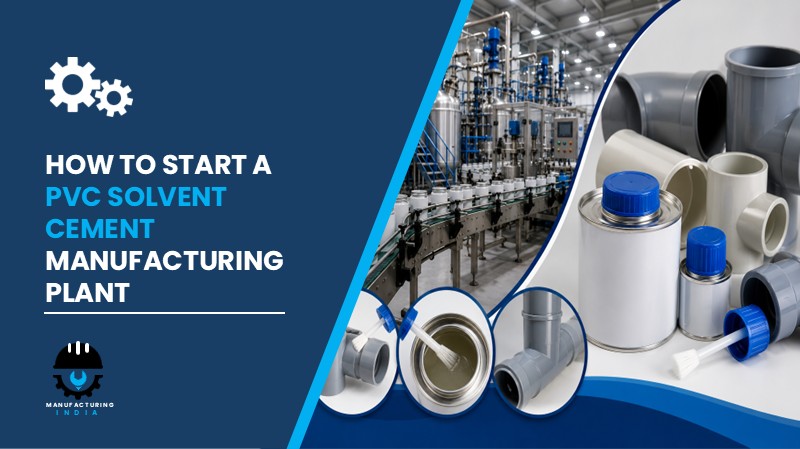
Setting up a PVC solvent cement manufacturing plant in India presents a compelling investment case, driven by surging demand across construction, plumbing, and electrical sectors. As urbanisation accelerates and infrastructure spending intensifies, PVC solvent cement has become an indispensable bonding adhesive for water supply systems, drainage networks, and electrical conduit installations. The product plays a critical role in India’s housing, industrial piping, and irrigation ecosystems – all of which are expanding at a pace that justifies new domestic production capacity.
India’s structural advantages make it one of the most strategically sound locations for this investment. Rapid urbanisation, the government’s push under the Make in India initiative, and the country’s established chemical manufacturing corridors in Gujarat and Maharashtra create a ready-made environment for PVC solvent cement production. The residential construction industry, which grew at 6.8% during FY2024-25 and is poised to reach USD 350 billion by 2030, provides a sustained long-term demand pipeline that investors can reliably plan around.
PVC solvent cement manufacturing in India combines policy-backed infrastructure growth, cost-competitive production, and robust demand from construction, plumbing, and irrigation sectors. With gross profit margins ranging between 30-45% and a well-defined manufacturing process, this investment offers strong financial viability and credible break-even potential for investors across plant capacities.
What is PVC Solvent Cement?
PVC solvent cement is a bonding adhesive used to join PVC (polyvinyl chloride) pipes and fittings. It is composed of a blend of solvents, resins, and stabilisers that dissolve the surfaces of PVC to create a strong, durable bond. The product’s defining properties – chemical resistance, bond strength, and compatibility with standard PVC substrates – make it irreplaceable in high-stakes applications where leak-proof connections are essential.
The primary production method is solvent blending, polymerisation, and quality control procedures, a multi-step process that involves precise formulation of raw materials, controlled reaction environments, and rigorous testing before dispatch. The end-use industries served by PVC solvent cement include construction, plumbing, electrical, and industrial piping sectors – all of which register consistent demand in India’s growing economy. The PVC solvent cement segment is projected to account for 50.5% of the solvent cement market share in 2025, reflecting its dominance within the broader adhesive and sealant category.
Cost of Setting Up a PVC Solvent Cement Manufacturing Plant in India
The total cost of establishing a PVC solvent cement manufacturing plant in India depends on capacity, technology selection, geographic location, level of automation, and regulatory compliance requirements. Investors must plan for both one-time capital expenditure and recurring operational costs across a multi-year horizon.
1. Capital Expenditure (CapEx)
The capital investment required to set up this facility covers several major heads. Land and site development costs – including land registration charges, boundary development, and site preparation – form a substantial portion of the total CapEx and must be budgeted early in the project planning cycle. Investors may consider locating the plant within a Special Economic Zone (SEZ) or a designated industrial estate to benefit from infrastructure availability and potential tax concessions.
Civil works and construction costs cover the manufacturing shed, quality control laboratory, raw material storage area, finished goods warehouse, and administrative block. These costs vary by state and construction methodology but are a non-negotiable element of the overall capital plan.
Machinery and equipment represent the largest single component of total capital expenditure. Key machinery required for a PVC solvent cement manufacturing plant includes:
- High-speed mixers
- Dissolvers
- Reaction vessels
- Filtration systems
- Automated filling machines
- Capping stations
- Labelling systems
- Quality control testing apparatus
Other capital costs include effluent treatment plant (ETP) installation, pre-operative expenses, commissioning charges, and any applicable import duties on specialised equipment sourced internationally.
Request a Sample Report for In-Depth Market Insights: https://www.imarcgroup.com/pvc-solvent-cement-manufacturing-plant-project-report/requestsample
2. Operational Expenditure (OpEx)
The operating cost structure of a PVC solvent cement manufacturing plant is primarily driven by raw material consumption. Raw materials – PVC resin, tetrahydrofuran (THF)/cyclohexanone, and acetone – collectively account for approximately 70-80% of total operating expenses. Establishing long-term supply contracts with reliable domestic and international vendors is a recommended strategy to stabilise procurement costs and reduce exposure to price volatility.
Utility costs, covering electricity, water, and steam required for production and facility operations, account for approximately 5% of total OpEx. Other operating costs include transportation and logistics, packaging materials, salaries and wages, maintenance and repairs, depreciation on fixed assets, and applicable taxes. By the fifth year of operations, total operational costs are expected to increase substantially due to inflation, market fluctuations, and potential rises in the cost of key raw materials. Supply chain disruptions, rising consumer demand, and shifts in the global economy are additional factors expected to contribute to this increase.
3. Plant Capacity
The proposed manufacturing facility is designed with an annual production capacity of 5,000 MT, enabling economies of scale while maintaining operational flexibility. This capacity can be customised based on individual investor requirements, market demand projections, and site constraints. Profitability improves meaningfully with higher capacity utilisation, making it essential for investors to target efficient ramp-up during the first two to three years of commercial production.
4. Profit Margins and Financial Projections
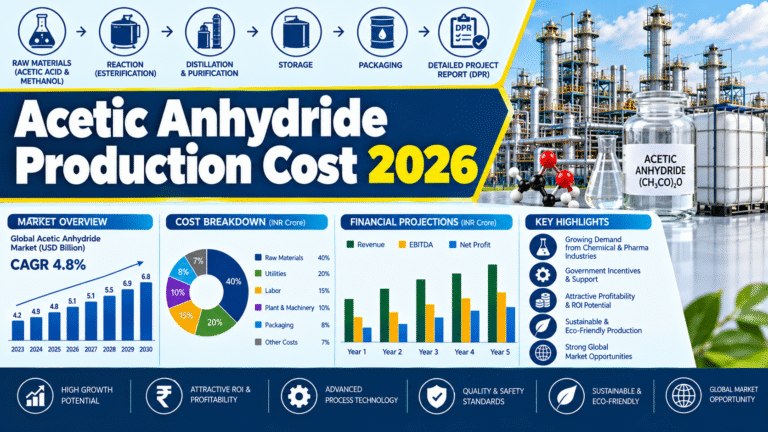
The PVC solvent cement manufacturing project demonstrates healthy profitability potential under normal operating conditions. Gross profit margins typically range between 30-45%, supported by stable demand and value-added applications. Net profit margins range between 15-25%, reflecting the cost efficiency achievable through optimised raw material procurement and operational management. The financial projections – covering NPV, IRR, payback period, and detailed income and expenditure analysis – are developed based on realistic assumptions related to capital investment, production capacity utilisation, pricing trends, and demand outlook, providing a comprehensive view of the project’s long-term financial viability.
Why Set Up a PVC Solvent Cement Plant in India?
High Demand in Construction and Plumbing: PVC solvent cement is crucial for bonding PVC pipes and fittings used in plumbing, drainage systems, and electrical conduits, which are experiencing growing demand in India’s rapidly expanding built environment. The product’s essentiality across residential, commercial, and industrial construction makes demand resilient across economic cycles.
Alignment with Infrastructure Growth: Ongoing urbanisation and the construction boom across the Asia-Pacific region are propelling demand for PVC cement, with governments and private players investing heavily in water infrastructure and electrical systems. India sits at the centre of this regional growth wave, making domestic manufacturing strategically well-positioned.
Rising DIY and Irrigation Trends: The increasing popularity of DIY plumbing and home improvement projects in emerging markets is further boosting demand for ready-to-use PVC solvent cement. Additionally, growing agricultural and landscaping irrigation networks are driving consumption of PVC pipes – and therefore the adhesives that join them – across rural and semi-urban India.
Policy and Regulatory Tailwinds: India’s Make in India initiative provides structural encouragement for chemical and materials manufacturing within the country. Industrial estates and SEZs across Gujarat, Maharashtra, and other manufacturing-heavy states offer ready infrastructure, reducing greenfield setup timelines and costs for new investors.
Cost-Competitive Manufacturing: India offers significant cost advantages in land acquisition, construction, and labour relative to developed markets. A local supply chain for some raw materials, combined with proximity to large end-use markets, further enhances the cost competitiveness of Indian production facilities.
Active Industry Investment: In May 2024, Weld-On – one of the leading global PVC solvent cement manufacturers – announced the acquisition of E-Z Weld, a producer of solvent cements, primers, and cleaners that exports to over 50 countries across Latin America, the Caribbean, the Middle East, Africa, Asia, and European markets. This consolidation signals strong global industry confidence and growing international demand for PVC bonding solutions.
Manufacturing Process – Step by Step
The PVC solvent cement manufacturing process uses solvent blending, polymerisation, and quality control procedures as the primary production method. The process is a multi-step operation involving several unit operations, material handling, and quality checks.
- Raw Material Receipt and Inspection: PVC resin, tetrahydrofuran (THF)/cyclohexanone, and acetone are received, inspected for quality, and transferred to designated storage areas.
- Solvent Blending: Solvents are combined in dissolvers and reaction vessels in precise formulations to achieve the required viscosity and chemical composition.
- High-Speed Mixing: High-speed mixers are used to homogenise the blend, ensuring consistent dispersion of resins and stabilisers throughout the mixture.
- Filtration: Filtration systems remove any undissolved particles or contaminants from the batch, ensuring product purity and consistency.
- Quality Control Testing: Analytical instruments monitor product concentration, purity, and stability. Technical tests and quality assurance criteria are applied at this stage to ensure compliance with specifications.
- Automated Filling and Capping: The finished PVC solvent cement is transferred to automated filling machines, followed by capping stations to seal containers securely.
- Labelling and Packaging: Labelling systems apply product information, and finished goods are packaged and prepared for dispatch to construction, plumbing, electrical, and industrial piping sectors.
Key Applications
PVC solvent cement serves a broad range of industries, all of which are actively growing in India’s development-driven economy.
- Plumbing and Piping Systems: Joining PVC pipes and fittings for water supply, drainage, and sewage systems in residential and commercial buildings.
- Construction and Infrastructure: Bonding PVC conduits, profiles, and fittings used in residential, commercial, and industrial construction projects.
- Irrigation Systems: Securely joining PVC pipes for agricultural and landscaping irrigation networks across India’s farming sector.
- Industrial Applications: Assembling PVC piping used in chemical handling, ventilation, and industrial process systems.
Leading Manufacturers
The global PVC solvent cement industry is served by a number of established multinational players with extensive production capacities and diverse application portfolios. Key players in this industry include:
- Henkel AG & Co.
- Sika AG
- Oatey Co.
- Weld-On
- Christy’s
These manufacturers serve end-use sectors such as construction, plumbing, electrical, and industrial piping on a global scale, and their expansion activities underscore the long-term commercial attractiveness of this product category.
Timeline to Start the Plant
The following phases outline the typical timeline for establishing a PVC solvent cement manufacturing unit in India:
- Feasibility study and project report preparation
- Land acquisition and site development
- Regulatory approvals and environmental clearances
- Factory licence and fire safety compliance
- Machinery procurement and installation
- Raw material supplier agreements and supply chain setup
- Trial production and quality testing
- Commercial production launch
Licences and Regulatory Requirements
Starting a PVC solvent cement manufacturing unit in India requires several approvals:
- Business registration (Proprietorship, LLP, or Pvt Ltd)
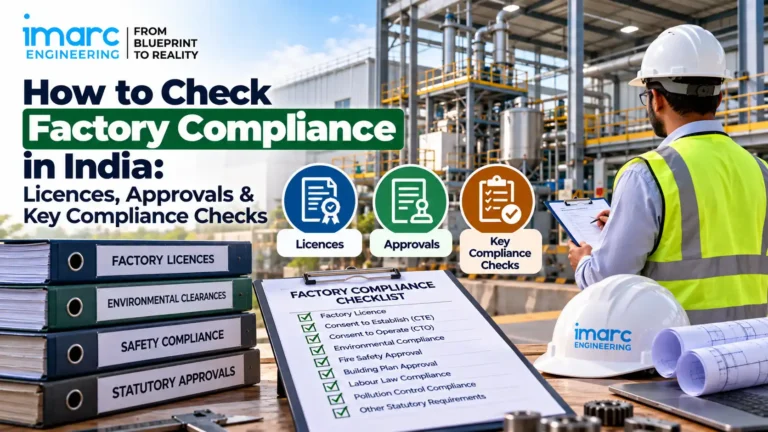
- Factory Licence under the Factories Act
- Environmental Clearance from the State Pollution Control Board
- GST Registration
- Fire Safety NOC
- Hazardous and chemical storage compliance (applicable given the use of THF/cyclohexanone and acetone)
- Effluent Treatment Plant (ETP) operational clearance
- Occupational Health and Safety compliance
Key Challenges to Consider
High Capital Requirements: Establishing a PVC solvent cement manufacturing plant involves significant upfront investment across land, civil works, and specialised machinery including high-speed mixers, reaction vessels, and automated filling systems.
Raw Material Price Volatility: The cost of PVC resin, tetrahydrofuran (THF)/cyclohexanone, and acetone – which collectively account for 70-80% of total OpEx – is subject to global commodity price movements, creating margin risk that must be managed through long-term supplier contracts.
Regulatory Compliance: The use of volatile solvents such as THF, cyclohexanone, and acetone requires strict adherence to chemical storage, handling, and emission standards set by India’s State Pollution Control Boards, adding operational complexity.
Technology and Innovation Pressure: Maintaining competitive product quality and process efficiency requires continuous investment in equipment upgrades and quality control systems to meet evolving industry standards.
Competition from Global Players: Established manufacturers such as Henkel AG & Co., Sika AG, Oatey Co., Weld-On, and Christy’s operate at scale and maintain strong brand recognition, requiring new entrants to differentiate on price, service, or regional proximity.
Skilled Manpower: Operating chemical blending and quality control equipment demands technically trained personnel, and attracting and retaining qualified staff can be a challenge in smaller industrial locations.
Frequently Asked Questions
1. How much does it cost to set up a PVC solvent cement manufacturing plant in India?
The total setup cost varies based on plant capacity, location, automation level, and technology. The cost covers land acquisition, civil construction, machinery such as high-speed mixers and reaction vessels, and pre-operative expenses. Detailed CapEx figures are available in the full project report from IMARC Group.
2. Is PVC solvent cement manufacturing profitable in India in 2026?
Yes. The project demonstrates gross profit margins of 30-45% and net profit margins of 15-25% under normal operating conditions, supported by sustained construction and infrastructure demand.
3. What machinery is required for a PVC solvent cement plant in India?
Key equipment includes high-speed mixers, dissolvers, reaction vessels, filtration systems, automated filling machines, capping stations, labelling systems, and quality control testing apparatus.
4. What licences and approvals are required to start a PVC solvent cement plant in India?
Required approvals include business registration, Factory Licence, Environmental Clearance, GST Registration, Fire Safety NOC, chemical compliance certification, ETP clearance, and Occupational Health and Safety compliance.
5. What raw materials are needed for PVC solvent cement manufacturing?
The primary raw materials are PVC resin, tetrahydrofuran (THF)/cyclohexanone, and acetone. These together account for 70-80% of total operating expenses.
6. What are the environmental compliance requirements for a PVC solvent cement plant in India?
Plants must install and operate an Effluent Treatment Plant, comply with emission standards for volatile solvents, obtain clearance from the State Pollution Control Board, and maintain advanced monitoring systems to detect leaks or process deviations.
7. What is the best location to set up a PVC solvent cement plant in India?
Optimal locations offer proximity to raw material suppliers, reliable infrastructure, transportation access, and compliance with local zoning regulations. Industrial estates and SEZs in Gujarat and Maharashtra are well-suited for this type of chemical manufacturing facility.
8. What is the break-even period for this type of plant in India?
The break-even period depends on capacity utilisation, pricing strategy, and operational efficiency. Detailed payback period and NPV analysis are included in the full feasibility report. Higher capacity utilisation accelerates break-even.
9. What government incentives are available for manufacturers in India?
India offers a range of incentives under the Make in India initiative, including SEZ benefits, state industrial policy subsidies, capital subsidy schemes, and export promotion programmes applicable to chemical manufacturing units.
Key Takeaways for Investors
PVC solvent cement manufacturing in India presents a well-rounded investment opportunity, underpinned by structurally growing demand from construction, plumbing, irrigation, and industrial piping sectors. The project is financially viable across a range of plant capacities, with gross profit margins of 30-45% and net margins of 15-25% offering meaningful returns on capital deployed. The residential construction industry’s growth trajectory toward USD 350 billion by 2030, combined with the PVC solvent cement segment’s projected 50.5% share of the solvent cement market in 2025, confirms the depth and durability of addressable demand. For investors willing to navigate the regulatory and raw material management complexities, this manufacturing unit offers a credible path to long-term profitability in one of Asia’s most dynamic industrial markets.
About the Author