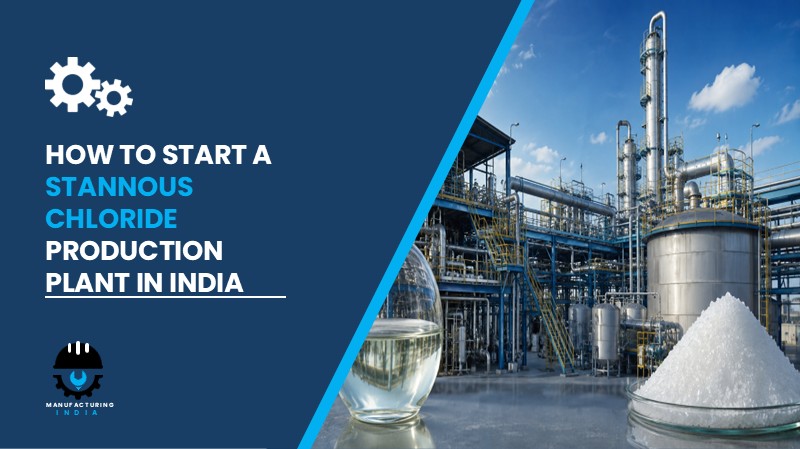
Setting up a stannous chloride production plant in India presents a compelling investment case at a time when the country’s construction sector is booming, its PVC and plastics industry is expanding at pace, its electronics and surface treatment manufacturing base is deepening under the PLI scheme, and its specialty chemical and pharmaceutical sectors are collectively generating growing demand for one of the most functionally versatile inorganic tin compounds in the industrial chemicals market. Stannous chloride (SnCl₂) — the white crystalline tin(II) chloride compound produced through the controlled reaction of metallic tin with hydrochloric acid — serves simultaneously as a reducing agent in chemical synthesis, a sensitiser in electroplating and metallisation processes, a stabiliser in PVC production, a catalyst in pharmaceutical and organic chemistry applications, and a reagent in textile dyeing and mirror silvering — a multi-sector utility that ensures stable, diversified, and recurring demand across India’s most rapidly growing industrial segments. As India’s construction-driven PVC consumption grows, its electronics manufacturing expands, and its specialty chemical exports deepen, the domestic requirement for domestically produced, high-purity stannous chloride is building into a commercially significant investment opportunity with an extraordinary market growth trajectory.
India’s structural positioning for stannous chloride production is strongly supported by both market fundamentals and policy momentum. India’s construction sector is projected to grow by 8.1% in real terms in 2025 and 6.4% in 2026, driven by rising investments in infrastructure development and large-scale energy projects — growth that directly increases PVC pipe, cable insulation, and polymer profile consumption and by extension, demand for PVC stabilisers including stannous chloride. India’s tin processing and inorganic chemicals manufacturing base in Gujarat and Maharashtra provides the supply chain access to tin metal and hydrochloric acid that a stannous chloride plant requires. The Make in India initiative actively supports specialty chemical manufacturing with policy incentives, while specialty chemical industrial estates in Ankleshwar, Dahej, and Hyderabad offer the corrosion-resistant reactor infrastructure, chemical handling expertise, and regulatory frameworks that a tin chloride production facility needs to operate safely and at commercial scale.
Investing in a stannous chloride production plant in India today aligns India’s booming construction and PVC industry, expanding electronics manufacturing, and growing specialty chemicals sector with a global stannous chloride market growing from USD 6.69 Billion in 2025 to USD 25.28 Billion by 2034 at an exceptional CAGR of 15.9%. With gross profit margins of 35–45% and net profit margins of 18–25% at annual production capacities of 1,000–5,000 MT, the unit economics are commercially strong and the investment’s diversified multi-sector application base supports long-term revenue resilience across India’s industrial growth cycle.
What is Stannous Chloride?
Stannous chloride (SnCl₂) is an inorganic tin compound that exists in two forms: a white crystalline solid and an aqueous solution. The manufacturing process requires the combination of metallic tin with hydrochloric acid while maintaining specific temperature and concentration levels. The process starts with filtration which removes impurities from the reaction mixture, followed by concentration to obtain desired results through crystallisation and drying processes.
Stannous chloride functions mainly as a reducing agent which people use in electroplating and metallisation processes because it works as a sensitiser — activating non-conductive substrate surfaces to accept subsequent metal deposition in printed circuit board manufacturing and decorative plating operations. The substance serves important functions in three additional areas: textile dyeing where it acts as a mordant and reducing agent, mirror silvering where it sensitises glass surfaces before silver deposition, and polymer stabilisation where it improves the thermal stability and processing performance of PVC compounds. The substance acts as a catalyst and intermediate for different organic reactions in both pharmaceutical and chemical production fields. Stannous chloride functions as a crucial compound which various industries use for multiple purposes because of its high reactivity and ability to adapt to different manufacturing processes.
The primary production process covers reaction of metallic tin with hydrochloric acid, solution purification, filtration, evaporation or concentration, crystallisation, drying, quality testing, and packaging. End-use industries served include pharmaceuticals, specialty chemicals, plastics and polymers, textiles, electronics, and electroplating. Applications span use as a reducing agent, catalyst, PVC stabiliser, electroplating sensitiser, and reagent in chemical synthesis across India’s diverse industrial customer base.
Cost of Setting Up a Stannous Chloride Production Plant in India
The cost of establishing a stannous chloride production plant in India depends on production capacity, target product grade between crystalline solid and aqueous solution forms, process technology selection, geographic location — particularly proximity to tin metal and hydrochloric acid supply chains — degree of automation, and the chemical safety and quality compliance requirements applicable to stannous chloride supplied to PVC, electroplating, pharmaceutical, and specialty chemical customers.
1. Capital Expenditure (CapEx)
Land and Site Development forms a foundational component of total capital investment, covering land acquisition charges, site registration, boundary development, acid-resistant drainage and chemical containment infrastructure, and site utilities. Investors may explore specialty chemicals industrial estates in Gujarat’s Ankleshwar and Dahej petrochemical corridors, Maharashtra’s Raigad district, or Telangana’s Hyderabad Pharma City — locations where corrosion-resistant chemical plant infrastructure, hydrochloric acid supply chain proximity, regulatory expertise, and established specialty chemical customer networks provide the most commercially advantaged operating environment for a new stannous chloride producer.
Civil Works and Construction cover the main production building housing corrosion-resistant reactor systems fabricated from acid-resistant materials compatible with hydrochloric acid and tin chloride chemistry, filtration and washing stations, evaporation and concentration equipment, crystallisation vessels, drying areas, a quality control laboratory equipped for purity analysis, tin content determination, and trace metal measurement, finished goods storage with humidity control for crystalline product, an administrative block, and utilities infrastructure including steam for evaporation and heating operations.
Machinery and Equipment represent the largest single component of total CapEx for a stannous chloride production plant. Key machinery required includes:
- Corrosion-resistant reactors
- Filtration units
- Evaporators
- Crystallisers
- Dryers
- Storage tanks
- Packaging systems
Other Capital Costs include an effluent treatment plant (ETP) for managing hydrochloric acid-containing and tin-bearing process effluents, fume scrubbing systems for hydrogen chloride gas emissions during the tin dissolution reaction, tin recovery from process effluents to minimise material loss given tin metal’s significant unit cost, pre-operative expenses, commissioning charges, and import duties on specialised crystallisation equipment or analytical instruments not available domestically at the required specification level.
Request a Sample Report for In-Depth Market Insights: https://www.imarcgroup.com/stannous-chloride-production-cost-analysis-report/requestsample
2. Operational Expenditure (OpEx)
Raw Material Cost is the overwhelmingly dominant operational expense, accounting for approximately 75–85% of total OpEx. The primary raw materials are tin metal and hydrochloric acid. Tin metal — as the metallic feedstock consumed in stoichiometric quantities and converted to stannous chloride — drives the vast majority of raw material cost and is a globally traded commodity whose pricing is determined by LME tin markets and the dynamics of primary tin mining from Malaysia, Indonesia, Bolivia, and other producing nations. Ongoing fluctuations in global tin prices continue to influence production economics and investment decisions in the stannous chloride market, making tin metal procurement strategy and price risk management the most critical operational priority. Well-established global tin production networks ensure consistent raw material availability, though pricing volatility must be managed through forward contracts or supplier pricing agreements. Hydrochloric acid is the secondary input, widely available domestically from chloralkali producers. Long-term procurement contracts for both inputs are essential for production cost stability.
Utility Cost is the second-largest OpEx component, representing 10–15% of total operating expenses, covering electricity and steam for reactor operations, evaporation and concentration units, drying equipment, and general plant services. Steam consumption for evaporation and drying stages constitutes the primary utility cost, and optimising the heat integration between reactor heat recovery and evaporation heating requirements is an important lever for managing the utility cost position.
Other Operating Costs include transportation and distribution to PVC compound manufacturers, electroplating and surface treatment processors, specialty chemical producers, pharmaceutical API manufacturers, and textile dyeing operations, moisture-resistant packaging materials for crystalline stannous chloride, salaries and wages for inorganic chemists and quality control analysts, routine machinery maintenance including reactor lining inspection and crystalliser cleaning, depreciation on production equipment, and applicable taxes. By the fifth year of operations, total operational costs are projected to increase substantially due to inflation, tin metal price movements, hydrochloric acid cost changes, supply chain disruptions, rising consumer demand, and shifts in the global economy.
3. Plant Capacity
The proposed production facility for stannous chloride is designed with an annual production capacity ranging between 1,000 and 5,000 metric tonnes, enabling economies of scale while maintaining operational flexibility to serve a diversified customer base across PVC stabilisation, electroplating, specialty chemical synthesis, pharmaceutical, and textile dyeing applications. Plant capacity can be customised per investor requirements and phased in line with secured customer purchase agreements across the multiple end-use segments. Profitability improves with higher capacity utilisation, making established customer relationships with PVC compound manufacturers, printed circuit board plating operations, and specialty chemical producers across India’s industrial heartland a strategic commercial foundation for the investment.
4. Profit Margins and Financial Projections
The financial projections for a stannous chloride production plant demonstrate healthy profitability potential under normal operating conditions. Gross profit margins typically range between 35–45%, supported by stable multi-sector demand and the value-added chemical conversion from tin metal feedstock to a precisely characterised, application-specific inorganic compound serving diverse industrial customers. Net profit margins are projected at 18–25%. A comprehensive financial analysis covering NPV (net present value), IRR (internal rate of return), payback period, gross margin progression, and net margin development across a five-year horizon is essential before committing capital. The project’s ROI profile and long-term sustainability are assessed against realistic assumptions on capital investment, production capacity utilisation, tin metal pricing trends, and demand outlook from the pharmaceuticals, specialty chemicals, plastics and polymers, textiles, electronics, and electroplating end-use sectors.
Why Set Up a Stannous Chloride Production Plant in India?
Expanding PVC and Polymer Demand from India’s Construction Boom. Rising construction and packaging activities boost PVC stabiliser consumption globally. India’s construction sector is projected to grow by 8.1% in real terms in 2025 and 6.4% in 2026, driven by rising investments in infrastructure development and large-scale energy projects — a construction expansion that increases demand for PVC pipes, window profiles, cable insulation, and architectural products that all require tin-based and other stabilisers including stannous chloride for thermal stabilisation during PVC processing. This direct, construction-driven demand driver provides one of the most reliable and measurable demand anchors available to a stannous chloride producer in India.
Strong Demand from Surface Treatment and Electronics Manufacturing. Electroplating and metallisation industries depend on stannous chloride sensitising properties for activating substrate surfaces before metal deposition in printed circuit board manufacturing, decorative plating, and functional surface treatment operations. Growth in electronics manufacturing and metal finishing activities is further contributing to stannous chloride market expansion. India’s expanding electronics manufacturing base under the PLI scheme — producing smartphones, consumer electronics, industrial electronics, and automotive electronics — is creating growing domestic demand for electroplating-grade stannous chloride as PCB manufacturing and component metallisation volumes increase.
Global Market Growth at 15.9% CAGR Creating Exceptional Investment Timing. The global stannous chloride market, valued at USD 6.69 Billion in 2025, is expected to reach USD 25.28 Billion by 2034 at a CAGR of 15.9% — a growth rate that places stannous chloride among the fastest-growing specialty inorganic chemicals categories globally. Expanding demand from PVC stabilisation, electroplating, and chemical synthesis industries is driving this trajectory, with India positioned to capture both growing domestic demand and export revenue as the country’s specialty chemical manufacturing competitiveness deepens.
Versatile Industrial Applications Providing Demand Diversification. Broad usage of stannous chloride across specialty chemicals, pharmaceuticals, textiles, and electronics ensures diversified and stable demand that insulates producers from single-sector cyclicality. An Indian stannous chloride producer serving PVC manufacturers in Gujarat, electroplating operations in Delhi-NCR, pharmaceutical manufacturers in Hyderabad, and specialty chemical producers in Maharashtra simultaneously builds a revenue base that is resilient across different industrial and economic cycles.
Active Global Investment Confirming Market Strength. In May 2025, T1N Mining established a partnership with MCC Shenkan — a subsidiary of China Minmetals — to develop the Oortsog Ovoo tin project in Mongolia, where metallurgical testwork results demonstrate an ability to recover high amounts of stannous chloride as a valuable tin chemical intermediate that can be sold directly or processed further into tin metal, increasing project value. In July 2023, Coachella received a USD 500,000 state grant to launch a Stannous Chloride Pilot Programme testing its effectiveness in reducing chromium-6 levels in drinking water — an emerging environmental remediation application that opens a new and publicly funded demand segment for stannous chloride beyond its established industrial uses.
Well-Established Global Tin Supply Chains Supporting Production Continuity. Well-established global tin production networks ensure consistent raw material availability for stannous chloride producers, with multiple producing nations providing supply diversification that reduces single-source dependency risk. India’s proximity to Southeast Asian tin producers — particularly Malaysian and Indonesian smelters — and established tin import logistics through major ports provide a reliable and cost-competitive tin metal supply channel for domestic stannous chloride production.
Production Process — Step by Step
The stannous chloride production process uses reaction of metallic tin with hydrochloric acid, solution purification, filtration, evaporation or concentration, crystallisation, drying, quality testing, and packaging as the primary production method. Each stage requires precisely controlled temperature, acid concentration, reaction completion, and crystallisation conditions to produce stannous chloride of the target purity, crystal form, moisture content, and trace metal profile required by PVC, electroplating, pharmaceutical, and specialty chemical customers.
- Tin Metal Receipt and Preparation: High-purity tin metal — refined ingots or granules of specified purity — is received from certified suppliers, quality-checked for tin content and trace metal impurities, and prepared in granulated or broken form to maximise surface area and reaction rate in the dissolution stage.
- Dissolution Reaction in Corrosion-Resistant Reactors: Prepared tin metal is charged into corrosion-resistant reactors and reacted with hydrochloric acid at controlled temperature and acid concentration. The exothermic dissolution reaction produces stannous chloride in aqueous solution and hydrogen gas as a by-product, with continuous temperature management and hydrogen ventilation through fume scrubbing systems required for safe operation throughout the reaction.
- Reaction Completion and Control: Acid concentration, temperature, and tin metal charge ratio are carefully managed throughout the reaction to achieve complete tin dissolution while maintaining the Sn²⁺ reducing environment that prevents oxidation to SnCl₄ (stannic chloride) — an unwanted by-product that would reduce product purity and yield.
- Solution Purification: The crude stannous chloride solution undergoes purification processing — including addition of tin metal excess to maintain reducing conditions, filtration to remove insoluble tin compounds and impurities — to produce a clarified, high-purity SnCl₂ solution suitable for downstream concentration and crystallisation.
- Filtration: Purified stannous chloride solution is processed through filtration units to remove any remaining particulate impurities, producing a clear solution of the target SnCl₂ concentration ready for evaporation and concentration.
- Evaporation and Concentration: Filtered solution is processed through evaporators under controlled temperature and vacuum conditions to concentrate the stannous chloride solution to the supersaturation level required for controlled crystallisation, with care taken to prevent oxidation of Sn²⁺ to Sn⁴⁺ during heating through maintenance of hydrochloric acid excess and inert atmosphere.
- Crystallisation: Concentrated stannous chloride solution is processed through crystallisers under controlled cooling and seeding conditions to produce SnCl₂·2H₂O dihydrate or anhydrous SnCl₂ crystals of the specified morphology, size distribution, and crystal purity required for the target product grade — dihydrate for most industrial applications, anhydrous for demanding electroplating and pharmaceutical applications.
- Drying: Crystallised stannous chloride is processed through dryers under controlled temperature and atmosphere conditions to achieve the target moisture content — removing free surface moisture while maintaining the specified crystal hydration state and preventing partial oxidation to insoluble stannic compounds.
- Quality Testing: Finished stannous chloride undergoes comprehensive quality testing covering tin(II) content by titrimetric analysis, total tin assay, trace metal content by ICP-OES, moisture content, colour, and solubility characteristics, verifying compliance with customer or standard product specifications before packaging.
- Packaging and Dispatch: Specification-compliant stannous chloride is packaged in moisture-resistant sealed bags or drums using packaging systems to prevent atmospheric oxidation and hydration during storage and transit, then dispatched to PVC compound manufacturers, electroplating and surface treatment processors, specialty chemical producers, pharmaceutical manufacturers, and textile dyeing operations.
Key Applications
Stannous chloride produced in India serves a commercially diverse and structurally stable range of industrial applications across multiple end-use sectors:
- Chemical Industry: Functions as a reducing agent and key intermediate in diverse chemical synthesis processes including organic reductions, dye chemistry, and specialty chemical manufacturing where its controlled Sn²⁺/Sn⁴⁺ redox chemistry enables selective transformations.
- Plastics and Polymer Industry: Acts as a PVC stabiliser, improving thermal stability and processing performance of PVC compounds by scavenging hydrogen chloride generated during PVC thermal degradation — a critical function that protects both product quality and processing equipment.
- Electroplating Sector: Serves as a sensitiser in printed circuit board manufacturing and decorative metallisation, enabling uniform metal deposition during subsequent electroless plating steps by activating substrate surfaces through Sn²⁺ adsorption.
- Pharmaceutical Industry: Utilised in select formulations, radiopharmaceutical labelling applications, and controlled laboratory research where stannous chloride’s reducing properties enable specific chemical transformations required in pharmaceutical synthesis.
Leading Producers
The global stannous chloride industry is served by a group of specialty inorganic chemistry companies with diverse production capabilities and application portfolios across PVC, electroplating, chemical synthesis, and pharmaceutical segments. Key players in the global market include:
- Mason Corporation
- Reaxis
- Showa Kako Corp.
- TIB Chemicals
- Yunnan Tin Company
- HaiDi Fine Chemicals
- Rugao Guangpu Chemical
Timeline to Start the Plant
Establishing a stannous chloride production plant in India involves a structured multi-phase development sequence. Investors should plan for the following phases:
- Feasibility study and project report preparation
- Land acquisition and site development
- Regulatory approvals and environmental clearances
- Factory licence and fire safety compliance
- Machinery procurement and installation
- Raw material supplier agreements and supply chain setup
- Trial production and quality testing
- Commercial production launch
Licences and Regulatory Requirements
Starting a stannous chloride production unit in India requires several approvals spanning business registration, chemical safety, environmental, and industrial compliance domains:
- Business registration (Proprietorship, LLP, or Pvt Ltd)
- Factory Licence under the Factories Act
- Environmental Clearance from the State Pollution Control Board
- GST Registration
- Fire Safety NOC
- Hazardous/Chemical compliance applicable to hydrochloric acid handling, hydrogen gas generation during tin dissolution, and tin compound toxicity management under the Manufacture, Storage and Import of Hazardous Chemical (MSIHC) Rules
- Effluent Treatment Plant (ETP) operational clearance with tin recovery capability to manage hydrochloric acid-containing and tin-bearing process effluents
- Occupational Health and Safety compliance including tin compound dust and hydrochloric acid fume exposure monitoring and control
Key Challenges to Consider
Tin Metal Price Volatility and LME Exposure. Tin metal accounts for approximately 75–85% of total OpEx — a raw material cost concentration among the highest in specialty inorganic chemical manufacturing — with pricing directly tied to LME tin futures that can move 20–30% or more annually based on global supply conditions, demand from solder and electronics, and production disruptions at major tin-producing nations. Managing this cost exposure requires forward purchasing contracts, customer contract price adjustment mechanisms linked to LME tin prices, and careful inventory positioning relative to tin price cycle expectations.
Sn²⁺ Oxidation Prevention Throughout Processing. Stannous chloride’s value derives from its tin(II) — divalent tin — content, which is susceptible to air oxidation to tin(IV) compounds including SnO₂ and SnCl₄ that are insoluble, non-reducing, and commercially worthless. Preventing Sn²⁺ oxidation throughout dissolution, concentration, crystallisation, drying, and storage requires maintaining reducing conditions through excess hydrochloric acid, nitrogen atmosphere, and minimising air exposure at every stage — adding process complexity and operational discipline requirements that distinguish stannous chloride manufacturing from simpler inorganic salt production.
Corrosion-Resistant Infrastructure Requirements. The production process involves concentrated hydrochloric acid and stannous chloride solution — both highly corrosive to common construction and equipment materials — requiring that all process contact surfaces, reactors, pipes, pumps, valves, and storage tanks be fabricated from appropriate corrosion-resistant materials including HDPE, glass-lined steel, rubber-lined steel, or titanium. This materials specification adds capital cost and procurement lead time compared to conventional chemical plant construction.
Hydrogen Gas Safety Management. The dissolution of tin metal in hydrochloric acid generates hydrogen gas as a by-product throughout the reaction stage — a flammable gas requiring continuous ventilation, hydrogen gas monitoring, explosion-proof electrical systems in the reactor area, and fume scrubbing to capture accompanying hydrochloric acid vapour. Managing this concurrent fire and acid hazard requires comprehensive process safety engineering and ongoing operational safety management.
Competition from Established Global Producers. The competitive landscape includes established producers including Yunnan Tin Company, TIB Chemicals, Showa Kako Corp., Reaxis, and Mason Corporation, alongside Chinese specialty chemical producers including HaiDi Fine Chemicals and Rugao Guangpu Chemical with significant scale and tin supply proximity advantages. New Indian producers must compete through domestic supply chain advantages, competitive pricing, product customisation, and the supply reliability advantages that proximity to India’s growing PVC, electronics, and specialty chemical manufacturing base provides over import-dependent competitors.
Quality Consistency Across Customer Application Specifications. Serving PVC stabiliser, electroplating, pharmaceutical, and specialty chemical customers simultaneously requires maintaining multiple product specifications — total tin content, Sn²⁺ purity, moisture, trace metal profile, crystal form, and particle size — that differ across application grades, demanding robust quality management systems, batch traceability, and flexible production protocols across the customer portfolio.
Frequently Asked Questions
1. How much does it cost to set up a stannous chloride production plant in India?
The total setup cost depends on production capacity, product grade specification, process technology configuration, location, and automation level. CapEx covers land and site development with acid-resistant chemical plant construction, core machinery including corrosion-resistant reactors, filtration units, evaporators, crystallisers, dryers, storage tanks, and packaging systems, along with ETP with tin recovery capability, fume scrubbing systems, and other capital costs. A detailed project report with full CapEx and OpEx breakdowns is available on request.
2. Is stannous chloride production profitable in India in 2026?
Yes. The project demonstrates gross profit margins of 35–45% and net profit margins of 18–25% under normal operating conditions, supported by stable multi-sector demand from PVC and polymer manufacturers, electroplating and electronics producers, specialty chemical companies, and pharmaceutical manufacturers. The global market’s exceptional 15.9% CAGR growth from USD 6.69 Billion in 2025 to USD 25.28 Billion by 2034 provides a robust long-term demand foundation alongside India’s construction-driven PVC consumption growth.
3. What machinery is required for a stannous chloride production plant in India?
Key machinery includes corrosion-resistant reactors, filtration units, evaporators, crystallisers, dryers, storage tanks, and packaging systems. All process equipment must be fabricated from corrosion-resistant materials compatible with hydrochloric acid and stannous chloride solution chemistry throughout the production flow.
4. What licences and approvals are required to start a stannous chloride production plant in India?
Required approvals include business registration, a Factory Licence under the Factories Act, Environmental Clearance from the State Pollution Control Board, GST registration, a Fire Safety NOC, MSIHC Rules compliance for hydrochloric acid and hydrogen gas handling, ETP operational clearance with tin recovery capability, and Occupational Health and Safety compliance.
5. What raw materials are needed for stannous chloride production?
The primary raw materials are tin metal and hydrochloric acid. Tin metal accounts for approximately 75–85% of total operating expenses, making tin procurement strategy, LME tin price risk management, and supplier relationship management with certified tin metal traders and refiners the most critical cost management levers for the investment.
6. What are the environmental compliance requirements for a stannous chloride production plant in India? The unit must obtain Environmental Clearance from the State Pollution Control Board, operate a certified ETP with tin recovery capability for hydrochloric acid-containing and tin-bearing process effluents, install hydrogen chloride fume scrubbing systems for reactor area emissions, implement hydrogen gas safety ventilation and monitoring in the reaction area, and maintain monitoring systems for wastewater discharge and air emissions in line with applicable state pollution control standards.
7. What is the best location to set up a stannous chloride production plant in India?
Optimal locations offer proximity to tin metal import logistics hubs or domestic tin traders, hydrochloric acid supply from chloralkali producers, established specialty chemical infrastructure, and access to PVC, electronics, and pharmaceutical customer clusters. Specialty chemical industrial estates in Gujarat’s Ankleshwar and Dahej zones, Maharashtra’s Raigad district, and Telangana’s Hyderabad Pharma City are among the most strategically relevant options.
8. What is the break-even period for this type of plant in India?
The break-even period depends on production capacity, capacity utilisation rate, tin metal pricing trends, and demand conditions across PVC, electroplating, specialty chemical, and pharmaceutical customer segments. A detailed financial analysis including payback period, NPV, and IRR projections is included in the full project report, available via the sample request link.
9. What government incentives are available for manufacturers in India?
The Make in India initiative, PLI schemes for specialty chemicals and electronics manufacturing, and state-level chemical industry promotion policies in Gujarat, Maharashtra, and Telangana provide financial and regulatory support for stannous chloride production investments. Capital subsidies, power tariff concessions, and export promotion benefits under specialty inorganic chemicals categories may be applicable depending on the chosen plant location and production profile.
Key Takeaways for Investors
A stannous chloride production plant in India represents a commercially compelling investment in a specialty inorganic compound positioned at the intersection of India’s most robustly growing industrial sectors — construction-driven PVC consumption, electronics manufacturing expansion, specialty chemical deepening, and pharmaceutical growth — that collectively constitute one of the most commercially stable and structurally supported demand environments available to any inorganic chemical producer in the Indian market. The project demonstrates strong financial viability across annual production capacities of 1,000 to 5,000 MT, with gross profit margins of 35–45% and net profit margins of 18–25% confirming attractive unit economics driven by the meaningful value-added chemical conversion of tin metal into a versatile, multi-application industrial compound. The global stannous chloride market, valued at USD 6.69 Billion in 2025, is projected to reach USD 25.28 Billion by 2034, growing at a CAGR of 15.9% — placing stannous chloride among the fastest-growing specialty inorganic chemicals categories globally — with India’s own construction sector growth of 8.1% in 2025 and electronics PLI expansion creating a directly quantifiable domestic demand pull. With T1N Mining’s May 2025 partnership for stannous chloride recovery from tin project metallurgy signalling the compound’s growing recognition as a direct commercial product alongside tin metal, and the July 2023 Coachella chromium-6 remediation pilot demonstrating its emerging environmental applications, demand sustainability for India-based stannous chloride production is structurally robust, multi-sector diversified, and commercially compelling across the full investment horizon.
About the Author