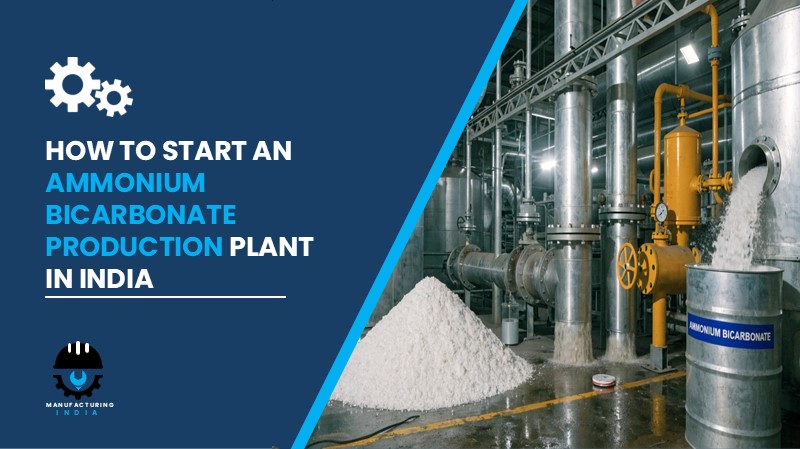
Setting up an ammonium bicarbonate production plant in India presents a compelling investment case driven by rising demand from food processing and bakery ingredients, chemicals and industrial processing, agriculture and fertilizer intermediaries, fire safety formulations, and carbon capture utilization (CCU) projects. As one of the most versatile specialty chemicals in active use, ammonium bicarbonate serves as a critical leavening agent for low-moisture baked goods and a key industrial input across several high-growth sectors. With India’s food processing industry expanding rapidly and its chemical sector recording sustained output growth, this is precisely the kind of product whose domestic production can replace costly imports and address deep-rooted supply chain dependencies.
India’s structural advantages — including lower land and labour costs, an expanding industrial estate ecosystem across states such as Gujarat and Maharashtra, and a government actively promoting domestic chemical production under the Make in India initiative — make it a strategically sound location for this production. The country’s strong base of ammonia and CO₂ sources, combined with its growing food manufacturing and agricultural sectors, positions it as an ideal hub for scaling ammonium bicarbonate production capacity. Investors setting up a unit in India can benefit from proximity to large end-use markets, cost-competitive operations, and an increasingly supportive regulatory environment for specialty chemical producers.
India’s ammonium bicarbonate production sector sits at the intersection of food-grade chemistry, industrial processing, and emerging carbon utilization pathways — offering policy-backed, cost-competitive operations with gross profit margins of 25–35%, net margins of 10–20%, and strong demand sustainability across bakery, chemicals, agriculture, fire safety, and CCU industries, making it a high-viability investment with a break-even horizon of 3 to 6 years.
What is Ammonium Bicarbonate?
Ammonium bicarbonate (NH₄HCO₃) is a white, crystalline powder that decomposes on heating to release ammonia, carbon dioxide, and water. It is widely valued as a chemical leavening agent in specific baked products and plays a meaningful role as an industrial input in several downstream chemical processes. In food applications, it is particularly suited for low-moisture baked goods such as crackers and dry cookies, where residual odor is minimized due to the complete volatilization of its decomposition products during baking, leaving no residual salts in the finished product.
The production process is built on widely available feedstocks — ammonia, water, and carbon dioxide — through a carbonation reaction that produces ammonium bicarbonate crystals, which are then recovered, dewatered, and dried. The process involves standard unit operations: carbonation reaction, precipitation and crystallization, solid-liquid separation, drying and sizing, and blending. Manufacturers can differentiate through tight control of moisture, particle size, purity, and packaging, supporting both food-grade and industrial-grade product portfolios.
The product serves a broad range of end-use industries, including food processing and bakery ingredients, chemicals and industrial processing, agriculture and fertilizer intermediaries, fire safety and specialty formulations, and CCU and industrial emissions utilization projects.
Cost of Setting Up an Ammonium Bicarbonate Production Plant in India
The total cost of establishing an ammonium bicarbonate production plant in India depends on several interconnected variables: production capacity, technology selection, geographic location, degree of automation, and applicable regulatory compliance requirements. Investors should evaluate both capital and operating expenditure in detail before committing resources.
1. Capital Expenditure (CapEx)
Land and Site Development represents one of the more substantial initial outlays. Investors can reduce upfront land costs and avail infrastructure benefits by locating within notified Special Economic Zones (SEZs) or state-designated industrial estates in chemical manufacturing corridors. Costs include land registration, boundary development, and all related site preparation charges.
Civil Works and Construction cover the construction of production sheds, laboratory facilities, raw material and finished goods storage areas, and administrative blocks. The civil layout must account for safety buffers appropriate to ammonia handling and must designate separate zones for production, quality control, and dispatch.
Machinery and Equipment account for the largest share of total CapEx. Key machinery required for an ammonium bicarbonate production plant includes:
- Carbonization columns
- Absorber reactor systems
- Crystallizers
- Filtration units
- Dryers
- Blenders and mixers
- Screening units
- Carbon dioxide compressors
- Ammonia synthesis units
- Cooling systems
- Storage tanks for raw materials and finished products
- Pumps, valves, and piping systems
- Quality control laboratory instruments
- Energy supply systems
Other Capital Costs include effluent treatment plant (ETP) installation, pre-operative expenses such as feasibility studies and project report preparation, commissioning costs, and any applicable import duties on specialized machinery not available domestically.
Request a Sample Report for In-Depth Market Insights: https://www.imarcgroup.com/ammonium-bicarbonate-manufacturing-plant-project-report/requestsample
2. Operational Expenditure (OpEx)
Raw Material Cost is the dominant operating cost driver for this production unit. The three primary raw materials — ammonia, carbon dioxide, and water — must be sourced reliably and at competitive prices. Ammonia alone accounts for approximately 60–70% of total OpEx, making supplier contract strategy and procurement planning critical levers for profitability. Long-term contracts with established suppliers are recommended to mitigate price volatility and ensure uninterrupted production.
Utility Cost — covering electricity, water, and steam — accounts for a further 20–25% of total OpEx. Reliable grid connectivity or captive power arrangements are advisable given the energy intensity of drying and compression operations.
Other Operating Costs include transportation and logistics, moisture-protective packaging materials, salaries and wages for plant personnel, routine maintenance, depreciation on capital assets, and applicable taxes. By the fifth year of operations, total operational costs are projected to increase substantially due to factors such as inflation, market fluctuations, potential rises in the cost of key materials, supply chain disruptions, and shifts in global demand dynamics.
3. Plant Capacity
The production facility is designed with an annual capacity ranging between 10,000 and 50,000 metric tonnes, enabling economies of scale while retaining operational flexibility for different investor profiles. Capacity can be customized to suit specific investor requirements, project phasing strategies, and target market size. As a general principle, profitability improves meaningfully with higher capacity utilization, making a phased ramp-up to full capacity a financially sound approach for new entrants.
4. Profit Margins and Financial Projections
The project demonstrates strong profitability potential under normal operating conditions. Gross profit margins typically range between 25–35%, supported by stable end-use demand and the value-added nature of food-grade and industrial-grade applications. Net profit margins are projected in the range of 10–20%. Full financial viability assessments — including Net Present Value (NPV), Internal Rate of Return (IRR), payback period analysis, profit and loss account, liquidity analysis, and sensitivity analysis — are covered in detail in the comprehensive project report. The break-even period for an ammonium bicarbonate production plant in India typically ranges from 3 to 6 years, depending on plant capacity, market demand, and cost management efficiency.
Why Set Up an Ammonium Bicarbonate Production Plant in India?
Essential Input for Niche Baking Applications. Ammonium bicarbonate remains a preferred leavener for specific low-moisture baked goods where complete conversion to gases supports texture without leaving residual salts. As baked goods producers focus increasingly on texture, chemical efficiency, and controlled leavening action, demand from India’s rapidly growing food processing and bakery sector provides a durable, volume-driven consumption base.
Process Built on Widely Available Feedstocks. Production primarily uses ammonia, water, and carbon dioxide — inputs with established domestic supply chains across India’s chemical and fertilizer industrial base. This procurement flexibility and integration potential with existing ammonia and CO₂ sources reduces sourcing risk and supports cost-competitive operations.
Sustained Chemical Sector Output Growth. According to the American Chemistry Council (ACC), chemical output rose by 2.6% in 2025, with further output growth of 1.9% projected for 2026 due to consistent operating conditions across the chemical production sector. This steady growth reflects ongoing industrial demand for ammonium bicarbonate as an input in dyes, pigments, and specialty chemical value chains.
Cost-Competitive Production Environment. India offers lower land acquisition costs, a large technically skilled workforce at competitive wage rates, and an extensive industrial estate ecosystem with plug-and-play infrastructure. These advantages reduce both CapEx and OpEx compared to equivalent facilities in Western markets, improving the overall return profile of the investment.
Active Industry Investment and Emerging CCU Pathways. In November 2025, the Federal Government of Nigeria announced the commencement of a methanol and ammonium bicarbonate production plant in Ondo State, targeting 160,000 metric tonnes of ammonium bicarbonate annually, signaling growing global confidence in the product’s commercial scalability. Additionally, advances in carbon capture utilization (CCU) pathways — which convert captured CO₂ into saleable ammonium bicarbonate crystals — are creating a new demand driver aligned with decarbonization mandates, offering Indian producers an opportunity to position early in this emerging segment.
Local Supply Chain Preference. Indian food manufacturers, chemical processors, and fertilizer intermediary producers increasingly prefer locally manufactured specialty inputs to reduce import dependency, shorten lead times, and manage foreign exchange exposure. A domestically established ammonium bicarbonate production unit is well-placed to capture this import substitution opportunity.
Ammonium Bicarbonate Production Process – Step by Step
The ammonium bicarbonate production process uses a carbonation reaction as the primary production method, followed by a sequence of standard chemical engineering operations to yield a pure, stable crystalline product suitable for food-grade and industrial-grade applications.
- Carbonation Reaction: Ammonia, water, and carbon dioxide are combined in carbonization columns and absorber reactor systems to initiate the reaction and produce ammonium bicarbonate in aqueous solution.
- Precipitation and Crystallization: Ammonium bicarbonate is precipitated and crystallized from the reaction mixture using controlled temperature and concentration conditions in crystallizer units.
- Solid-Liquid Separation: Filtration units are used to separate the crystallized ammonium bicarbonate solids from the remaining liquid phase, removing excess water and impurities.
- Drying and Sizing: Dryers reduce residual moisture content to specification levels; screening units classify the dried product by particle size to meet food-grade or industrial-grade requirements.
- Blending and Quality Checks: Blenders and mixers are used to homogenize batches; quality control laboratory instruments monitor purity, moisture content, and particle size distribution at each stage.
- Packaging and Dispatch: The finished product is packed in moisture-resistant packaging designed to preserve stability and shelf life, then dispatched to end-use industries including food processing and bakery, chemicals and industrial processing, agriculture and fertilizer intermediaries, fire safety, and CCU projects.
Key Applications
Ammonium bicarbonate serves a diverse set of industries, each leveraging distinct functional properties of the compound:
- Food Processing and Bakery: Used as a chemical leavening agent for low-moisture baked goods such as cookies and crackers, generating CO₂ and aeration during baking while fully volatilizing without leaving residual salts.
- Chemical and Industrial Processing: Used as an industrial chemical input where controlled decomposition and mild alkalinity are functionally useful; also applied in certain dyes and pigments value chains depending on downstream chemistry.
- Agriculture and Fertilizer Intermediaries: Serves as an intermediary input in agricultural chemical supply chains.
- Fire Safety and Specialty Formulations: Used in select formulations where decomposition gases and chemical behavior are leveraged for fire extinguishing applications.
- CCU and Emissions Utilization Projects: Used as a target product in carbon capture pilot projects, converting flue gas constituents into industrial ammonium bicarbonate crystals, directly linking production demand to decarbonization and emissions-utilization initiatives in industrial clusters.
Leading Ammonium Bicarbonate Producers
The global ammonium bicarbonate market is served by several major multinational producers with extensive production capacities and diversified application portfolios across food processing, industrial chemicals, agriculture, and CCU sectors. Key players in the global market include:
- Nutrien Ltd
- Yara International ASA
- CF Industries Holdings, Inc.
- K+S Aktiengesellschaft
- Haifa Group
- SABIC
Timeline to Start an Ammonium Bicarbonate Production Plant
Setting up a fully operational ammonium bicarbonate production unit in India typically takes between 12 and 24 months. The key phases are:
- Feasibility study and project report preparation
- Land acquisition and site development
- Regulatory approvals and environmental clearances
- Factory licence and fire safety compliance
- Machinery procurement and installation
- Raw material supplier agreements and supply chain setup
- Trial production and quality testing
- Commercial production launch
Licences and Regulatory Requirements
Starting an ammonium bicarbonate production unit in India requires several approvals across central, state, and local government bodies:
- Business registration (Proprietorship, LLP, or Pvt Ltd)
- Factory Licence under the Factories Act
- Environmental Clearance from the State Pollution Control Board
- GST Registration
- Fire Safety NOC
- Hazardous and chemical compliance (applicable given ammonia handling requirements)
- Effluent Treatment Plant (ETP) operational clearance
- Occupational Health and Safety compliance
Key Challenges to Consider
High Capital Requirements. Establishing a viable-scale ammonium bicarbonate production unit involves substantial investment across land, civil works, specialized machinery such as carbonization columns, crystallizers, and dryers, and safety infrastructure for ammonia handling, which demands rigorous design and commissioning.
Raw Material Price Volatility. Ammonia, the dominant raw material accounting for 60–70% of OpEx, is subject to global price fluctuations driven by natural gas costs, fertilizer demand cycles, and supply disruptions. Carbon dioxide procurement can also be exposed to industrial availability and pricing shifts.
Regulatory Compliance. Ammonia is a hazardous chemical, and its storage, handling, and processing are subject to stringent safety and environmental regulations. Securing all required clearances — particularly environmental and chemical compliance approvals — can extend the project timeline if not planned proactively.
Technology and Innovation Pressure. Advances in carbonation, crystallization, drying, and moisture-resistant packaging techniques are continuously raising industry benchmarks for product stability, handling, and shelf life. Investors must incorporate current best-practice process control systems to remain cost-efficient and quality-competitive.
Competition from Global Players. The market includes large multinational producers such as Nutrien Ltd, Yara International ASA, CF Industries Holdings, K+S Aktiengesellschaft, Haifa Group, and SABIC, who bring scale, established supply chains, and deep customer relationships. Indian producers will need to differentiate through quality control, local responsiveness, and competitive pricing.
Skilled Manpower. Operating carbonization, crystallization, and drying systems at food-grade purity standards requires trained chemical engineers and process technicians. Recruiting, training, and retaining qualified plant personnel in tier-2 industrial locations requires proactive HR planning.
Frequently Asked Questions
1. How much does it cost to set up an ammonium bicarbonate production plant in India?
The total setup cost depends on plant capacity (ranging from 10,000 to 50,000 MT per annum), technology selection, location, and level of automation. Key cost components include land and site development, civil works, machinery and equipment such as carbonization columns and crystallizers, ETP installation, and pre-operative expenses. A detailed cost breakdown is available in the project report.
2. Is ammonium bicarbonate production profitable in India in 2026?
Yes. The project demonstrates healthy profitability under normal operating conditions, with gross profit margins of 25–35% and net profit margins of 10–20%, supported by stable demand from food processing, industrial chemicals, agriculture, and CCU applications.
3. What machinery is required for an ammonium bicarbonate production plant in India?
Key machinery includes carbonization columns, absorber reactor systems, crystallizers, filtration units, dryers, blenders and mixers, screening units, carbon dioxide compressors, cooling systems, storage tanks, and quality control laboratory instruments.
4. What licences and approvals are required to start an ammonium bicarbonate production plant in India?
Required approvals include business registration, Factory Licence under the Factories Act, Environmental Clearance from the State Pollution Control Board, GST Registration, Fire Safety NOC, hazardous and chemical compliance certifications, ETP operational clearance, and Occupational Health and Safety compliance.
5. What raw materials are needed for ammonium bicarbonate production?
The primary raw materials are ammonia, carbon dioxide, and water. Ammonia accounts for approximately 60–70% of total operating expenditure and is the most cost-sensitive procurement item.
6. What are the environmental compliance requirements for an ammonium bicarbonate production plant in India?
Producers must obtain Environmental Clearance from the State Pollution Control Board, install and operate an effluent treatment plant (ETP), meet emission standards for ammonia and CO₂ handling, implement advanced leak-detection monitoring systems, and comply with all applicable hazardous chemical storage and handling regulations.
7. What is the best location to set up an ammonium bicarbonate production plant in India?
The site must offer easy access to key raw materials (ammonia, CO₂, water), proximity to target food processing and chemical markets, reliable transportation and utility infrastructure, and compliance with local zoning and environmental regulations. Industrial corridors in Gujarat and Maharashtra, with their established chemical ecosystems, are strong candidates.
8. What is the break-even period for an ammonium bicarbonate production plant in India?
The break-even period typically ranges from 3 to 6 years, depending on plant capacity, capacity utilization rates, market demand, and operational cost management.
9. What government incentives are available for ammonium bicarbonate producers in India?
Governments may offer incentives such as capital subsidies, tax exemptions, reduced utility tariffs, export benefits, and interest subsidies under various national and state-level industrial promotion schemes. The Make in India initiative and state-level chemical industry policies provide additional support avenues for new investors.
Key Takeaways for Investors
An ammonium bicarbonate production plant in India offers a well-grounded investment opportunity backed by multi-sector demand from food processing and bakery, chemicals and industrial processing, agriculture and fertilizer intermediaries, fire safety, and the emerging CCU segment. The project demonstrates financial viability across a range of plant capacities — from 10,000 to 50,000 MT per annum — with gross margins of 25–35% and net margins of 10–20% achievable under standard operating conditions. The global ammonium bicarbonate market was valued at USD 1.47 billion in 2025 and is projected to reach USD 2.00 billion by 2034, growing at a CAGR of 3.5% from 2026 to 2034, reflecting durable and expanding demand. With India’s food production scale, chemical sector growth, cost-competitive manufacturing environment, and emerging role in carbon utilization pathways, the long-term demand outlook for domestically produced ammonium bicarbonate is structurally strong and investor-ready.
About the Author