Setting up a welding rod manufacturing plant in India presents a compelling investment case driven by the country’s accelerating infrastructure development, rapid urbanisation, expanding automotive and heavy engineering manufacturing base, growing renewable energy installations, and the broad-based demand for structural steel fabrication across construction, shipbuilding, oil and gas, and power generation sectors. Welding rods also known as stick electrodes, consumable metal wires coated in flux and used in Shielded Metal Arc Welding (SMAW) to join base metals by melting into the joint are among the most fundamentally essential consumable industrial inputs in India’s entire manufacturing and infrastructure economy. Every steel structure erected, every pipeline joined, every ship hull fabricated, every pressure vessel assembled, and every heavy machine repaired requires welding rods across the construction and maintenance lifecycle. The global welding rod market was valued at USD 6.65 billion in 2025 and is projected to reach USD 11.33 billion by 2034 at a CAGR of 6.1%, driven by the rise of renewable energy projects including wind and solar power installations, expanding infrastructure investment, and the growing deployment of automated welding systems across automotive and industrial manufacturing.
India’s structural advantages make it an exceptionally strong location for establishing a welding rod manufacturing plant. The country’s automotive industry is set to reach a total of USD 300 billion in 2026 according to IBEF directly sustaining large and growing procurement of welding consumables for chassis fabrication, body panel assembly, and exhaust system manufacturing. India’s vast infrastructure construction pipeline highways under Bharatmala, metro rail systems, smart cities, renewable energy installations, and industrial manufacturing clusters generates multi-sector, geographically distributed welding rod demand that domestic producers are well-positioned to serve. Established steel processing and metal fabrication industrial clusters in Maharashtra, Gujarat, Tamil Nadu, and Haryana provide investors with access to mild steel wire supply chains, technical engineering talent, and established distribution networks serving construction contractors, fabrication workshops, and OEM maintenance buyers across the country.
A welding rod manufacturing plant in India is positioned within a global market growing at 6.1% CAGR from USD 6.65 billion in 2025 toward USD 11.33 billion by 2034, driven by renewable energy installations, infrastructure expansion, automotive manufacturing, and industrial fabrication demand. With gross margins of 25–35% and net margins of 12–18% at 10,000–30,000 MT annual production capacity, and India’s automotive industry targeting USD 300 billion in 2026, this investment delivers commercially stable, infrastructure-demand-anchored financial returns.
What is a Welding Rod?
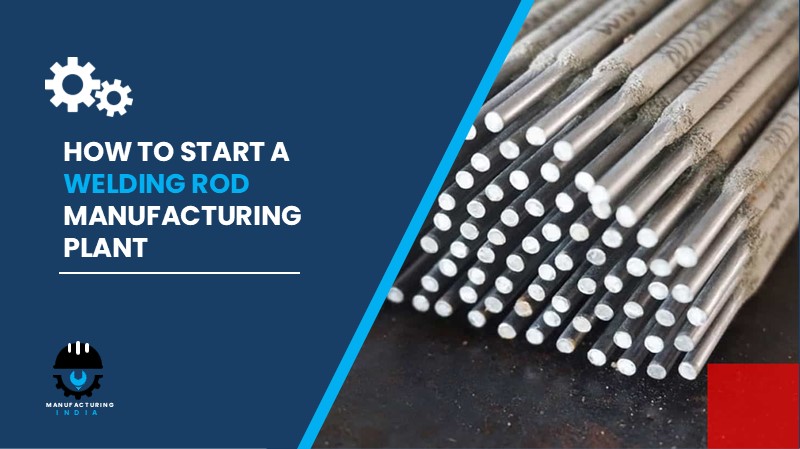
A welding rod, also known as a stick electrode, is a consumable metal wire used in Shielded Metal Arc Welding (SMAW) to join base metals by melting into the joint. It consists of a core metal wire coated in flux, which acts as an electrical conductor and provides shielding to protect the molten pool from atmospheric contamination. When an arc is struck, the heat melts the rod, forming the filler material, while the flux creates a protective slag covering that prevents weld pool oxidation and ensures consistent weld quality. Common types like E6013 and E7018 are selected based on material type, desired strength, and welding position requirements.
Welding rods are crucial for structural, pipe, and repair welding across a broad range of industrial applications, providing the filler metal, flux shielding, and arc stabilisation that the SMAW process requires. The primary production method involves wire drawing, heat treatment, extrusion, and baking a multi-step manufacturing process integrating wire preparation, flux mixing and coating, extrusion, and quality verification at each stage. End-use industries served include construction and infrastructure, shipbuilding, automotive, heavy equipment, oil and gas, power generation, and structural fabrication covering applications from joining structural steel and pipeline welding through to repair and maintenance of heavy machinery, ship hull fabrication, and pressure vessel assembly.
Cost of Setting Up a Welding Rod Manufacturing Plant in India
The total investment required to establish a welding rod manufacturing plant in India depends on plant capacity, electrode type range, geographic location, level of automation, and compliance with BIS product standards and environmental regulatory requirements. Investors must account comprehensively for both one-time capital expenditure and recurring operational costs when preparing a feasibility study or detailed project report (DPR).
1. Capital Expenditure (CapEx)
Land and Site Development constitutes a foundational investment. Costs for land registration, boundary construction, internal road layout, drainage infrastructure, and site levelling vary based on whether the facility is within a government-notified industrial estate, a metal products manufacturing cluster, or on privately acquired industrial land. Manufacturing locations in Maharashtra, Gujarat, Tamil Nadu, and Haryana — proximate to both mild steel wire supply chains and large concentrations of fabrication workshop, construction contractor, and OEM maintenance buyers — minimise raw material inbound logistics costs and maximise distribution network efficiency.
Civil Works and Construction encompasses the main wire drawing and preparation hall, flux mixing and preparation room, extrusion production area, baking oven building with high-temperature infrastructure, quality control and testing laboratory, finished rod storage and packaging hall, and administrative block. The construction standards for welding rod manufacturing include heat-resistant building materials in oven areas, adequate ventilation for flux dust management during mixing and extrusion, and chemical-resistant flooring in the flux preparation zone adding to civil construction costs relative to standard light metal fabrication facilities.
Machinery and Equipment represent the single largest component of capital expenditure. Key machinery required for a welding rod manufacturing plant includes:
- Wire drawing machines
- Cut-to-length lines
- Flux mixing stations
- Extrusion presses
- Baking ovens
- Quality testing rigs
- Vacuum packaging lines
Other Capital Costs include the effluent treatment plant (ETP) for managing flux preparation and equipment cleaning wastewater, pre-operative expenses covering regulatory filings and BIS certification preparation, plant commissioning charges, utility connection fees, and import duties applicable to specialised wire drawing machines or automated extrusion presses sourced internationally.
Request a Sample Report for In-Depth Market Insights: https://www.imarcgroup.com/welding-rod-manufacturing-plant-project-report/requestsample
2. Operational Expenditure (OpEx)
Raw Material Cost is the dominant driver of operating expenditure, accounting for approximately 70–80% of total OpEx reflecting the high material content of the finished welding rod product. The primary and most cost-significant inputs are mild steel wire, flux materials including rutile and cellulose, and binding agents. Mild steel wire the metallic core that forms the structural and electrical backbone of every welding rod represents the overwhelmingly largest single cost line, with its price linked to domestic and international steel commodity markets subject to iron ore, coking coal, and energy cost dynamics. Rutile and cellulosic flux materials determine the arc characteristics, mechanical properties, and application position suitability of different electrode grades including E6013 and E7018. Binding agents provide the adhesion and rheological properties required for consistent flux extrusion coating quality and adhesion to the wire core. Investors are advised to negotiate long-term supply contracts with domestic steel wire rod manufacturers, flux material importers, and chemical binder suppliers to stabilise input costs and ensure production continuity. Proximity to mild steel wire processing operations in major industrial states reduces inbound logistics costs materially.
Utility Costs – covering electricity for wire drawing machines, extrusion presses, baking ovens, and quality testing equipment account for approximately 10–15% of total OpEx. Baking ovens which heat-treat coated electrodes at controlled temperatures to achieve the required moisture content and coating hardness specifications for each electrode type are the most energy-intensive process step in welding rod production. Investors in regions with competitive industrial electricity tariffs and reliable grid supply are better positioned to manage this cost component. Water and compressed air for flux mixing operations add further utility requirements to the facility’s operating cost base.
Other Operating Costs include outbound transportation to construction contractors, fabrication workshops, automotive OEM tier suppliers, shipyards, oil and gas project operators, power plant maintenance contractors, and welding consumable distributors; packaging materials including retail boxes, cartons, and vacuum-sealed packaging for moisture-sensitive low-hydrogen electrode grades; employee salaries and wages for wire drawing operators, flux technicians, extrusion line operators, baking oven technicians, and quality inspectors; equipment maintenance; quality assurance testing for tensile strength, ductility, and AWS/ISO electrode certification; depreciation on civil and machinery assets; and applicable taxes including GST. By the fifth year of operations, total operational costs are expected to increase substantially due to inflation, market fluctuations, potential rises in mild steel wire and flux material prices, supply chain disruptions, rising consumer demand, and shifts in the global economy.
3. Plant Capacity
The proposed welding rod manufacturing facility is designed with an annual production capacity ranging between 10,000 and 30,000 MT, enabling significant economies of scale while maintaining operational flexibility across different electrode types, diameters, strength classes, and coating formulations from general-purpose E6013 electrodes for construction and maintenance applications through to E7018 low-hydrogen electrodes for critical structural and pressure vessel welding. This capacity range is well-aligned with the procurement requirements of construction contractors, fabrication and engineering companies, OEM maintenance departments, welding distributor networks, and export buyers across Asia-Pacific and the Middle East. Capacity can be customised based on investor requirements and mild steel wire procurement network scale. Profitability improves consistently with higher capacity utilisation, and welding rod manufacturing plants support phased capacity expansion through additional extrusion lines and baking oven capacity with contained incremental CapEx.
4. Profit Margins and Financial Projections
The welding rod manufacturing plant demonstrates healthy and stable profitability potential under normal operating conditions. Gross profit margins typically range between 25–35%, supported by stable multi-sector demand and the value-added, specification-differentiated nature of certified electrode products relative to commodity mild steel wire inputs. Net profit margins range between 12–18%, reflecting the high raw material cost intensity and moderate utility requirements of the extrusion and baking production model. A comprehensive financial analysis should include income projections, expenditure forecasts, gross and net margin tracking across Years 1 through 5, net present value (NPV), internal rate of return (IRR), payback period, and a full profit and loss account. Sensitivity analysis covering mild steel wire commodity price movements and welding rod selling price variability is recommended for investment-grade financial planning.
Why Set Up a Welding Rod Manufacturing Plant in India?
Critical Industrial Consumable Ensuring Permanent Multi-Sector Demand. Welding rods are essential consumables in fabrication, construction, shipbuilding, automotive, oil and gas, and infrastructure projects making them indispensable for structural integrity, equipment assembly, maintenance, and repair across industries. Every fabricated steel structure, maintained piece of industrial equipment, and joined pipeline requires welding electrode consumption creating a non-discretionary, recurring demand profile that provides manufacturing investors with commercially stable and predictable buyer volumes across all economic and seasonal cycles.
India’s Automotive Sector Providing Large and Growing Electrode Demand. The automotive industry in India is set to reach a total of USD 300 billion in 2026 according to IBEF — directly driving procurement of welding consumables for chassis welding, body panel fabrication, exhaust system assembly, and vehicle repair and maintenance operations across OEM assembly plants, tier supplier fabrication shops, and vehicle service infrastructure. As India’s automotive manufacturing modernises and expands, the structural demand for precision welding consumables across the production and aftermarket value chain grows in tandem.
Renewable Energy Installations Driving New Application Demand. The welding rod market is driven by the rise of renewable energy projects including wind and solar power installations where structural steel towers, wind turbine components, solar panel mounting structures, and power transmission infrastructure require extensive fabrication welding throughout manufacturing and installation. India’s aggressive national renewable energy capacity expansion targets are directly generating construction-phase demand for welding consumables at project scale a fast-growing demand channel that complements the steady maintenance and repair electrode consumption from operational renewable energy installations.
Infrastructure Expansion Across Construction and Transportation Creating Sustained Volume. Government investments in transportation networks, smart cities, energy projects, defence production, and domestic manufacturing initiatives including PLI schemes and localisation programmes indirectly strengthen demand for welding electrodes and consumables across every infrastructure construction and industrial manufacturing activity in India. The Bharatmala highway programme, metro rail expansion, airport construction, and industrial corridor development all require structural steel welding at scale — translating directly into sustained welding rod procurement from domestic manufacturers.
ESAB’s €275 Million EWM Acquisition Confirming Sectoral Investment Confidence. In June 2025, ESAB Corporation announced that it had signed a definitive agreement to acquire EWM GmbH, a German-based leader in heavy industrial welding equipment and advanced automation, for approximately €275 million. This acquisition strengthens ESAB’s portfolio in premium arc welding technology, advanced inverter power sources, and automated welding systems signalling the sustained strategic investment and market consolidation that the world’s leading welding companies are making in the welding consumables and equipment sector, directly validating the long-term commercial importance of welding rod and consumable manufacturing.
Lincoln Electric’s Vanair Acquisition Expanding Mobile Welding Power Solutions. In July 2024, Lincoln Electric announced that it had acquired Vanair Manufacturing, LLC a Michigan City, Indiana-based manufacturer of mobile power solutions serving the U.S. service truck market offering vehicle-mounted compressors, generators, welders, hydraulics, chargers/boosters, and electrified power equipment. This acquisition by the world’s largest welding company signals the expanding commercial scope of the welding ecosystem and the sustained market confidence that major global players continue to invest in welding-related manufacturing capacity and capability globally.
Manufacturing Process – Step by Step
The welding rod manufacturing process uses wire drawing, heat treatment, extrusion, and baking as the primary production method. Below are the main stages involved in the welding rod manufacturing process flow:
- Raw Material Receipt and Quality Testing: Mild steel wire rod, rutile and cellulosic flux materials, and binding agents are received, tested for dimensional conformance, chemical composition, and quality against specification, and cleared for production scheduling following quality verification.
- Wire Drawing: Wire drawing machines reduce the incoming mild steel wire rod to the precise diameter specification required for each electrode type and diameter class typically ranging from 2.0 mm to 6.0 mm through a series of progressive drawing dies that reduce cross-section and improve surface finish while maintaining tensile strength and ductility in the drawn wire.
- Wire Straightening and Cut-to-Length: Cut-to-length lines straighten the drawn wire and cut it to the precise electrode length specification typically 300 mm or 450 mm with cut quality and dimensional accuracy maintained within the tight tolerances required for consistent extrusion coating alignment and arc stability in use.
- Flux Mixing: Flux mixing stations blend rutile powder, cellulosic materials, metallic powders, and binding agents in the specified proportions for each electrode formulation with mixing intensity and duration controlled to achieve the homogeneous, consistent paste viscosity required for uniform extrusion coating quality. Different flux formulations produce different electrode performance characteristics, including arc stability, slag coverage, mechanical properties of the deposited weld metal, and positional welding capability.
- Extrusion Coating: Extrusion presses push the cut wire sections through an extrusion die simultaneously fed with the prepared flux paste, applying a uniform annular coating of flux around the wire core at a controlled thickness that meets the specified coating diameter for each electrode type. Coating concentricity the uniformity of flux distribution around the wire circumference is a critical quality parameter verified throughout the extrusion run.
- Drying (Pre-Bake): Freshly extruded electrodes undergo initial ambient or low-temperature drying to reduce surface moisture and improve coating mechanical stability before loading into baking ovens for the primary heat treatment stage.
- Baking: Baking ovens heat-treat the coated electrodes at controlled temperatures typically ranging from 120°C to 450°C depending on the electrode type for specified holding periods that drive off residual moisture, improve coating hardness, and achieve the flux microstructure and hydrogen content specifications required for each electrode grade. Low-hydrogen E7018 electrodes require higher baking temperatures and longer holding times to achieve the critically low moisture content that prevents hydrogen-induced cracking in the weld.
- Quality Inspection and Testing: Quality testing rigs subject representative samples from each production batch to a comprehensive suite of AWS/ISO/IS qualification tests including visual inspection of coating concentricity and surface quality, bend test for coating adhesion, tensile strength and impact toughness testing of deposited weld metal, and diffusible hydrogen testing for low-hydrogen grades. Batch release is conditional on all parameters meeting the applicable specification acceptance criteria for the designated electrode classification.
- Stamping and Identification: Each approved electrode is stamped or marked with the electrode classification code, manufacturer identification, diameter, and batch reference for product traceability and end-user specification compliance verification.
- Packaging: Vacuum packaging lines seal finished electrodes in moisture-barrier packaging including vacuum-sealed foil packs for low-hydrogen electrodes, standard carton packaging for general-purpose grades, and retail display boxes for construction and maintenance market distribution with outer cartons marked with product specification, quantity, storage instructions, and batch documentation.
- Dispatch to End-Use Industries: Finished welding rods are dispatched to construction contractors, structural fabrication shops, automotive OEM maintenance departments, shipyards, oil and gas project operators, power plant and industrial facility maintenance contractors, and welding consumable wholesale distributors.
Key Applications
Welding rods produced at this type of facility serve five primary end-use sectors with specific electrode classification, coating formulation, and performance requirements for each:
- Welding and Fabrication: Used for structural steel welding, general metal fabrication, and repair and maintenance work across engineering shops, construction sites, and industrial facilities the broadest and most volume-driven application category for general-purpose E6013 electrodes.
- Automotive: Applied for chassis welding, body panel repairs, and exhaust system fabrication across automotive OEM assembly plants, tier supplier manufacturing operations, and vehicle service and repair centres requiring consistent weld quality and high-speed deposition.
- Construction: Used for building frameworks, reinforcement joining, pipeline systems, and heavy equipment structure fabrication across residential, commercial, and infrastructure construction projects requiring electrodes capable of all-position welding in field conditions.
- Shipbuilding and Marine: Applied in hull fabrication, deck structure assembly, and offshore platform welding where the combination of salt-corrosive environment resistance, all-position capability, and demanding mechanical property specifications requires specialised electrode formulations.
- Oil and Gas: Used for pipeline welding, pressure vessel fabrication, storage tank construction, and refinery maintenance where low-hydrogen E7018 and specialised high-strength electrodes are mandated by pipeline codes and pressure equipment standards.
Leading Welding Rod Manufacturers
The global welding rod industry is served by several large-scale multinational manufacturers with extensive production capacities and diversified end-use application portfolios. Key players include:
- Lincoln Electric
- ESAB
- Hobart Brothers Company
- Kobe Steel (KOBELCO)
- Ador Welding
Timeline to Start the Plant
Investors planning to establish a welding rod manufacturing plant in India should anticipate the following project development phases:
- Feasibility study and project report preparation
- Land acquisition and site development
- Regulatory approvals and environmental clearances
- Factory licence and fire safety compliance
- Machinery procurement and installation
- Raw material supplier agreements and supply chain setup
- Trial production and quality testing
- Commercial production launch
Licences and Regulatory Requirements
Starting a welding rod manufacturing unit in India requires several approvals:
- Business registration (Proprietorship, LLP, or Private Limited Company)
- Factory Licence under the Factories Act
- Bureau of Indian Standards (BIS) certification under IS 814 for covered electrodes for manual metal arc welding mandatory for supply to government infrastructure projects and qualified institutional procurement
- Environmental Clearance from the State Pollution Control Board
- GST Registration
- Fire Safety NOC
- Effluent Treatment Plant (ETP) operational clearance for flux preparation and equipment cleaning wastewater management
- Occupational Health and Safety compliance covering flux dust exposure monitoring, wire drawing machinery safety, and baking oven operations
- AWS (American Welding Society) or ISO 2560 electrode classification certification for export-destined products and multinational OEM supply qualification where applicable
Key Challenges to Consider
Mild Steel Wire Price Volatility as the Dominant Cost Variable. Mild steel wire accounting for 70–80% of total OpEx is priced against domestic and international steel commodity markets subject to iron ore, coking coal, and energy cost cycles. Any meaningful increase in wire rod prices directly and materially compresses gross margins. Long-term supply contracts with domestic steel wire rod manufacturers, multi-supplier procurement diversification, and strategic inventory management during price-advantageous periods are essential risk mitigation practices.
BIS and AWS/ISO Electrode Classification Certification Requirements. All welding electrodes sold to government infrastructure projects and qualified institutional buyers in India must carry BIS IS 814 certification. Export-destined products and multinational OEM supply require AWS classification or ISO 2560 certification compliance. Obtaining and maintaining these certifications across product range expansions and ongoing production batches requires dedicated testing infrastructure, third-party laboratory relationships, and ongoing documentation management adding to quality system operational overhead.
Flux Formulation Expertise as a Critical Product Differentiator. Different flux coating formulations rutile, cellulosic, basic, and iron powder variants produce fundamentally different welding performance characteristics including arc stability, penetration profile, slag removal, mechanical properties, and positional capability. Developing proprietary flux formulations with verifiable performance advantages over commodity competitors requires experienced welding technologists and application engineering investment that goes beyond equipment and raw material procurement. This formulation expertise is the primary technical differentiator between commodity and premium-priced electrode manufacturers.
Moisture Management for Low-Hydrogen Electrode Quality. E7018 and other low-hydrogen electrode grades require stringent moisture management throughout production including high-temperature baking, moisture-barrier packaging, and cold-storage requirements for the finished product to maintain the critically low diffusible hydrogen content that prevents hydrogen-induced cracking in critical welded joints. Any breakdown in moisture control at any stage from production through storage and delivery compromises product quality and can lead to field welding failures creating significant customer liability and reputational risk for manufacturers whose moisture management systems are inadequate.
Competition from Established Domestic and Multinational Brands. India’s welding consumable market is served by established players including Ador Welding one of India’s largest domestic electrode manufacturers alongside international brands including Lincoln Electric, ESAB, and Kobe Steel with strong technical reputations and established fabrication workshop customer relationships. New entrants must differentiate through product quality consistency, competitive pricing for construction and maintenance market volumes, or technical service capability that supports the welding procedure qualification requirements of industrial and infrastructure buyers.
Skilled Manpower for Wire Drawing and Flux Technology Operations. Operating wire drawing machines, flux mixing stations, extrusion presses, and baking ovens while maintaining electrode quality standards requires skilled operators trained in wire drawing technology, flux chemistry, extrusion process control, and welding consumable quality management. Sourcing and retaining qualified personnel with this combination of metallurgical and process engineering skills presents a challenge in locations outside established metal manufacturing industrial clusters.
Frequently Asked Questions
1. How much does it cost to set up a welding rod manufacturing plant in India?
The total cost depends on plant capacity (10,000–30,000 MT per annum), electrode type range, location, and automation level. CapEx covers land, industrial civil construction, and machinery including wire drawing machines, cut-to-length lines, flux mixing stations, extrusion presses, baking ovens, quality testing rigs, and vacuum packaging lines, along with pre-operative and regulatory costs including BIS certification.
2. Is welding rod manufacturing profitable in India in 2026?
Yes. With gross margins of 25–35% and net margins of 12–18%, supported by multi-sector demand across construction, automotive, oil and gas, shipbuilding, renewable energy, and industrial maintenance, a global market growing at 6.1% CAGR toward USD 11.33 billion by 2034, and India’s automotive industry targeting USD 300 billion in 2026, the investment presents a commercially sound profitability case.
3. What machinery is required for a welding rod manufacturing plant in India?
Key equipment includes wire drawing machines, cut-to-length lines, flux mixing stations, extrusion presses, baking ovens, quality testing rigs, and vacuum packaging lines.
4. What licences and approvals are required to start a welding rod manufacturing plant in India?
Required approvals include business registration, BIS certification under IS 814 for covered electrodes, Factory Licence, Environmental Clearance, GST Registration, Fire Safety NOC, ETP operational clearance, Occupational Health and Safety compliance, and AWS/ISO electrode classification certification where export or multinational OEM supply is targeted.
5. What raw materials are needed for welding rod manufacturing?
The primary raw materials are mild steel wire, flux materials including rutile and cellulosic compounds, and binding agents. Additional inputs include metallic powder additives for specific electrode formulations, moisture-barrier packaging materials, and stamping inks for electrode classification marking.
6. What are the environmental compliance requirements for a welding rod manufacturing plant in India?
Environmental Clearance from the State Pollution Control Board is required, along with an ETP for managing flux preparation and equipment cleaning wastewater, compliance with ambient air dust emission standards for flux mixing and extrusion operations, and adherence to solid waste management rules for flux material waste and packaging by-product disposal.
7. What is the best location to set up a welding rod manufacturing plant in India?
States with established steel wire processing industries and proximity to large construction, fabrication, automotive, and infrastructure project activity — including Maharashtra, Gujarat, Tamil Nadu, and Haryana — offer the best combination of mild steel wire supply access, logistics connectivity to fabrication workshop and contractor buyers, industrial skill base availability, and state-level manufacturing incentive support.
8. What is the break-even period for this type of plant in India?
The break-even period depends on plant capacity utilisation, product mix across general-purpose and speciality electrode grades, mild steel wire procurement cost management, and distributor network development speed. A full NPV and IRR analysis incorporating sensitivity testing for wire rod price movements and electrode selling price variability is recommended for investment-grade financial planning.
9. What government incentives are available for welding rod manufacturers in India?
Make in India manufacturing investment incentives, PLI scheme benefits for metal products manufacturing where applicable, state-level industrial zone incentive schemes in Maharashtra and Gujarat, BIS product certification support programmes, and general domestic manufacturing promotion policies supporting construction and infrastructure material localisation all provide relevant financial and market access support for qualifying welding rod manufacturing investments.
Key Takeaways for Investors
A welding rod manufacturing plant in India represents a commercially stable, multi-sector investment opportunity backed by a global market valued at USD 6.65 billion in 2025 growing at 6.1% CAGR toward USD 11.33 billion by 2034, the non-discretionary and permanent demand nature of welding electrodes as an essential consumable across construction, automotive, shipbuilding, oil and gas, renewable energy, and industrial maintenance sectors, and India’s own large and rapidly growing fabrication economy anchored by a USD 300 billion automotive industry target for 2026. Financial viability is demonstrated across a production capacity range of 10,000 to 30,000 MT per annum, with gross margins of 25–35% and net margins of 12–18% achievable under competitive mild steel wire procurement and efficient extrusion and baking operations. Major global strategic acquisitions ESAB’s June 2025 agreement to acquire EWM GmbH for approximately €275 million, and Lincoln Electric’s July 2024 acquisition of Vanair Manufacturing confirm the sustained strategic investment that the world’s leading welding companies are placing in welding technology and consumable manufacturing capability globally. With India’s infrastructure pipeline deepening, renewable energy installations accelerating, and manufacturing sector modernising across automotive, shipbuilding, and heavy engineering all supported by government PLI and Make in India incentives the long-term demand sustainability and commercial returns for welding rod manufacturing investors in India are comprehensively and durably well-supported throughout the decade ahead.
About the Author