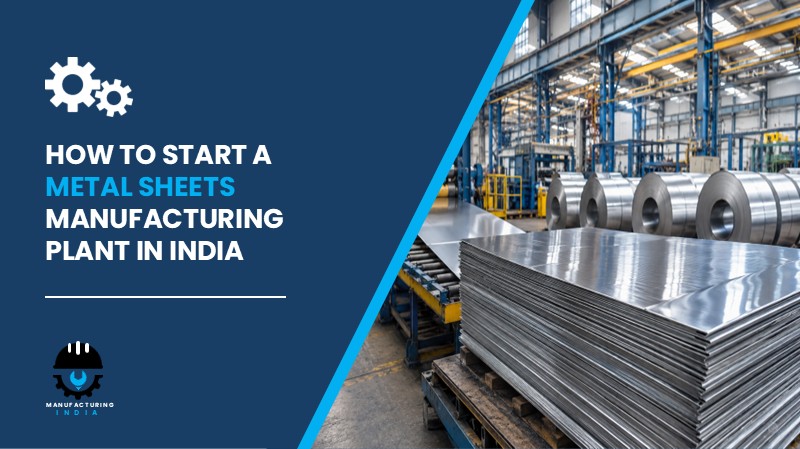
Setting up a metal sheets manufacturing plant in India presents a compelling investment case at a time when the country’s construction sector is expanding at a historic pace, its automotive industry is scaling rapidly, its industrial machinery manufacturing is deepening, and its government is investing unprecedented capital in infrastructure development that demands reliable, high-quality flat-rolled metal products at every stage of the value chain. Metal sheets — the flat-rolled metal products manufactured by rolling raw metal through rolling mills to achieve consistent thickness and surface finish from materials including carbon steel, stainless steel, aluminium, and galvanised steel — are among the most fundamental intermediate materials in the modern industrial economy, serving as the structural, protective, and functional backbone of construction, automotive, machinery, appliance, and fabrication applications. As India’s urbanisation accelerates, its pre-engineered building market expands, and its automotive and industrial manufacturing sectors modernise toward higher-strength and lighter-weight materials, the domestic requirement for domestically produced, specification-grade metal sheets is growing into one of the country’s most commercially important and volume-driven manufacturing investment opportunities.
India’s market-level data confirms the exceptional scale of this opportunity. The India metal sheets market was valued at USD 9.91 Billion in 2025 and is expected to reach USD 21.91 Billion by 2034, exhibiting a CAGR of 9.2% — one of the highest growth rates of any construction and industrial materials market tracked for the Indian subcontinent. This India-specific data point — unique among the product categories covered in this series — confirms that the domestic market itself, not merely export potential, is the primary commercial driver for a metal sheets manufacturing plant established in India today. Government-backed infrastructure initiatives, automotive production recovery, urbanisation-driven construction activity, and the growing preference for pre-engineered buildings and modular construction are all simultaneously expanding the addressable market for domestically produced metal sheets at a pace that makes new rolling and processing capacity commercially necessary and financially sound.
Investing in a metal sheets manufacturing plant in India today aligns India’s USD 9.91 Billion domestic market — projected to more than double to USD 21.91 Billion by 2034 at a 9.2% CAGR — with expanding construction, automotive, and industrial manufacturing demand, and a growing preference for lightweight, high-strength, and sustainability-aligned sheet metal materials. With gross profit margins of 15–25% and net profit margins of 5–12% at annual production capacities of 50,000–200,000 MT, the volume-driven economics of this investment support commercially reliable and strategically resilient long-term returns.
What are Metal Sheets?
Metal sheets are flat-rolled metal products which manufacturers create by rolling raw metal through rolling mills until they achieve consistent thickness and surface finish. The production process uses carbon steel, stainless steel, aluminium, galvanised steel, and other alloyed metals as its primary raw materials. Metal sheets are available in various thicknesses, widths, and surface treatments depending on end-use requirements across construction, automotive, machinery, and fabrication applications.
The materials provide high structural strength together with excellent durability and corrosion resistance — which increases significantly when they receive protective coatings or galvanisation treatment — and they support multiple fabrication methods including bending, cutting, stamping, and welding. Metal sheets serve many applications due to their precise dimensions and strong mechanical properties, making them suitable for structural frameworks, automotive panels, roofing systems, equipment enclosures, and fabricated components across India’s entire industrial economy. The production process covers hot rolling, cold rolling, annealing, pickling, surface coating and galvanising, and cutting and finishing — a multi-stage value-addition sequence that transforms raw steel coils or aluminium billet into precisely specified flat-rolled products serving diverse industrial end-use specifications.
End-use industries served include construction, automotive manufacturing, heavy machinery, and industrial fabrication. Applications span roofing and cladding panels, vehicle body parts, structural frames, equipment enclosures, storage tanks, and ducting systems.
Cost of Setting Up a Metal Sheets Manufacturing Plant in India
The cost of establishing a metal sheets manufacturing plant in India depends on plant capacity, product mix across hot-rolled, cold-rolled, galvanised, and coated variants, rolling mill technology selection, geographic location — particularly proximity to steel coil and aluminium suppliers — degree of automation, and the quality compliance and BIS certification requirements applicable to structural and automotive-grade metal sheets sold in the Indian market.
1. Capital Expenditure (CapEx)
Land and Site Development forms a foundational component of total capital investment, covering land acquisition charges, site registration, boundary development, heavy-duty industrial drainage infrastructure, and site utilities including high-capacity electrical supply for rolling mill motors. The location must offer easy access to key raw materials such as steel coils, zinc for galvanising, and chemicals for pickling and cleaning operations. Proximity to target construction, automotive, and industrial fabrication markets minimises distribution costs on heavy, bulk finished product shipments. The site must have robust infrastructure including reliable heavy-load transportation networks, high-capacity utilities, and waste management systems. Compliance with local zoning laws and environmental regulations must also be ensured. Steel manufacturing clusters in Odisha, Jharkhand, Chhattisgarh, and Maharashtra, and industrial zones in Gujarat, offer the most commercially advantaged combinations of raw material supply and market access.
Plant Layout Optimisation is a critical civil and process engineering investment for a metal sheets facility. The layout must be optimised to enhance workflow efficiency, safety, and minimise material handling distances across the rolling, annealing, pickling, coating, and slitting sequence. Separate areas for raw material coil storage with heavy crane infrastructure, the rolling mill bay, annealing and heat treatment areas, pickling and chemical treatment zones, galvanising or coating lines, the slitting and shearing hall, quality control testing laboratory, finished coil and sheet storage, and dispatch docks must be designated. Space for future expansion — including additional rolling capacity and surface treatment lines — should be incorporated to accommodate business growth as market penetration and customer contracts develop.
Machinery and Equipment represent the largest single component of total CapEx for a metal sheets manufacturing plant. Essential equipment includes:
- Rolling mills
- Annealing furnaces
- Pickling lines
- Galvanising or coating units
- Shearing and slitting machines
- Automated material handling systems
Other Capital Costs include an effluent treatment plant (ETP) to minimise environmental impact and ensure compliance with emission standards for pickling acid and galvanising bath effluents, fume scrubbing for acid pickling and galvanising operations, pre-operative expenses, BIS certification costs for structural and automotive grade products, commissioning charges, and import duties on specialised rolling mill stands or automated surface coating line equipment not available domestically at the required throughput and quality specification.
Request a Sample Report for In-Depth Market Insights: https://www.imarcgroup.com/metal-sheets-manufacturing-plant-project-report/requestsample
2. Operational Expenditure (OpEx)
Raw Material Cost is the overwhelmingly dominant operational expense, accounting for approximately 80–85% of total OpEx. The primary raw materials are steel coils, zinc for galvanising, and chemicals for pickling and cleaning. Steel coils — as the primary ferrous feedstock consumed in the largest volumes and converted into flat-rolled metal sheet products through rolling and surface treatment — drive the vast majority of raw material cost and are priced in correlation with global steel markets, iron ore, coking coal, and scrap metal pricing cycles. Zinc, consumed in hot-dip galvanising operations to provide corrosion protection, represents the second most significant material input for galvanised sheet production lines. Pickling chemicals — hydrochloric or sulphuric acid for oxide scale removal — are consumed in smaller volumes but are process-critical inputs. Long-term contracts with reliable suppliers for all three input categories must be negotiated to stabilise pricing and ensure a steady supply.
Utility Cost is the second-largest OpEx component, representing approximately 10–15% of total operating expenses, covering electricity for rolling mill motors — the most energy-intensive equipment in the plant — annealing furnace fuel, pickling line pumping and heating, galvanising bath temperature maintenance, and automated material handling systems. Optimising rolling mill pass schedules and annealing cycle parameters to reduce energy consumption per tonne of product is an important operational lever for improving the facility’s cost position relative to less efficient competitors.
Other Operating Costs include transportation and distribution of heavy coil and sheet product to construction contractors, automotive stamping plants, machinery fabricators, appliance manufacturers, and steel service centre customers, protective packaging for finished sheet products, salaries and wages for rolling mill operators and quality engineers, routine machinery maintenance including roll change schedules and annealing furnace refractory upkeep, depreciation on high-value rolling and coating equipment, and applicable taxes. By the fifth year, the total operational cost is expected to increase substantially due to factors such as inflation, market fluctuations, and potential rises in the cost of key materials. Additional factors, including supply chain disruptions, rising consumer demand, and shifts in the global economy, are expected to contribute to this increase.
3. Plant Capacity
The proposed manufacturing facility is designed with an annual production capacity ranging between 50,000 and 200,000 MT, enabling economies of scale while maintaining operational flexibility across product grades including hot-rolled structural sheets, cold-rolled precision sheets, galvanised roofing and cladding sheets, and coated automotive-grade sheets. Plant capacity can be customised per investor requirements and scaled through additional rolling mill stands, annealing capacity, and surface treatment lines as market demand and customer qualification milestones progress. Profitability improves with higher capacity utilisation across the rolling mill and coating lines, making secured supply agreements with large construction developers, automotive component manufacturers, or steel service centres a commercial foundation that should be established in parallel with plant commissioning activities.
4. Profit Margins and Financial Projections
The financial projections for a metal sheets manufacturing plant demonstrate healthy profitability potential under normal operating conditions. Gross profit margins typically range between 15–25%, supported by stable demand and value-added applications across construction, automotive, and industrial fabrication customer segments. Net profit margins are projected at 5–12%, reflecting the high raw material cost concentration of 80–85% of OpEx in steel coils and the volume-driven economics characteristic of flat-rolled metal product manufacturing at commercial scale. A comprehensive financial analysis covering NPV (net present value), IRR (internal rate of return), payback period, gross margin progression, and net margin development across a five-year horizon is essential before committing capital, with projections developed based on realistic assumptions related to capital investment, operating costs, production capacity utilisation, steel coil pricing trends, and demand outlook.
Why Set Up a Metal Sheets Manufacturing Plant in India?
Core Industrial Raw Material with Constant Market Demand. Metal sheets function as the primary material which supports all modern infrastructure systems, transportation networks, and fabrication processes — establishing their role as an intermediate material which maintains constant market needs throughout all economic periods and cycles. This structural demand stability — driven by the non-discretionary nature of construction and industrial fabrication activity — provides a commercial foundation that is more resilient to economic cyclicality than most manufacturing investment categories.
India-Specific Market Growing at 9.2% CAGR — Fastest-Growing Domestic Market. The India metal sheets market, valued at USD 9.91 Billion in 2025, is projected to reach USD 21.91 Billion by 2034 at a CAGR of 9.2% — confirming that India’s domestic demand growth trajectory for flat-rolled metal products is among the most exceptional in the global industry. This India-specific market data — driven by infrastructure investment, urban construction, automotive expansion, and industrial modernisation — makes domestic market demand the primary investment rationale, independently of any export market consideration.
Infrastructure and Urbanisation Growth Driving Structural Sheet Demand. The consumption of structural and coated metal sheets has increased due to rapid urban development, industrial growth, and government infrastructure development projects across India. Pre-engineered buildings, modular construction, metro rail infrastructure, highway bridges, industrial warehouses, and residential roofing all consume large volumes of galvanised and coated metal sheets — demand categories that are all growing simultaneously under India’s infrastructure investment cycle.
Technological Advancements and Sustainability-Driven Collaboration Reshaping the Industry. In November 2025, Tokyo Steel Manufacturing announced that its pickled hot-rolled steel sheets are being used in several Toyota vehicle models, produced via electric arc furnaces using 100% scrap and generating approximately 400 kg of CO₂ per metric tonne — roughly one-fifth of blast furnace emissions. The company also promotes “Car-to-Car” recycling using automotive scrap for steel production — signalling the sustainability direction of premium automotive-grade metal sheet supply that positions low-carbon producers advantageously with ESG-conscious customers.
Sustainability-Driven Circular Economy Collaboration Creating Market Differentiation. In March 2025, Škoda Auto became part of the SATURNIN initiative, which links manufacturers to improve reuse of sheet metal scrap and lower carbon emissions by matching steel offcuts from one company’s production with other companies’ material needs — reducing energy-intensive reprocessing. Supporting its Strategy 2030 goals, Škoda aims for carbon-neutral production in Czech and Indian plants by decade’s end. Such initiatives indicate the growing metal sheets market being reshaped by increasing industrial demand, focus on resource efficiency, and rising adoption of low-carbon production and recycling strategies — trends that Indian producers can align with to access premium supply chain positions.
Automotive Lightweight Materials Transition Expanding Premium Sheet Demand. In the automotive sector, the shift toward lightweight and high-strength materials is accelerating adoption of advanced high-strength steel and aluminium sheets to improve fuel efficiency and meet emission standards. India’s automotive manufacturing sector — serving both domestic and export vehicle production — is a growing consumer of precision-rolled, high-strength sheet metal that commands premium pricing over commodity structural grades, improving the margin profile of well-positioned sheet metal producers who invest in cold-rolling and surface treatment capability.
Manufacturing Process — Step by Step
The metal sheets manufacturing process uses hot rolling, cold rolling, annealing, pickling, surface coating and galvanising, and cutting and finishing as the primary production method. Each stage requires controlled rolling parameters, furnace temperature profiles, bath chemistry, and dimensional accuracy to deliver metal sheets meeting the thickness, surface quality, tensile strength, and corrosion resistance specifications required by construction, automotive, and industrial fabrication customers.
- Raw Material Receipt and Incoming Inspection: Steel coils or aluminium billets are received from certified steel producers or aluminium rolling mills, quality-checked for composition, surface condition, and dimensional specification compliance, and transferred to coil storage on heavy-duty cradles pending the rolling mill schedule.
- Hot Rolling: Steel billets or thick slabs are heated in reheating furnaces to rolling temperature — typically 1,100–1,250°C — and passed through rolling mills in successive reduction passes to reduce thickness from slab dimensions to hot-rolled coil gauge, typically 2–12 mm thickness, with controlled finishing temperature, rolling speed, and coiling temperature parameters managing the mechanical properties developed in the finished hot-rolled product.
- Annealing: Hot-rolled or cold-rolled coils that require softening for subsequent forming or coating operations are processed through annealing furnaces at controlled temperature and atmosphere conditions — continuous annealing or batch box annealing depending on the product specification — to relieve rolling work hardening, restore ductility, and develop the target mechanical property profile required by downstream fabrication processes.
- Pickling: Hot-rolled coils are processed through pickling lines where dilute hydrochloric or sulphuric acid removes the iron oxide scale formed during hot rolling, producing a clean, scale-free surface required for cold rolling, galvanising, or surface coating downstream. Acid concentration, temperature, and line speed are controlled to achieve complete scale removal without over-pickling the base metal surface.
- Cold Rolling: Pickled hot-rolled coils are processed through cold rolling mills — tandem or reversing mill configurations — to reduce gauge from hot-rolled thickness to the cold-rolled precision gauge specified for automotive, appliance, or precision fabrication applications, with controlled rolling force, tension, and lubrication parameters managing the flatness, surface quality, and dimensional accuracy of the finished cold-rolled product.
- Galvanising or Surface Coating: Cold-rolled or hot-rolled pickled coils are processed through galvanising or coating units where the steel surface is hot-dip galvanised by continuous immersion in a molten zinc bath — producing the zinc coating that provides the cathodic corrosion protection essential for roofing, cladding, and outdoor structural applications — or alternatively processed through colour coating, anti-fingerprint, or other specialty coating systems for premium architectural and automotive applications.
- Shearing and Slitting: Finished coated or uncoated coils are processed through shearing and slitting machines to produce metal sheets of the specified length and width — standard roofing sheet lengths, automotive blank dimensions, or custom fabrication sizes — with automated material handling systems managing coil transport and finished sheet stacking throughout the cutting and packaging sequence.
- Quality Control and Testing: Finished metal sheets undergo comprehensive quality testing covering thickness measurement, tensile strength and yield strength testing, coating weight measurement for galvanised products, surface quality visual inspection, and dimensional compliance verification against applicable IS, BIS, and customer-specific specification requirements before release for dispatch.
- Packaging and Dispatch: Specification-compliant metal sheets and coils are bundled, protected with edge protectors and wrapping materials, and marked with product specification, heat number, and customer order identification before dispatch to construction contractors, automotive stamping plants, machinery fabricators, appliance manufacturers, roofing installers, and steel service centre customers.
Key Applications
Metal sheets manufactured in India serve the entire spectrum of structural, functional, and aesthetic applications across India’s construction, automotive, and industrial economy:
- Construction: Used in roofing sheets, wall cladding, structural decking, and reinforcement panels across residential, commercial, and industrial building construction — the largest and most volume-driven application segment for Indian metal sheet producers.
- Automotive: Utilised in body panels, chassis components, and interior structural parts across passenger vehicles, commercial vehicles, and two-wheelers where high-strength, lightweight, and surface-quality characteristics are mandatory for assembly and painting operations.
- Industrial Machinery: Employed in machine frames, protective housings, and fabricated assemblies across general engineering, material handling equipment, and process plant fabrication applications.
- Appliances and Fabrication: Used in cabinets, panels, storage systems, and metal furniture across white goods manufacturing, office equipment, and commercial equipment fabrication segments.
Leading Manufacturers
The global metal sheets industry is served by a group of large multinational and domestic steel and aluminium producers with extensive rolling and surface treatment capacities. Key players in the global and Indian markets include:
- JSW Steel Ltd
- Tata BlueScope Steel Private Limited
- Nippon Steel Corporation
- POSCO
- United States Steel Corporation
- JFE Steel
- Baosteel Group
- Howmet Aerospace, Inc.
- Ma’aden
- Hindalco Industries Limited
- Kaiser Aluminum Corporation
- Constellium SE
- Aleris Corporation
- Hulamin Limited
- Norsk Hydro ASA (Speira)
Timeline to Start the Plant
Establishing a metal sheets manufacturing plant in India involves a structured multi-phase development sequence. Investors should plan for the following phases:
- Feasibility study and project report preparation
- Land acquisition and site development
- Regulatory approvals and environmental clearances
- Factory licence and fire safety compliance
- Machinery procurement and installation
- Raw material supplier agreements and supply chain setup
- Trial production and quality testing
- Commercial production launch
Licences and Regulatory Requirements
Starting a metal sheets manufacturing unit in India requires several approvals spanning business registration, product quality certification, environmental, chemical handling, and industrial safety compliance domains:
- Business registration (Proprietorship, LLP, or Pvt Ltd)
- Factory Licence under the Factories Act
- Environmental Clearance from the State Pollution Control Board
- GST Registration
- Fire Safety NOC
- BIS licence under applicable IS standards for structural, automotive, and galvanised metal sheet product categories where mandatory BIS certification applies under government procurement and building code requirements
- Hazardous/Chemical compliance applicable to pickling acid and galvanising bath chemical handling under the Manufacture, Storage and Import of Hazardous Chemical (MSIHC) Rules
- Consent to Establish and Consent to Operate from the State Pollution Control Board for a large-scale industrial installation with pickling, galvanising, and coating emissions
- Effluent Treatment Plant (ETP) operational clearance for managing pickling acid effluents and galvanising bath waste streams
- Occupational Health and Safety compliance
Key Challenges to Consider
Steel Coil Cost Concentration and Global Steel Price Volatility. Steel coils account for approximately 80–85% of total OpEx — the highest raw material cost concentration in the flat-rolled metals manufacturing sector — with steel coil pricing directly tied to global steel markets, iron ore, coking coal, and scrap metal pricing cycles that can move 20–30% or more within a year. Managing this cost exposure requires long-term procurement contracts with domestic steel producers, customer contract price adjustment mechanisms linked to published steel indices, and careful inventory positioning relative to steel price cycle expectations.
High Capital Intensity of Rolling Mill Equipment. Rolling mills — comprising hot mill, cold mill, annealing line, pickling line, and galvanising or coating line equipment — represent among the highest capital costs per tonne of output capacity in the metals processing sector. Achieving the 50,000–200,000 MT annual production capacity required for competitive unit economics demands significant capital commitment in heavy equipment with long procurement lead times, requiring careful financial planning and financing structure development before project commitment.
Pickling and Galvanising Environmental Compliance. Acid pickling operations generate hydrochloric or sulphuric acid-containing effluents and acid fumes requiring comprehensive treatment and ventilation infrastructure. Hot-dip galvanising produces zinc-contaminated waste streams and flux fumes that require dedicated ETP capability and air emission controls. Managing these dual chemical and environmental compliance obligations requires dedicated infrastructure investment and ongoing regulatory engagement with state pollution control authorities.
Competition from Established Domestic Integrated Steel Producers. The Indian metal sheets market is served by large integrated steel producers including Tata BlueScope Steel, JSW Steel, and JSW Coated Products with massive production scale, captive hot-rolled coil supply advantages, established BIS certifications, and long-standing customer relationships across construction, automotive, and appliance segments. New entrants must compete through customer service responsiveness, product customisation capability, regional distribution advantages, or niche product specialisation to establish commercially meaningful positions against established scale competitors.
Automotive Grade Qualification Cycles. Supplying metal sheets to automotive OEM stamping plants and tier-1 automotive component manufacturers requires passage through rigorous material qualification and supplier approval processes that can extend 12–24 months. These qualification cycles require multiple sample submissions, mechanical property validation, surface quality audits, and production consistency evidence before commercial order approval — obligations that must be planned as part of the pre-revenue investment period for automotive-grade product lines.
Skilled Manpower for Rolling Mill Operations. Maintaining consistent rolling gauge, flatness, surface quality, and coating weight across high-speed continuous rolling and coating operations requires experienced rolling mill technicians, process metallurgists, and quality control engineers — a specialised technical workforce requiring ongoing investment in recruitment, skills development, and competitive retention programmes.
Frequently Asked Questions
1. How much does it cost to set up a metal sheets manufacturing plant in India?
Capital requirements generally include land acquisition, construction, equipment procurement, installation, pre-operative expenses, and initial working capital. Equipment costs — including rolling mills, annealing furnaces, pickling lines, galvanising or coating units, shearing and slitting machines, and automated material handling systems — represent a significant portion of capital expenditure. The total amount varies with capacity, technology, and location. A detailed project report with full CapEx and OpEx breakdowns is available on request.
2. Is metal sheets manufacturing profitable in India in 2026?
Yes. The project demonstrates gross profit margins of 15–25% and net profit margins of 5–12% under normal operating conditions, supported by India’s exceptional domestic market growth — from USD 9.91 Billion in 2025 to USD 21.91 Billion by 2034 at a 9.2% CAGR — driven by construction, automotive, and industrial fabrication demand.
3. What machinery is required for a metal sheets manufacturing plant in India?
Key machinery includes rolling mills, annealing furnaces, pickling lines, galvanising or coating units, shearing and slitting machines, and automated material handling systems. Rolling mills are the most capital-intensive and production-critical equipment, determining the output capacity, product gauge range, and dimensional quality of the finished metal sheet products.
4. What licences and approvals are required to start a metal sheets plant in India?
Required approvals include business registration, a Factory Licence under the Factories Act, Environmental Clearance from the State Pollution Control Board, GST registration, a Fire Safety NOC, BIS licence for applicable product categories, MSIHC Rules compliance for pickling acid and galvanising chemical handling, Consent to Establish and Consent to Operate for industrial emissions, ETP operational clearance, and Occupational Health and Safety compliance.
5. What raw materials are needed for metal sheets manufacturing?
The primary raw materials are steel coils, zinc for galvanising operations, and chemicals for pickling and cleaning. Steel coils account for approximately 80–85% of total operating expenses, making steel coil procurement strategy, supplier contracts with domestic integrated steel producers, and steel price risk management the most critical cost management levers for the investment.
6. What are the environmental compliance requirements for a metal sheets plant in India?
The unit must obtain Environmental Clearance from the State Pollution Control Board, hold Consent to Operate with acid pickling and galvanising emission standard compliance, operate a certified ETP for managing pickling acid effluents and zinc-contaminated galvanising waste streams, install fume scrubbing for pickling and galvanising operations, and maintain stack emission monitoring in line with applicable state pollution control standards.
7. What is the best location to set up a metal sheets plant in India?
Optimal locations offer proximity to hot-rolled steel coil supply from integrated steel producers, reliable high-capacity electricity supply for rolling mill motors, logistics connectivity to large construction and automotive customer markets, and established heavy industry infrastructure. Steel manufacturing clusters in Odisha, Jharkhand, Chhattisgarh, and Maharashtra, and industrial zones in Gujarat and Rajasthan, are among the most strategically relevant options for this investment.
8. What is the break-even period for this type of plant in India?
The break-even period depends on plant capacity, capacity utilisation rate, steel coil pricing trends, and demand conditions across construction, automotive, and industrial fabrication customer segments. A detailed financial analysis including payback period, NPV, and IRR projections is included in the full project report, available via the sample request link.
9. What government incentives are available for manufacturers in India?
The Make in India initiative, state-level steel and metal processing zone incentives, capital subsidy schemes under state investment promotion boards, and government infrastructure programme procurement preference for domestically manufactured structural and galvanised metal sheets provide financial and regulatory support for metal sheets manufacturing investments. Export promotion benefits for specification-grade flat-rolled metal products may also be applicable depending on the production profile.
Key Takeaways for Investors
A metal sheets manufacturing plant in India represents one of the most commercially grounded and volume-scalable manufacturing investments available in the country’s industrial materials sector — anchored by the exceptional domestic market growth trajectory confirmed by the India metal sheets market’s expansion from USD 9.91 Billion in 2025 to USD 21.91 Billion by 2034 at a 9.2% CAGR, driven by construction, automotive, and industrial fabrication demand that is simultaneously expanding across all three customer segments. The project demonstrates financial viability across annual production capacities of 50,000 to 200,000 MT, with gross profit margins of 15–25% and net profit margins of 5–12% confirming commercially sound unit economics at the volume scale where rolling mill and coating line efficiency drives competitive cost positions and sustained profitability. With Tokyo Steel’s November 2025 low-carbon hot-rolled sheet application in Toyota vehicle models confirming the sustainability innovation frontier of premium automotive sheet supply, Škoda’s March 2025 SATURNIN circular economy initiative demonstrating the commercial value of scrap-based sheet metal production, and India’s infrastructure investment cycle, pre-engineered building adoption, and automotive localisation drive sustaining long-term procurement volume growth, demand sustainability for India-based metal sheets manufacturing is structurally robust, policy-backed, and commercially compelling across the full investment horizon.
About the Author