Introduction
Environmental compliance in India has moved from periodic inspection to continuous, real-time surveillance.
For manufacturers operating boilers, furnaces, or effluent treatment plants, this shift means one thing: emission data is no longer private: emission data is no longer private. It is transmitted automatically to regulators every few minutes, around the clock.
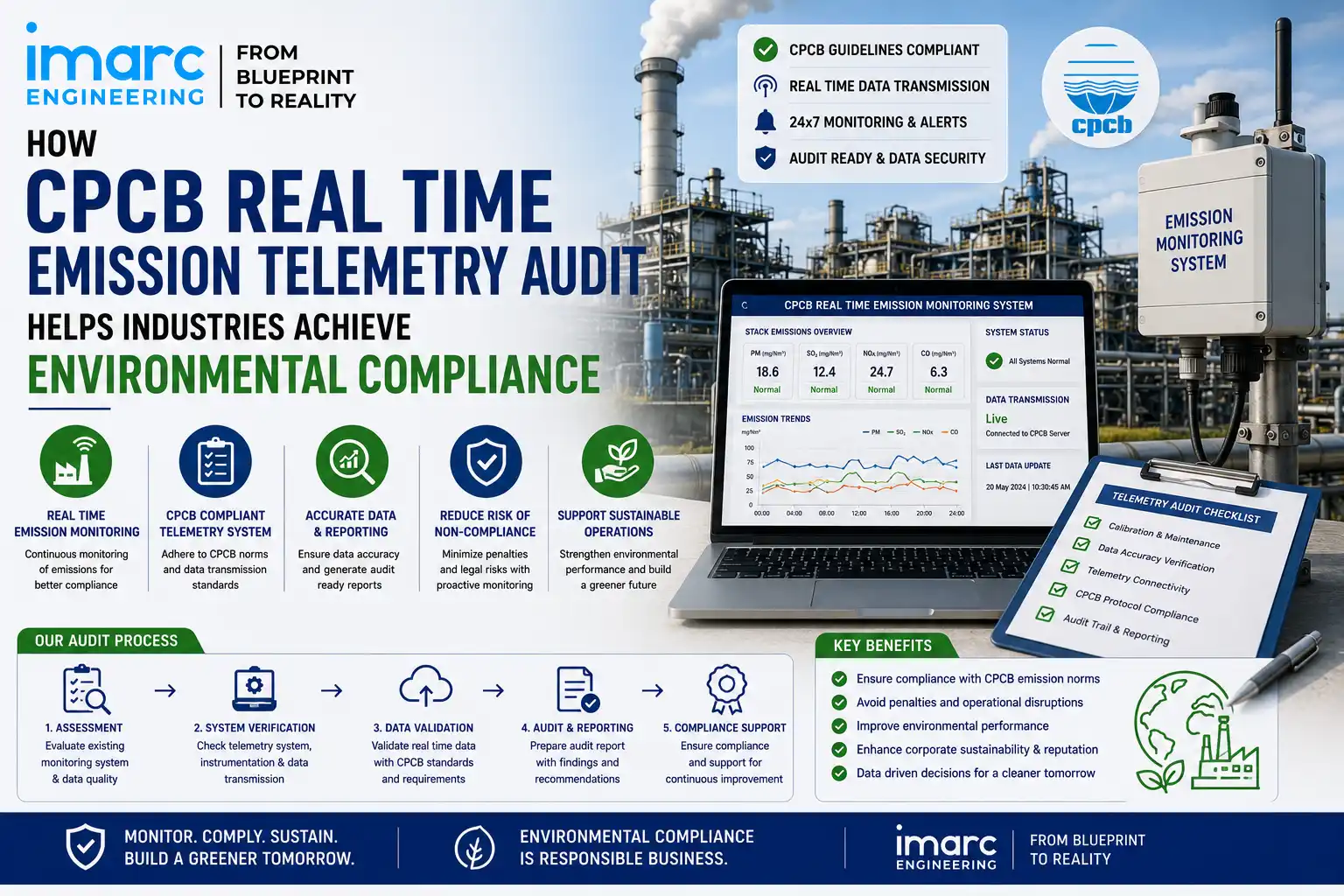
A CPCB Real Time Emission Telemetry Audit verifies that monitoring systems accurately capture, transmit, and report emissions data before regulators identify compliance gaps.
IMARC Engineering provides CPCB Real Time Emission Telemetry Audit services, helping manufacturers verify OCEMS performance, telemetry accuracy, regulatory reporting, and environmental compliance across India. This article explains what the audit covers, why real-time telemetry compliance has become non-negotiable, and how a structured audit process helps industries close gaps before they trigger penalties or closure directions.
Why CPCB Real Time Emission Telemetry Audit Has Become Central to Environmental Compliance
Several regulatory and enforcement developments are converging to make telemetry-based verification unavoidable for industrial units.
Scale of the Mandate
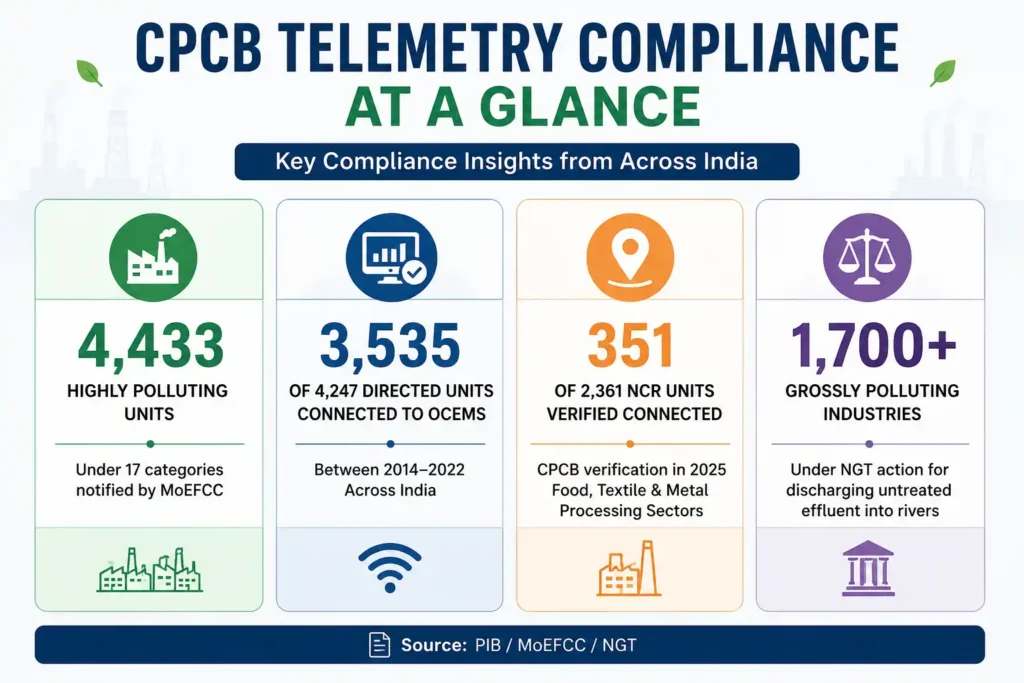
There are 4,433 highly polluting industrial units across 17 categories in India, including pulp and paper, distilleries, sugar, tanneries, power plants, cement, oil refineries, fertiliser, and pharmaceuticals, per the Ministry of Environment, Forest and Climate Change. Between 2014 and 2022, out of 4,247 directed industrial units, 3,535 had installed and connected Online Continuous Emission Monitoring Systems (OCEMS) to CPCB and State Pollution Control Board servers, per PIB data.
NCR Enforcement Has Intensified
CPCB verification in 2025 found that out of 2,361 air-polluting units in the Food and Food Processing, Textile, and Metal Processing sectors across Delhi-NCR, only 351 units had their OCEMS connected to CPCB servers, leaving over 2,000 units non-compliant. CPCB has since mandated OCEMS and PTZ camera installation for these sectors, with a hard compliance deadline of December 31, 2025.
A New Reporting Portal Has Replaced the Old One
CPCB issued a fresh directive under the Water Act, 1974 and Air Act, 1981, requiring all industries to register on a new OCEMS/ODAMS portal, submitting location coordinates, sector classification, analyser details, and station metadata for direct real-time transmission to CPCB servers.
Judicial Pressure Is Rising
The National Green Tribunal has directed CPCB and state regulators in Delhi, Uttar Pradesh, Haryana, and Bihar to act against more than 1,700 Grossly Polluting Industries discharging untreated effluent into the Ganga, Yamuna, and other water bodies, citing failure to install functioning Online Continuous Effluent Monitoring Systems.
Classification Determines the Obligation
CPCB’s CEMS guidelines, issued in August 2017 and revised in August 2018, mandate continuous emission monitoring specifically for Red category industries, tying the telemetry obligation directly to a unit’s pollution classification. The regulatory direction is clear— real-time telemetry is no longer optional compliance infrastructure. It has become the primary evidence regulators use to determine environmental compliance status.
Why Unverified Telemetry Systems Create Legal and Commercial Risk
Most telemetry failures are not detected by the industry itself. They surface during a regulatory inspection, a court-mandated review, or an SPCB data audit — at which point remediation options narrow considerably.
The consequences of unverified or malfunctioning real-time monitoring systems include:
- Closure directions: SPCBs and PCCs are directed to issue closure orders to units operating without installed and connected OCEMS, particularly in Red category and NCR sectors.
- Penal action: Non-registration on the new OCEMS/ODAMS portal or continued non-connectivity can trigger action under the Water Act and Air Act.
- CTO/CTE renewal delays: Consent to Operate and Consent to Establish renewals increasingly require demonstrated telemetry connectivity, not just a certificate on file.
- Export and ESG exposure: Buyers and certification bodies conducting supply chain due diligence treat environmental non-compliance as a material ESG red flag.
- Data integrity and audit trail gaps: Analyzers that are installed but poorly calibrated generate inaccurate readings that can trigger false alerts or, worse, mask real exceedances.
- GRAP-linked shutdowns: In NCR and other non-attainment cities, units without verified real-time monitoring are the first to be shut down under Graded Response Action Plan restrictions during high-pollution periods.
A structured telemetry audit identifies these gaps in a controlled setting, before a regulator does.
Why Environmental Compliance Begins Before Telemetry Installation
While a CPCB Real Time Emission Telemetry Audit evaluates the performance of an operating monitoring system, long-term compliance actually begins much earlier—with site selection, environmental approvals, statutory permissions, and legal due diligence. Understanding these regulatory requirements at the planning stage helps industries avoid future compliance gaps, penalties, and project delays.
Core Components of a CPCB Real Time Emission Telemetry Audit Process
A credible audit examines the full chain — from the sensor at the stack to the data reaching the CPCB server — across six interconnected areas.
1. Analyzer and Sensor Verification
- Confirmation that installed analyzers are CPCB-approved for the relevant parameters (PM, SO₂, NOx, and effluent-specific parameters)
- Physical inspection of sampling points, probes, and sensor placement against stack geometry requirements
- Verification that analyzer specifications match the unit’s actual process and fuel profile
2. Data Connectivity and Server Integration
- End-to-end testing of data transmission from the analyzer to the CPCB and SPCB servers
- Confirmation of active registration on the current OCEMS/ODAMS portal
- Confirmation of 24×7 uptime and identification of transmission gaps or blackout periods
3. Calibration and Accuracy Audit
- Review of calibration schedules, calibration gas certificates, and drift correction records
- Cross-verification of analyzer readings against manual stack monitoring results
- Assessment of maintenance logs and analyzer service history
4. Alert and Escalation Testing
- Verification that automatic SMS/email alerts trigger correctly when readings exceed prescribed norms
- Testing of internal escalation protocols once an alert is received
- Review of corrective action turnaround time for past exceedance events
5. Regulatory Documentation Review
- Cross-check of CTE/CTO conditions against actual monitoring commitments
- Verification of category classification (Red/Orange/Green/White) and its telemetry implications
- Review of prior CPCB/SPCB correspondence, notices, and compliance directions
6. Portal Registration and Reporting Compliance
- Confirmation of active registration on the current OCEMS/ODAMS portal
- Review of historical data submission consistency and reporting gaps
- Documentation readiness for SPCB inspection or NGT-linked review
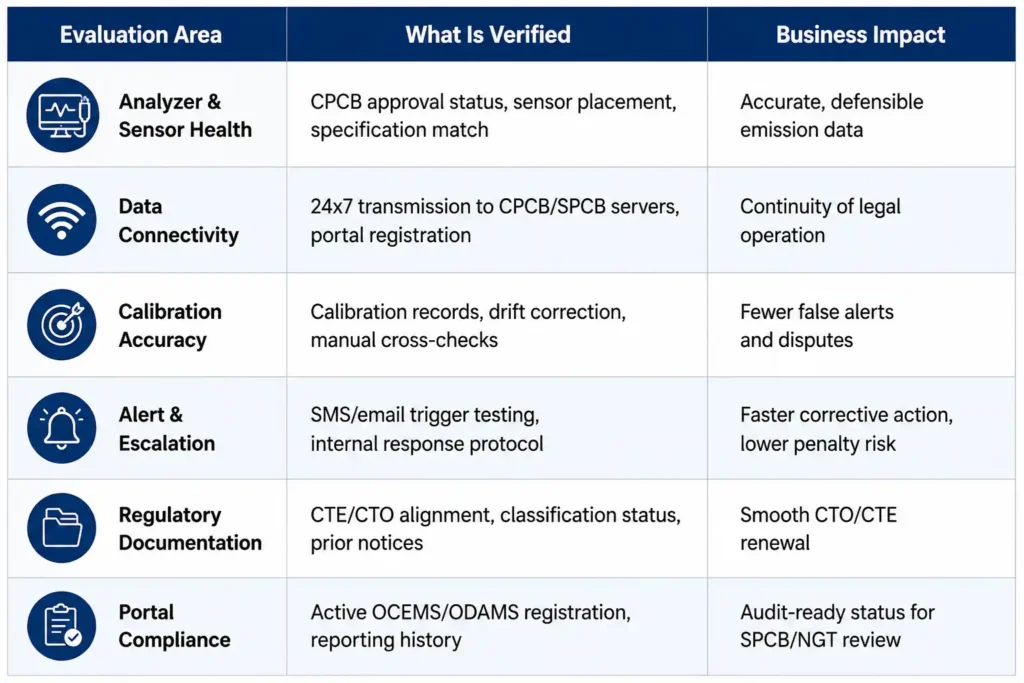
CPCB Telemetry Audit: Evaluation Areas and Business Impact
The table below summarizes what each stage of the audit verifies and the business outcome it protects.
How IMARC Engineering Conducts CPCB Real Time Emission Telemetry Audits
IMARC Engineering follows a structured methodology for CPCB Real-Time Emission Telemetry Audits, built around verified on-site evidence rather than self-declared compliance status.
- Pre-audit documentation review: Assessing existing CTE/CTO conditions, category classification, and prior CPCB/SPCB correspondence before any site visit.
- On-site analyzer and connectivity verification: Physical inspection of installed analyzers, sampling points, and live data transmission to CPCB and SPCB servers.
- Calibration and accuracy testing: Cross-checking analyzer output against manual monitoring and calibration certification.
- Alert and escalation simulation: Testing whether exceedance alerts trigger correctly and whether internal response protocols function as intended.
- Gap reporting and remediation roadmap: Structured documentation of every gap, ranked by regulatory and operational risk, with a corrective action timeline.
- Ongoing compliance advisory: Support with OCEMS/ODAMS portal registration, CTE/CTO renewal alignment, and preparation for SPCB or NGT-linked reviews.
IMARC Engineering supports this audit across pharmaceuticals, chemicals, cement, power, food processing, textiles, metal processing, and other sectors covered under CPCB’s 17 highly polluting categories.
Schedule a CPCB Real-Time Emission Telemetry Audit to identify compliance gaps before regulatory inspections: https://www.imarcengineering.com/contact?service=environmental-compliance-audits
Common Mistakes Industries Make in Telemetry Compliance
- Assuming installation equals compliance: An installed analyzer that is not connected, calibrated, or transmitting live data does not satisfy CPCB’s telemetry requirement.
- Ignoring calibration drift: Analyzers that are never recalibrated gradually report inaccurate readings, creating both false alerts and undetected exceedances.
- Treating portal registration as a one-time task: Migration to the new OCEMS/ODAMS portal requires active re-registration; industries that skip this step risk being treated as non-compliant by default.
- No internal escalation protocol: Receiving an automatic exceedance alert without a defined internal response process delays corrective action and compounds regulatory exposure.
- Overlooking classification changes: A unit reclassified from Orange to Red category inherits new telemetry obligations that are frequently missed until an inspection flags them.
- Relying on vendor self-certification: Accepting an analyzer vendor’s compliance claim without independent verification leaves gaps undiscovered until CPCB or SPCB conducts its own check.
Conclusion
India’s shift toward real-time, continuous environmental monitoring means emission and effluent data now reaches regulators the moment it is generated. For manufacturers, exporters, and industrial businesses, this makes a CPCB Real Time Emission Telemetry Audit a core part of operational risk management, not a compliance formality.
Analyzer accuracy, data connectivity, calibration integrity, alert responsiveness, documentation alignment, and portal registration together determine whether a facility can demonstrate genuine compliance when a regulator, court, or investor asks for evidence.
Through structured CPCB Real Time Emission Telemetry Audit services, calibration verification, telemetry validation, OCEMS compliance reviews, and portal registration support, IMARC Engineering helps industries across India identify compliance gaps before they lead to penalties, closure notices, or operational disruptions.
Contact Us:
IMARC Engineering
Phone: +91-120-433-0800
Email: sales@imarcengineering.com
India: C-130, Sector 2, Noida, Uttar Pradesh 201301
LinkedIn: https://www.linkedin.com/showcase/imarc-engineering
About the Author