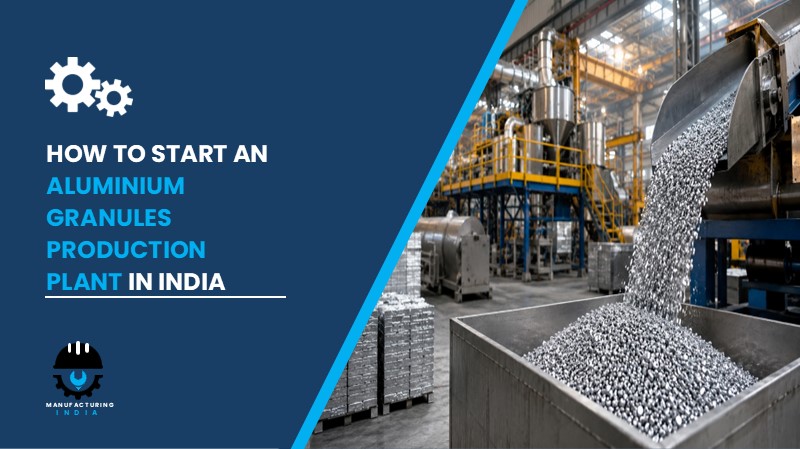
Setting up an aluminium granules production plant in India presents a compelling investment case, driven by strong and diversified demand from steel manufacturing, chemicals, pyrotechnics, aerospace & defense, automotive, additive manufacturing, and industrial manufacturing sectors. Aluminium granules are used as a deoxidizer and alloying agent in steel production, a reducing agent in chemical processes, feedstock for powder metallurgy, additive manufacturing (3D printing), pyrotechnic formulations, thermal spray coatings, and specialized industrial applications. Because these granules retain aluminium’s core properties of lightweight strength, corrosion resistance, and high thermal and electrical conductivity, they remain indispensable across multiple industrial value chains.
India’s push toward domestic metal production, infrastructure expansion, and defence indigenization under Make in India programs is strengthening demand for aluminium-based industrial materials, including aluminium granules. Steel producers, chemical manufacturers, and industrial processors are increasingly seeking reliable domestic suppliers to minimize lead times, reduce import dependence, and ensure uninterrupted supply – a strategically sound opening for regional producers.
This investment benefits from policy support under Make in India, cost-competitive economics, and steady demand from steel, chemicals, and advanced manufacturing sectors. With gross margins of 14–22% and net margins of 5–10%, it offers a credible path to break-even viability.
What is Aluminium Granules?
Aluminium granules are small, uniform particles of pure aluminium or aluminium alloys, typically ranging in size from 1 mm to 15 mm. They are produced by melting the metal and cooling it into solid, free-flowing grains — a safer, denser, less explosive alternative to fine aluminium powder. In metallurgy, they are used for metal alloying, deoxidation, and master alloy production, while in manufacturing they act as resin fillers for cold cast metal effects and vacuum-formed components.
The aluminium granules production process is centered on melting of primary aluminium ingots (or recycled scrap), refining, atomization using inert gas, cooling, screening, grading, and packaging. End-use industries served include metallurgy, steel manufacturing, chemicals, pyrotechnics, aerospace & defense, automotive, additive manufacturing, and industrial manufacturing.
Cost of Setting Up an Aluminium Granules Production Plant in India
Cost depends on capacity, technology, location, automation, and regulatory compliance.
1. Capital Expenditure (CapEx)
Capital investment for the aluminium granules production plant depends on capacity, technology, and location, covering land acquisition, site preparation, and infrastructure. Land and site development – including registration, boundary development, and related charges – forms a substantial part of the investment; investors can evaluate industrial estates or designated zones offering robust infrastructure, transportation, and utilities, while ensuring compliance with local zoning and environmental regulations.
Civil works cover production sheds, quality-testing areas, storage, and administrative blocks. Machinery costs account for the largest share of capital expenditure, with scale and automation level determining the total.
Key machinery required includes:
- Melting furnaces
- Holding furnaces
- Inert gas atomization systems
- Metal delivery nozzles
- Cooling chambers
- Cyclone separators
- Screening and grading units
- Dust collection systems
- Storage silos
- Packaging machines
Other capital costs cover utility setup (electricity, water, steam) and pre-operative and commissioning expenses.
Request a Sample Report for In-Depth Market Insights: https://www.imarcgroup.com/aluminium-granules-manufacturing-plant-project-report/requestsample
2. Operational Expenditure (OpEx)
Raw material cost is the largest component of operating expenses. Aluminium ingots (or aluminium scrap for the secondary route) and inert gas (argon/nitrogen for atomization) together account for approximately 65–72% of total OpEx, making long-term supplier contracts essential to mitigate price volatility.
Utility cost, covering electricity, water, and steam, accounts for approximately 14–18% of OpEx. Other costs include transportation, packaging, salaries and wages, maintenance, depreciation, and taxes.
By the fifth year, total operational cost is expected to rise substantially due to inflation, market fluctuations, rising raw material costs, supply chain disruptions, and broader shifts in the global economy.
3. Plant Capacity
The facility is designed with an annual production capacity ranging between 5,000–15,000 MT, enabling economies of scale while maintaining flexibility. Capacity can be customized based on investor requirements, and profitability generally improves with higher capacity utilisation.
4. Profit Margins and Financial Projections
Financial projections cover ROI, net present value (NPV), profitability, and long-term sustainability, based on capital investment, operating costs, capacity utilization, and demand outlook. Gross profit margins typically range between 14–22%, while net profit margins range between 5–10%. Payback period, liquidity, and internal rate of return figures form part of the full financial analysis.
Why Set Up an Aluminium Granules Plant in India?
Essential Industrial Raw Material Demand. Aluminium granules are widely used in steel deoxidation, thermite formulations, chemical processing, pyrotechnics, metallurgy, pigments, and additive manufacturing.
Megatrend Alignment. Expanding steel production, growing demand for lightweight materials, rapid industrialization, and advanced manufacturing technologies are driving steady demand, alongside rising infrastructure, automotive lightweighting, and renewable energy investments.
Policy and Regulatory Tailwinds. Government initiatives promoting domestic metal production, infrastructure expansion, defence indigenization, and Make in India programs are strengthening demand for aluminium-based industrial materials.
Cost-Competitive, Moderately Barriered Entry. Production is less capital-intensive than advanced metal manufacturing, though uniform particle size, controlled granulation, and stringent safety standards create meaningful entry barriers favouring technically proficient operators.
Active Renewable and Industrial Investment. As per the Ministry of New and Renewable Energy, India added a record 44.5 GW of renewable energy capacity in 2025 — activity that reinforces broader aluminium consumption trends.
Local Supply Chain Preference. Steel producers, chemical manufacturers, foundries, and industrial processors increasingly seek reliable domestic suppliers to minimize lead times and reduce import dependence.
Manufacturing Process – Step by Step
The aluminium granules production process uses melting, refining, and inert-gas atomization as the primary method, followed by cooling, screening, grading, and packaging.
- Melting: Aluminium ingots (or recycled aluminium scrap) are melted in melting furnaces.
- Refining and holding: The molten metal is refined and held at process temperature in holding furnaces.
- Atomization: Molten aluminium is dispersed into fine droplets using inert gas atomization systems with argon or nitrogen, via metal delivery nozzles.
- Cooling: Droplets solidify into granules as they pass through cooling chambers.
- Separation: Cyclone separators separate solidified granules from the process gas stream.
- Screening and grading: Screening and grading units sort granules by particle size.
- Dust control: Dust collection systems manage fine particulates for safety and environmental compliance.
- Storage and packaging: Granules are held in storage silos, packed using packaging machines, and dispatched to end-use industries such as metallurgy, chemicals, and aerospace & defense.
Key Applications
- Steel & Metallurgy: Deoxidizer, alloying additive, and reducing agent in steel and ferroalloy production.
- Chemical Industry: Production of aluminium-based chemicals, reducing agent in chemical synthesis, and catalyst applications.
- Pyrotechnics & Explosives: Manufacture of fireworks, pyrotechnic compositions, thermite mixtures, and explosive formulations.
- Refractories & Advanced Materials: Refractory materials, ceramics, powder metallurgy products, and additive manufacturing feedstock.
Leading Manufacturers
Leading producers in the global aluminium granules industry include:
- Alcoa Corporation
- ALTANA AG (via ECKART Division)
- AMG Advanced Metallurgical Group N.V.
- Metal Powder Company Ltd. (MEPCO)
Timeline to Start the Plant
- Feasibility study and project report preparation
- Land acquisition and site development
- Regulatory approvals and environmental clearances
- Factory licence and fire safety compliance
- Machinery procurement and installation
- Raw material supplier agreements and supply chain setup
- Trial production and quality testing
- Commercial production launch
Licences and Regulatory Requirements
Starting an aluminium granules production unit in India requires several approvals:
- Business registration (Proprietorship, LLP, or Pvt Ltd)
- Factory Licence under the Factories Act
- Environmental Clearance from State Pollution Control Board
- GST Registration
- Fire Safety NOC
- Hazardous/chemical handling compliance for inert gas and metal processing
- Effluent Treatment Plant (ETP) operational clearance
- Occupational Health and Safety compliance
Key Challenges to Consider
High Capital Requirements. Machinery costs, including melting furnaces, atomization systems, and screening and grading units, account for the largest share of capital expenditure.
Raw Material Price Volatility. Aluminium ingots (or scrap) and inert gas together make up 65–72% of OpEx, so input cost swings can materially affect profitability.
Regulatory Compliance. Safety protocols, monitoring systems, and effluent treatment requirements must be implemented throughout production to meet emission standards.
Quality and Process Control Pressure. Achieving uniform particle size, controlled granulation, and high purity requires consistent process discipline, since inconsistent quality can restrict access to demanding applications like additive manufacturing.
Competition from Established Players. Global producers such as Alcoa Corporation, ALTANA AG, AMG Advanced Metallurgical Group N.V., and Metal Powder Company Ltd. (MEPCO) set a high bar for new entrants.
Skilled Manpower. Operating melting furnaces, atomization systems, and quality assurance protocols requires trained, well-supervised personnel.
Frequently Asked Questions
1. How much does it cost to set up this facility in India?
Cost depends on capacity, technology, location, automation, and regulatory compliance, covering land, civil works, machinery, and other capital costs.
2. Is aluminium granules production profitable in India in 2026?
Gross margins of 14–22% and net margins of 5–10% indicate healthy profitability potential under normal operating conditions.
3. What machinery is required for this facility in India?
Melting furnaces, holding furnaces, inert gas atomization systems, metal delivery nozzles, cooling chambers, cyclone separators, screening and grading units, dust collection systems, storage silos, and packaging machines.
4. What licences and approvals are required to start the unit in India?
Business registration, a Factory Licence, Environmental Clearance, GST Registration, Fire Safety NOC, hazardous/chemical compliance, ETP clearance, and occupational health and safety compliance.
5. What raw materials are needed for aluminium granules production?
Aluminium ingots (or scrap for the secondary route) and inert gas (argon/nitrogen for atomization).
6. What are the environmental compliance requirements for an aluminium granules plant in India?
Environmental Clearance from the State Pollution Control Board, an operational ETP, and safety/monitoring systems.
7. What is the best location to set up this facility in India?
Easy access to aluminium ingots or scrap and inert gas supply, proximity to markets, and robust transportation and utility infrastructure.
8. What is the break-even period for this type of plant in India?
It depends on capacity utilisation, pricing trends, and cost structure, detailed through payback period and NPV analysis in the full financial projections.
9. What government incentives are available for manufacturers in India?
Make in India programs and initiatives promoting domestic metal production, infrastructure expansion, and defence indigenization support demand for aluminium-based industrial materials.
Key Takeaways for Investors
This opportunity taps into steady, diversified demand from steel manufacturing, chemicals, pyrotechnics, aerospace & defense, automotive, and additive manufacturing sectors, underpinned by policy support under Make in India. The project shows healthy financial viability across its proposed 5,000–15,000 MT annual capacity range, with gross margins of 14–22% and net margins of 5–10%. With Asia-Pacific already accounting for about 44.8% of the global aluminium granules market and India’s renewable energy build-out – including a record 44.5 GW of capacity added in 2025 – continuing to drive aluminium consumption, demand fundamentals for domestically produced aluminium granules appear well-positioned for long-term investor interest.
About the Author