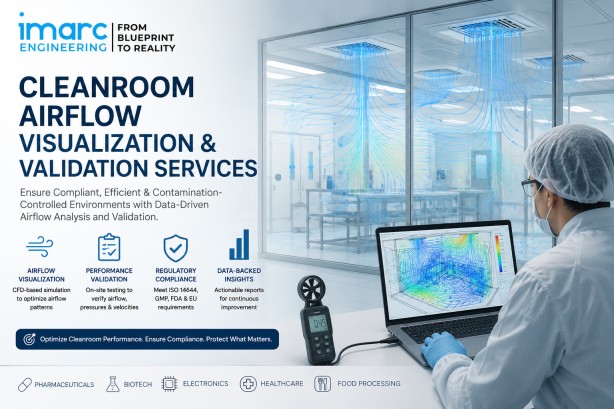
cleanroom airflow visualization and validation services
Contamination control is the single largest determinant of product safety in sterile pharmaceutical, biologic, and medical device manufacturing. At the centre of that control system is airflow visualization (smoke studies), one of the most critical qualification exercises for demonstrating that cleanroom airflow protects products, operators, and critical processing zones.
India’s cleanroom technology market illustrates why this exercise has moved from a “nice to have” to a regulatory non-negotiable. The domestic cleanroom HVAC segment alone is projected to approach USD 3.95 billion in 2026, while the broader cleanroom technologies market in India is expected to cross USD 636 million by 2033, growing at close to a 9.9% CAGR from 2026 onward, driven largely by pharmaceutical, biologics, and medical device expansion (Fortune Business Insights, 2026).
Globally, the cleanroom technologies market is on a similar trajectory, moving from roughly USD 10.99 billion in 2026 toward USD 17.67 billion by 2034, with Asia-Pacific identified as the fastest-growing region on the back of pharmaceutical and biologics capacity additions . As facility footprints expand, the number of qualification cycles requiring airflow visualization is expanding just as fast.
Why Airflow Visualization Has Become a Compliance Priority
The regulatory push behind smoke studies strengthened significantly after the 2022 revision of EU GMP Annex 1, which made airflow visualization an explicit, non-optional requirement for facilities relying on unidirectional airflow to protect Grade A and Grade B zones. The revision introduced a firm requirement to run these studies under both static and dynamic conditions, and to document them through synchronised video recordings that also capture operator movement and equipment interaction (ZeroFrame, 2026).
India’s regulatory landscape has tightened in parallel. The Drugs Controller General of India has directed state regulators to enforce the revised Schedule M, which upgrades the country’s GMP framework to align with WHO-GMP, PIC/S, and EU-GMP expectations (Drishti IAS, 2026). Industry estimates suggest that of India’s roughly 10,500 pharmaceutical manufacturing units, only around 2,000 currently hold WHO-GMP certification, leaving a substantial compliance gap. This gap is now driving increased demand for cleanroom airflow visualization and validation services, as facility upgrades, particularly in cleanroom HVAC systems and airflow qualification become critical to achieving regulatory compliance.
For manufacturers, this means smoke studies are no longer confined to initial qualification. They must be repeated whenever there is a change to process, equipment layout, operator intervention pattern, or applicable regulation, and increasingly form part of a routine, risk-based requalification schedule.
What Airflow Visualization Actually Verifies
An airflow visualization study uses a controlled release of visible smoke or fog, typically from a smoke generator or an oil-based aerosol source, to make the invisible movement of air observable and recordable. The objective is not decorative; it confirms that:
- Unidirectional airflow in Grade A/ISO Class 5 zones stays undisturbed and protects the critical zone from ingress of lower-grade air
- Air does not recirculate into dead zones around equipment, fixtures, or operator positions
- Pressure cascades between adjacent rooms of differing grades function as designed, particularly at doorways, pass-throughs, and material transfer points
- Airflow patterns remain protective both “at rest” (no personnel or equipment activity) and “in operation” (simulated interventions, filling, stoppering, and other aseptic activities)
Where filled or closed products move to an adjacent, lower-grade cleanroom through a small egress point, the study must specifically demonstrate that air does not travel backward from the lower-grade space into the protected zone (PDA, 2026). This is precisely the failure mode a smoke study is designed to catch before it becomes a batch-level contamination event.
Step-by-Step Methodology for a Compliant Smoke Study
1. Define the Study Protocol and Risk Basis
Before any smoke is released, the protocol should identify the rooms, equipment, and critical zones under test, the acceptance criteria for airflow direction and velocity, camera positions, and the operational scenarios to be simulated. The protocol should be risk-based, prioritising Grade A/B zones, filling lines, and any area with a documented history of environmental monitoring excursions.
2. Position Smoke Sources Correctly
Smoke feeders must sit perpendicular to the direction of unidirectional airflow and, wherever possible, release close to the HEPA filter face rather than mid-room, using flexible hose extensions to reach larger coverage areas (AZoM, 2026). Smoke density must be sufficient to show turbulence and direction clearly without obscuring the camera’s field of view.
3. Capture At-Rest and In-Operation Conditions
Every critical zone should be filmed under both states: machinery running with no personnel present, and full simulated operation with gowned operators performing representative interventions. Regulators now treat this dual documentation as a formal validation tool rather than optional good practice, reinforcing the technical rigour expected of the study.
4. Record, Timestamp, and Retain Video Evidence
Multiple synchronised camera angles give inspectors a complete, unambiguous view of airflow behaviour at each critical point. All footage, along with the protocol, raw observations, and any deviation notes, must be retained as part of the validation package, since FDA and European inspections typically begin by reviewing the smoke study protocol, raw video, study report, investigation records, CAPA documentation, and risk assessments (Pharmaguideline, 2026).
5. Analyse, Document Deviations, and Take Corrective Action
Reviewers should look specifically for reverse flow at doorways, eddies around equipment corners, and stagnation zones near critical surfaces. Where a deviation is found, corrective engineering action, such as adjusted diffuser placement, revised equipment layout, or additional return-air grilles, must be implemented and retested before the room is released for use.
6. Establish a Requalification Cadence
Smoke studies are not a one-time event. They should be repeated after any change that could plausibly affect airflow, and on a scheduled basis aligned with the facility’s broader requalification and environmental monitoring programme.
Common Pitfalls That Undermine Study Validity
- Releasing smoke too far from the filter face, masking turbulence close to the source
- Testing only the “at rest” condition and skipping simulated interventions, missing the disruption operators actually cause
- Insufficient camera coverage, leaving blind spots at doorways and equipment corners that inspectors specifically look for
- Treating the study as a one-time qualification exercise instead of integrating it into change control and periodic requalification
Industry-Specific Considerations
- Sterile injectables and biologics manufacturers need particular focus on filling line first-air protection and pressure cascades between the Grade A/B core and surrounding support rooms
- Biotechnology R&D and vaccine production facilities must validate airflow around cell culture and fermentation zones where bioburden sensitivity is high
- Medical device manufacturers operating under ISO/GMP-controlled environments need airflow verification calibrated to their specific ISO 14644 classification and assembly line layout
- Food and nutraceutical processors working in hygienic zones benefit from the same principles applied at a lower classification tier, focused on preventing cross-contamination between processing stages
- EPCM consultants and facility engineering teams should build airflow visualization checkpoints into the commissioning schedule rather than treating it as a late-stage validation add-on
Where This Is Heading in 2026
- Facility teams are increasingly pairing traditional smoke studies with computational fluid dynamics (CFD) modelling to predict airflow behaviour at the design stage, reducing costly rework after installation.
- 2026 industry trend data points to Asia-Pacific as the fastest-expanding cleanroom capacity region, driven by India and China clinical trial outsourcing and CDMO expansion, with growth shifting toward modular, digitally monitored cleanroom architectures that integrate IoT and AI-based validation systems
- For India specifically, the compliance deadline pressure tied to the revised Schedule M means airflow qualification is now a board-level capital planning item, not just a quality assurance checklist entry.
- Facilities that build CFD-based airflow prediction and smoke study readiness into project design at the DPR stage, rather than retrofitting compliance after construction, are positioned to move through Schedule M gap assessments and WHO-GMP audits with far fewer costly design reversals.
How IMARC Engineering Can Help
IMARC Engineering supports pharmaceutical, biotechnology, medical device, and food processing manufacturers across the full cleanroom validation lifecycle, from protocol design and smoke study execution to deviation investigation, CFD-based airflow modelling, and Schedule M, WHO-GMP, and EU-GMP compliance documentation. Our engineering and validation teams work directly with plant heads, QA leaders, and EPCM project teams to ensure airflow visualization studies are executed correctly the first time and stand up to regulatory scrutiny.
If your facility is preparing for initial cleanroom qualification, a requalification cycle, or a Schedule M compliance upgrade, IMARC Engineering’s validation specialists can help design and execute a study protocol suited to your specific process and risk profile.
Consult IMARC Engineering’s Cleanroom Validation Specialists: https://www.imarcengineering.com/contact?service=clean-room-and-cold-chain-design
Frequently Asked Questions
1. What is an airflow visualization (smoke study)?
It’s a qualification test using visible smoke to show how air actually moves in a cleanroom, confirming unidirectional airflow protects critical zones as designed.
2. When should smoke studies be repeated?
After any change to process, layout, equipment, or interventions affecting airflow, plus on a scheduled, risk-based requalification cadence tied to environmental monitoring programmes.
3. Is airflow visualization mandatory under Annex 1?
Yes. The 2022 EU GMP Annex 1 revision explicitly requires airflow visualization studies under static and dynamic conditions for unidirectional airflow zones, with video documentation.
4. What is the difference between static and dynamic smoke studies?
Static (“at rest”) tests airflow with machinery running but no personnel; dynamic (“in operation”) tests airflow during simulated interventions with gowned operators present.
5. How does airflow visualization support Schedule M compliance?
Revised Schedule M aligns India’s GMP with WHO-GMP and EU-GMP, requiring validated airflow and HVAC performance; smoke studies provide the documented evidence.
Contact Us:
IMARC Engineering
Phone: +91-120-433-0800
Email: sales@imarcengineering.com
India: C-130, Sector 2, Noida, Uttar Pradesh 201301
LinkedIn: https://www.linkedin.com/showcase/imarc-engineering/
About the Author