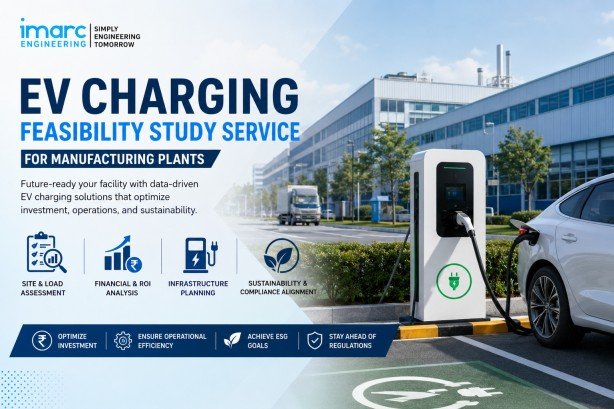
India’s industrial sector is entering a decisive phase in its electric mobility transition. For manufacturing plants, this shift is no longer confined to corporate sustainability pledges; it now touches daily plant operations, from in-plant material handling to outbound logistics fleets and employee transport. A structured EV charging feasibility study service for manufacturing plants has become the essential first step before any capital is committed to charging infrastructure, ensuring that electrical, spatial, regulatory, and financial factors are evaluated together rather than in isolation.
Recent industry signals underline the pace of this shift:
- Electric truck registrations nearly quadrupled in the first five months of 2026
- Vedanta has reported that around 14 percent of its light motor vehicle fleet has already transitioned to electric mobility
- UltraTech Cement has deployed electric trucks for bulk logistics and plans to gradually replace conventional diesel vehicles across its network
- Truck makers report a sharp rise in enquiries from industrial and logistics customers, citing fuel-cost volatility and supply-chain resilience as key drivers
Why an EV Charging Feasibility Study Matters Now
Manufacturing plants differ fundamentally from public charging locations. They combine high, often already-stressed industrial electrical loads with fleet charging patterns that must align with shift schedules, production uptime, and safety zoning. Unlike a standalone public charging station, a plant cannot simply add load without first understanding how it interacts with existing production-critical circuits. A comprehensive feasibility study helps manufacturers answer three critical engineering and investment questions:
- How much additional load can the site safely absorb
- Where should charging infrastructure physically sit within an operating facility
- What is the realistic payback period once tariffs, subsidies, and utilization are factored in
Policy momentum reinforces the urgency:
- The PM E-DRIVE scheme carries a ₹10,900 crore outlay running through March 2026 (with charging-infrastructure support extended to March 2028)
- ₹2,000 crore of this is earmarked specifically for public and semi-public charging deployment, targeting roughly 72,300 stations nationwide
- As of March 2026, government data recorded 27,737 chargers installed and 22,753 operational, concentrated heavily in Uttar Pradesh, Karnataka, Maharashtra, and Tamil Nadu
- Industrial estates and manufacturing clusters in these states are increasingly expected to integrate charging readiness into new project approvals
The Six-Step EV Charging Feasibility Framework
Step 1: Define the Charging Demand Profile
Every feasibility study begins with an honest inventory of present and projected EV load, covering:
- In-plant material handling equipment (forklifts, tuggers) transitioning to electric variants
- Outbound and inbound logistics fleets, particularly electric trucks and light commercial vehicles
- Employee and visitor vehicle charging needs
- Captive shuttle or bus fleets for large campuses
Plants should model a three-to-five-year adoption curve rather than sizing for today’s fleet alone, since under-provisioning capacity now often means a costly retrofit later. Charger type should also be matched to use case:
- Slow AC charging for overnight fleet and employee parking
- DC fast charging for high-utilization logistics fleets that need rapid turnaround between shifts
Step 2: Assess Electrical Load and Grid Capacity
This is the technical core of the study. Engineers evaluate the plant’s existing sanctioned load, transformer headroom, and substation capacity against the additional demand that AC and DC fast chargers will introduce. Key considerations include:
- Peak demand overlap between production processes and charging windows
- Feeder capacity margins, with CEA-aligned guidance recommending a 1.25x safety buffer over calculated load
- Harmonics and power quality impacts of DC fast chargers on sensitive manufacturing equipment
- DISCOM coordination for load enhancement approvals and, where applicable, dedicated EV tariff categories
EV charging is a de-licensed activity under the Electricity Act, 2003, so manufacturers do not need a separate distribution license to install captive chargers. However, installations must still meet:
- Central Electricity Authority safety regulations
- Bureau of Indian Standards specifications, including IS 17017-1 and -2 for AC chargers and IS 17017-23/24 for DC fast chargers above 50 kW
Step 3: Plan Site Layout and Infrastructure Placement
Manufacturing sites carry constraints that public charging locations do not: fire safety zoning, hazardous material storage, restricted vehicular movement paths, and existing utility corridors. Charging infrastructure must be woven into an already-functioning industrial layout without disrupting production flow or safety clearances. A feasibility study should map:
- Proximity of charging bays to fleet parking, loading docks, and shift-change traffic flow
- Cable routing and conduit paths that avoid production-critical zones
- Canopy, ventilation, and fire suppression requirements for DC fast charging clusters
- Future expansion space, since charger counts typically grow in phases rather than all at once
Retrofitting cable trenches or transformer positions after commissioning is significantly more expensive than planning for them upfront, making this sequencing one of the most common sources of cost overruns in industrial charging projects.
Step 4: Confirm Regulatory and Compliance Requirements
Compliance in an industrial setting spans multiple regulators:
- Chargers must carry valid type-test certification
- Installation must be executed by a licensed electrical contractor under a certified competent person, per CEA’s safety regulations
- Open communication protocols such as OCPP 1.6J or 2.0.1 are increasingly expected for networked chargers, supporting interoperability and future integration with plant energy management systems
- Plants under environmental or ESG disclosure frameworks should align charging documentation with BRSR reporting requirements, since fleet electrification data increasingly feeds into corporate sustainability disclosures
Step 5: Build the Cost-Benefit and ROI Model
A feasibility study is only actionable once it translates technical findings into financial terms. This stage should model:
- Capital cost across chargers, civil works, transformer upgrades, and DISCOM charges
- Applicable PM E-DRIVE and state-level subsidies, which can offset a meaningful share of upstream power infrastructure costs on qualifying projects
- Operating costs under industrial or EV-specific tariff structures, weighed against diesel or fuel-cost baselines for fleet vehicles
- Potential carbon credit generation under India’s Carbon Credit Trading Scheme for large-scale green charging deployments
Financing structure comparison and sensitivity analysis both matter at this stage:
- Outright capital purchase, charging-as-a-service arrangements, and leasing models each shift the balance between upfront capital exposure and long-term operating cost
- Utilization assumptions, tariff changes, and subsidy timelines all move the payback period, so decision-makers should see a range of outcomes rather than a single optimistic projection
Step 6: Sequence Implementation and Commissioning
The final stage converts findings into an executable roadmap:
- Procurement of certified equipment
- DISCOM liaison and load sanction
- Civil and electrical works
- Commissioning tests and integration with plant monitoring systems
Phasing charger rollout against fleet electrification timelines, rather than deploying full capacity upfront, helps plants match capital spend to actual utilization.
Watch The Latest Insight
Key Trends Shaping EV Charging Feasibility in 2026
Several developments are directly relevant to feasibility planning this year:
- The Ministry of Heavy Industries’ national conference on charging infrastructure, held in Bengaluru in May 2026, approved nearly 4,900 additional public chargers worth over ₹500 crore
- The same event announced the Unified Bharat eCharge platform, a single digital interface intended to standardize charger discovery and payments across operators, signaling greater interoperability expectations for new industrial deployments
- Corporate fleet electrification is accelerating well beyond pilot scale, with industrial groups across cement, mining, and metals reporting double-digit percentages of light vehicle fleets already converted
- Truck makers report a marked rise in enquiries from large industrial and logistics customers
For manufacturing plants, this means feasibility studies commissioned today should be built for a charging demand curve that will likely be steeper than current fleet composition suggests, rather than one anchored to present-day vehicle counts alone.
How IMARC Engineering Can Help
IMARC Engineering supports manufacturing plants across sectors with end-to-end EV charging feasibility studies, from electrical load assessment and DISCOM coordination to site layout planning, CEA/BIS compliance mapping, and ROI modeling. Our EPCM background means recommendations are grounded in what is practically buildable within an operating industrial facility, not just theoretical best practice, and every study we deliver accounts for the realities of a live production environment rather than a greenfield assumption alone.
Whether you are electrifying in-plant material handling, outbound logistics fleets, or planning charging infrastructure for a greenfield facility, our team helps translate feasibility findings into a phased, fundable implementation plan that keeps pace with India’s evolving EV charging policy landscape and your plant’s own growth trajectory.
Consult IMARC Engineering for an EV Charging Feasibility Study: https://www.imarcengineering.com/contact?service=ev-charging-infrastructure-advisory
Contact Us:
IMARC Engineering
Phone: +91-120-433-0800
Email: sales@imarcengineering.com
India: C-130, Sector 2, Noida, Uttar Pradesh 201301
LinkedIn: https://www.linkedin.com/showcase/imarc-engineering/
About the Author