
Inventory sits at the intersection of two things every manufacturer cares about: cash and customer service. Too much stock ties up working capital that could be funding growth elsewhere. Too little stock means missed orders and customers who go to a competitor instead. Most manufacturers do not have an inventory problem so much as an inventory accuracy problem, where the numbers in the system do not reflect what is actually on the shelf.
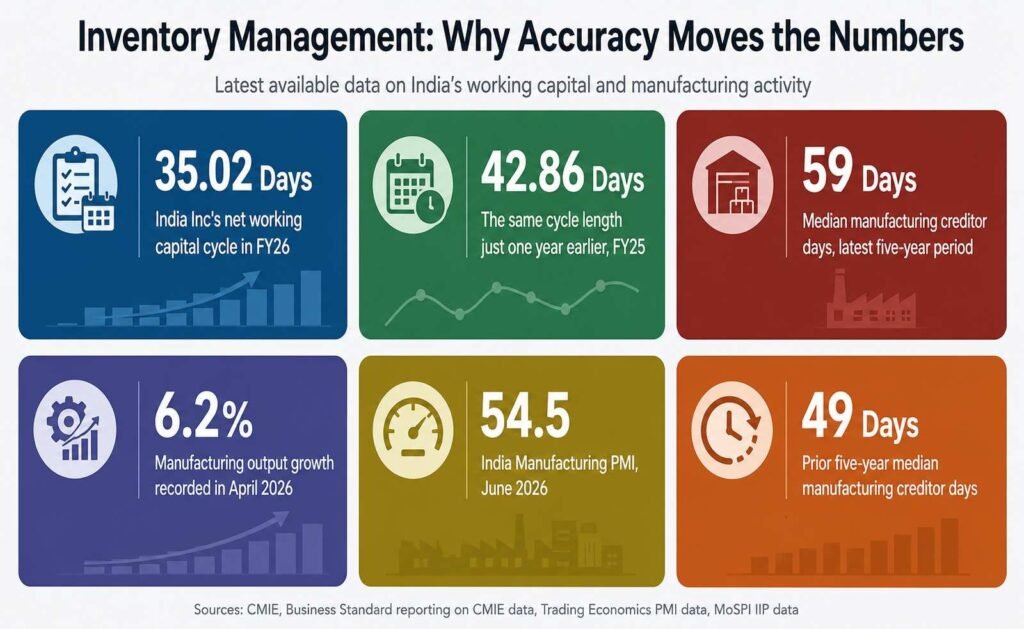
India Inc has been actively working on this exact issue. According to provisional data from the Centre for Monitoring Indian Economy, the net working capital cycle for Indian companies tightened to 35.02 days in FY26, down from 42.86 days in FY25, one of the sharpest year-on-year improvements in over a decade of tracked data. For manufacturing companies specifically, median creditor days have risen to 59 days in the latest five-year period, up from a historical median of 49 days, reflecting a deliberate effort to stretch payment cycles and free up cash tied to inventory and receivables.
This is the backdrop against which Inventory Management Consulting has become a priority rather than a back-office exercise. With manufacturing output growing 6.2% in April 2026 and factory activity continuing to expand, the volume of stock moving through Indian plants is increasing, and the cost of inaccurate inventory data scales up right alongside it.
Why Accuracy Matters More Than Volume
A facility can hold the right total value of inventory and still have a serious problem if that value is misallocated, sitting in slow-moving SKUs while fast-moving items run short. Inventory accuracy, not just inventory volume, is what determines whether a business can fulfil orders on time without carrying excess working capital.
This distinction matters because most internal reviews still measure inventory performance in aggregate, total stock value against a budgeted target, rather than at the SKU level where the actual accuracy problem lives. A plant can report healthy overall stock turns while individual product lines are simultaneously stocking out and sitting on dead inventory, a pattern that only becomes visible once accuracy is measured item by item rather than as a single facility-wide number.
The financial upside of fixing this is larger than most finance teams expect. Even a small improvement in inventory record accuracy has been shown to unlock outsized gains across gross margin, working capital, and cash flow, because inaccurate records quietly drive stockouts, overstocking, shrinkage, and forecasting errors that compound across an entire supply chain rather than staying contained to a single line item.
Where Inventory Accuracy Typically Breaks Down
Inventory accuracy problems tend to concentrate around a handful of recurring causes, and different tools address different parts of the problem.
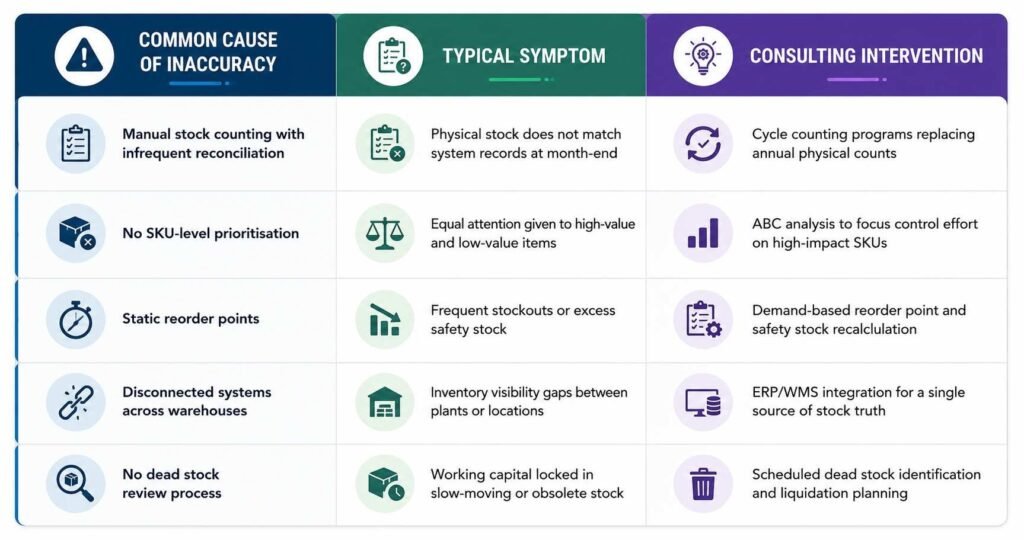
Each of these interventions addresses a different root cause, which is why a generic inventory software rollout without first identifying which of these problems a facility actually has often fails to move the needle on accuracy.
What a Structured Inventory Consulting Engagement Covers
Inventory management consulting typically works through the following sequence:
- A baseline audit comparing system records against physical stock to quantify the actual accuracy gap
- SKU segmentation using ABC or similar analysis to prioritise control effort where it has the most financial impact
- Demand pattern analysis to set reorder points and safety stock levels based on actual consumption rather than static assumptions
- Process redesign for receiving, put-away, and picking, since accuracy gaps are often introduced at these handoff points rather than during storage itself
- Implementation of a cycle counting schedule to catch and correct discrepancies continuously rather than discovering them once a year
Transform Your Inventory Management: https://www.imarcengineering.com/contact?service=inventory-optimization-and-stock-planning
The Reporting Problem Hiding Behind the Operational One
Inventory accuracy issues do not stay contained to the warehouse floor. When system records diverge from physical stock, the gap eventually surfaces in financial statements, since inventory valuation feeds directly into cost of goods sold and balance sheet figures. A facility that discovers a material stock discrepancy during a year-end audit is not just facing an operational fix, it is facing a reconciliation exercise that finance teams have to explain to auditors and, in some cases, restate figures over.
This connection is one of the reasons inventory accuracy has moved up the priority list for finance leadership rather than staying purely an operations concern. A consulting engagement that treats inventory accuracy as a finance-adjacent problem, not just a warehouse process issue, tends to get more sustained attention and budget than one framed purely around operational efficiency.
Why Timing Matters Right Now
The tightening working capital cycle across Indian manufacturing is not incidental. Companies are actively managing cash more carefully in a year marked by trade and geopolitical uncertainty, and inventory is one of the largest components of working capital a manufacturer directly controls. A facility that has not reviewed its reorder logic, safety stock assumptions, or SKU-level accuracy in this environment is leaving one of its biggest cash levers unexamined at precisely the moment competitors are tightening theirs.
Rising manufacturing output adds a second pressure point. As production volumes grow, the absolute cost of small inventory accuracy gaps grows with it, since the same percentage error now applies to a larger base of stock moving through the plant.
How IMARC Engineering Turns Stock Data Into a Financial Advantage
Improving inventory accuracy requires understanding both the physical flow of stock through a facility and the working capital implications of how that stock is managed. IMARC Engineering works with manufacturing companies across pharmaceuticals, chemicals, food processing, and industrial goods to diagnose where inventory accuracy breaks down and to redesign the processes and systems that cause it.
This includes running baseline accuracy audits against physical stock counts, segmenting inventory by value and movement to prioritise control effort where it matters most, recalculating reorder points and safety stock against actual demand patterns rather than static assumptions, and setting up cycle counting programs that catch discrepancies continuously instead of at an annual stock check. The goal is a stock position that supports both service levels and working capital targets simultaneously, rather than treating the two as a permanent trade-off.
If you want to read more about this explore our latest insights: https://www.imarcengineering.com/blog/how-to-optimize-inventory-for-manufacturing-plants-in-india
Conclusion
Inventory problems in Indian manufacturing are rarely about having too much or too little stock in aggregate, they are about the system’s picture of that stock not matching reality. As working capital cycles tighten across Indian companies and manufacturing output continues to grow, structured inventory management consulting gives facilities a way to improve stock accuracy and free up cash without compromising the service levels their customers expect.
Contact Us:
IMARC Engineering
Phone: +91-120-433-0800
Email: sales@imarcengineering.com
India: C-130, Sector 2, Noida, Uttar Pradesh 201301
LinkedIn: https://www.linkedin.com/showcase/imarc-engineering/
About the Author