State Industrial Policy Incentive Advisory Service
India’s manufacturing investment landscape has shifted from a single national policy conversation to a fiercely competitive marketplace between states. With the Indian economy growing 7.7 percent in real terms in FY 2025-26 and nominal GDP reaching ₹346.36 lakh crore, manufacturing has emerged as a principal driver of this growth, recording double-digit expansion in two of the last three financial years. For promoters, CFOs, and EPCM teams evaluating where to locate the next plant, state industrial policy incentives, particularly SGST refunds and capital subsidies, have become the deciding variable between a profitable project and a marginal one.
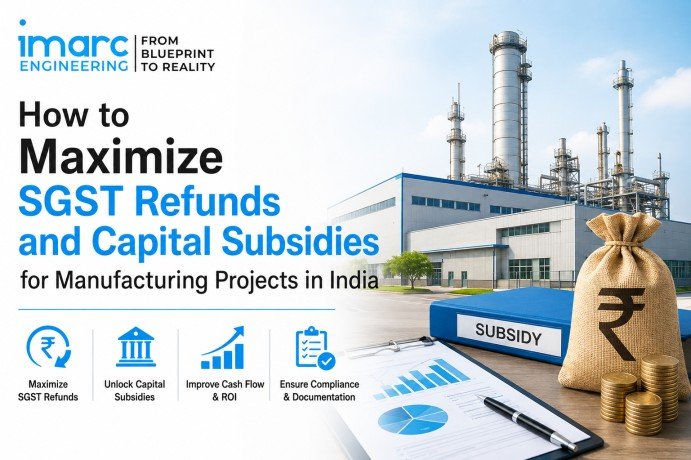
Choosing the right state, structuring the right claim, and timing disbursement correctly can shift project economics by a meaningful percentage of total capital outlay. As incentive regimes become more complex and state-specific, many investors are increasingly relying on a State Industrial Policy Incentive Advisory Service to assess eligibility, optimize incentive realization, and improve overall project viability before committing capital.
Why State Industrial Policy Incentives Matter
1. They directly improve project IRR. Capital subsidies reduce the effective cost of plant and machinery, while SGST refunds return a share of tax paid on sales back into working capital.
2. States are actively competing for the same capital. The top five states, Maharashtra, Karnataka, Gujarat, Delhi, and Tamil Nadu, account for nearly 85 percent of India’s FDI inflows, making state selection a strategic decision, not a formality.
3. Incentive design varies sharply by state and sector. A subsidy structure that works for an MSME in Uttar Pradesh may be irrelevant to a mega project in Maharashtra or Gujarat.
4. Dovetailing with central schemes multiplies returns. State incentives can often be layered with central Production Linked Incentive schemes, improving total recovery.
5. State Industrial Policy Incentive Timelines and documentation gaps cause forfeiture. Incentives are policy driven and time bound; missed filing windows or incomplete Fixed Capital Investment documentation can permanently reduce eligible claims.
Regulatory and Policy Framework
- State-specific industrial policies such as Maharashtra’s Industries, Investment and Services Policy (MIISP) 2025, the Viksit Gujarat Industrial Policy 2026, and Uttar Pradesh’s Industrial Investment and Employment Promotion Policy govern eligibility, ceilings, and disbursement mechanics.
- SGST reimbursement structures typically refund a defined percentage of the state’s share of GST collected on sales, subject to a lifetime cap linked to Fixed Capital Investment.
- Capital subsidy ceilings are usually expressed as a percentage of eligible capital investment, capped at a fixed rupee amount that varies by project scale and region within the state.
- Central scheme convergence, including the semiconductor mission and PLI frameworks, allows dovetailing with state benefits where policy permits.
- Implementing agencies, such as District Industries Centres, State Industrial Development Corporations, and single-window portals, administer claims and verification.
- NITI Aayog’s Investment Friendliness Index 2026 now formally benchmarks states on investment readiness, adding a layer of comparative scrutiny that influences how aggressively states design incentive packages.
Industry Challenges and Common Mistakes
1.Selecting a state based on headline subsidy percentages alone, without modeling actual disbursement caps, incentive periods, and net present value.
2. Underestimating documentation intensity. SGST refund claims are not automatic ITC adjustments; they require separate claims under industrial policy, with strict audit trails.
3. Missing eligibility windows tied to commercial production dates, which can disqualify an otherwise eligible project.
4. Failing to structure Eligible Capital Investment correctly, including land, building, plant and machinery, and infrastructure costs, resulting in understated subsidy claims.
5. Overlooking booster provisions, such as employment, export, or women-workforce boosters that can meaningfully increase capital subsidy percentages.
6. Treating incentives as static. Policies are revised frequently; a scheme referenced during project planning may already be superseded by the time construction begins.
7. Ignoring non-fiscal friction points. Investors continue to flag long approval timelines, land access difficulties, and skilled labour shortages, particularly in high-value manufacturing sectors, which can erode the value of fiscal incentives if not planned for.
Steps to Consider When Selecting an Advisory Partner
1. Multi-state comparative capability
- Ability to model SGST refund value, capital subsidy ceilings, and interest or power tariff subsidies across competing states simultaneously
- Familiarity with sector-specific thrust categories, since incentive tiers differ for electronics, EV, textiles, chemicals, and engineering projects
2. Regulatory and documentation depth
- Demonstrated experience preparing Fixed Capital Investment schedules and eligible capital investment computations that withstand audit
- Working relationships with District Industries Centres, State Industrial Development Corporations, and single-window clearance systems
3. Integration with project execution
- Coordination between incentive planning and EPCM project scheduling, since capital subsidy eligibility often depends on machinery procurement and commissioning timelines
- Ability to align claim filing with commercial production dates and financial year cycles
4. Post-approval monitoring
- Ongoing tracking of policy amendments, GR notifications, and claim renewal requirements through the full incentive period
IMARC Engineering’s Structured Advisory Methodology
Step 1. State and Sector Benchmarking: Comparative analysis of SGST refund structures, capital subsidy ceilings, and thrust sector classifications across shortlisted states.
Step 2. Eligibility and Fixed Capital Investment Mapping: Detailed computation of eligible capital investment components to maximize claimable subsidy value.
Step 3. Application and Documentation Structuring: Preparation of policy-compliant applications, project reports, and supporting documentation for implementing agencies.
Step 4. Approval and Disbursement Coordination: Liaison with District Industries Centres, SIDCs, and single-window portals to track approvals and staged disbursements.
Step 5. Post-Sanction Compliance and Renewal: Continuous monitoring of policy amendments and annual claim filings through the incentive period.
Connect With An Expert: https://www.imarcengineering.com/contact?service=industrial-licensing-incentive-advisory
Incentive Lifecycle Overview
| Stage | Key Activity | Typical Timeline |
| Pre-investment | State and sector benchmarking, incentive modeling | 4 to 6 weeks |
| Application | Eligible capital investment mapping, documentation | 6 to 10 weeks |
| Sanction | Agency review, approval, incentive letter issuance | 3 to 6 months |
| Disbursement | Staged capital subsidy or SGST refund release | Annual, over incentive period |
| Compliance | Renewal filings, policy amendment tracking | Ongoing through incentive tenure |
Industry-Specific Considerations
- Sector classification materially changes incentive value. Electronics manufacturing has grown from ₹1.9 trillion in 2014-15 to ₹11.3 trillion in 2024-25, and semiconductors have become a major battleground following the India Semiconductor Mission.
- Under which the Centre has committed ₹76,000 crore, with projects worth around ₹1.60 trillion approved across six states as of April 2026.
- States are responding with sector-specific frameworks; for instance, Haryana has proposed draft ESDM and e-waste recycling policies aiming to attract ₹10,000 crore in investment and create around 75,000 jobs.
- Manufacturers in EV components, batteries, and cleanroom-dependent electronics should evaluate thrust sector status early, since it often determines whether the subsidy ceiling is calculated on a standard or enhanced basis.
Business Outcomes for Manufacturers
- Improved project IRR through reduced effective capital cost
- Stronger early-stage cash flow via periodic SGST refund realization
- Lower risk of forfeited incentives through structured compliance tracking
- Better-informed site selection decisions based on comparative state modeling
- Reduced audit and disallowance risk through accurate Fixed Capital Investment documentation
Trends in 2026
1. State policies are becoming more structured and time-bound. Maharashtra’s MIISP 2025 targets approximately ₹70.5 trillion in investments and 5 million new jobs by 2030, reflecting a shift toward large, quantified industrial development goals.
2. Gujarat has strengthened its incentive framework. The Viksit Gujarat Industrial Policy 2026 is a five-year framework effective from June 1, 2026, supported by a GSDP of USD 329.7 billion in 2024-25 and approximately 40% of India’s port cargo handling.
3. Investment readiness benchmarking is reshaping state competition. NITI Aayog’s Investment Friendliness Index is encouraging states to strengthen not only fiscal incentives but also regulatory transparency, ease of doing business, and project implementation capabilities to attract manufacturing investments.
4. Booster-linked subsidy structures are expanding. States such as Uttar Pradesh and Maharashtra are increasingly rewarding employment generation, export orientation, and women workforce participation through enhanced incentive packages.
5. Convergence between state and central incentive schemes is increasing. States are aligning their industrial policies with initiatives such as the Production Linked Incentive (PLI) Scheme and the India Semiconductor Mission, enabling manufacturers in sectors such as semiconductors, EVs, batteries, and electronics to maximize combined incentive benefits.
These developments reinforce the need for manufacturers to evaluate state incentive frameworks alongside location strategy, project economics, and long-term investment plans rather than treating incentives as standalone financial benefits.
How IMARC Engineering Helps Manufacturers Maximize State Incentives
IMARC Engineering supports manufacturers through state comparison studies, investment modeling, incentive eligibility assessments, Fixed Capital Investment calculations, application preparation, documentation, government coordination, and post-sanction compliance. By integrating incentive planning into project development, IMARC Engineering helps investors maximize financial benefits while reducing approval risks.
Conclusion
State industrial policy incentives are no longer a background consideration in manufacturing project planning; they are a primary lever for capital efficiency and cash flow management. With incentive frameworks growing more sophisticated, sector-specific, and compliance-intensive, manufacturers benefit most from structured, comparative advisory support rather than state-by-state improvisation. A disciplined approach to benchmarking, documentation, and post-sanction compliance determines whether incentive value is fully realized or partially forfeited.
Frequently Asked Questions
1. What is the difference between SGST refund and capital subsidy?
SGST refund reimburses a share of state GST paid on sales after commercial production begins, while capital subsidy reduces upfront investment cost, typically calculated as a percentage of eligible capital investment.
2. Can state incentives be combined with central PLI schemes?
Yes, in many cases dovetailing is permitted, allowing manufacturers to claim both state and central benefits, subject to specific policy provisions.
3. How is Fixed Capital Investment calculated for subsidy purposes?
It generally includes land, building, new plant and machinery, and eligible infrastructure costs, with land often capped at a defined percentage of total investment.
4. Do incentive percentages differ by project scale?
Yes, most policies classify projects as large, mega, super mega, or ultra mega, with different subsidy ceilings and employment obligations for each category.
5. What happens if a manufacturer misses a filing deadline?
Missed windows can result in permanent forfeiture of that year’s claim, making proactive compliance tracking essential.
Contact Us:
IMARC Engineering
Phone: +91-120-433-0800
Email: sales@imarcengineering.com
India: C-130, Sector 2, Noida, Uttar Pradesh 201301
LinkedIn: https://www.linkedin.com/showcase/imarc-engineering/
About the Author