Key takeaways
- PLC, SCADA, HMI, and DCS are not interchangeable terms for the same thing. Each covers a different layer of an automation system, and a plant usually needs several of them working together, not just one.
- Most Indian manufacturing plants run automation in stages over many years, which means a new project usually has to integrate with existing PLCs, sensors, and control panels from multiple vendors rather than starting from a blank slate.
- An automation project scoped around available technology, rather than around the specific process it is meant to control, tends to under-deliver on the efficiency gains it was justified by.
- Cybersecurity for operational technology (OT) networks is frequently treated as an afterthought in automation projects, even though a compromised control system carries safety and production risk that a compromised IT system typically does not.
- Automation ROI is easier to justify on paper than to realize in practice, and the gap between the two usually comes down to whether operators were properly trained on the new system before go-live, not whether the technology itself worked.
- A phased automation rollout, validated at each stage before moving to the next, generally produces a more reliable outcome than a single large-scale implementation across an entire plant at once.
Introduction
Automation projects fail less often because of the technology and more often because of how they are scoped. A control system designed around a generic template, rather than the specific process it needs to run, tends to leave gaps that only show up after commissioning, when a mismatch between the automation logic and actual plant behavior starts producing false alarms or unexpected downtime. This is the gap an Industrial Automation Consultant is meant to close, translating a plant’s actual process and existing equipment into a control system design that fits, rather than one that looks correct on a proposal document.
This guide covers what PLC, SCADA, HMI, and DCS systems actually do, what a proper automation implementation process looks like, and where these projects most commonly run into trouble in Indian manufacturing settings.
Why Automation Projects Need Specialist Consulting
- Mixed-vendor legacy environments: Most operating plants have accumulated PLCs, sensors, and control panels from different vendors over years of incremental automation, and a new project usually has to integrate with this existing mix rather than replace it wholesale.
- Process-specific control logic: Generic automation templates rarely match a specific plant’s process sequence closely enough, and the gap tends to surface as false alarms, unnecessary shutdowns, or control logic that fights against how the process actually runs.
- OT cybersecurity exposure: Control system networks are increasingly connected to broader plant IT infrastructure, which introduces a cybersecurity risk profile that a plant’s existing IT security approach was not necessarily built to cover.
- ROI that depends on adoption, not just installation: An automation system that works technically but is not properly understood by the operators running it day to day will underperform its projected efficiency gains regardless of how well it was engineered.
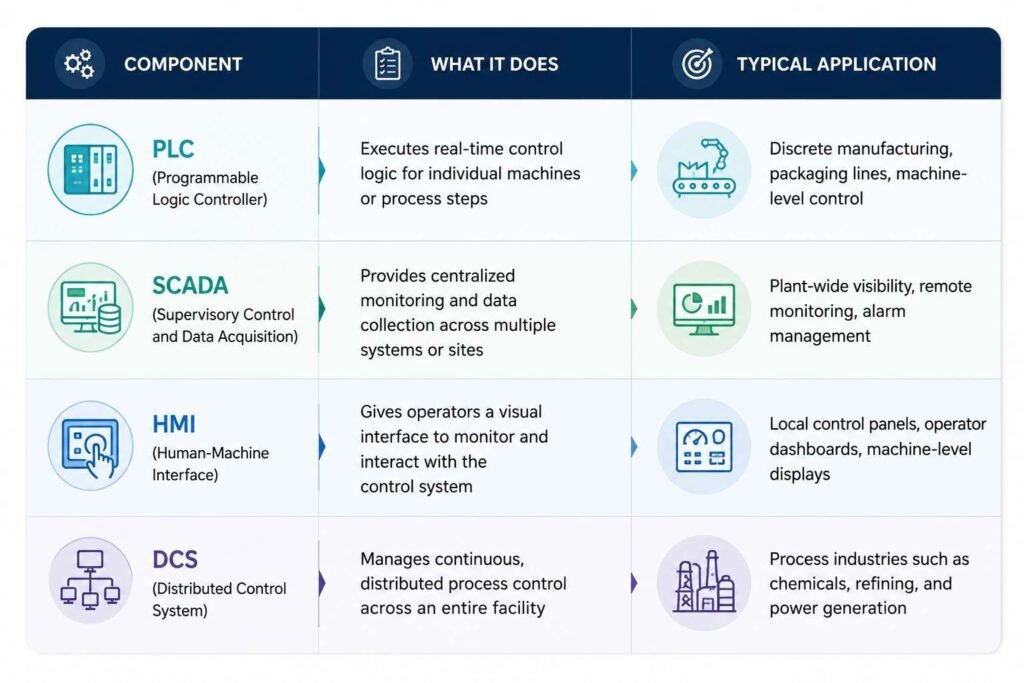
Core Components of an Industrial Automation System
PLC, SCADA, HMI, and DCS each play a distinct role, and understanding what each one actually does is the starting point for scoping a project correctly.
The Automation Implementation Process
A well-run automation project follows a defined sequence, and skipping ahead to programming before the design stage is properly completed is one of the more common reasons a system underperforms after commissioning.
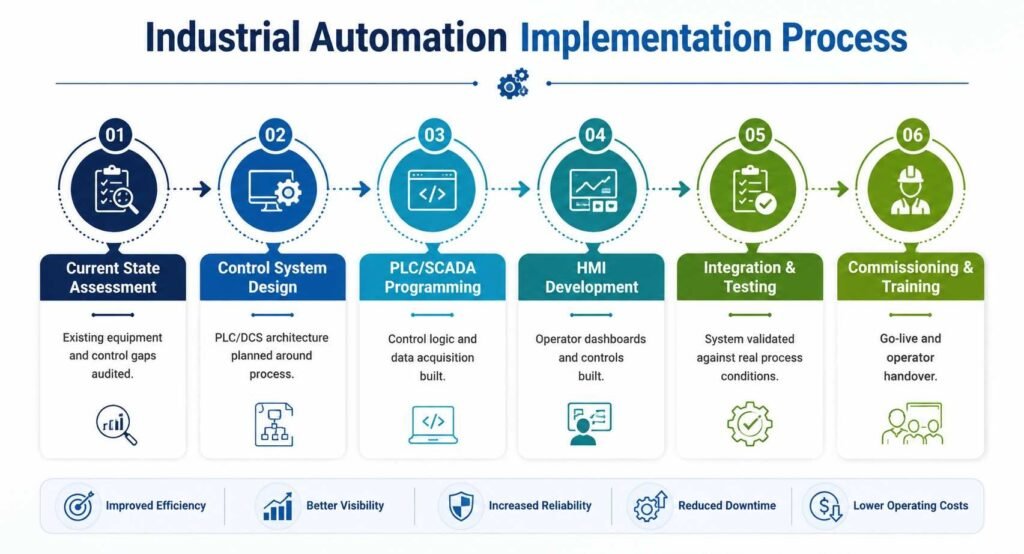
- Current state assessment: Existing equipment, control gaps, and process bottlenecks are audited before any new system is designed, so the automation is built around what the plant actually needs rather than a generic assumption.
- Control system design: PLC or DCS architecture is planned specifically around the plant’s process sequence, not adapted after the fact from a standard template.
- PLC/SCADA programming: Control logic and data acquisition systems are built to match the design, with process-specific logic rather than generic default configurations.
- HMI development: Operator dashboards and control interfaces are built around how operators actually work the floor, not just around what the underlying system is technically capable of displaying.
- Integration and testing: The full system is validated against real process conditions before go-live, surfacing mismatches between the design and actual plant behavior while they are still cheap to fix.
- Commissioning and training: The system goes live alongside structured operator training, since an automation system that operators do not fully understand tends to get bypassed or underused regardless of its technical capability.
Common Challenges in Industrial Automation Projects
- Scoping a control system around available technology rather than the specific process it needs to run, which produces a system that looks complete but does not fit plant reality.
- Underestimating the integration effort needed to connect new automation with existing multi-vendor legacy equipment already on the floor.
- Treating OT cybersecurity as a downstream IT concern rather than a design consideration built into the automation architecture from the start.
- Moving to full-scale rollout without a phased validation approach, which means design gaps surface across an entire plant at once rather than during a contained pilot.
- Under-investing in operator training relative to the technical build, which limits realized ROI even when the underlying system performs as designed.
How IMARC Engineering Helps with Industrial Automation and Digital Monitoring in India
IMARC Engineering helps manufacturers plan and implement industrial automation projects that integrate seamlessly with existing multi-vendor equipment, rather than replacing entire control systems unnecessarily. The engagement begins with a comprehensive assessment of existing PLCs, sensors, control panels, and process workflows to identify automation gaps, integration requirements, and improvement opportunities.
Based on this assessment, IMARC Engineering develops process-specific control system architectures and supports the implementation of PLC, SCADA, HMI, and DCS solutions as an integrated automation ecosystem. The team follows a phased implementation approach, validating each stage through testing and commissioning before expanding across the facility. Structured operator training and performance validation are incorporated into the rollout to help manufacturers achieve the intended productivity, quality, and operational efficiency improvements.
Consult IMARC Engineering for Industrial Automation: https://www.imarcengineering.com/contact?service=automation-digital-monitoring-setup
Final Thoughts
Industrial automation delivers on its efficiency case when the control system is designed around the plant’s actual process and existing equipment, not around a generic template that looks complete on paper. PLC, SCADA, HMI, and DCS each solve a different part of that problem, and the projects that succeed are the ones that scope all four correctly together, validate the system in stages, and invest as much in operator training as in the technical build itself.
Contact Us:
IMARC Engineering
Phone: +91-120-433-0800
Email: sales@imarcengineering.com
India: C-130, Sector 2, Noida, Uttar Pradesh 201301
LinkedIn: https://www.linkedin.com/showcase/imarc-engineering/
About the Author