Introduction
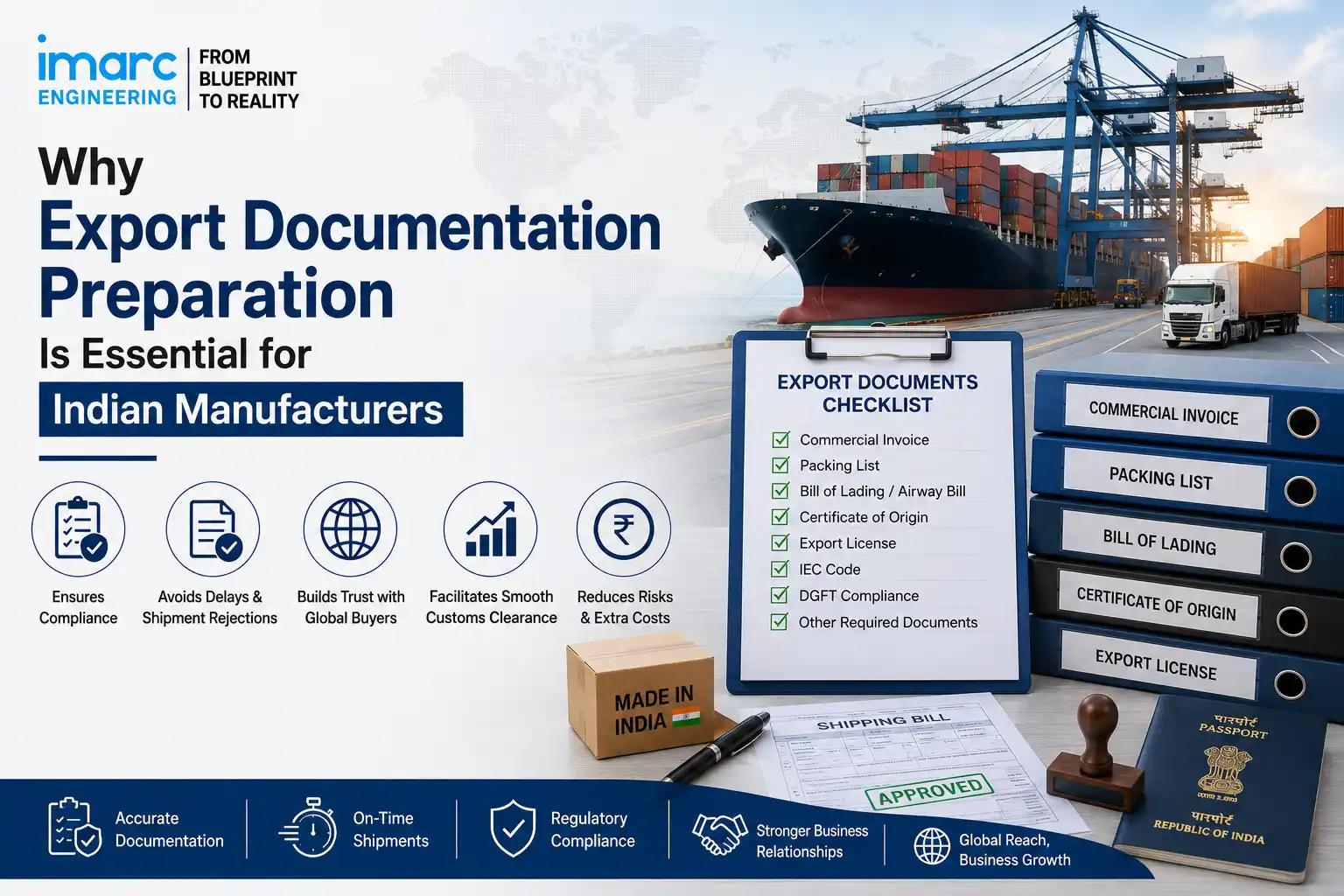
Export documentation is one of the most critical—and most frequently underestimated—parts of export-oriented manufacturing. While manufacturers often focus on production capacity, quality, and dispatch planning, documentation determines whether goods move smoothly through customs, satisfy buyer requirements, and support timely payment.
Once goods are packed and the container is booked, the hidden problems surface: customs holds, demurrage, delayed payment under letters of credit, rejected claims under trade finance, and buyer disputes over incomplete or inconsistent papers. These issues are rarely visible in a production schedule or a price quotation. They often emerge only when shipment documents are prepared with the same level of planning and quality control as production and dispatch before the shipment moves.
IMARC Engineering supports manufacturers with operational and commercial readiness for export-oriented production across India. This article explains why export documentation preparation is essential, which documents matter most, and how structured preparation reduces clearance delays, payment risk and compliance exposure.
Why Export Documentation Matters for Indian Manufacturers in 2026
India’s export performance continues to strengthen alongside manufacturing growth.
Manufacturing is estimated to grow around 7% at constant prices in FY 2025-26, according to MoSPI’s First Advance Estimates. FDI into manufacturing rose 18% in FY 2024-25 to US$19.04 billion, as reported by the Ministry of Commerce and Industry and DPIIT. The Production Linked Incentive (PLI) scheme has attracted cumulative investment exceeding ₹2.16 lakh crore, with cumulative production and sales surpassing ₹20.41 lakh crore as of December 2025, per PIB. Combined goods and services exports have reached record levels in recent years, with merchandise exports supported by pharmaceuticals, engineering goods, electronics, chemicals, textiles and auto components.
As more plants target regulated and competitive overseas markets, documentation quality becomes a gatekeeper. Logistics costs have improved to an estimated 7.97% of GDP (DPIIT-NCAER study), yet a single incomplete or inconsistent document can still hold a shipment, delay payment or trigger compliance queries. A structured documentation process turns export ambition into reliable, bankable transactions.
How Documentation Errors Affect Export Performance
Most export documentation problems follow a familiar pattern: last-minute preparation, inconsistent data across documents, unclear responsibility between commercial, logistics and finance teams, and limited understanding of buyer or letter-of-credit requirements.
Common consequences include:
- Customs and port delays: Missing or mismatched documents that hold clearance and generate demurrage or detention.
- Payment delays or discrepancies: Letters of credit and bank presentations rejected because documents do not match LC terms.
- Buyer disputes: Quantity, description, origin or packing details that do not align with the commercial invoice or contract.
- Compliance exposure: Incorrect HS classification, origin claims or regulatory certificates that invite scrutiny.
- Working-capital strain: Goods shipped but payment delayed because documentation is incomplete or under query.
- Reputation damage: Repeated documentation issues that reduce buyer confidence and future order preference.
Accurate export documentation protects clearance, payment and credibility—it is far more than a regulatory requirement.
Core Export Documents Every Indian Manufacturer Must Get Right
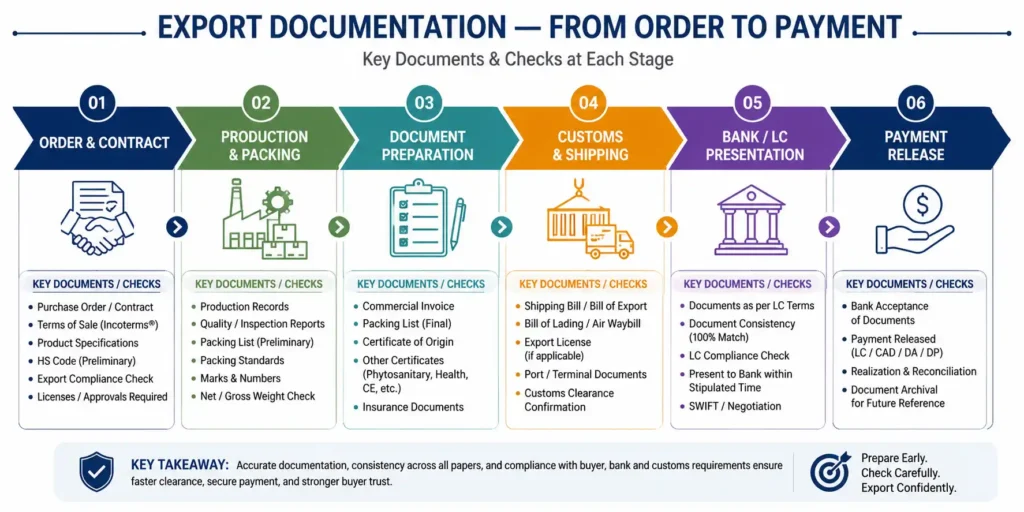
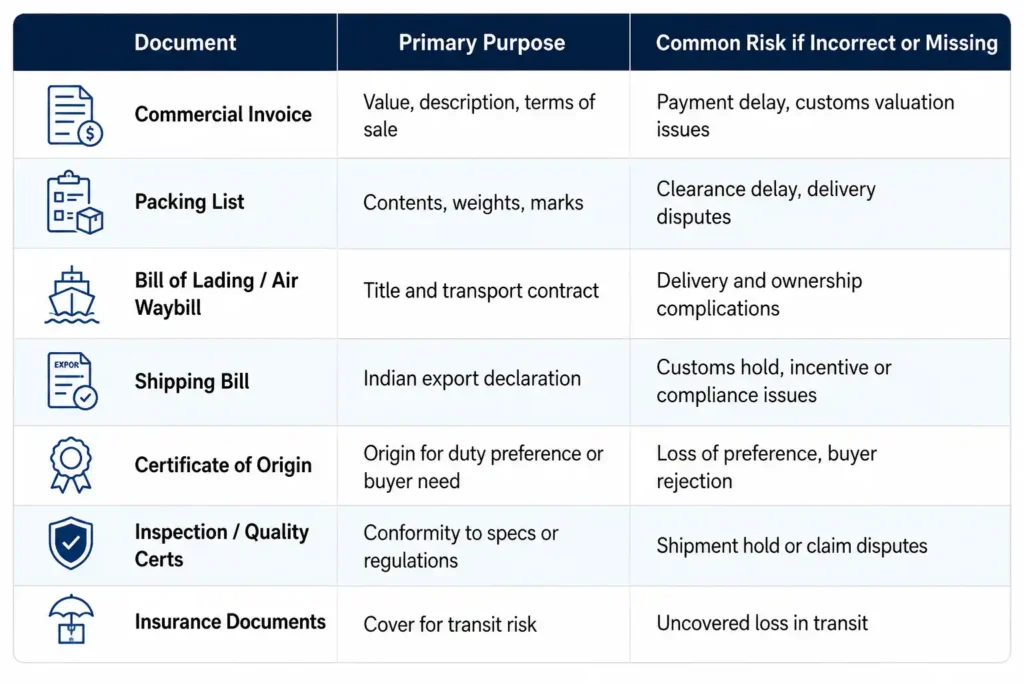
While exact requirements vary by product, destination and payment method, most shipments depend on a core set of documents:
- Commercial Invoice
- Packing List
- Bill of Lading / Air Waybill
- Shipping Bill / Bill of Export
- Certificate of Origin (preferential or non-preferential)
- Inspection or quality certificates (where required)
- Insurance documents
- Any product-specific certificates (for example phytosanitary, health, or sector regulatory certificates)
Consistency of data — exporter and consignee details, description, quantity, value, HS code, origin and shipping marks — across this set is as important as the presence of each document.
How Structured Documentation Preparation Improves Export Performance
When documentation is treated as a controlled process rather than a last-minute task, exporters typically gain:
- Faster customs clearance and lower risk of demurrage
- Higher first-time acceptance of documents under letters of credit
- Fewer buyer queries and disputes after shipment
- Clearer internal ownership between commercial, logistics and finance
- Better readiness for repeat orders and new markets
- Stronger evidence trail for audits, claims and trade finance
These benefits depend on starting document preparation early, aligning data across systems, and checking requirements against the specific contract, LC and destination rules.
How IMARC Engineering Supports Export-Oriented Manufacturers
IMARC Engineering helps manufacturers strengthen export readiness by aligning production processes, quality documentation, packaging, traceability, and commercial documentation with international buyer and regulatory requirements. The team supports manufacturers during export-oriented plant setup, operational readiness, and market expansion by improving documentation consistency, process control, and compliance across production, quality, logistics, and commercial functions.
Typical support includes:
- Export readiness assessments
- Documentation and process gap analysis
- Production and traceability alignment
- Packaging and labelling readiness
- Operational coordination between production, logistics, and commercial teams
- Regulatory and compliance advisory for export-oriented manufacturing
Contact IMARC Engineering to discuss your Export Readiness Consulting requirements: https://www.imarcengineering.com/contact?service=export-readiness-consulting
Best Practices for Export Documentation Management
- Create standardized document templates.
- Maintain a centralized documentation checklist.
- Verify HS codes and product descriptions before shipment.
- Cross-check commercial invoice, packing list, and shipping documents.
- Review destination-specific documentation requirements before dispatch.
Common Mistakes in Export Documentation Preparation
- Starting document preparation only after the container is booked
- Allowing different data (description, quantity, value, HS code) across invoice, packing list and shipping bill
- Ignoring specific letter-of-credit conditions until bank presentation
- Treating Certificate of Origin and product certificates as optional afterthoughts
- No single owner for document accuracy across commercial, logistics and finance
- Failing to archive a complete, consistent set for claims, audits and repeat orders
Conclusion
Export growth for Indian manufacturers depends on more than competitive pricing and production capacity. It depends on the ability to move goods through customs, satisfy buyers and banks, and receive payment without repeated friction. Accurate export documentation serves as the formal bridge between the factory and successful global trade.
When invoices, packing lists, transport documents, origin certificates and supporting papers are prepared early, consistently and in line with contract and destination requirements, Indian exporters reduce clearance delays, payment risk and compliance exposure. In an environment of rising manufacturing output and export ambition – supported by PLI, FDI and improving logistics – disciplined documentation is a core part of export competitiveness.
Through operational alignment, evidence readiness, and export-oriented advisory, IMARC Engineering helps Indian exporters strengthen the link between production and reliable international trade.
Contact Us:
IMARC Engineering
Phone: +91-120-433-0800
Email: sales@imarcengineering.com
India: C-130, Sector 2, Noida, Uttar Pradesh 201301
LinkedIn: https://www.linkedin.com/showcase/imarc-engineering/
About the Author