Introduction
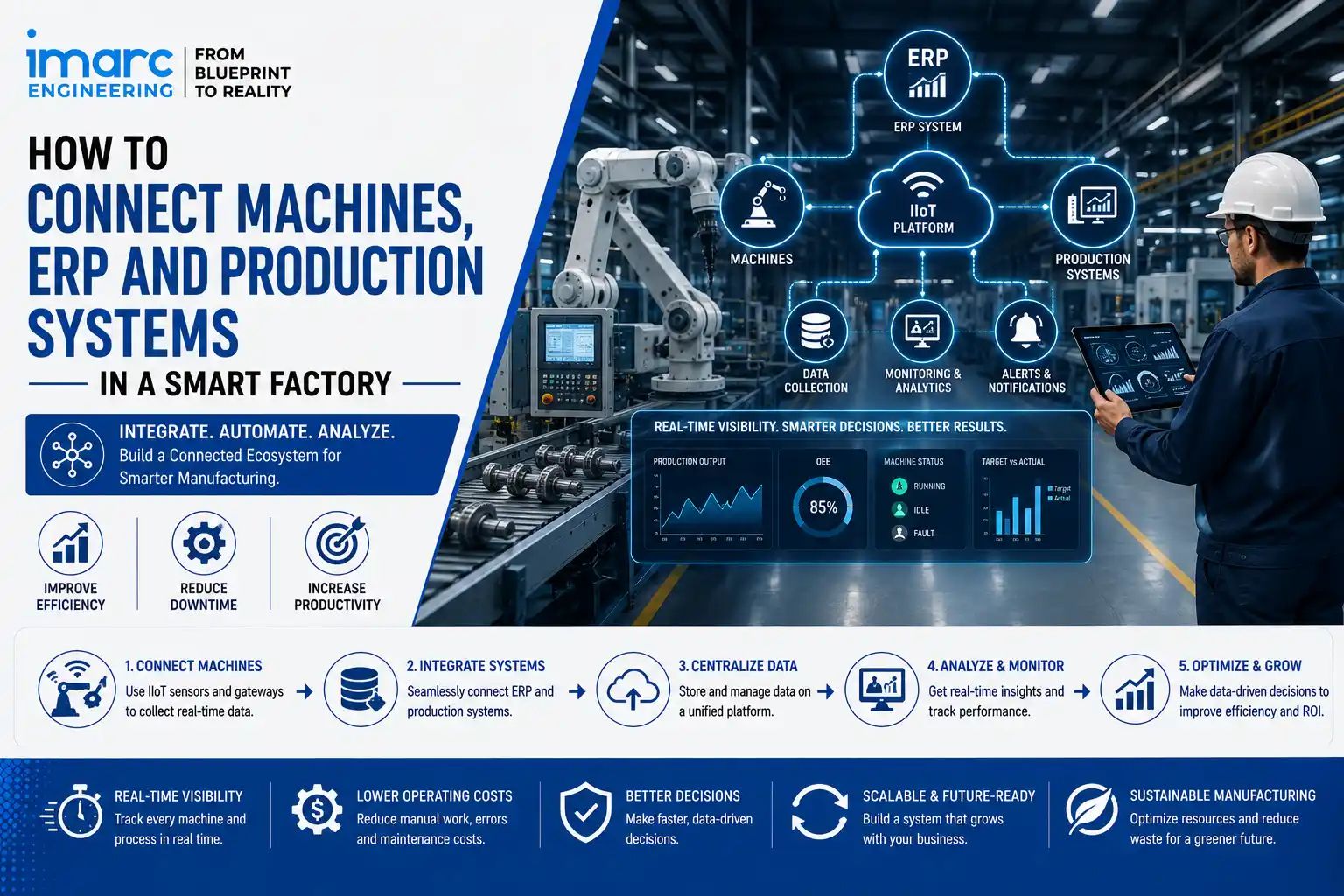
Connecting machines, ERP and production systems is an important step toward building a more responsive smart factory — and one of the easiest to get wrong when integration is treated as a pure IT project.
Once systems are live, the hidden problems surface: machine data that never reaches planning, ERP orders that do not reflect real shop-floor status, production systems that run in isolation, and dashboards that look modern but do not drive decisions. These gaps are rarely visible in a software demo. They become clear only when connectivity is designed around process flow, data ownership and decision needs — not only around device count or software licences.
A structured approach to machine, ERP and production-system integration can help manufacturers improve visibility, control and productivity. This article explains the key integration layers, practical implementation steps and common challenges involved in connecting these systems.
Why Machine–ERP–Production Connectivity Matters for Indian Manufacturers
India’s manufacturing sector continues to expand under policy support and rising competitive pressure.
- Manufacturing growth is estimated at around 7% at constant prices in FY 2025-26 (MoSPI First Advance Estimates).
- FDI into manufacturing rose 18% in FY 2024-25 to US$19.04 billion (Ministry of Commerce & Industry / DPIIT).
- PLI cumulative investment has exceeded ₹2.16 lakh crore, with cumulative production and sales surpassing ₹20.41 lakh crore as of December 2025 (PIB).
- Logistics costs have improved to an estimated 7.97% of GDP (DPIIT-NCAER study).
As plants add capacity, automation and export commitments, disconnected systems become a drag on throughput, quality and delivery. Connecting machines, ERP and production systems turns isolated data into usable operational control.
What “Connected” Means in a Smart Factory
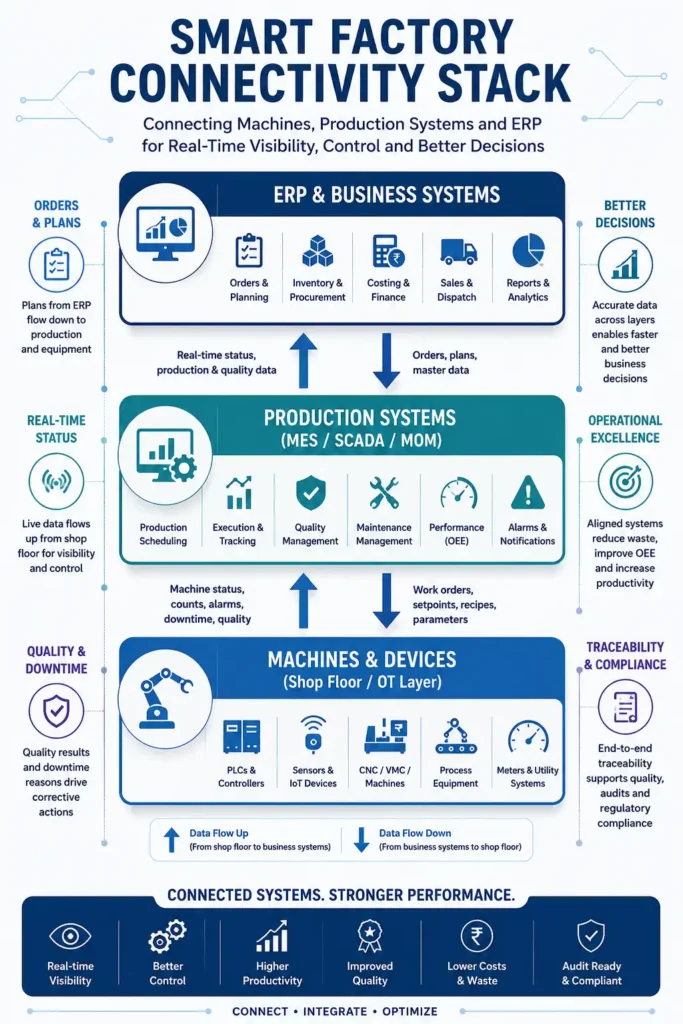
A connected smart factory typically links three layers so that information can flow in both directions:
- Machines and shop-floor devices — PLCs, sensors, CNCs, process equipment, utilities meters
- Production systems — MES, SCADA, production scheduling, quality and maintenance systems
- ERP and business systems — orders, inventory, planning, costing, procurement and dispatch
Connectivity is successful when:
- Production plans in ERP reflect real capacity and status on the floor
- Machine and line data update production systems without manual re-entry
- Quality, downtime and output data support both shop-floor action and management reporting
- Exceptions (breakdowns, quality holds, material shortages) are visible early enough to act
Key Building Blocks of Machine–ERP–Production Integration
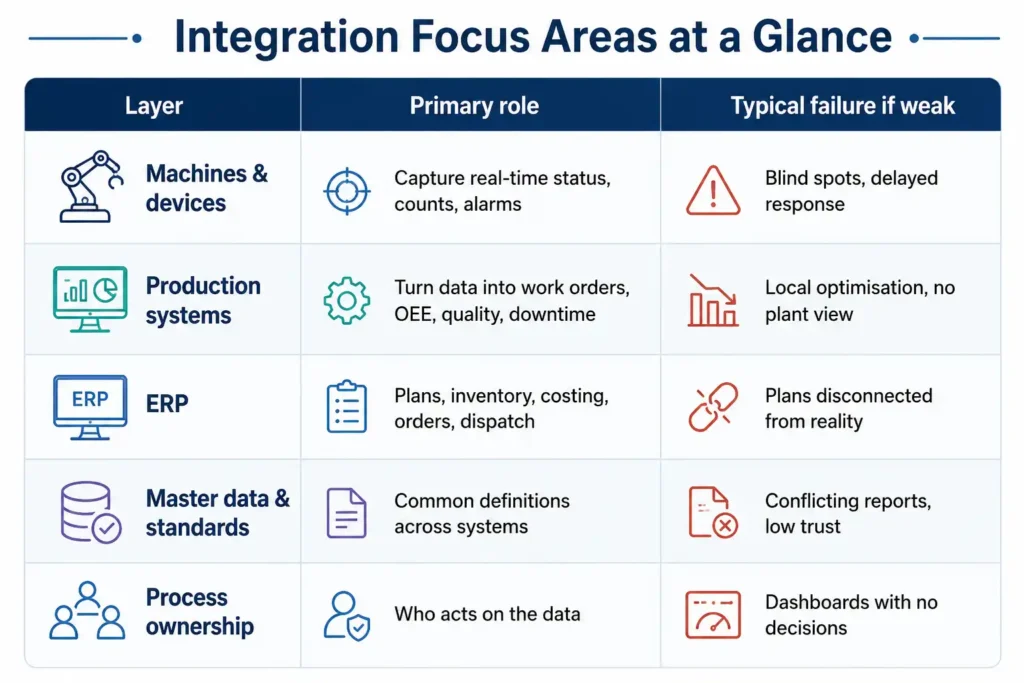
1. Machine and device connectivity
Reliable data from PLCs, sensors and equipment — counts, status, alarms, energy, cycle times — via standard industrial protocols and edge/gateway layers where needed.
2. Production system layer
Manufacturing Execution System (MES) that turns machine data into work orders, performance tracking, quality records and downtime reason codes.
3. ERP integration
Controlled exchange of master data, orders, material consumption, finished goods and status so planning and finance stay aligned with the floor.
4. Data standards and master data
Consistent codes for products, operations, work centres, scrap reasons and units of measure — without which integration creates noise, not insight.
5. Security and access control
OT–IT boundary protection, user roles and audit trails so connectivity does not open uncontrolled risk.
6. Process ownership
Clear responsibility for who defines, validates and acts on data — operations, quality, maintenance and planning — not only the IT vendor.
How to Approach Integration Without Disrupting Operations
Step 1. Start from decisions, not devices Define which decisions need better data, such as scheduling, downtime response, material staging, quality release or dispatch.
Step 2. Map current systems and gaps List machines, production software, ERP modules and manual workarounds that currently bridge them.
Step 3. Stabilise the production process first Integration amplifies both good flow and bad flow. Fix obvious workflow and bottleneck issues before committing to heavy digital investment.
Step 4. Connect in phases Begin with critical lines or work centres, prove value, then expand. Avoid a single “big bang” cutover across the whole plant.
Step 5. Standardise data at the source Agree on definitions for downtime, scrap, completion and quality status before building interfaces.
Step 6. Validate on the floor Supervisors and operators must trust the screens. If shop-floor users consistently bypass the system, the integration is unlikely to deliver its intended operational value, regardless of technical go-live.
Step 7. Measure operational outcomes Track OEE components, schedule adherence, manual-entry reduction and response time to disruptions — not only the number of systems connected.
Common Integration Patterns That Work in Practice
- Machine counters and status feeding a production dashboard, then selected KPIs to ERP
- ERP work orders released to MES; completion and consumption reported back
- Quality results recorded in production systems and used for ERP inventory status
- Maintenance signals from machines triggering work orders in maintenance or ERP modules
- Energy and utility data linked to lines for cost and efficiency visibility
The right pattern depends on process type, scale and existing system landscape — not on a generic smart-factory diagram.
What Good Connectivity Delivers
When machines, ERP and production systems are properly linked with process discipline, manufacturers can improve:
- Faster visibility of downtime and bottlenecks
- Fewer manual entries and reconciliation errors
- Better alignment between plan and actual output
- Clearer material and inventory status
- Stronger quality traceability
- Cleaner data for continuous improvement and audits
How IMARC Engineering Supports Smart Factory Connectivity
IMARC Engineering helps manufacturers plan and implement smart-factory integration by aligning plant processes, machine connectivity, production systems, ERP workflows, and operational decision-making. The focus is on building phased, process-driven integration architectures that improve production visibility and control without disrupting live operations.
- Process and workflow clarity before system design
- Identification of decision points that need machine and ERP data
- Phased integration thinking linked to live operations
- Coordination inputs across operations, engineering and system teams
- Support for greenfield smart-factory planning and brownfield upgrades
These principles can be applied across pharmaceuticals, food and beverage, chemicals, auto components, electronics, FMCG and other discrete industrial manufacturing environments.
Common Mistakes When Connecting Machines, ERP and Production Systems
- Buying software before defining which operational decisions must improve
- Connecting every machine at once without phased proof of value
- Ignoring master data and shop-floor ownership
- Treating OT and IT as separate projects with no joint process design
- Measuring success by “interface live” rather than improvements in throughput, quality and plan adherence
- Adding dashboards on top of unstable processes and expecting efficiency gains
Speak with IMARC Engineering’s expert team for smart-factory and operational integration support across India: https://www.imarcengineering.com/contact-us
Conclusion
Connecting machines, ERP and production systems is central to building a smart factory that actually runs better — not only one that reports more numbers. In India’s growing manufacturing economy — supported by PLI investment, rising FDI and improving logistics — plants that link shop-floor reality to planning and business systems gain faster response, cleaner data and stronger control over output and cost.
The winning approach starts with process and decision needs, connects in phases, standardises data at the source, and keeps ownership on the floor. When those principles guide integration, connectivity becomes a productivity tool rather than a stalled IT programme.
A process-aligned and phased approach can help manufacturers connect machines, ERP and production systems in ways that improve plant visibility, control and operational performance.
Contact Us:
IMARC Engineering
Phone: +91-120-433-0800
Email: sales@imarcengineering.com
India: C-130, Sector 2, Noida, Uttar Pradesh 201301
LinkedIn: https://www.linkedin.com/showcase/imarc-engineering/
About the Author