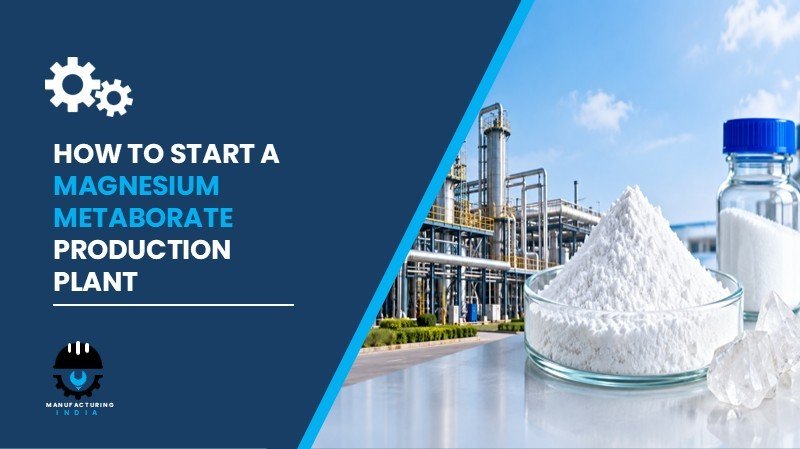
A magnesium metaborate production plant setup in India presents a compelling investment case for entrepreneurs eyeing India’s specialty inorganic chemicals space. Demand for the compound is tied to ceramics, refractories, specialty glass, chemicals, catalysts, and advanced materials – industries that depend on high-purity, thermally stable inorganic compounds. As a boron-containing specialty material, it plays a growing role in high-temperature material systems, making it a strategically relevant input for India’s industrial materials base.
India’s broader economic momentum – urbanisation, infrastructure expansion, and continued support under the Make in India initiative – creates a favourable backdrop for this production. The country’s chemicals and petrochemicals base is already sizeable: the Government of India’s Department of Chemicals and Petrochemicals reported production of major chemicals and petrochemicals reached 58,617 million tonnes in FY 2024-25, indicating the scale of the downstream, refractory-consuming sector this material can serve. This makes India a strategically sound base for the plant.
This magnesium metaborate production plant combines Make in India policy support, cost-competitive economics, and steady demand from ceramics, refractories, and specialty glass. With gross margins of 28-36% and net margins of 12-18%, it offers a financially viable path toward break-even for investors who manage utilisation and sourcing carefully.
What is Magnesium Metaborate?
Magnesium metaborate is an inorganic compound formed by the reaction of magnesium oxide and boric acid. It is characterised by a white crystalline powder appearance and excellent thermal stability, and finds use in chemical synthesis, ceramics, and as a flame retardant. It serves as a component in glass and ceramics production while acting as an additive that enhances material properties and structural integrity.
Producers can tailor magnesium metaborate grades based on purity, particle size, morphology, and phase composition, letting a single plant serve both standard and specialty demand. The magnesium metaborate production process uses raw-material preparation, weighing, mixing, controlled reaction, filtration, drying, calcination, grinding, classification, quality testing, and packaging, serving industries including ceramics, refractories, specialty glass, chemicals, catalysts, and advanced materials.
Cost of Setting Up a Magnesium Metaborate Production Plant in India
Overall cost for a magnesium metaborate production plant depends on capacity, technology, location, automation level, and regulatory compliance requirements.
1. Capital Expenditure (CapEx)
Land and site development form a substantial part of capital outlay, covering land registration and boundary development. Civil works – the production shed, lab, storage areas, and admin block – add to this layer and must align with an efficient plant layout.
Machinery represents the largest single share of capital expenditure. Key machinery required includes:
- Raw-material storage tanks and silos
- Weighing and dosing systems
- Crushers, pulverizers, ball mills, and attrition mills
- High-shear mixers and slurry-preparation tanks
- Reaction vessels and agitated reactors
- Heating systems and condensers
- Filtration units, filter presses or centrifuges, and washing systems
- Tray dryers, rotary dryers, and spray dryers (where required)
- Calcination furnaces and rotary kilns
- Cooling systems
- Grinders, pulverizers, sieving and classification equipment
- Blending machines and dust-collection systems
- Material-transfer systems and storage vessels
- Filling and packaging machines
- Laboratory equipment and process-control systems
Other capital costs cover pre-operative expenses, commissioning, and effluent treatment infrastructure needed before operations begin.
Request a Sample Report for In-Depth Market Insights: https://www.imarcgroup.com/magnesium-metaborate-manufacturing-plant-project-report/requestsample
2. Operational Expenditure (OpEx)
Raw material cost is the largest component, with sodium metaborate tetrahydrate and magnesium chloride together accounting for approximately 45-55% of total OpEx. Given this weight, long-term supplier contracts help stabilize pricing and secure supply.
Utility cost – electricity, water, and steam – makes up roughly 15-20% of OpEx, tied to calcination and drying energy use. Other operating costs include transportation, packaging, salaries, depreciation, taxes, and maintenance.
Operating costs are projected to rise materially between year one and year five, driven by inflation, market fluctuations, and higher raw material, supply chain, and global economic costs.
3. Plant Capacity
The facility is designed around an annual capacity of 1,000-3,000 MT, balancing economies of scale with flexibility. Capacity can be customised to investor requirements, and profitability improves as utilisation rises toward the upper end of this range.
4. Profit Margins and Financial Projections
Gross profit margins typically range between 28-36%, while net profit margins fall between 12-18%, supported by stable demand and value-added applications. A complete view of NPV, IRR, payback period, and profit-and-loss projections depends on the capacity, location, and cost assumptions chosen, and is best developed through project-specific modelling.
Why Set Up a Magnesium Metaborate Plant in India?
Specialty Material Demand: The compound serves niche applications needing magnesium- and boron-containing inorganic materials, giving producers differentiated, less commoditised demand.
Ceramic and High-Temperature Opportunities: Continued demand for specialty ceramics and material systems exposed to elevated temperatures sustains downstream applications for magnesium borate compounds.
Policy and Regulatory Tailwinds: The Make in India initiative, focused on strengthening domestic specialty-chemicals manufacturing, supports building import-substitutable capacity within the country.
Cost-Competitive Production: Access to industrial land, a large skilled labour pool, and an established domestic chemicals supply chain keep costs competitive relative to other hubs.
Active Downstream Investment: Production of major chemicals and petrochemicals reached 58,617 million tonnes in FY 2024-25 per the Department of Chemicals and Petrochemicals, and magnesium-borate refractory castables are being developed for fluid catalytic cracking (FCC) units, where linings face erosion, thermal stress, and contact with catalysts and petroleum-derived materials. Asia-Pacific already holds about 42.0% of the global market, underscoring the region’s relevance to future demand.
Local Supply Chain Preference: Producers serve ceramics, glass manufacturing, chemical industries, construction materials, and metallurgy – sectors that often prefer domestic sourcing to reduce logistics costs and lead times.
Production Process – Step by Step
The magnesium metaborate production process uses this multi-step reaction and finishing sequence as its primary method:
- Raw-Material Preparation: Sodium metaborate tetrahydrate and magnesium chloride are readied and checked against specification.
- Weighing: Materials are precisely weighed and dosed for consistent stoichiometry.
- Mixing: High-shear mixers blend materials into a uniform feed.
- Controlled Reaction: Reaction vessels or agitated reactors form magnesium metaborate.
- Filtration: Filter presses or centrifuges separate solid product from liquid.
- Drying: Tray, rotary, or spray dryers dry the filtered material.
- Calcination: Calcination furnaces or rotary kilns set the thermal stability and phase composition.
- Grinding: Grinders and pulverizers reduce material to target particle size.
- Classification: Sieving equipment separates output by particle size.
- Quality Testing: Laboratory checks verify purity and specifications.
- Packaging: Filling and packaging machines prepare product for dispatch to ceramics, refractories, glass, chemicals, catalysts, and materials customers.
Key Applications
Magnesium metaborate serves several specialty and high-temperature material applications:
- Ceramics: A magnesium- and boron-containing component in selected ceramic formulations.
- Refractory Materials: Used in high-temperature systems, including petrochemical refractory linings.
- Specialty Glass: Supports formulations relying on boron compounds for performance.
- Catalysts: Investigated as a functional catalyst or catalyst-support material.
- Flame-Retardant Systems: Contributes to selected flame-retardant formulations.
- Advanced Materials: Relevant to R&D of boron-containing functional materials.
Leading Producers
The global market includes a small set of established players. Key players include:
- Ascent Petrochem Holdings Co., Limited
- Otto Chemie Pvt. Ltd.
These producers serve ceramics, glass manufacturing, chemical industries, construction materials, and metallurgy.
Timeline to Start the Plant
- Feasibility study and project report preparation
- Land acquisition and site development
- Regulatory approvals and environmental clearances
- Factory licence and fire safety compliance
- Machinery procurement and installation
- Raw material supplier agreements and supply chain setup
- Trial production and quality testing
- Commercial production launch
Licences and Regulatory Requirements
Starting a magnesium metaborate production unit in India requires several approvals:
- Business registration (Proprietorship, LLP, or Pvt Ltd)
- Factory Licence under the Factories Act
- Environmental Clearance from the State Pollution Control Board
- GST Registration
- Fire Safety NOC
- Hazardous/chemical handling compliance
- Effluent Treatment Plant (ETP) operational clearance
- Occupational Health and Safety compliance
Key Challenges to Consider
High Capital Requirements: Setting up a magnesium metaborate production plant needs a large upfront investment in reaction, filtration, drying, and calcination machinery.
Raw Material Price Volatility: Sodium metaborate tetrahydrate and magnesium chloride make up 45-55% of operating costs, so price swings directly affect profitability.
Regulatory Compliance: Environmental clearances, factory licensing, and effluent treatment obligations need ongoing monitoring.
Technology and Product Development Pressure: Rising demand for controlled purity, particle size, morphology, and thermal stability requires continual process refinement.
Competition: Established players such as Ascent Petrochem Holdings Co., Limited and Otto Chemie Pvt. Ltd. already serve core sectors, so new entrants must differentiate on quality or service.
Skilled Manpower: Reliable operation of reaction, calcination, and testing equipment needs trained staff, which takes time to build in this specialised segment.
Frequently Asked Questions
1. How much does it cost to set up a magnesium metaborate production plant in India?
Cost depends on capacity, technology, location, and automation, driven by land, civil works, machinery, and other capital costs, plus ongoing operating expenses.
2. Is magnesium metaborate production profitable in India in 2026?
The category shows healthy potential, with gross margins of 28-36% and net margins of 12-18%, supported by demand from ceramics, refractories, and specialty glass.
3. What machinery is required for a magnesium metaborate plant in India?
Core machinery includes storage tanks and silos, dosing systems, mixers, reaction vessels, filtration units, dryers, calcination furnaces or rotary kilns, and grinding, classification, and packaging equipment.
4. What licences and approvals are required to start a magnesium metaborate plant in India?
Requirements include business registration, a Factory Licence, Environmental Clearance, GST registration, Fire Safety NOC, hazardous/chemical handling compliance, ETP clearance, and occupational health and safety compliance.
5. What raw materials are needed for magnesium metaborate production?
The primary raw materials are sodium metaborate tetrahydrate and magnesium chloride, together accounting for 45-55% of OpEx.
6. What are the environmental compliance requirements for a magnesium metaborate plant in India?
Plants need Environmental Clearance, an operational Effluent Treatment Plant, and adherence to hazardous/chemical handling and emission-control standards.
7. What is the best location to set up a magnesium metaborate plant in India?
The site should offer easy access to raw material supplies, proximity to target markets, and reliable transportation, utility, and waste management infrastructure.
8. What is the break-even period for this type of plant in India?
Break-even depends on capacity, utilisation, and cost structure; a full analysis covering NPV, IRR, and payback period is built through project-specific modelling.
9. What government incentives are available for manufacturers in India?
The Make in India initiative and supportive policy for domestic chemicals and petrochemicals production create a favourable backdrop, though eligibility should be verified per project.
Key Takeaways for Investors
This magnesium metaborate production plant taps into steady demand from ceramics, refractories, specialty glass, chemicals, catalysts, and advanced materials. Financial viability holds across the 1,000-3,000 MT capacity range, with gross margins of 28-36% and net margins of 12-18%. With Asia-Pacific holding about 42.0% of the global market and India’s chemicals and petrochemicals base reaching 58,617 million tonnes of production in FY 2024-25, downstream demand for specialty refractory and ceramic inputs looks durable for the plant’s growth in India.
About the Author