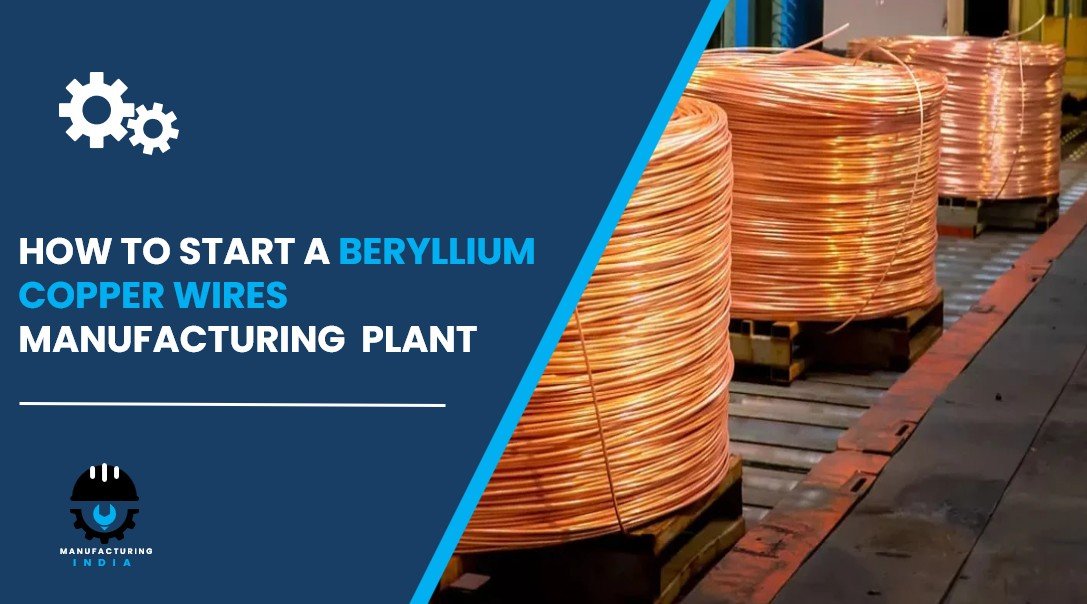
Setting up a beryllium copper wires manufacturing plant in India represents a compelling investment proposition underpinned by robust and structurally growing demand from the electrical and electronics industry, telecommunications infrastructure build-out, aerospace and defense programs, automotive electronics, and precision engineering applications. As industries increasingly favour components that combine high electrical conductivity with mechanical strength, corrosion resistance, and dimensional stability under thermal and vibrational stress, beryllium copper wires occupy an increasingly critical position across electrical contacts, springs, connectors, and sensor components. This growth trajectory, combined with premium pricing supported by value-added alloy processing and strong end-use diversification, creates a highly favourable manufacturing environment for new entrants with efficient melting, drawing, and heat-treatment capabilities.
What are Beryllium Copper Wires?
Beryllium copper wires are alloys of copper and beryllium, with beryllium content typically ranging between 0.2% and 2%. This composition gives the alloy an outstanding combination of electrical conductivity, tensile strength, elasticity, and corrosion resistance that pure copper cannot match. Unlike conventional copper wires, beryllium copper retains its strength at elevated temperatures and exhibits exceptional fatigue resistance, making it well suited to applications demanding precision and long service life under repeated mechanical or electrical stress.
The alloy is non-magnetic, spark-proof, and dimensionally stable, characteristics that make it particularly valuable in safety-critical and sensitive electronic environments such as explosive atmospheres, aerospace instrumentation, and high-frequency telecommunications equipment. Beryllium copper wires are commonly supplied across a range of tempers, from soft-annealed to fully age-hardened, and undergo drawing, solution heat treatment, age hardening, and surface finishing to meet the performance specifications of end-use industries including electrical contacts, springs, switches, relays, aerospace components, telecommunication equipment, automotive electronics, and industrial control systems.
The global beryllium copper wires market was valued at approximately USD 1.67 Billion in 2025. According to IMARC Group estimates, the market is expected to reach USD 2.42 Billion by 2034, exhibiting a CAGR of 4.2% from 2026 to 2034, supported by rising demand for high-performance alloys, miniaturised electronics, and the ongoing build-out of telecommunications and electric vehicle infrastructure.
Cost of Setting Up a Beryllium Copper Wires Manufacturing Plant
The total capital investment required to establish a beryllium copper wires manufacturing plant is shaped by several key parameters: annual production capacity (typically ranging from 1,500 to 2,000 Tons per annum), the process route adopted (continuous casting and hot rolling versus alternative billet-and-extrusion routes, with or without integrated wire drawing and heat treatment lines), the level of automation across melting, casting, drawing, and finishing sections, facility specification, raw material sourcing strategy, and applicable safety and environmental compliance requirements given the toxicity of beryllium in particulate form. Below is a structured breakdown of the major cost components.
1. Capital Expenditure (CapEx)
Total capital investment in a beryllium copper wires manufacturing plant covers the following major heads:
Land and Site Development
This encompasses land acquisition or lease, site preparation, boundary development, and utilities connectivity. Site selection should prioritise proximity to copper cathode and beryllium alloy master suppliers to ensure a steady, low-transport-cost supply of core raw materials. Access to reliable power infrastructure for induction melting and heat treatment operations, strong road and rail logistics for inbound feedstock and outbound finished wire, availability of process water and cooling systems of suitable quality, and a trained workforce familiar with precision metallurgical processing and beryllium handling protocols are critical site selection criteria. Compliance with industrial zoning regulations, occupational safety standards for beryllium exposure, fire and electrical safety norms applicable to induction furnace operations, and effluent and emission compliance frameworks must be assessed from project initiation.
Civil Works and Construction
Building costs cover the main processing facility including the melting and alloying section, continuous casting bay, hot rolling mill, wire rod preparation area, multi-stage wire drawing hall, solution heat treatment and age hardening furnace section, surface finishing and inspection area, automated packaging and dispatch infrastructure, quality control and metallurgical testing laboratory, administrative block, and utility infrastructure including power backup, cooling water systems, fume extraction and beryllium dust containment systems, and effluent treatment plant. Construction must comply with applicable factory act requirements, occupational health and safety standards specific to beryllium particulate exposure, fire-proofing norms for high-temperature melting operations, and local industrial building codes.
Machinery and Equipment
Machinery represents the single largest CapEx component. Key equipment required for a beryllium copper wires manufacturing plant includes:
- Melting and Alloying Furnaces: Induction furnaces with enclosed melting chambers and fume extraction systems to melt copper cathodes and introduce beryllium alloy master under controlled atmosphere, minimising beryllium oxide fume generation
- Continuous Casting Machines: Horizontal or vertical continuous casting systems that solidify the molten alloy into cast rod or billet feedstock of consistent cross-section for downstream rolling
- Hot Rolling Mills: Rolling stands that reduce cast rod to intermediate wire rod dimensions while refining the internal grain structure of the alloy
- Wire Rod Preparation Systems: Descaling, cleaning, and surface conditioning equipment that prepares hot-rolled rod for multi-stage cold drawing
- Multi-Stage Wire Drawing Machines: Progressive die-drawing lines that reduce wire rod to finished gauge through a sequence of dies, with intermediate annealing as required to manage work hardening
- Solution Heat Treatment Furnaces: Continuous or batch furnaces that heat drawn wire to solutionising temperature and rapidly quench it, setting the alloy into a soft, workable state prior to age hardening
- Age Hardening (Precipitation Hardening) Furnaces: Precisely controlled furnaces that hold solutionised wire at an elevated temperature for a defined duration to precipitate the beryllium-rich phase and develop the alloy’s characteristic strength and conductivity
- Surface Finishing Equipment: Bright annealing lines, acid pickling or mechanical descaling systems, and where required plating lines for tin, silver, or nickel coating of finished wire
- Inspection and Quality Control Systems: Eddy current testing equipment, tensile and conductivity testers, dimensional gauging systems, and spectrometers for verifying beryllium content and alloy composition against specification
- Spooling, Coiling and Packaging Lines: Automated take-up and spooling equipment, coil binding and labelling systems, and packaging lines for reels, coils, and straight-length dispatch formats
- Fume Extraction and Beryllium Containment Systems: Dedicated ventilation, HEPA filtration, and enclosed process design to maintain airborne beryllium concentrations within permissible exposure limits across melting, grinding, and finishing operations
- Material Handling and Warehousing: Overhead cranes, coil handling equipment, raw material storage for copper cathodes and beryllium alloy master under controlled conditions, and finished goods warehousing with batch traceability
Other Capital Costs
These include pre-operative expenses, commissioning charges, import duties on specialised casting, drawing, and heat treatment equipment, staff training in precision metallurgy and beryllium safety handling, initial raw material and consumable inventory for production commissioning, regulatory compliance setup including occupational exposure monitoring systems, and ISO 9001 / ISO 14001 / ISO 45001 management system establishment costs.
Request a Sample Report for In-Depth Market Insights: https://www.imarcgroup.com/beryllium-copper-wires-manufacturing-plant-project-report/requestsample
2. Operational Expenditure (OpEx)
Raw materials principally copper cathodes and beryllium alloy master, along with fluxes and process consumables constitute the dominant operating cost, typically representing 75-80% of total OpEx. Utility costs, driven primarily by electricity consumption of induction melting, continuous casting, and heat treatment operations, account for 5-10% of OpEx. Labour, maintenance, quality control, packaging, transportation, depreciation, taxes, and overhead costs constitute the remainder of the operating cost base.
3. Plant Capacity
The proposed beryllium copper wires manufacturing facility is designed with an annual production capacity ranging between 1,500-2,000 Tons/year, enabling economies of scale while maintaining operational flexibility. This capacity range supports a diversified product portfolio spanning multiple wire gauges and tempers, serving electrical and electronics manufacturers, telecommunications equipment producers, automotive electronics suppliers, and aerospace component fabricators through both domestic and export channels.
4. Profit Margins and Financial Projections
The project demonstrates healthy profitability potential under normal operating conditions. Financial projections encompass capital investment, operating costs, capacity utilisation ramp-up schedule, product mix across wire gauges and tempers, and forward demand outlook underpinned by growth in electronics manufacturing, telecommunications infrastructure, and automotive electrification. A comprehensive feasibility analysis includes sensitivity analysis, Net Present Value (NPV), Internal Rate of Return (IRR), and Payback Period calculations. Gross profit margins for beryllium copper wires processing typically range from 25-30%, supported by premium pricing for value-added alloy processing and stable demand from precision engineering applications. Net profit margins of 10-15% are achievable with disciplined cost management, optimal capacity utilisation, and effective yield control across the drawing and heat treatment stages.
Why Set Up a Beryllium Copper Wires Manufacturing Plant?
Rising Demand for High-Performance Alloys
Advanced electronics and communication systems increasingly require materials that combine the highest strength, conductivity, and reliability in compact form factors. Beryllium copper’s unique property profile positions it as a preferred material wherever conventional copper alloys fall short on strength, fatigue resistance, or dimensional stability, supporting sustained demand growth across precision engineering sectors.
Critical Role in Miniaturized Electronics
The alloy’s combination of mechanical and electrical performance enables the design of increasingly small electronic components, including micro-springs, connectors, and sensor elements, without sacrificing durability or conductivity. As devices continue to shrink while performance requirements rise, beryllium copper wires remain difficult to substitute in space-constrained precision applications.
Growth in Telecom and EV Infrastructure
The continued rollout of 5G networks and the expansion of electric vehicle production are pushing sustained demand for copper alloys engineered for this application. As per data reported by the IEEE Communications Society, India’s 5G market is expanding rapidly, with Reliance Jio leading in subscriber base and nationwide availability, followed by Bharti Airtel, recognised for strong network performance. By end-2025, India reached nearly 400 million 5G subscriptions and about 1.17 billion total mobile users, accelerating demand for beryllium copper wires in telecom infrastructure and high-performance connectivity systems. Parallel growth in electric and hybrid vehicle electronics is increasing demand for wire and connector materials capable of resisting vibration, thermal cycling, and sustained mechanical stress.
Premium Pricing and Value Addition
The processing complexity of beryllium copper, spanning precision melting, continuous casting, multi-stage drawing, and controlled heat treatment, supports premium pricing relative to conventional copper alloy wires. This value-added positioning translates into stronger margins for processors capable of consistently meeting the tight metallurgical and dimensional tolerances demanded by end users.
Scalable and Technology-Driven Operations
Advanced wire drawing and heat treatment processes allow processors to scale production efficiently while maintaining tight quality control. Investment in automated inspection and process monitoring systems supports consistent output quality as capacity utilisation increases, allowing new entrants to build operational expertise progressively while expanding scale.
Urbanisation and Rising Disposable Incomes
Approximately 45% of the world’s 8.2 billion people resided in urban areas in 2025, according to the United Nations World Urbanization Prospects 2025 report by UN DESA. Rising urban infrastructure investment, expanding consumer electronics penetration, and growing disposable incomes are supporting higher demand for the precision electrical components in which beryllium copper wires are used, providing a structural demand tailwind for processors with strong industrial and OEM distribution relationships.
Diversified and Resilient End-Use Base
Beryllium copper wires serve electrical and electronics, telecommunications, aerospace and defense, automotive, and industrial control sectors simultaneously, providing resilience against demand volatility in any single end-use segment. Continued investment across these sectors in reliability-critical components supports a broad and diversified demand base for processors entering the market.
Manufacturing Process Overview
The beryllium copper wires manufacturing operation transforms copper cathodes and beryllium alloy master into finished precision wire through a sequence of melting, casting, forming, and finishing operations. The key process stages are:
- Raw Material Reception and Inspection: Copper cathodes, beryllium alloy master, and fluxes received from suppliers are inspected and verified against composition and quality specifications before being released to the melting section.
- Melting and Alloying: Copper cathodes are melted in induction furnaces under controlled atmosphere, with beryllium alloy master added in precise proportions, typically 0.2-2%, to achieve the target alloy composition while minimising beryllium fume generation.
- Continuous Casting: The molten alloy is continuously cast into rod or billet form of consistent cross-section, establishing the base feedstock for downstream hot rolling.
- Hot Rolling: Cast rod is hot rolled to reduce cross-section and refine grain structure, producing intermediate wire rod suitable for cold drawing.
- Wire Rod Preparation: Hot-rolled rod undergoes descaling and surface conditioning to remove oxide scale and surface defects prior to drawing.
- Wire Drawing: Rod is progressively drawn through a series of dies to reduce diameter to the target finished gauge, with intermediate annealing applied as needed to manage work hardening across multiple drawing passes.
- Solution Heat Treatment: Drawn wire is heated to solutionising temperature and rapidly quenched, dissolving the beryllium-rich phase into solid solution and leaving the alloy in a soft, formable condition.
- Age Hardening (Precipitation Hardening): Solutionised wire is held at a controlled elevated temperature for a defined duration, precipitating fine beryllium-rich particles that develop the alloy’s characteristic high strength, hardness, and conductivity.
- Surface Finishing: Age-hardened wire undergoes bright annealing, pickling, or mechanical finishing, with plating (tin, silver, or nickel) applied where specified by end-use requirements.
- Quality Control: Finished wire is tested for tensile strength, electrical conductivity, beryllium content, dimensional accuracy, and surface quality to verify compliance with customer and industry specifications before release.
- Spooling, Packaging and Dispatch: Finished wire is wound onto spools or coiled and packaged for dispatch to electrical, telecommunications, automotive, and aerospace component manufacturers, with full batch traceability maintained for quality assurance.
Key Applications of Beryllium Copper Wires
The beryllium copper wires market serves several major end-use segments across electrical, telecommunications, automotive, and aerospace sectors:
- Electrical and Electronics Industry: Beryllium copper wires are used in the manufacture of high-reliability connectors, terminals, and micro-springs that demand longevity in conductivity and stability in mechanical properties across consumer and industrial electronics.
- Telecommunications Sector: The wires are used in components for signal transmission and 5G infrastructure mainly due to their excellent characteristics such as insulation, conduction, and resistance to thermal fatigue in high-density network equipment.
- Automotive and EV Electronics: The wires enable the development of compact electrical systems with high performance by providing superior wire strength and resistance to fatigue from thermal and vibration cycling in vehicle electronic systems.
- Aerospace and Defense: The alloy is used in the fabrication of mission-critical components where precision, non-magnetic properties, and long service life are the prime requirements, including connectors, springs, and sensor elements in avionics systems.
- Industrial Control and Relays: The combination of conductivity, spring temper, and fatigue resistance makes beryllium copper wire well suited to switch contacts, relay components, and precision instrumentation used in industrial control systems.
Global Beryllium Copper Wires Market Outlook
The global beryllium copper wires market was valued at approximately USD 1.67 Billion in 2025. According to IMARC Group estimates, the market is expected to reach USD 2.42 Billion by 2034, exhibiting a CAGR of 4.2% from 2026 to 2034. The beryllium copper wires market benefits from multiple structural demand drivers:
- Rising demand for high-performance alloys across advanced electronics and communication systems that require the highest strength, conductivity, and reliability
- Critical role in miniaturised electronics, enabling the design of small, high-precision components without sacrificing mechanical or electrical performance
- Continued expansion of 5G networks and electric vehicle infrastructure, sustaining demand for copper alloys engineered for high-frequency and high-reliability applications
- Premium pricing and value addition from precision processing, supporting stronger margins for beryllium copper wire producers relative to conventional copper alloys
- Continued urbanisation, with approximately 45% of the world’s population residing in urban areas as of 2025, supporting higher demand for precision electrical components across expanding urban infrastructure
- Scalable and technology-driven operations, with advances in wire drawing and heat treatment enabling processors to expand capacity while maintaining quality standards
- Diversified and resilient end-use base spanning electrical and electronics, telecommunications, aerospace and defense, automotive, and industrial control sectors, reducing exposure to single-segment demand volatility
Leading manufacturers in the global beryllium copper wires industry include several multinational companies with extensive production capacities and diverse application portfolios. Key players include Materion Corporation, NGK Insulators Ltd., IBC Advanced Alloys Corp., Belmont Metals Inc., and ALB Copper Alloys Co., Ltd., serving end-use sectors such as electronics, telecommunications, automotive, aerospace, and the industrial equipment manufacturing segment.
Latest Industry Developments
- January 2025: DOMADIA published a blog highlighting beryllium copper’s high tensile strength and mechanical reliability, with values ranging from 70,000 to 200,000 psi depending on alloy and treatment. This underscores the metal’s continued use in high-performance sectors, reinforcing the growing demand for beryllium copper wires in precision applications.
- July 2024: Recent studies on Cu-Be alloy microstructure published by MDPI highlighted that controlled aging treatments boosted strength beyond 1000 MPa and enhanced stiffness through refined microstructural changes. These insights supported optimised beryllium copper wires for precision engineering applications demanding durability alongside reliable electrical performance globally across industries.
Licenses and Regulatory Requirements
Establishing a beryllium copper wires manufacturing unit requires a range of approvals and certifications, which may vary by country and jurisdiction, including:
- Business registration and company incorporation under applicable company law
- Factory License under applicable state Factories Act provisions for manufacturing operations
- Occupational exposure monitoring and compliance under hazardous substance handling regulations specific to airborne beryllium particulate, given its classification as a recognised occupational health hazard
- BIS (Bureau of Indian Standards) or equivalent certification for copper alloy wire products under applicable quality standards
- Pollution Control Board Clearances – Consent to Establish (CTE) and Consent to Operate (CTO) for manufacturing operations involving metal melting and finishing effluents
- Hazardous waste handling and disposal authorisation for furnace slag, pickling effluent, and beryllium-bearing process residues
- ISO 9001:2015 Quality Management System Certification for quality management infrastructure compliance
- ISO 14001 Environmental Management System Certification and ISO 45001 Occupational Health and Safety Certification, particularly significant given beryllium’s occupational health profile
- Weights and Measures (Legal Metrology) registration for packaged coil and reel labelling and net quantity declaration
- Export-Import Code (IEC) for international market access
- Trademark and Brand Registration for proprietary branded product launch
Key Challenges to Consider
Beryllium Handling and Occupational Safety
Beryllium in particulate or fume form is a recognised occupational health hazard that can cause chronic beryllium disease with prolonged inadequately controlled exposure. Melting, grinding, and finishing operations must incorporate enclosed process design, fume extraction, HEPA filtration, and rigorous exposure monitoring compliant with applicable occupational safety regulations. Continuous investment in engineering controls, personal protective equipment, and periodic medical surveillance of the workforce is a non-negotiable operational requirement rather than a discretionary cost.
Alloy Composition Precision and Quality Control
Beryllium copper’s performance depends on tightly controlled beryllium content, typically within a narrow compositional band, along with precisely managed solution heat treatment and age hardening parameters. Deviations in composition or heat treatment cycle can materially affect strength, conductivity, and fatigue performance, making in-line spectrometric analysis and disciplined process control essential to consistent product quality across production batches.
Raw Material Price Volatility
Copper cathode and beryllium alloy master prices are subject to global commodity price cycles, mining supply constraints, and geopolitical factors affecting beryllium supply chains, which are geographically concentrated in a small number of producing countries. Processors must manage cost structures through long-term supply agreements and hedging strategies to maintain margins through commodity price cycles.
Competition from Substitute Alloys
In certain applications, beryllium copper faces competition from phosphor bronze, nickel silver, and other copper alloys that, while offering lower performance in some dimensions, are available at lower cost and without the occupational handling considerations associated with beryllium. Processors must clearly differentiate on performance and reliability to maintain premium pricing against these substitutes.
Capital Intensity of Precision Processing
Establishing integrated melting, casting, drawing, and heat treatment capability represents a substantial capital commitment relative to simpler copper alloy processing. New entrants must carefully evaluate the phasing of investment between basic wire production and fully integrated operations capturing higher-value finished tempers and surface-finished products, based on available capital and target markets.
Quality Certification and Traceability Requirements
Aerospace, defense, and telecommunications customers typically require rigorous batch traceability, certified test reports, and adherence to industry-specific quality standards. Maintaining these certifications requires ongoing investment in laboratory infrastructure, documentation systems, and surveillance audit preparedness, as any compliance lapse can disrupt market access with high-value customers.
Frequently Asked Questions (FAQs)
1. How much does it cost to set up a beryllium copper wires manufacturing plant?
The total investment depends on plant capacity (1,500-2,000 Tons per annum), the process route adopted (continuous casting and hot rolling with integrated drawing and heat treatment), automation level, facility specification, location, and target market certifications. Costs cover land, civil construction (melting section, casting bay, rolling mill, drawing hall, heat treatment furnaces, finishing area, quality laboratory, utilities), machinery (induction furnaces, casting machines, rolling mills, drawing machines, heat treatment furnaces, inspection systems), quality certifications, working capital, and regulatory compliance including beryllium exposure controls. A comprehensive feasibility study from IMARC Group provides detailed, capacity-specific cost estimates covering all CapEx and OpEx components.
2. Is beryllium copper wires manufacturing a profitable business in 2026?
Yes. Sustained demand from electronics manufacturing, telecommunications infrastructure, automotive electronics, and aerospace sectors, combined with gross margins of 25-30% and net profit margins of 10-15%, make beryllium copper wires manufacturing financially attractive. Premium pricing supported by the alloy’s value-added processing and performance characteristics offers meaningful margin advantages over conventional copper alloy wire production.
3. What machinery and equipment are required for a beryllium copper wires manufacturing plant?
Key equipment includes induction melting furnaces with fume extraction, continuous casting machines, hot rolling mills, wire rod preparation systems, multi-stage wire drawing machines, solution heat treatment and age hardening furnaces, surface finishing and plating lines, inspection systems including eddy current testers and spectrometers, and automated spooling and packaging lines for coil and reel dispatch.
4. What licenses and approvals are required?
Required approvals include company registration, Factory License, occupational exposure monitoring compliance for beryllium handling, BIS or equivalent quality certification, Pollution Control Board clearances, hazardous waste handling authorisation, and ISO 9001 / ISO 14001 / ISO 45001 management system certification. Occupational health and safety compliance specific to beryllium exposure is a mandatory legal prerequisite for manufacturing operations in most jurisdictions.
5. How long does it take to commission a beryllium copper wires manufacturing plant?
Typically, 12-24 months from project initiation to commercial production launch, depending on project scale, facility construction timeline, equipment procurement lead times for casting, drawing, and heat treatment systems, regulatory approvals, and occupational safety certification timelines, which should be initiated early in the project to avoid delays to commercial launch.
6. What are the key raw materials for beryllium copper wires manufacturing?
The primary raw materials are copper cathodes and beryllium alloy master, typically supplied as a copper-beryllium master alloy to manage the handling of elemental beryllium. Other key inputs include fluxes for melting operations, process consumables for drawing and finishing, and packaging materials including spools, reels, and protective wrapping for finished wire.
7. What is the break-even period for a beryllium copper wires manufacturing plant?
The break-even period generally depends on capacity utilisation ramp-up trajectory, the product mix across wire gauges and tempers, raw material supply consistency, and offtake arrangements with electronics, telecommunications, and automotive customers. Securing long-term supply agreements for copper cathode and beryllium alloy master, alongside stable offtake arrangements with OEM customers, significantly improves revenue predictability and supports faster break-even achievement.
8. What are the main product forms of beryllium copper wire and their applications?
Beryllium copper wire is supplied across multiple gauges and tempers, from soft-annealed wire suitable for further forming to fully age-hardened, high-strength spring temper wire. Soft and intermediate tempers serve applications requiring further mechanical forming, while fully hardened tempers serve precision springs, connectors, and relay contacts where maximum strength and fatigue resistance are required.
9. What government incentives are available for beryllium copper wires processors?
Processors may benefit from electronics and precision manufacturing sector incentive schemes, state-level industrial investment incentives and capital subsidies for advanced manufacturing units, infrastructure support under industrial park and manufacturing cluster schemes, and export promotion benefits for value-added alloy wire exports.
10. How does beryllium copper wires manufacturing compare to other copper alloy processing in terms of setup?
Compared to conventional copper alloy wire processing such as phosphor bronze or brass, beryllium copper manufacturing requires significantly more rigorous occupational safety infrastructure given beryllium’s toxicity profile, along with tighter process control across solution heat treatment and age hardening stages to achieve target mechanical properties. The core casting and drawing technology is broadly similar to other copper alloy processing, allowing processors with experience in precision wire drawing to adapt existing technical capabilities to beryllium copper with targeted investment in beryllium handling infrastructure and heat treatment precision.
Key Takeaways for Investors
The beryllium copper wires manufacturing industry represents a structurally resilient and financially attractive investment opportunity positioned at the intersection of advanced electronics manufacturing, telecommunications infrastructure expansion, and automotive electrification. Stable demand from electrical and electronics, telecommunications, aerospace and defense, automotive, and industrial control channels provides resilience against single-segment demand volatility, while premium pricing supported by value-added precision processing offers meaningful margin advantages over conventional copper alloy production. The expanding footprint of 5G networks and electric vehicle infrastructure provides a structural demand tailwind, while the alloy’s difficult-to-substitute performance profile in miniaturised, high-reliability applications supports durable long-term demand. The scalable nature of the value chain from basic wire drawing to fully integrated melting-to-finishing operations allows investors to phase capital deployment according to risk appetite and target market positioning, while disciplined investment in beryllium handling safety and quality certification builds the operational credibility required to serve high-value aerospace, defense, and telecommunications customers.
About the Author