Introduction
Mega industrial projects do not acquire land the way a standalone factory does. A single semiconductor fab, green energy giga-complex, or integrated industrial city can require anywhere from a few hundred to tens of thousands of acres, assembled across dozens of parcels, multiple landowners, and often more than one government agency.
That scale changes the playbook entirely. Standard industrial land purchase relies on title checks and a single registration. Mega project land assembly layers in state MoUs, land pooling frameworks, Social Impact Assessments, and multi-agency coordination that can make or break a project’s timeline before construction even begins.
This guide sets out how large-scale industrial land acquisition actually works in India in 2026, the routes available to promoters, and where professional land acquisition service support materially reduces delay and litigation risk on capital-intensive projects.
Why Mega Project Land Acquisition Is a Different Discipline
- India’s DPIIT Industrial Land Bank mapped 4,523 industrial parks across 7.70 lakh hectares as of December 2025, with 1.25 lakh of 6.45 lakh total plots still vacant and a further 1.35 lakh hectares available for fresh allotment within existing parks.
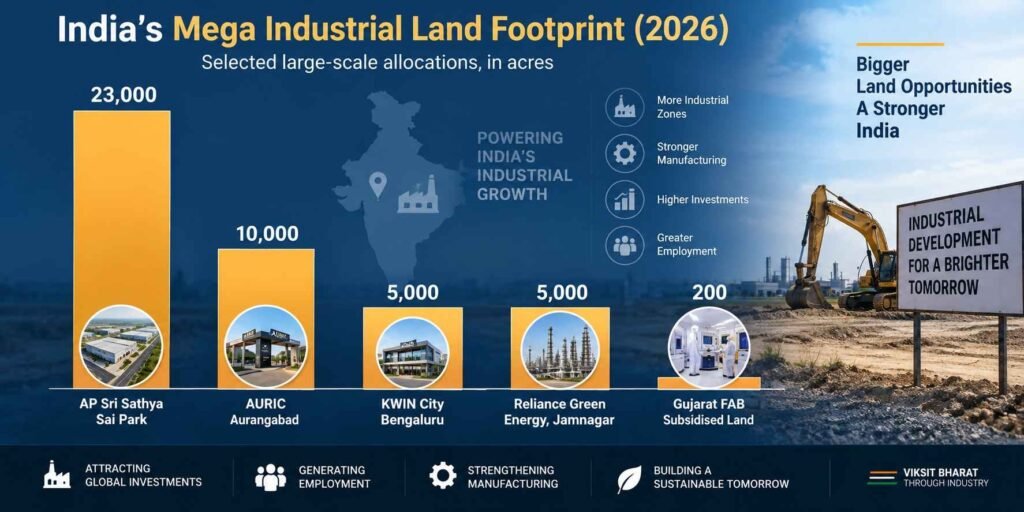
- Recent mega allocations illustrate the scale involved: Andhra Pradesh’s proposed industrial park in Sri Sathya Sai district spans 23,000 acres, the Aurangabad Industrial City (AURIC) under the Delhi-Mumbai Industrial Corridor covers 10,000 acres, and Reliance’s Green Energy Giga Complex in Jamnagar sits on roughly 5,000 acres.
- Karnataka’s upcoming KWIN City near Bengaluru pairs a 200-acre semiconductor park with 5,000 acres earmarked for R&D, while Tata Electronics’ fab at Dholera received formal SEZ notification over a 66-hectare site in April 2026.
- Gujarat’s semiconductor policy offers a land subsidy of up to 75 percent for the first 200 acres acquired for a fabrication project, showing how state incentive design is now built around mega-project land economics rather than standard industrial plots.
- With 12-13 semiconductor projects approved nationally by mid-2026 at a cumulative investment exceeding INR 1.64 lakh crore, and Semicon 2.0 adding an outlay of INR 1,27,500 crore in July 2026, the pipeline of large-footprint projects competing for assembled industrial land is only growing.
For a practical walkthrough of the site factors that matter before land is finalised, Watch IMARC Engineering’s video Industrial Site Selection in India: 7 Critical Factors to Evaluate Before Buying Land is a useful companion to this guide– https://youtu.be/uGysUbxW9Wk?si=tDhBpMNn70cWpviM
Land Acquisition Routes Available for Mega Projects
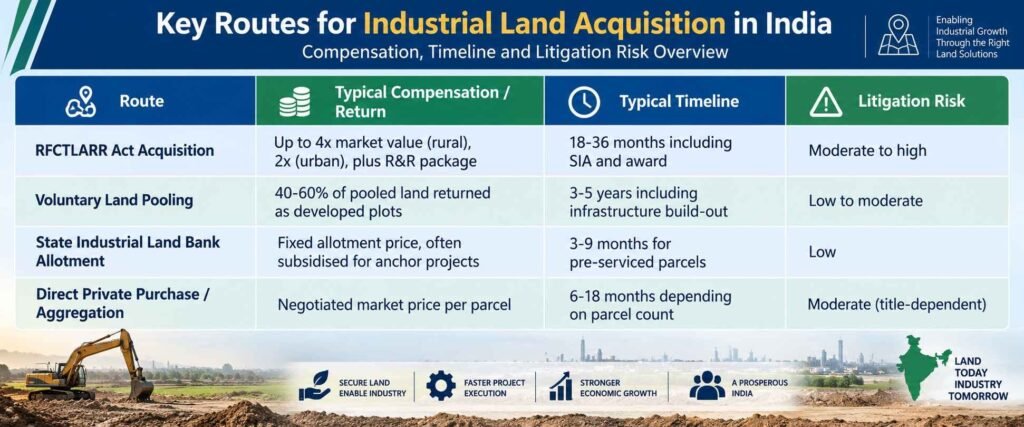
Promoters assembling large industrial sites in India typically choose from four routes, often in combination across a single project footprint:
- Statutory acquisition under the RFCTLARR Act, 2013: government-led acquisition with mandatory Social Impact Assessment for large projects, compensation up to four times market value in rural areas and twice in urban areas, and rehabilitation and resettlement obligations.
- Voluntary land pooling: landowners surrender raw land to a development authority, which builds trunk infrastructure and returns a share of developed, market-ready plots. Jammu and Kashmir’s Land Pooling Policy 2026 sets a 70 percent pooling threshold to trigger a scheme and returns 60 percent of the area to landowners as developed plots; Punjab’s 2026 framework offers landowners a choice between developed plots and statutory RFCTLARR compensation.
- State industrial land bank allotment: land already assembled and serviced by agencies such as MIDC, GIDC, KIADB, SIPCOT, HSIIDC, and NICDC-backed Special Purpose Vehicles is allotted directly to anchor investors, often with committed timelines and plug-and-play infrastructure.
- Direct private purchase and aggregation: promoters or their advisors negotiate directly with landowners across multiple contiguous parcels, most viable where parcel count is limited and title is clean.
Comparing the Four Acquisition Routes
The National Industrial Corridor Push Behind Mega Project Land Supply
- The Union Cabinet approved a dedicated Industrial Park scheme under the National Industrial Corridor Development Programme on March 18, 2026, sanctioning parks of 100-1,000 acres (25 acres for hilly and northeastern states) with central assistance of up to INR 1 crore per acre for core infrastructure.
- As of the March 2026 Cabinet approval, India already had 306 operational plug-and-play industrial parks with 20 more under development, backed by the BHAVYA scheme’s INR 33,660 crore outlay following an initial INR 2,500 crore allocation in Budget 2025-26.
- These land banks are structured specifically to shorten the acquisition timeline for large anchor investments, since land is pre-assembled, pre-serviced, and pre-cleared before an investor signs on.
Step-by-Step Process for Mega Project Land Assembly
- Site and corridor screening: benchmarking candidate parcels or land bank options against feedstock, logistics, workforce, and utility requirements.
- State MoU and anchor investor engagement: most mega projects begin with a Memorandum of Understanding defining incentive commitments, land allotment terms, and delivery timelines.
- Acquisition route selection: choosing between RFCTLARR acquisition, land pooling, direct land bank allotment, or a blended approach across the project footprint.
- Title and encumbrance verification across all parcels: for aggregation-heavy projects this can mean verifying 30-year title chains across dozens or hundreds of individual holdings.
- Social Impact Assessment and rehabilitation planning: mandatory where RFCTLARR acquisition applies, covering livelihood loss, resettlement, and community consultation.
- Environmental and forest clearance overlay checks: confirming the assembled footprint avoids eco-sensitive zones, forest land, or CRZ-restricted areas that could block development mid-process.
- Registration, mutation, and possession handover: completing statutory registration, updating revenue records, and securing physical possession before construction mobilisation.
- Zoning finalisation and Change of Land Use: converting agricultural or mixed-use parcels to industrial classification ahead of Environmental Clearance and Consent to Establish applications.
Common Challenges in Mega Project Land Acquisition
- Fragmented ownership: hundreds of small holdings must be aggregated with individually clean title, multiplying diligence effort compared with a single-owner parcel.
- Political and social sensitivity: large acquisitions draw community and political attention; land pooling frameworks have faced protests in states such as Punjab even where participation is voluntary.
- Sequencing errors: starting construction planning before land pooling infrastructure timelines (typically 3-5 years) or RFCTLARR awards are finalised routinely stalls mega projects mid-execution.
- Environmental overlay surprises: large contiguous footprints are more likely to intersect forest land, wildlife buffers, or CRZ boundaries that were not screened at the MoU stage.
- State versus central coordination gaps: land bank allotments under NICDP-linked SPVs still require state revenue department cooperation for mutation and possession, and delays at this handoff are a recurring source of schedule slippage.
How IMARC Engineering’s Expertise Can Help in Mega Industrial Land Acquisition
- Structuring the right acquisition route or blended strategy across RFCTLARR acquisition, land pooling, and land bank allotment for large, multi-parcel footprints
- Coordinating title, encumbrance, and litigation verification across large numbers of individual land holdings
- Managing Social Impact Assessment, rehabilitation planning, and community engagement for RFCTLARR-based acquisitions
- Screening assembled footprints against environmental, forest, and CRZ constraints before commitments are finalised
- Liaising with state industrial development agencies and NICDC-linked SPVs for land bank allotment and possession handover
- Sequencing land assembly with zoning conversion, Environmental Clearance, and Consent to Establish timelines to protect the overall project schedule
Get in Touch With Our Team: https://www.imarcengineering.com/contact?service=land-acquisition-legal-due-diligence
Conclusion
Land for a mega industrial project is rarely a single transaction; it is an assembly exercise spanning multiple routes, agencies, and timelines that must be sequenced correctly from the MoU stage onward. Promoters who match the acquisition route to the project’s scale and sensitivity, and who build environmental and social diligence into the plan early, consistently avoid the multi-year delays that unstructured land assembly produces on India’s largest industrial investments.
Contact Us:
IMARC Engineering
Phone: +91-120-433-0800
Email: sales@imarcengineering.com
India: C-130, Sector 2, Noida, Uttar Pradesh 201301
LinkedIn: https://www.linkedin.com/showcase/imarc-engineering/
About the Author