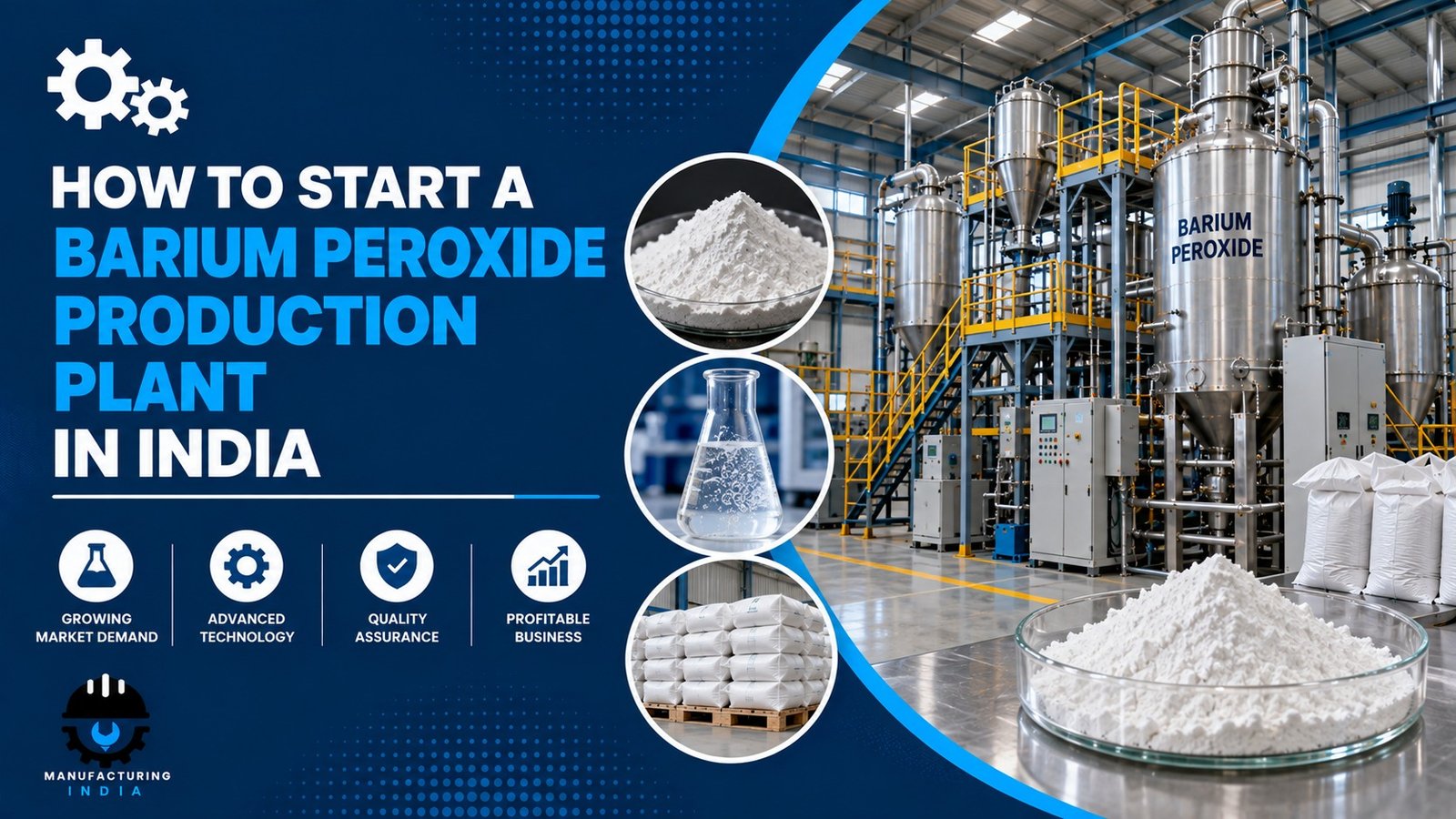
Setting up a barium peroxide production plant in India presents a compelling investment case, given demand from chemical production, specialty chemicals, pyrotechnics, laboratory chemicals, pharmaceuticals, and environmental applications. As a strong oxidizing agent that releases oxygen when heated, this compound plays a critical role in oxidation reactions, bleaching formulations, and specialty chemical synthesis across these industries.
India’s expanding chemical processing base positions the country as a strategically sound location for this facility, particularly as Asia Pacific already accounts for approximately 43.7% of the global market. With the domestic chemicals market valued at USD 220 Billion in 2023 and projected to reach USD 400–450 Billion by 2030 (NITI Aayog), a well-planned facility is positioned to serve substantial and growing downstream demand.
Backed by Asia Pacific’s dominant 43.7% share of the global market, healthy gross margins of 25–35%, and a fast-growing domestic chemicals sector, this investment offers a cost-competitive route into specialty oxidizing agents, with steady demand from chemical, pharmaceutical, and laboratory end-users supporting sound break-even viability.
What is Barium Peroxide?
Barium peroxide is an inorganic compound with the chemical formula BaO2. It is a grayish-white, granular solid that is historically significant as one of the earliest compounds used to manufacture hydrogen peroxide. As a strong oxidizing agent, it reacts vigorously with combustible materials and releases oxygen when heated to high temperatures. It is widely utilized in pyrotechnics to produce a vivid green flame color, as well as in tracer ammunition, glass bleaching, and oxygen generation systems.
The barium peroxide production process uses solid-state reaction or controlled oxidation, followed by drying, grinding, and sieving to produce the desired purity and particle size. This method serves end-use industries such as chemical production, specialty chemicals, pyrotechnics, laboratory chemicals, pharmaceuticals, and environmental applications.
Cost of Setting Up a Barium Peroxide Production Plant in India
The cost of a barium peroxide production plant depends on capacity, technology, location, automation, and regulatory compliance.
1. Capital Expenditure (CapEx)
Capital investment covers land acquisition, site preparation, and infrastructure, optimized through industrial estates or SEZ-linked plots offering developed utilities and faster approvals. Civil works cover the production shed, laboratory, storage areas, and administrative block.
Machinery represents a significant share of capital expenditure for a barium peroxide production plant, since equipment costs scale with automation level and capacity chosen. Key machinery required includes:
- Reaction vessels or oxidation furnaces
- Feed hoppers
- Metering systems
- Agitators
- Temperature-control units
- Filtration units
- Centrifuges
- Dryers
- Pulverizers
- Sieving machines
- Storage vessels
- Packaging machines
Other capital costs include effluent treatment systems, pre-operative and commissioning expenses, and applicable import duties on specialized machinery.
Request a Sample Report for In-Depth Market Insights: https://www.imarcgroup.com/barium-peroxide-manufacturing-plant-project-report/requestsample
2. Operational Expenditure (OpEx)
Raw material cost is the largest OpEx component, at approximately 45–55% of total OpEx, comprising barium carbonate and hydrogen peroxide (or barium oxide and oxygen). Long-term supplier contracts help stabilize pricing against volatility and secure consistent supply.
Utility cost, covering electricity, water, and steam, accounts for approximately 15–20% of OpEx. Other operating costs include transportation, packaging, salaries, maintenance, depreciation, and taxes. By the fifth year, total operational cost is expected to rise substantially due to inflation, market fluctuations, and supply chain disruptions.
3. Plant Capacity
The proposed facility is designed with an annual production capacity ranging between 2,000–8,000 MT, enabling economies of scale while maintaining operational flexibility. Capacity can be customized based on investor requirements, and profitability generally improves with higher capacity utilisation as fixed costs are spread across greater output.
4. Profit Margins and Financial Projections
Financial projections cover net present value (NPV), internal rate of return (IRR), payback period, liquidity, and profitability analysis. Under normal operating conditions, a barium peroxide production plant typically shows gross margins of 25–35% and net margins of 10–16%, reflecting healthy profitability supported by stable demand.
Why Set Up a Barium Peroxide Plant in India?
An Essential Specialty Chemical for Oxidation Applications: This compound serves as a strong oxidizing agent and oxygen-releasing agent, supporting applications across chemical synthesis, bleaching, and laboratory processes, positioning it as a valuable specialty chemical for diverse processing requirements.
Moderate but Justifiable Entry Barriers: Requiring lower capital investment than many advanced chemical facilities, controlled reaction conditions, raw material purity, product stability, and safe handling of oxidizing materials create entry barriers favouring experienced producers focused on consistent quality.
Megatrend Alignment: Growing chemical processing, specialty chemical output, laboratory research, and industrial processing activities are supporting demand for high-purity oxidizing agents, while expanding pharmaceutical, agrochemical, and advanced-materials industries create further opportunities.
Policy and Industrial Push: Investments in chemical processing, pharmaceutical output, specialty chemicals, and domestic capacity are indirectly supporting demand, with initiatives promoting local chemical processing and reduced dependence on imported specialty chemicals further encouraging domestic capacity growth.
Cost-Competitive, Localized Supply Chains: Chemical manufacturers, laboratories, and industrial users increasingly favour local, dependable suppliers to shorten lead times and maintain consistent raw material availability, creating opportunities for regional producers with efficient sourcing and strong quality systems.
Active Industry Investment: In August 2026, a study published in Ceramics International demonstrated that phase-pure nanoparticles of this compound, synthesized through a hydrothermal route, can achieve efficient ultraviolet photodetection without external dopants, highlighting their potential as a low-cost material for next-generation UV photodetector applications.
Production Process – Step by Step
The barium peroxide production process uses solid-state reaction or controlled oxidation as the primary production method, followed by a series of unit operations, material handling steps, and quality checks.
- Reaction or Oxidation: Raw materials are processed in reaction vessels or oxidation furnaces under controlled conditions using feed hoppers and metering systems.
- Agitation and Temperature Control: Agitators and temperature-control units maintain uniform reaction conditions for consistent product quality.
- Filtration: Filtration units separate the reaction product from residual liquid and impurities.
- Centrifugation: Centrifuges further separate and concentrate the solid product.
- Drying: Dryers remove residual moisture to stabilize the material.
- Pulverizing: Pulverizers reduce the dried material to the required particle size.
- Sieving: Sieving machines classify particles to achieve the desired purity and particle-size distribution.
- Storage and Packaging: Storage vessels hold the finished product before packaging machines complete the process, preparing it for dispatch to chemical, pharmaceutical, and laboratory end-users.
Key Applications
This compound serves a diverse set of end-use industries centered on oxidation and specialty chemical processing:
- Chemical Industry: Oxidizing agents, bleaching formulations, and specialty chemical synthesis.
- Pharmaceutical Industry: Oxidation reactions and pharmaceutical intermediate production.
- Ceramics and Glass: Specialty formulations, glazing processes, and high-temperature applications.
- Laboratories and Research: Oxidation reactions, analytical chemistry, and chemical synthesis.
Leading Manufacturers
Leading producers in this global industry include several multinational companies with extensive production capacities and diverse application portfolios. Key players include:
- Solvay
- American Elements
- Sigma-Aldrich
Timeline to Start the Plant
- Feasibility study and project report preparation
- Land acquisition and site development
- Regulatory approvals and environmental clearances
- Factory licence and fire safety compliance
- Machinery procurement and installation
- Raw material supplier agreements and supply chain setup
- Trial production and quality testing
- Commercial production launch
Licences and Regulatory Requirements
Starting a barium peroxide production unit in India requires several approvals:
- Business registration (Proprietorship, LLP, or Pvt Ltd)
- Factory Licence under the Factories Act
- Environmental Clearance from State Pollution Control Board
- GST Registration
- Fire Safety NOC
- Hazardous/Chemical compliance for oxidizing material handling
- Effluent Treatment Plant (ETP) operational clearance
- Occupational Health and Safety compliance
Key Challenges to Consider
High Capital Requirements: Machinery accounts for the largest share of capital expenditure, requiring significant investment before operations can begin.
Raw Material Price Volatility: Barium carbonate and hydrogen peroxide (or barium oxide and oxygen) are subject to price fluctuations that can affect operating costs.
Regulatory Compliance: Controlled reaction conditions, raw material purity, product stability, and safe handling of oxidizing materials require sustained investment in quality and safety systems.
Competition from Established Players: Multinational players such as Solvay, American Elements, and Sigma-Aldrich hold extensive production capacities and diverse application portfolios.
Technology and Purity Pressure: Manufacturers increasingly focus on product purity, production efficiency, process safety, and environmental performance.
Skilled Manpower: Controlled-reaction and quality-control work requires trained personnel to maintain consistent standards.
Frequently Asked Questions
1. How much does it cost to set up a barium peroxide production plant in India?
Cost depends on capacity, automation level, land and site development, and civil works; a detailed CapEx and OpEx breakdown is covered in the full feasibility report.
2. Is barium peroxide production profitable in India in 2026?
The facility demonstrates healthy profitability potential, with gross margins of 25–35% and net margins of 10–16% under normal operating conditions.
3. What machinery is required for a barium peroxide plant in India?
Key machinery includes reaction vessels or oxidation furnaces, feed hoppers, metering systems, agitators, temperature-control units, filtration units, centrifuges, dryers, pulverizers, sieving machines, storage vessels, and packaging machines.
4. What licences and approvals are required to start a barium peroxide plant in India?
Requirements include business registration, a Factory Licence, Environmental Clearance, GST Registration, Fire Safety NOC, hazardous/chemical compliance, ETP clearance, and occupational health and safety compliance.
5. What raw materials are needed for barium peroxide production?
Barium carbonate and hydrogen peroxide (or barium oxide and oxygen) are the primary raw materials.
6. What are the environmental compliance requirements for a barium peroxide plant in India?
Plants require Environmental Clearance from the State Pollution Control Board, an operational Effluent Treatment Plant, and adherence to emission and safety monitoring standards.
7. What is the best location to set up a barium peroxide plant in India?
Sites should offer easy access to raw materials, proximity to target markets, robust transportation and utility infrastructure, and compliance with local zoning and environmental regulations.
8. What is the break-even period for this type of plant in India?
Break-even timing depends on capacity utilisation, pricing, and cost structure, assessed through payback period and net present value analysis in the financial projections.
9. What government incentives are available for manufacturers in India?
Incentives vary by state and are typically tied to industrial estate or SEZ location, land and infrastructure support, and compliance with regulatory frameworks.
Key Takeaways for Investors
A barium peroxide production plant offers a compelling opportunity supported by demand from chemical production, specialty chemicals, pyrotechnics, laboratory chemicals, pharmaceuticals, and environmental applications. Financial projections indicate sound viability across capacities ranging from 2,000–8,000 MT annually, with gross margins of 25–35% and net margins of 10–16%. Asia Pacific’s approximately 43.7% share of the global market, alongside India’s domestic chemicals market growing from USD 220 Billion in 2023 toward USD 400–450 Billion by 2030 (NITI Aayog), points to sustained long-term demand for specialty oxidizing agents, positioning a well-planned facility for durable relevance.
About the Author