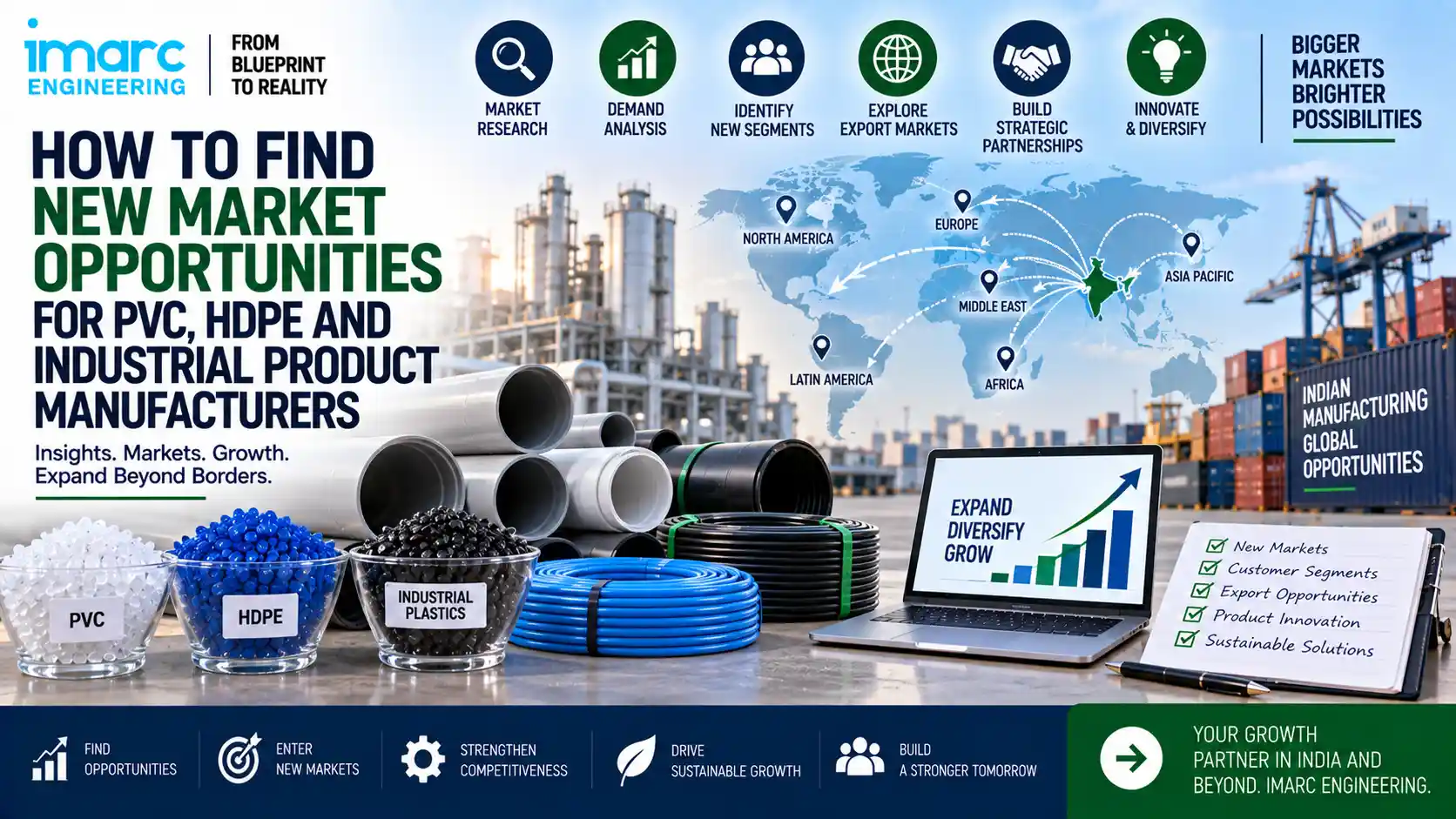
Most PVC, HDPE and industrial product manufacturers grow by serving the same customers, applications and regions year after year. That works until competition rises or existing buyers slow down. A genuine new market opportunity is not the industry that sounds promising — it is one where demand, buyer accessibility, technical suitability, competition, pricing, margins, logistics, compliance, payment risk and repeat-order potential all hold up under scrutiny.
This article sets out a practical method PVC, HDPE and industrial product manufacturers can use to find new applications, buyer segments, regions and export opportunities. Manufacturers looking to expand their distribution network can also explore Distribution Partner Identification to connect with suitable channel partners in new markets.
Understanding Which Products Can Serve New Applications
Not every PVC or HDPE product fits every application. Manufacturers should first map what their products can genuinely do before chasing new demand.
- PVC products commonly serve water supply and plumbing, drainage and sewerage, irrigation piping, electrical conduits and cable protection, and construction profiles.
- HDPE products commonly serve pressure pipelines for water and irrigation, industrial and mining slurry transport, telecom cable ducting, storage tanks, and geomembranes.
- Other industrial products — fittings, sheets, films, moulded and fabricated items — serve construction, industrial utilities, EPC projects, OEM supply and institutional procurement, depending on specification.
Before pursuing a new application, verify:
- Material grade and formulation
- Product specifications and dimensions
- Pressure and temperature rating
- Chemical compatibility with the intended use
- Applicable standards (such as BIS specifications)
- Testing and certification requirements
A product performing well in one application may not meet another’s technical requirements, even within the same industry.
How Manufacturers Can Identify New Market Opportunities
Identifying a new market opportunity is a sequence, not a single decision. The infographic below outlines the practical flow, from product capability to pilot market entry.
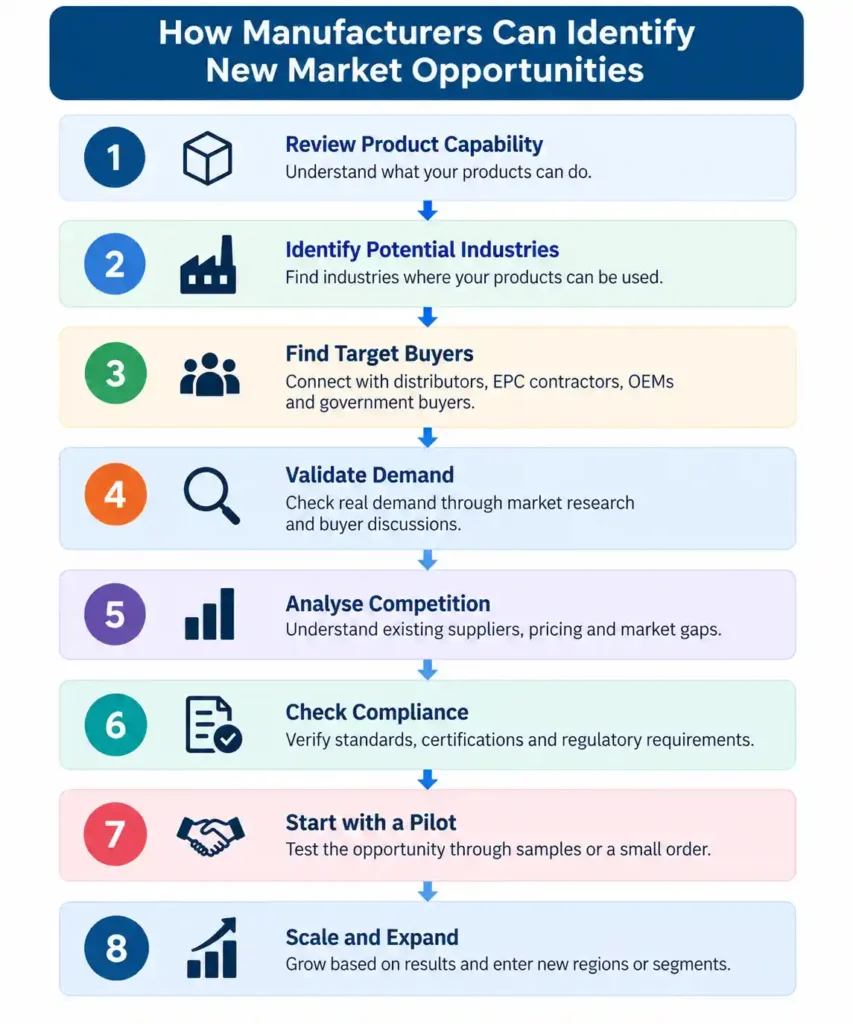
Alt text: Flow diagram showing eight steps for PVC, HDPE and industrial manufacturers to find new market opportunities — product capability review, industry mapping, buyer identification, demand validation, competition review, compliance check, pilot entry and market expansion.
Each stage should be completed before moving to the next one, ending with a small pilot order rather than a full-scale commitment.
Identify Industries Creating Demand for PVC, HDPE and Industrial Products
Different industries generate different demand patterns. Assess usage, likely buyers, whether demand is project-based or recurring, and required approvals.
- Water and wastewater infrastructure – Pipes, fittings and valves for water boards, EPC contractors and municipal bodies; tender-driven, BIS certification usually required.
- Irrigation and agriculture – Drip, sprinkler and lift-irrigation piping for farmer groups, distributors and irrigation departments, often on seasonal, scheme-linked cycles.
- Urban development and construction – Conduits, drainage and plumbing products for builders and contractors; recurring demand tied to construction activity.
- Industrial parks and manufacturing facilities – Utility piping and cable protection sourced by EPC firms and plant engineering teams; approvals depend on the plant.
- Mining and mineral processing – HDPE pipelines for slurry and water transport, bought by mining firms or EPC contractors, subject to abrasion and pressure checks.
- Telecommunications – HDPE ducts for cable protection, sourced by telecom infrastructure companies and network projects.
- Energy and renewable-energy projects – Piping and cable protection where technically suitable, usually bought project-wise by EPC contractors.
- Chemical, food and pharmaceutical facilities – Suitable only where material compatibility and hygiene are verified.
- EPC and infrastructure projects – Recurring institutional demand through tenders, requiring registration and consistent supply.
Confirm demand for each industry rather than assuming it from the category.
Explore Geographic Market Opportunities in India
A product selling well in one state may face different competition, freight costs or compliance requirements elsewhere. Shortlist regions by reviewing industrial projects, water and irrigation schemes, infrastructure development, industrial corridors, manufacturing clusters, construction and agricultural activity, and existing distributor coverage.
| Evaluation Factor | Questions Manufacturers Should Ask |
|---|---|
| Demand | Are new projects, tenders or construction activity visible here? |
| Competition | Who already supplies here, at what price and quality level? |
| Logistics | What is the freight cost and delivery time to this region? |
| Buyer availability | Are distributors, dealers or direct buyers accessible here? |
| Pricing | Can we price competitively after freight and retain margin? |
| Compliance | Does the state have specific procurement or approval rules? |
| Growth potential | Is this a one-time opportunity or a repeat-order market? |
Reviewing these factors together, not in isolation, helps avoid entering a region that looks promising on paper but is not commercially viable.
Find New Buyer Segments and Sales Channels
Beyond direct customers, new demand can come through regional distributors and dealers, EPC and infrastructure contractors, OEMs and system integrators, project consultants, government procurement agencies, institutional buyers, industrial procurement teams, and importers or contract buyers.
Before onboarding any of these, evaluate order volume, technical approval requirements, credit period, territory expectations, after-sales support, customisation needs, minimum order quantity and repeat-purchase potential. A distributor wanting exclusive territory on a low order commitment carries different risk than a government buyer purchasing via open tenders.
Use Government and Official Data to Validate Market Opportunities
Check demand against official data, not third-party market estimates. Useful sources: Ministry of Commerce and Industry, Department of Chemicals and Petrochemicals, DPIIT, Ministry of Jal Shakti, Ministry of Housing and Urban Affairs, Ministry of Agriculture and Farmers Welfare, government tender portals, the Government e-Marketplace (GeM), DGCI&S, the Trade Intelligence and Analytics (TIA) Portal, and the Bureau of Indian Standards.
For instance, the Ministry of Jal Shakti reported that around 15.82 crore of India’s 19.36 crore rural households (about 81.71%) had tap water connections as of March 2026 under the Jal Jeevan Mission, with the Union Cabinet approving an enhanced JJM 2.0 outlay of ₹8.69 lakh crore that month, extending the programme to December 2028 (PIB) — activity directly relevant to pipe manufacturers.
When using trade data, verify the correct HS code first, and never mix raw PVC or HDPE polymer data with finished pipes, fittings, sheets or films — sector-level plastics figures are not product-specific demand.
Evaluate Export Market Opportunities
Shortlist export markets using product-specific import demand, not general plastics-sector figures:
- Existing Indian exports of the specific product (correct HS code), via DGCI&S or the TIA Portal
- Freight, transit time and applicable tariffs or duties
- Any relevant India–partner-country trade agreement
- Local product standards and certification requirements
- Competitor presence and existing importer or distributor networks
- Currency and payment risk
- Packaging and documentation requirements
- Political and logistics risk
A market with strong general plastics demand but no verified import history for the specific product should be treated as unproven until confirmed through direct buyer contact.
Validate the Opportunity Before Investing
- Shortlist suitable target markets.
- Identify actual buyers and distributors.
- Review competitors and pricing.
- Share samples and technical documents.
- Collect buyer feedback.
- Verify certifications and approvals.
- Conduct pilot sales or small-volume orders.
- Evaluate repeat-order potential.
- Calculate freight, margins and working-capital needs.
- Decide whether to scale, modify the product or reject the opportunity.
Useful evaluation parameters here, not universal benchmarks, include qualified enquiries, sample-to-order conversion, repeat-order rate, average order size, contribution after freight, payment cycle, rejection rate, distributor performance and sales-cycle duration.
Assess Product Readiness for the New Market
General market demand and technically addressable demand are not the same thing. A market may need large pipe volumes, but only manufacturers meeting the required rating, standard and certification can actually supply it. Confirm specifications, material grade, pressure rating, applicable BIS, ISO, ASTM or customer standards, testing facilities, packaging, labelling, batch traceability, technical datasheets, installation guidelines, warranty terms, customisation, and whether capacity can meet the buyer’s volumes consistently.
Evaluate Competition and Positioning
Competing purely on price rarely holds up once freight and margin pressures are factored in. Assess competitors on product quality, price, delivery reliability, product range, customisation, certifications, technical support, minimum order quantity, credit terms, distributor margins, complaint handling and replacement support.
Sustainable positioning is usually built through faster delivery, custom sizes, consistent quality, better documentation, regional stocking, reliable after-sales support and specialised application expertise — harder for competitors to replicate than a lower price.
Build a Practical Market-Entry Plan
This is an illustrative framework, not a universal timeline; actual durations vary by product, region and buyer type.
First 30 days: Product capability mapping, industry research, target-market shortlisting and competitor review.
Next 30 days: Buyer and distributor identification, sample sharing, technical discussions, and pricing and logistics analysis.
Final 30 days: Pilot orders, logistics testing, buyer feedback collection and commercial viability review.
How IMARC Engineering Can Help
IMARC Engineering supports PVC, HDPE and industrial product manufacturers in structuring this evaluation, from application and industry assessment to distribution partner identification and buyer requirement review. The team assists with technical feasibility inputs, manufacturing-readiness review and engineering coordination for expansion decisions — helping manufacturers approach new markets with a clearer, documented basis for decision-making, without guaranteeing sales outcomes.
How IMARC Engineering Can Support Manufacturers
| Manufacturer Challenge | Relevant IMARC Engineering Support |
|---|---|
| Identifying suitable industries | Application and industry opportunity assessment |
| Finding new regions | Geographic and industrial market evaluation |
| Identifying distributors | Distribution partner identification |
| Understanding buyer requirements | Buyer, project and technical requirement assessment |
| Evaluating manufacturing readiness | Product, process and capacity review |
| Entering industrial supply chains | OEM, EPC and industrial buyer opportunity assessment |
| Planning expansion | Manufacturing project planning and engineering coordination |
| Evaluating new product opportunities | Technical feasibility and application-oriented assessment |
Connect with IMARC Engineering for market-opportunity assessment, distribution partner identification and technical support for your expansion plans: https://www.imarcengineering.com/contact?service=distribution-partner-identification
Conclusion
Finding new market opportunities for PVC, HDPE and industrial products comes down to structured evaluation, not guesswork. Manufacturers who verify product suitability, industry demand, buyer access, competition, compliance, logistics, and pricing and margins — and validate every opportunity through a pilot before scaling — are better placed to expand into new applications, regions and export markets with sustainable, repeat-order business rather than one-off orders.
Contact Us:
IMARC Engineering
Phone: +91-120-433-0800
Email: sales@imarcengineering.com
India: C-130, Sector 2, Noida, Uttar Pradesh 201301
LinkedIn: https://www.linkedin.com/showcase/imarc-engineering/
About the Author