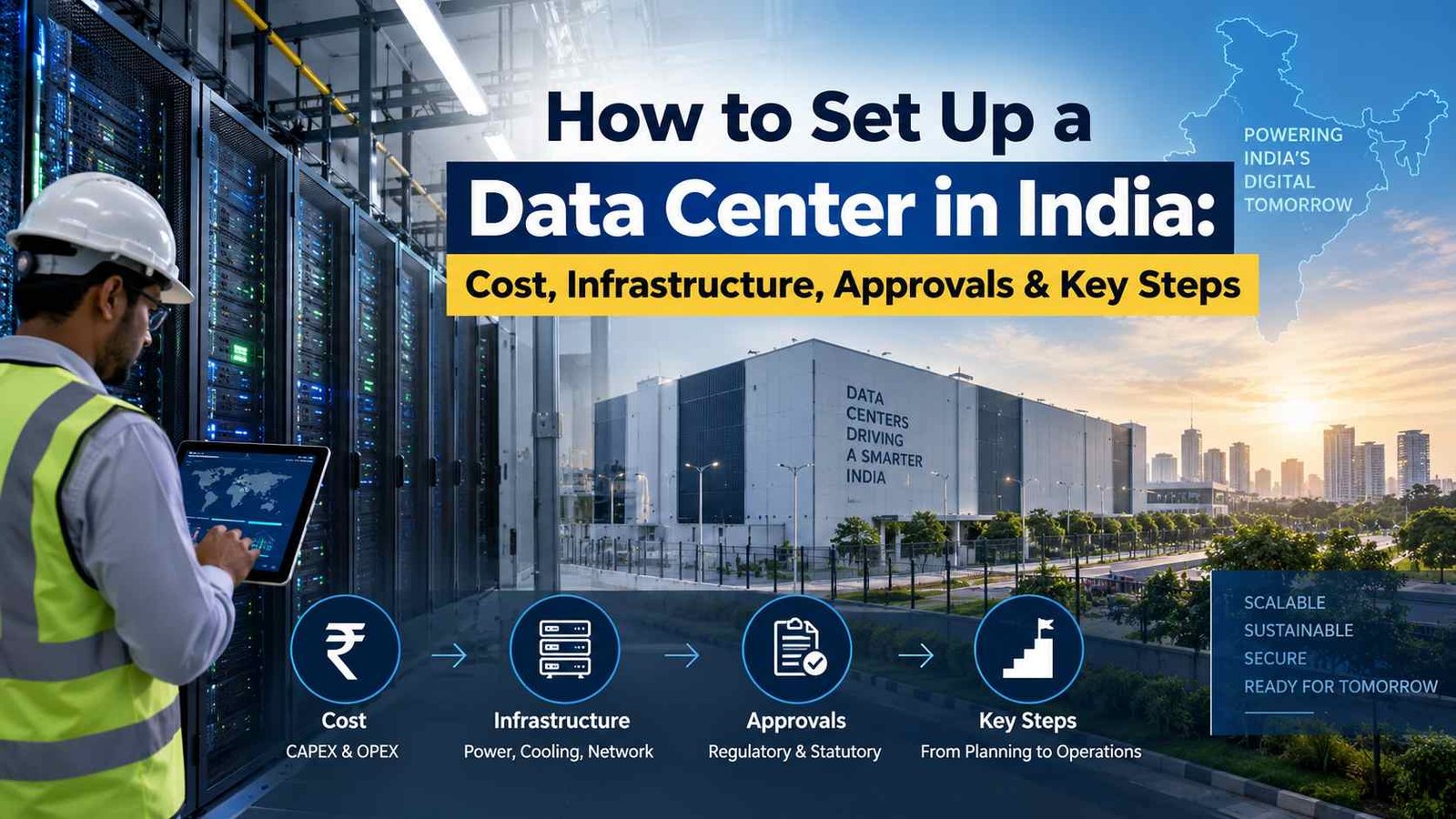
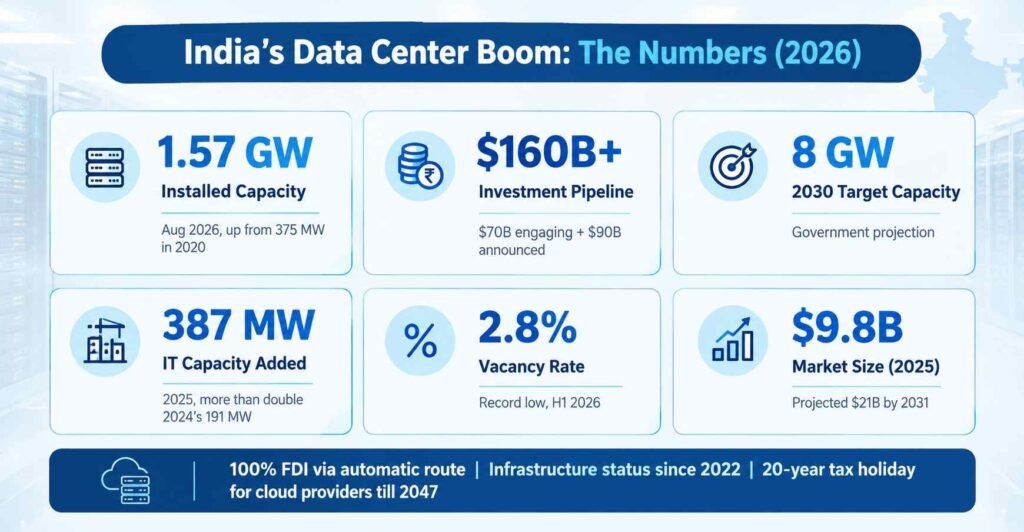
India’s installed data center capacity reached 1.57 GW in August 2026, up from just 375 MW in 2020. Behind this rapid expansion are approximately USD 70 billion in ongoing investments and another USD 90 billion in announced projects, while the government is targeting 8 GW of data center capacity by 2030.
For hyperscalers, colocation operators, and enterprise sponsors evaluating India, the growth opportunity is significant. However, setting up a data center involves far more than securing land and installing IT infrastructure. Project sponsors need to assess development costs, power availability, statutory approvals, construction timelines, cooling requirements, redundancy levels, fire safety systems, and network connectivity before committing capital.
These factors can significantly influence data center project costs, implementation timelines, operational resilience, and long-term uptime. A structured approach to site selection, land and power assessment, infrastructure planning, regulatory approvals, engineering design, and project execution is therefore essential before breaking ground. This guide answers those questions directly, using the latest available data.
How Much Does It Cost to Set Up a Data Center in India?
In short, a Tier III facility in India costs roughly USD 6-8 million per MW of IT load, excluding land, while Tier IV and AI-ready high-density builds run higher.
- Tier III colocation (5-10 kW/rack density): ₹50-65 crore per MW (~USD 6-8 million per MW)
- Tier III hyperscale, optimised design: ₹55-70 crore per MW
- Tier IV mission-critical: ₹70-90 crore per MW
- AI-ready, high-density (20-50+ kW/rack) with liquid cooling: ₹70-95 crore per MW
Electrical systems (HV, MV, LV, UPS, generators) are the single largest cost category, typically 25-35% of total capex, followed by mechanical and cooling systems at 18-28%.
Annual operating cost typically runs 8-15% of facility revenue at occupancy, with power alone accounting for 50-65% of that spend, which is why PUE (Power Usage Effectiveness) optimization matters so much to long-term returns.
Infrastructure Requirements: Power, Cooling, Land, and Connectivity
Power supply and cooling architecture determine 60-75% of capex and 80-90% of operating expense, so these decisions carry more weight than almost anything else in the project.
- Power: A hyperscale facility typically needs a dedicated 132kV or 220kV grid connection with redundant feeders, N+1 or 2N redundancy across transformers and UPS, and diesel or gas generator backup covering 100% of IT and cooling load
- Cooling: Legacy air-cooled designs run a PUE of 1.45-1.55; new builds targeting AI workloads are pushing below 1.30 using rear-door heat exchangers, direct liquid cooling, or immersion cooling
- Water: Large facilities consume 1-3 million litres per day for evaporative cooling, which is pushing water-stressed hubs like Bengaluru toward dry or hybrid cooling systems
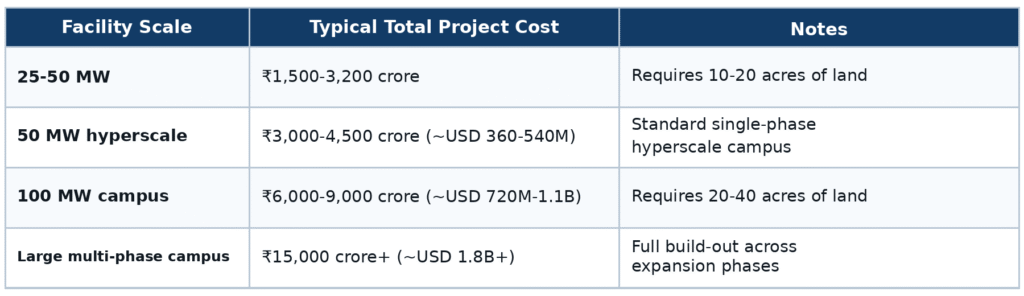
- Land: 10-20 acres for a 25-50 MW facility, scaling to 20-40 acres for a 100 MW campus, ideally sized with 50-100% margin for future expansion
- Renewable power: Open-access PPAs in Gujarat, Rajasthan, Tamil Nadu, and Karnataka can land renewable power at ₹4-7 per unit versus ₹7-10 per unit from state utilities
A detailed breakdown of these decisions, including how workload density is reshaping cooling architecture, is covered in IMARC Engineering’s guide on data center development in India, which walks through the full six-phase build process.
Regulatory Approvals Needed to Set Up a Data Center in India
The approval pathway spans central, state, and sector-specific frameworks, and mapping it correctly at the start avoids the delays that catch most first-time sponsors off guard.
- Environmental Clearance: required for larger projects under EIA Notification 2006, involving SEIAA/MoEFCC review, TOR determination, and public consultation
- Building Plan Approval: from the local Development Authority or Municipal Corporation, including structural design and NBC 2016 Part 4 fire compliance
- Fire NOC: provisional at construction, final at occupation, covering detection, suppression, and egress design
- Pollution Control Board consents: CTE before construction, CTO before operations
- Electrical Inspectorate and CEIG approval: required before energisation of HT installations
- Power Connection Agreement: with the state utility or via open access through the State Load Despatch Centre
- State Data Center Policy registration: to access single-window clearance and fiscal incentives
- DPDP Act compliance: operational obligations under the Digital Personal Data Protection Act 2023, including breach notification
Foreign investors can hold up to 100% via the automatic route, with government approval needed only where the investor is from a country sharing a land border with India, under Press Note 3. Data centers of at least 5 MW in a dedicated building also sit on India’s Harmonised Master List of Infrastructure Sub-Sectors since 2022, opening access to long-tenor infrastructure financing. Managing the construction-side compliance sequence, fire safety, structural sign-off, and site execution oversight, is where dedicated construction management services typically make the difference between a smooth build and a stalled one.
Key Steps to Set Up a Data Center: New Build or Retrofit?
Before locking a site, most sponsors face a structural choice: build a new greenfield campus from scratch, or expand an existing brownfield facility.
- Concept and feasibility (8-16 weeks): demand sizing, Tier classification, capital plan
- Site acquisition and approvals (6-12 months): land due diligence, statutory clearances, power tie-up initiation
- Detailed engineering (4-8 months): civil, MEP, IT room, and Tier design documentation
- EPC construction (18-30 months): civil, MEP, IT room build-out, integrated commissioning
- Testing and certification (3-6 months): Uptime Tier certification and customer acceptance
- Operations and scale-up: customer onboarding through 80%+ utilisation, typically 24-48 months
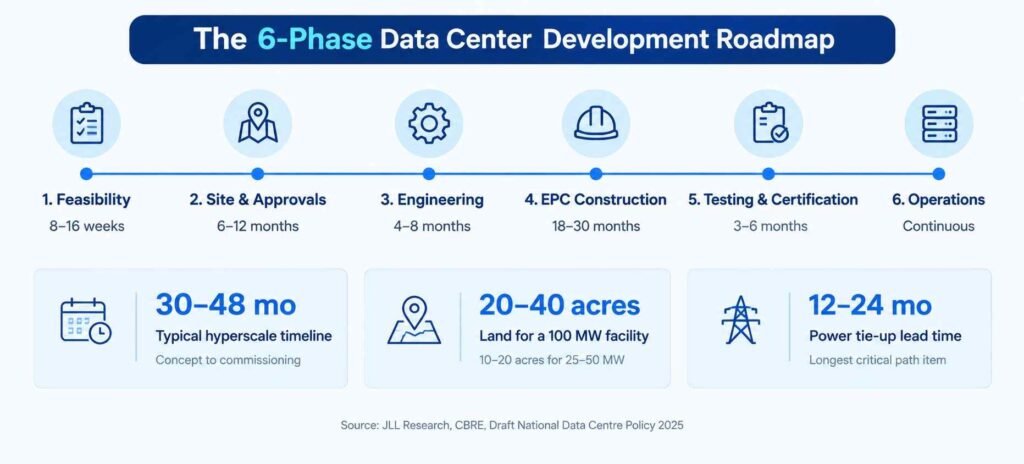
Power tie-up is consistently the longest-lead item, often 12-24 months for a greenfield site without existing high-voltage infrastructure, which is why sponsors who engage the utility and SLDC at concept stage compress their overall schedule the most. The greenfield-versus-brownfield decision itself is not unique to data centers. IMARC Engineering’s comparison of greenfield and brownfield manufacturing projects in India applies the same underlying logic: brownfield expansion is typically faster and needs 40-70% of greenfield capex, while greenfield gives full design freedom for future AI-density workloads that older facilities cannot retrofit cheaply.
Where Should You Build? Leading Data Center Hubs in India
- Mumbai/Navi Mumbai: largest hub, ~48-53% of operational capacity, driven by submarine cable landings and financial-sector demand
- Chennai: ~18-20% share, second-largest submarine cable landing point, increasingly favoured for AI-ready campuses
- Delhi-NCR: ~10% share, strong government, enterprise, and cloud demand
- Bengaluru: ~7% share, deep tech ecosystem but constrained by power and water availability
- Hyderabad, Pune, Visakhapatnam, Kolkata: emerging hubs offering larger land parcels and lower costs
How IMARC Engineering’s Expertise Can Help in Data Center Setup
- Multi-criteria site selection modelling power, connectivity, climate, and total cost of ownership over a 20-25 year facility life
- EPC project management across civil, MEP, IT room build-out, and Uptime Tier III/IV certification
- Regulatory pathway mapping across Environmental Clearance, Fire NOC, PCB consents, CEIG, and state data center policy registration
- Power strategy support for utility tie-ups, open-access PPA structuring, and renewable integration
- Sustainability and ESG integration, including IGBC LEED certification and PUE optimisation from design stage
Get in Touch With Our Team: https://www.imarcengineering.com/contact-us
Conclusion
Setting up a data center in India in 2026 means operating in one of the world’s fastest-growing digital infrastructure markets, but the returns depend on getting the fundamentals right early. Site selection on total cost of ownership rather than land price, power tie-up initiated at concept stage, and design built for future AI-density workloads are what separate facilities that scale smoothly from those that stall mid-build.
Contact Us:
IMARC Engineering
Phone: +91-120-433-0800
Email: sales@imarcengineering.com
India: C-130, Sector 2, Noida, Uttar Pradesh 201301
LinkedIn: https://www.linkedin.com/showcase/imarc-engineering/
About the Author