A zinc nitrite production plant setup in India presents a compelling investment case for investors tracking demand from metal finishing, automotive, industrial manufacturing, specialty chemicals, and chemical research. Zinc nitrite solutions support metal-surface treatment and chemical conversion processes where controlled composition is essential for consistent surface characteristics, making the compound valuable wherever corrosion-resistant metal components are required. As automotive and industrial manufacturing activity expands, demand for this specialized chemistry used in surface protection and customized industrial formulations is expected to grow alongside it.
India’s position in the global zinc-processing landscape adds further weight. According to the Ministry of Mines, Government of India, the country accounted for 6% of global zinc metal production during April-December 2025, out of a global total of 10.552 million tonnes. This base offers a relevant downstream environment, since production can integrate with existing zinc-salt operations. With Asia-Pacific already holding around 42.0% of the global zinc nitrite market, a plant based in India sits within the region driving global demand.
The opportunity is anchored by strong metal-finishing and automotive demand, an established domestic zinc-processing ecosystem, and healthy fundamentals – gross margins of 30-40% and net margins of 12-20% – that together support a reasonably attainable break-even path for a well-planned facility.
What is Zinc Nitrite?
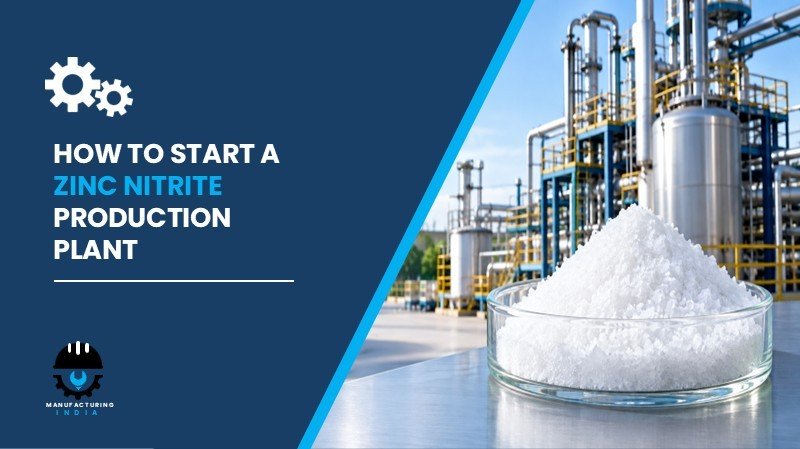
Zinc nitrite is an inorganic zinc salt with the chemical formula Zn(NO₂)₂ and a molecular weight of approximately 157.4 g/mol. It is available primarily as a specialty chemical or aqueous solution rather than a large-volume commodity, and is prepared through reactions involving a zinc compound and an alkali-metal nitrite; specialized routes employ ion-exchange membranes and electrodialysis for controlled impurity levels. It is used for metal-surface treatment, chemical conversion processes, coordination chemistry, and specialty research.
The zinc nitrite production process involves zinc-feed preparation, nitrite solution preparation, controlled reaction/metathesis, filtration, purification, concentration, quality testing, and packaging. A zinc nitrite production plant primarily serves metal finishing, automotive, industrial manufacturing, specialty chemicals, and chemical research industries.
Cost of Setting Up a Zinc Nitrite Production Plant in India
Cost depends on capacity, technology, location, automation level, and regulatory compliance.
1. Capital Expenditure (CapEx)
Land and site development forms a substantial part of the investment, covering land registration, boundary development, and related infrastructure. Civil works costs cover construction of the production shed, laboratory, storage areas, and administrative block. Machinery costs account for the largest portion of total capital expenditure for a zinc nitrite production plant. Key machinery required includes:
- Zinc-compound storage tanks
- Nitrite solution preparation tanks
- Stainless-steel reaction vessels
- Agitated reactors
- Chemical dosing systems and metering pumps
- pH-control systems
- Ion-exchange membrane units and electrodialysis cells
- Filtration systems, filter presses, and cartridge filters
- Purification columns
- Intermediate storage tanks
- Evaporators or concentration units and heat exchangers
- Crystallizers (where solid product is required)
- Dryers and powder-handling equipment
- Storage vessels and weighing systems
- Filling, bag-sealing, labeling, and palletizing equipment
Other capital costs cover effluent treatment infrastructure and pre-operative and commissioning expenses. Exact line-item figures for these categories are available in the report’s detailed CapEx breakdown.
Request a Sample Report for In-Depth Market Insights: https://www.imarcgroup.com/zinc-nitrite-manufacturing-plant-project-report/requestsample
2. Operational Expenditure (OpEx)
Raw material cost dominates operating expenditure for the zinc nitrite production plant: zinc sulfate (or zinc chloride), sodium nitrite, and ethanol together account for approximately 50-60% of total OpEx, making long-term supplier contracts important for stabilizing input pricing. Utility cost – electricity, water, and steam – represents around 12-18% of OpEx. Other operating costs include transportation, packaging, salaries, depreciation, taxes, and maintenance. By year five, total operational cost is expected to rise substantially due to inflation, market fluctuations, and raw material price increases.
3. Plant Capacity
The proposed zinc nitrite production plant is designed with an annual capacity ranging between 500-1,500 MT, allowing economies of scale while preserving flexibility. Capacity can be customized per investor requirements, and profitability generally improves as utilisation increases toward the higher end of this range.
4. Profit Margins and Financial Projections
The project shows healthy profitability potential under normal operating conditions. Gross profit margins typically range between 30-40%, supported by stable demand, while net profit margins range between 12-20%. Financial projections are built on realistic assumptions covering capital investment, operating costs, capacity utilisation, and pricing trends, with the underlying analysis covering ROI, NPV, IRR, and payback period.
Why Set Up a Zinc Nitrite Plant in India?
Specialty Chemical Demand: Zinc nitrite serves niche applications where controlled zinc-nitrite chemistry is required, giving a facility access to a defined but resilient customer base rather than pure commodity competition.
Metal Treatment Opportunity: Its use in chemical surface-treatment systems creates consistent demand from metal-processing industries needing corrosion-resistant components.
Established Zinc-Processing Base: With India contributing 6% of global zinc metal production during April-December 2025 against a global total of 10.552 million tonnes, the country’s zinc-processing ecosystem offers a relevant downstream base for the plant.
Regional Market Positioning: Asia-Pacific accounts for roughly 42.0% of the global zinc nitrite market, placing an India-based zinc nitrite production plant within the region generating the largest share of global demand.
High-Purity and Customization Potential: Manufacturers can target specialized grades with controlled concentrations and low unwanted-ion levels, suited to specific industrial processes.
Research and Industrial Integration: Demand from laboratories and materials research adds a further segment, while production can integrate with facilities manufacturing other specialty inorganic chemicals.
Zinc Nitrite Production Process – Step by Step
The production process uses controlled reaction and purification of prepared feedstocks:
- Zinc-Feed Preparation: Zinc sulfate or zinc chloride feedstock is prepared for reaction.
- Nitrite Solution Preparation: Sodium nitrite solution is prepared under controlled conditions.
- Controlled Reaction/Metathesis: The zinc feed and nitrite solution react, with ion-exchange membrane units and electrodialysis cells managing impurity levels.
- Filtration: Filtration systems, filter presses, and cartridge filters separate solids and impurities.
- Purification: Purification columns refine the solution to the required composition.
- Concentration: Evaporators or concentration units, supported by heat exchangers, bring the solution to the desired strength; crystallizers are used where a solid product is required.
- Quality Testing: The product undergoes quality assurance checks against technical specifications.
- Packaging: Filling, bag-sealing, labeling, and palletizing equipment prepare the finished product for dispatch to metal finishing, automotive, industrial manufacturing, specialty chemicals, and chemical research customers.
Key Applications
- Metal Surface Treatment: Used in specialized chemical conversion and metal-treatment processes.
- Corrosion Protection: Contributes to corrosion-control systems for metallic surfaces.
- Automotive Components: Applied to metal components requiring improved surface protection.
- Industrial Equipment: Used by metal-processing industries for surface conditioning and protection.
- Chemical Synthesis: Serves as a zinc-containing reagent in specialized inorganic and coordination chemistry.
- Research Applications: Its defined composition supports laboratory studies involving zinc coordination and inorganic materials.
Leading Zinc Nitrite Producers
Leading producers in the global industry include multinational companies with diverse application portfolios:
- Angene International Limited
- SAGECHEM LIMITED
These producers serve metal finishing, automotive, specialty chemicals, and chemical research sectors.
Timeline to Start the Plant
- Feasibility study and project report preparation
- Land acquisition and site development
- Regulatory approvals and environmental clearances
- Factory licence and fire safety compliance
- Machinery procurement and installation
- Raw material supplier agreements and supply chain setup
- Trial production and quality testing
- Commercial production launch
Licences and Regulatory Requirements
Starting a zinc nitrite production unit in India requires several approvals:
- Business registration (Proprietorship, LLP, or Pvt Ltd)
- Factory Licence under the Factories Act
- Environmental Clearance from State Pollution Control Board
- GST Registration
- Fire Safety NOC
- Hazardous/Chemical compliance for zinc and nitrite handling
- Effluent Treatment Plant (ETP) operational clearance
- Occupational Health and Safety compliance
Key Challenges to Consider
High Capital Requirements: Machinery costs account for the largest share of capital expenditure, given the extensive reaction, filtration, and concentration equipment involved.
Raw Material Price Volatility: Zinc sulfate (or zinc chloride), sodium nitrite, and ethanol drive 50-60% of OpEx, so price swings materially affect margins.
Regulatory Compliance: Environmental clearances, effluent treatment obligations, and chemical-handling safety protocols require ongoing monitoring.
Quality and Composition Control: Controlled concentrations and low unwanted-ion levels demand discipline across ion-exchange, electrodialysis, and purification stages.
Competition from Established Players: Angene International Limited and SAGECHEM LIMITED already operate with extensive capacities.
Skilled Manpower: Operating electrodialysis cells and crystallizers requires trained technical staff.
Frequently Asked Questions
1. How much does it cost to set up a zinc nitrite production plant in India?
Cost depends on capacity, technology, location, and automation, covering land, civil works, machinery, and other capital costs, with machinery the largest share.
2. Is zinc nitrite production profitable in India in 2026?
Yes – the project shows healthy potential, with gross margins of 30-40% and net margins of 12-20% under normal operating conditions.
3. What machinery is required for a zinc nitrite plant in India?
Key machinery includes storage tanks, reaction vessels, agitated reactors, ion-exchange membrane units, electrodialysis cells, filtration systems, evaporators, crystallizers, and packaging equipment.
4. What licences and approvals are required to start a zinc nitrite plant in India?
Requirements include business registration, a Factory Licence, Environmental Clearance, GST Registration, Fire Safety NOC, chemical-handling compliance, and ETP clearance.
5. What raw materials are needed for zinc nitrite production?
The primary raw materials are zinc sulfate (or zinc chloride), sodium nitrite, and ethanol, accounting for 50-60% of OpEx.
6. What are the environmental compliance requirements for a zinc nitrite plant in India?
Facilities need Environmental Clearance from the State Pollution Control Board and an operational Effluent Treatment Plant.
7. What is the best location to set up a zinc nitrite plant in India?
Site selection should prioritize proximity to zinc sulfate (or zinc chloride), sodium nitrite, and ethanol sources, plus reliable transportation, utilities, and zoning compliance.
8. What is the break-even period for this type of plant in India?
The feasibility report’s financial analysis covers payback period, NPV, and IRR to determine break-even timing based on chosen capacity and cost structure.
9. What government incentives are available for manufacturers in India?
The report’s regulatory and financial analysis sections cover procedures and financial assistance considerations relevant to setting up the facility.
Key Takeaways for Investors
A zinc nitrite production plant taps into steady demand from metal finishing, automotive, industrial manufacturing, specialty chemicals, and chemical research, supported by India’s existing zinc-processing ecosystem. Financial viability holds across the proposed 500-1,500 MT annual capacity range, with gross margins of 30-40% and net margins of 12-20% offering an attainable path to profitability as utilisation improves. With Asia-Pacific commanding roughly 42.0% of the global zinc nitrite market and India contributing 6% of global zinc metal production during April-December 2025, the demand outlook appears well-positioned to sustain long-term investment.
About the Author