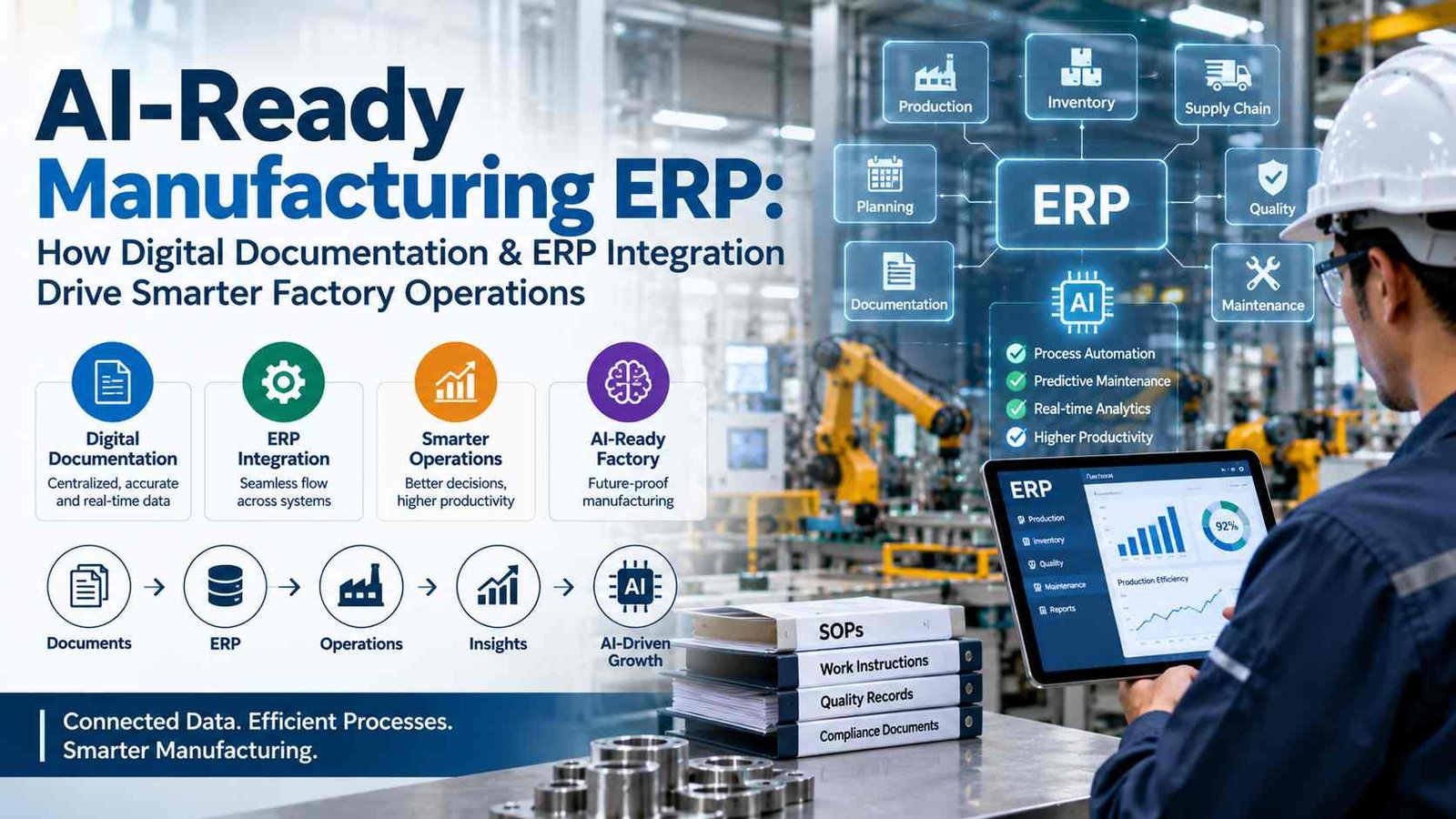
Most Indian manufacturers already run an ERP. Fewer run one that can actually feed the analytics, forecasting, and automated decision layers now being sold to them. The gap between the two is not software. It is the state of the data and documentation sitting underneath.
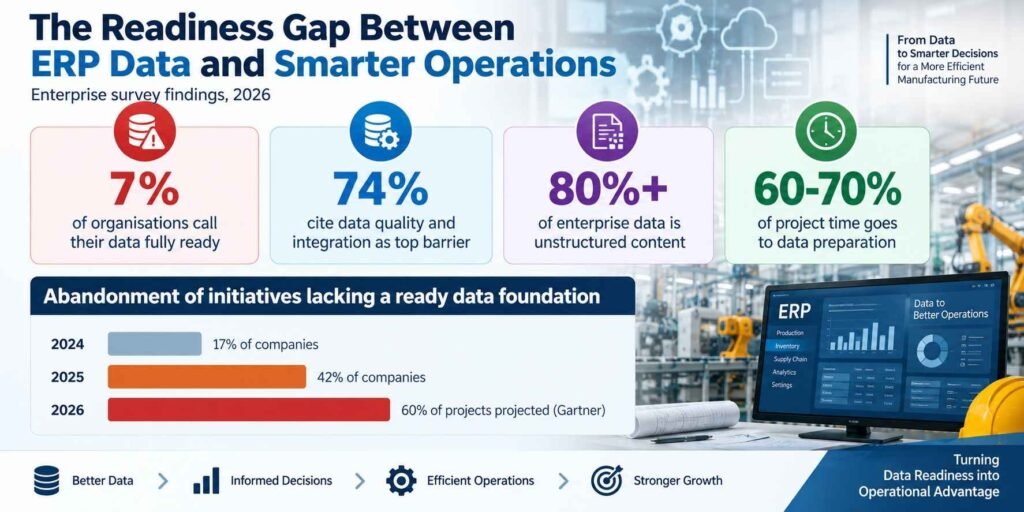
The numbers make the point sharply. A Cloudera and Harvard Business Review Analytic Services survey of 1,574 enterprise IT leaders published in March 2026 found that only 7% of organisations describe their data as completely ready for adoption of intelligent systems. Gartner projects that through 2026, organisations will abandon 60% of projects that lack a ready data foundation, with 63% of surveyed data management leaders either lacking or unsure of the practices required.
For a factory, readiness is decided long before any model runs. It is decided by whether the batch record links to the production order, whether the deviation links to the vendor master, and whether the drawing revision on the shop floor is the approved one. Structured ERP Integration Service work is what closes that gap, and digital documentation is the layer that makes the closure possible.
What Makes a Manufacturing ERP AI-Ready?
An AI-ready manufacturing ERP is one where operational data is discoverable, connected, governed, and reliable enough to be consumed by downstream systems without manual reconciliation. Five conditions define it:
- Single source of truth per master data domain, covering materials, vendors, equipment, work centres, and cost centres with named ownership
- Structured integration between ERP, MES, PLM, QMS, EDMS, and LIMS through defined APIs rather than point-to-point connections
- Documents carrying metadata, not just scanned images, so that content is searchable, versioned, and linkable to transactions
- Complete audit trails capturing every change with attribution, timestamp, and reason
- Real-time or near-real-time data flow between shop floor execution and enterprise transaction layers
Scanned PDFs of paper records fail all five. That distinction matters, because more than 80% of enterprise data is unstructured, and unindexed documents are the single largest blind spot in most manufacturing data estates.
Why Digital Documentation Is the Layer That Decides Everything
Manufacturing documentation is not an archive. It is the operational record of what was made, to which specification, by whom, under which approval, and with what deviation. When that record sits in files rather than in structured, linked systems, every downstream capability inherits the gap.
The operational contrast is measurable. Document retrieval typically falls from 5 to 10 minutes on paper systems to under 30 seconds on well-designed digital systems. Audit preparation compresses from 2 to 4 weeks down to 1 to 3 days. Physical storage costs typically decline 60% to 80%. Compliance findings typically reduce 50% to 70% against paper-based operations, and administrative productivity improves 15% to 25% through eliminating redundant handling.
Those gains are worth having on their own. Their larger value is that each one represents a document that has become machine-readable, attributable, and linked to a transaction.
Read our detailed analysis here: https://www.imarcengineering.com/blog/how-to-digitize-manufacturing-documentation-in-india
The Integration Architecture Behind Smarter Factory Operations
ERP integration determines whether documentation becomes an operational asset or an isolated repository. The patterns that consistently deliver value in Indian plants are specific rather than general:
- BOM synchronisation between PLM and ERP with defined transformation rules
- Batch manufacturing record generation triggered automatically from ERP production orders
- SOP linkage from the document system to ERP transactions and MES executions
- Deviation and CAPA integration between QMS and ERP so quality events carry cost and vendor attribution
- Supplier document expiry triggering automatic vendor holds in the ERP vendor master
- Calibration and maintenance records linked to the ERP asset master
- Training records linked from the learning system to the HR module
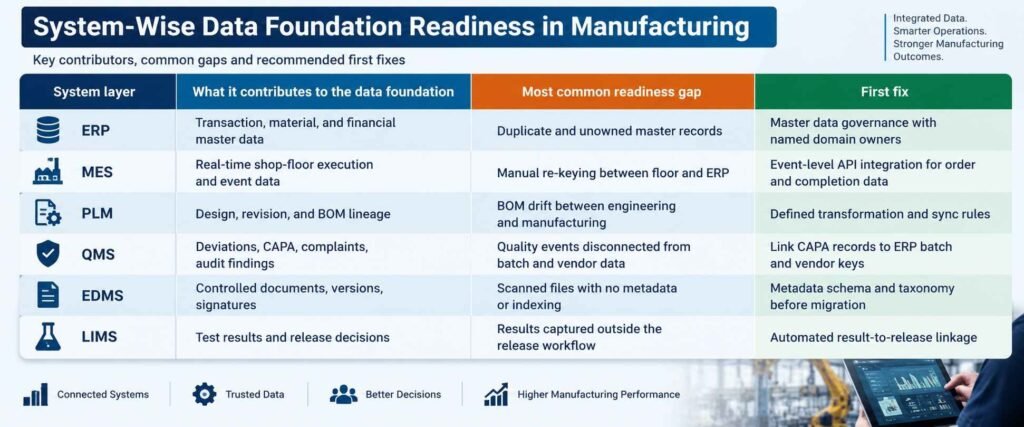
The table below maps where readiness typically breaks by system layer.
Compliance and Data Integrity Cannot Be Retrofitted
India’s legal framework already supports this shift. The Information Technology Act 2000 provides legal recognition for electronic records and digital signatures, with Class 3 Digital Signature Certificates issued by CCA-recognised authorities suitable for critical manufacturing documents. GST e-invoicing applies above the INR 5 crore turnover threshold, making native invoice and reconciliation workflows a selection requirement rather than an optional module. The Digital Personal Data Protection Act 2023 governs personal data across training, HR, and supplier records.
For regulated sectors, data integrity requirements go further. ALCOA+ principles require records to be Attributable, Legible, Contemporaneous, Original, Accurate, Complete, Consistent, Enduring, and Available. Systems used in pharmaceutical and medical device manufacturing additionally require documented Installation, Operational, and Performance Qualification, along with 21 CFR Part 11 or EU GMP Annex 11 compliance for export markets.
A system that satisfies these requirements is, by construction, closer to being analytics-ready than one that does not.
The Indian Adoption Context
India’s enterprise resource planning market reached USD 1,929.8 million in 2025, with cloud adoption growing 41% year on year, among the fastest rates in Asia-Pacific. Roughly 62% of mid to large manufacturers have implemented ERP, and around 58% of new installations are cloud-based. Manufacturing remains the single largest ERP vertical globally at about 24.5% of market share.
The addressable base is substantial. India had 7.61 crore registered MSMEs as of January 2026, including 1.60 crore manufacturing enterprises. Two deadlines are also concentrating minds: SAP ECC support ends in 2027, and compliance modules continue to tighten faster than on-premise systems can be patched.
Sequencing: What to Do Before the Intelligence Layer
- Run a current-state data and document audit quantifying volumes, formats, owners, and integration touchpoints
- Fix master data first, because integration built on drifting master records amplifies error rather than removing it
- Redesign the process before digitising it, since digitised broken workflows preserve inefficiency at higher cost
- Define the integration architecture on day one, favouring API-based connections over point-to-point links
- Migrate with metadata, not as bulk scans, so content is retrievable and linkable after transfer
- Fund change management proportionally, with leadership sponsorship, role-specific training, and embedded super-users
How IMARC Engineering’s Expertise Can Help in Building AI-Ready ERP and Documentation Systems
- Current-state assessment of documentation, master data quality, and system landscape, with a quantified business case
- Enterprise architecture design connecting ERP, MES, PLM, QMS, EDMS, and LIMS through defined interfaces
- System selection and vendor evaluation weighted on integration depth and localisation rather than module count
- Document taxonomy, metadata schema, and controlled migration planning
- Validation support covering IQ, OQ, and PQ for regulated pharmaceutical and medical device deployments
- Workflow redesign, change management, and post-deployment optimisation to protect adoption
Get in Touch With Our Team: https://www.imarcengineering.com/contact?service=digital-documentation-erp-integration
Conclusion
Readiness is an engineering outcome, not a procurement decision. Plants that govern master data, structure their documentation, and integrate their systems deliberately will find that smarter operations follow without a separate transformation programme. Those that defer the foundation will keep paying for pilots that cannot reach production. The sequencing, not the software budget, decides which group a manufacturer joins.
Frequently Asked Questions
What is an AI-ready manufacturing ERP?
It is an ERP environment where operational and documentation data is governed, structured, integrated across MES, PLM, QMS, and EDMS, and carries complete audit trails, so downstream analytics can consume it without manual reconciliation.
Is scanning paper records enough to digitise documentation?
No. Scanned files lack metadata, version control, workflow routing, and transaction linkage. True digital documentation changes how records are created and controlled, not just where they are stored.
Which integration should a manufacturer build first?
Master data governance, followed by ERP to MES event integration. Both are prerequisites for every other connection to hold.
Do these systems need validation in India?
Regulated pharmaceutical and medical device deployments require documented IQ, OQ, and PQ, along with 21 CFR Part 11 or EU GMP Annex 11 alignment for regulated export markets.
Contact Us:
IMARC Engineering
Phone: +91-120-433-0800
Email: sales@imarcengineering.com
India: C-130, Sector 2, Noida, Uttar Pradesh 201301
LinkedIn: https://www.linkedin.com/showcase/imarc-engineering/
About the Author