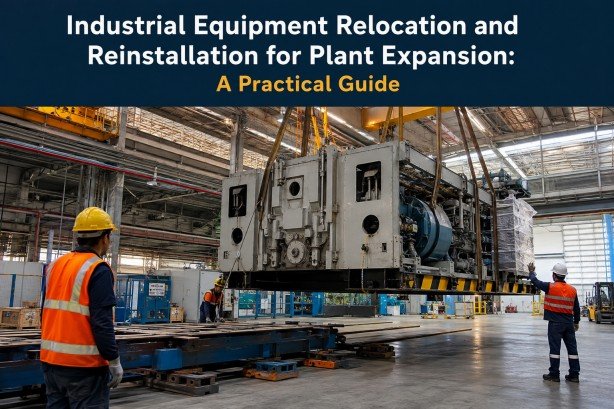
Industrial Machinery Relocation in Factory Interior
In a brownfield plant expansion, moving existing equipment is rarely as simple as unbolting a machine and setting it down somewhere else. The equipment needs to return to service with its required output, tolerances, safety functions, and reliability intact. That means relocation involves far more than lifting and transportation: dismantling, preservation, foundation readiness, alignment, utility reconnection, testing, and commissioning all have to be planned together.
This guide explains how industrial equipment relocation and reinstallation service works during plant expansion, where projects commonly run into trouble, and how manufacturers can plan the work to protect equipment condition while controlling production downtime. By understanding these risks and planning each stage in advance, manufacturers can protect valuable assets, coordinate shutdown activities more effectively, prepare the new installation area, and bring relocated equipment back into reliable production with minimal disruption.
Why Expansion Projects Force Equipment to Move
Plant expansion rarely means simply adding a new line next to the old one. In most brownfield projects, existing machines have to shift to make the new layout work. Common triggers include:
- New production line integration , existing equipment moves to free up floor space or connect properly with new machinery
- Layout optimization , repositioning equipment to improve material flow, operator movement, or safety clearances
- Utility or civil upgrades , machines temporarily relocated while electrical, piping, or flooring work is completed
- Department or process changes , equipment moved between production areas as processes evolve
- Facility consolidation , assets transferred between production blocks or facilities
It’s worth keeping one distinction clear: relocating a plant means moving an entire operation. Relocating equipment means moving specific assets , the scope and risk profile are very different, even though the two get confused often.
The Physical Move Is Only One Part of the Risk
For a properly engineered relocation, lifting and transportation are controlled activities. But project risk doesn’t end once the equipment reaches its new location , reinstallation problems typically trace back to a handful of causes:
- Foundation or leveling errors that introduce vibration
- Shaft or coupling misalignment after positioning
- Damaged sensors, cabling, or control wiring during dismantling
- Utility connections made at the wrong pressure, voltage, or flow rate
- Contamination entering hydraulic or pneumatic systems during downtime
- Calibration drift on instrumentation left idle too long
Some of these issues may not be immediately visible and can surface after restart as vibration problems, quality deviations, calibration issues, or unplanned stoppages..” That’s why relocation has to be treated as an engineering exercise, not a logistics job.
Planning the Relocation
Assess the Equipment and Capture a Performance Baseline
Before anything is disconnected, document the equipment’s current condition , dimensions, weight, lifting points, existing alignment data, and utility connections. Where practical, also capture a pre-move performance baseline: production rate, cycle time, power consumption, vibration, temperature, pressure/flow, quality indicators, alarm history, and calibration status. Without this baseline, demonstrating that reinstalled equipment performs “the same as before” becomes difficult.
Plan the Shutdown and Isolation
Every energy source , electrical, hydraulic, pneumatic, thermal, or stored mechanical energy , needs to be identified and isolated before dismantling. The facility’s applicable energy-isolation, lockout/tagout, and permit-to-work procedures should be followed, with isolation verified before work begins, not assumed.
Dismantle With Traceability in Mind
Every cable, pipe, sensor, and fastener that comes off should be tagged, match-marked, or photographed so it can be reconnected exactly as it was. A dismantling and component inventory , covering cables, sensors, guards, special fasteners, and spare parts , turns this from general advice into something an engineering manager can actually track. Sensitive components may also need protective covers or moisture and vibration protection if there’s a gap before reinstallation.
Preparing the New Location Before the Equipment Arrives
One of the most common causes of delay is equipment sitting idle because the receiving site isn’t ready. Before the move happens, confirm:
- Foundation readiness , dimensions, level, anchor-bolt condition, concrete condition, elevation, load distribution, grout requirements, and vibration isolation
- Utility readiness , power, compressed air, cooling, process piping, drainage, and control network connections are already in place, tested, and compatible with equipment requirements
- Access readiness , doors, corridors, ceiling height, and crane access can accommodate the equipment’s path
Preparing the destination before moving the equipment is one of the most effective ways to reduce avoidable installation delays and downtime.
Consult An Expert: https://www.imarcengineering.com/contact?service=equipment-relocation-and-reinstallation
Reinstallation: Positioning, Alignment, and Reconnection
For rotating and precision machinery, alignment should be verified using appropriate measurement methods rather than relying on visual positioning , generally carried out against OEM tolerances and any applicable installation standards for that equipment type.
After mechanical installation, utilities and controls need reconnection: electrical power and grounding, process piping, hydraulic and pneumatic circuits, and control/instrumentation links including PLC, sensors, and communication networks. A useful check at this stage is comparing pre- and post-installation condition against your baseline:
| Parameter | Before Relocation | After Reinstallation |
| Vibration | Baseline | Verify |
| Motor current | Baseline | Verify |
| Cycle time | Baseline | Verify |
| Temperature | Baseline | Verify |
| Output rate | Baseline | Verify |
| Product quality | Baseline | Verify |
Commissioning and Performance Validation
A relocated machine isn’t finished when it’s switched on. A structured sequence typically includes:
- Pre-commissioning checks , mechanical, electrical, and instrumentation verification, including safety functions such as emergency stops, guards, interlocks, and alarms
- No-load testing , checking vibration, temperature, rotation, and alarms without production conditions
- Loaded testing , introducing operating conditions progressively
- Performance validation , comparing results against OEM specs and the pre-move baseline
- Final acceptance , documenting results, closing punch-list items, and handing over as-built records
For equipment being returned to its previous operating configuration, relocation should be considered complete only once its required performance has been verified against approved operating criteria and, where appropriate, the pre-move baseline.
Minimizing Production Downtime
In many brownfield relocations, production downtime can become a larger operational cost than the physical move itself. It can be reduced through:
- Doing site preparation and utility work in parallel with dismantling, rather than sequentially
- Mapping the critical path , the activities that directly determine the restart date (often foundation curing, positioning, utility connection, alignment, and control integration) , and preparing those first
- Pre-fabricating utility connections at the new location in advance
- Scheduling the shutdown around planned maintenance or low-production periods
- Keeping spare parts and commissioning resources ready before reinstallation begins
Temporary vs. Permanent Relocation
Temporary relocation moves equipment to enable civil work, utility changes, or floor renovation, with the machine returning to its original or another location afterward. Permanent relocation moves equipment to its future position in the plant layout. The planning requirements differ, particularly around foundation design, utility sizing, and documentation , permanent moves generally warrant more upfront engineering.
What Determines Relocation Cost?
Cost typically depends on equipment size and weight, number of assets, dismantling complexity, rigging requirements, relocation distance, foundation or utility modifications, alignment requirements, commissioning scope, and the length of the required shutdown window.
Common Mistakes That Extend Downtime or Damage Equipment
- Moving equipment before the receiving site’s foundation or utilities are ready
- Skipping documentation during dismantling, leading to reassembly guesswork
- Treating alignment as a visual check instead of a measured one
- Skipping a pre-move performance baseline, making post-installation troubleshooting harder
- Treating utility reconnection as a separate task instead of coordinating it with mechanical installation and commissioning
- Re-energizing equipment before isolation and safety checks are fully verified
Equipment Relocation Readiness Checklist
- Equipment condition, OEM documentation, and performance baseline are recorded
- Lifting points and rigging plan are confirmed
- Utilities at the new location are available, tested, and compatible with equipment requirements
- Shutdown window and energy isolation procedure are approved
- Transportation route and access are cleared
- Commissioning personnel, test procedures, spares, and acceptance criteria are ready
View Related Insight:
Equipment Relocation and Reinstallation in India Minimize Downtime: https://www.imarcengineering.com/blog/equipment-relocation-reinstallation-india
Regulatory and Safety Considerations in India
Equipment relocation should be planned according to the safety requirements applicable to the facility, equipment, work activity, and location. In India, this may include the Occupational Safety, Health and Working Conditions Code, 2020, applicable state-level factory and occupational-safety requirements, relevant Bureau of Indian Standards requirements, and the equipment manufacturer’s installation instructions. The plan should also address applicable permit-to-work, energy-isolation, and lifting/rigging procedures. Because requirements vary by equipment type, facility, and state, the project team should verify the specific regulatory requirements before dismantling or reinstalling equipment.
How IMARC Engineering Can Help
IMARC Engineering supports industrial equipment relocation and reinstallation as an engineering-led activity within plant expansion and brownfield project programs. The scope can cover pre-relocation equipment assessment, dismantling and relocation planning, rigging coordination, receiving-site readiness, foundation and utility coordination, positioning, precision alignment, reconnection, commissioning, and performance verification , typically supported by documents such as an equipment condition report, tagging register, alignment report, and commissioning record. For projects involving multiple machines or phased shutdowns, this work can be integrated with broader plant expansion planning.
Conclusion
Equipment relocation during plant expansion succeeds or fails on what happens after the machine is physically moved. Careful assessment, a performance baseline, site readiness, precision alignment, and structured commissioning are what actually protect the equipment and keep downtime under control. For manufacturers undertaking brownfield expansion, an engineering-led relocation approach helps coordinate asset protection, site readiness, installation, alignment, and commissioning within the project’s shutdown and restart plan.
Contact Us:
IMARC Engineering
Phone: +91-120-433-0800
Email: sales@imarcengineering.com
India: C-130, Sector 2, Noida, Uttar Pradesh 201301
LinkedIn: https://www.linkedin.com/showcase/imarc-engineering/
About the Author