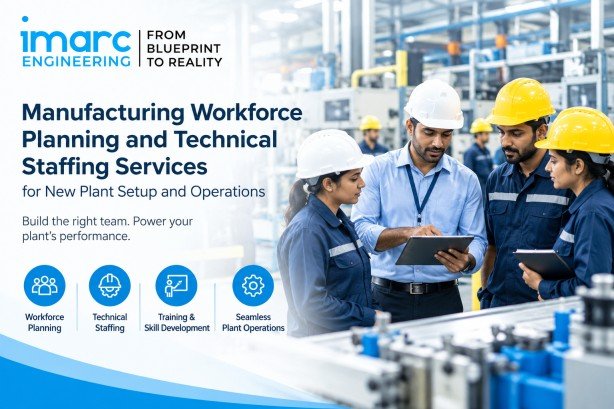
Manufacturing Workforce Planning and Technical Staffing Services
Setting up a new manufacturing plant in India does not end with installing machinery. Production can still be delayed when operators, maintenance technicians, quality personnel, and other critical roles are not recruited, trained, and deployed in line with the commissioning schedule. A perfectly sequenced construction and equipment timeline can still stall at trial production if the right technical staff aren’t in place when the plant needs them.
This is where manufacturing workforce planning services and technical staffing support can help, by aligning workforce requirements with plant capacity, process complexity, automation level, and operating shifts before the plant reaches commissioning. It’s not recruitment in the conventional sense. It’s an engineering-led exercise that works backward from how the plant is actually designed to operate, determining how many people, with what skills, are needed at each phase, from construction through stabilized operations.
Why Workforce Planning Can’t Wait Until the Plant Is Built
A common mistake in new plant projects is treating staffing as a post-construction activity, something to handle once the building is up and equipment is installed. By that point, it’s often too late to do it well.
Technical roles such as automation engineers, maintenance planners, and quality personnel typically need to be involved during equipment installation and pre-commissioning, not after. They support equipment validation, SOP development, and troubleshooting before trial production begins. A plant that waits until commissioning to start hiring risks onboarding delays and avoidable errors during the most sensitive stage of production.
Workforce planning works best when it starts alongside plant design and project execution, not after it.
Workforce Planning Is Not the Same as Technical Staffing
These two terms get used interchangeably, but they describe different work.
Workforce planning answers a structural question: how many people are required, in which functions, with what skill sets, across which shifts, at each stage of the project?
Technical staffing is what happens after that question is answered: sourcing, evaluating, selecting, and deploying the engineers, technicians, operators, supervisors, and other technical personnel required to fill those defined roles.
Skipping straight to staffing without a workforce plan tends to produce mismatched teams, too many generalists, not enough specialists where they matter, or a headcount that doesn’t reflect the plant’s actual shift structure. A defined manpower model needs to come first.
How Workforce Requirements Change Across Plant Setup and Operations
A manufacturing plant does not need the same team on day one of construction that it needs six months into commercial production. Manpower needs shift as the project moves through distinct phases:
- Construction – project engineers, site supervisors, safety personnel
- Equipment installation – mechanical, electrical, and instrumentation technicians
- Pre-commissioning – automation engineers, utilities and maintenance staff
- Commissioning – process engineers, quality personnel, production supervisors
- Trial production – operators, QC/QA staff, shift supervisors
- Commercial production – the full production and support organization
- Ramp-up – additional operators, maintenance coverage, and planning resources
- Stable operations – an optimized mix of permanent and contractual staff
Mapping these stages against a hiring and deployment timeline, rather than treating staffing as a single event, helps ensure critical technical roles are on-site when they’re needed, not weeks after equipment has already been installed.
Technical Staffing for Pre-Commissioning and Plant Start-Up
Pre-commissioning staffing is one of the areas where planning ahead makes the biggest operational difference. Selected personnel may need to be available before commercial production begins to support:
- Equipment familiarization and inspection
- SOP development
- Trial runs and process validation
- Operator training
- Maintenance planning
- Troubleshooting
- Quality-system preparation
- Commissioning support
Having these roles filled ahead of schedule, rather than during commissioning itself, is what connects plant setup, staffing, and a smoother path to commercial production.
What a Manufacturing Workforce Plan Actually Covers
A workforce plan usually spans seven functional areas, each with its own staffing logic:
- Production – machine and line operators, production technicians, shift supervisors, process and industrial engineers.
- Maintenance – mechanical and electrical maintenance engineers, instrumentation staff, automation/PLC engineers, reliability engineers, and maintenance planners.
- Quality – quality engineers, QC inspectors, laboratory and metrology technicians, calibration staff.
- Engineering and technical support – process, design, automation, and utilities engineers.
- EHS and safety – EHS managers, safety officers, industrial safety personnel, environmental specialists, emergency-response roles, and occupational health support, where applicable.
- Supply chain and plant support – production planners, procurement staff, warehouse operators, and logistics coordinators.
- Management and administration – plant leadership, HR, finance, and IT/OT support.
There’s no single ratio across these functions that applies to every plant. A pharmaceutical facility with heavy validation requirements looks different from a discrete-parts automotive plant, which is why a generic manpower calculator rarely holds up on its own.
Shift-Wise Staffing Is More Complicated Than It Looks
A common shortcut is dividing total required manpower by the number of shifts. In practice, this undercounts what’s actually needed. A realistic shift-wise plan accounts for:
- Number of shifts and shift duration
- Weekly operating days and mandated breaks
- Leave reserve and expected absenteeism
- Maintenance windows and changeover time
- Product mix and automation level
- Minimum safe staffing for hazardous processes
A simplified planning model can be expressed as: required workforce = base shift manpower × number of shifts + relief/leave reserve + support manpower. The actual staffing model should also account for operating hours, weekly offs, overtime rules, absenteeism, skill coverage, statutory requirements, maintenance coverage, and process-specific safety requirements, rather than being treated as a fixed formula.
Speak With An Expert: https://www.imarcengineering.com/contact?service=workforce-planning-and-technical-staffing
Automation Changes the Shape of the Workforce, Not Just the Size
Moving from a conventional production line to an automated one doesn’t just reduce headcount, it changes which roles matter most. Conventional lines lean on machine operators, supervisors, and manual inspection staff. Automated lines shift demand toward automation engineers, PLC/SCADA specialists, controls technicians, and reliability engineers, alongside a smaller operator base.
India’s vocational training ecosystem provides an established sourcing channel for technical roles. DGT’s Craftsmen Training Scheme currently covers 169 NSQF-compliant trades delivered through ITIs across the country, with the stated objective of providing skilled workers to industry. This can serve as an additional sourcing channel for technician and skilled-trade roles alongside conventional recruitment and staffing channels, particularly for equipment-adjacent positions where technically trained talent is available locally.
Skill Gaps Should Be Assessed Role by Role
For critical positions, a structured gap assessment can compare qualifications, hands-on equipment experience, process knowledge, digital skills (PLC, MES, ERP exposure), safety training, and shift readiness against the requirements of each role. This is especially relevant for automated or semi-automated plants, where equipment-specific knowledge can’t always be assumed from a candidate’s general work history, and where pre-deployment training may be needed to close a specific gap.
Permanent vs. Contractual: A Deliberate Choice, Not a Default
Core functions such as production, engineering, maintenance, and quality often require continuity of plant-specific knowledge, making permanent staffing one option worth evaluating. Contractual arrangements may be appropriate for support services, variable workloads, specialized activities, or other functions, depending on the operating model and applicable requirements. The right mix depends on operational criticality and workload variability at that specific plant, not a fixed industry ratio.
Regulatory Context Worth Factoring In
Workforce planning for a new Indian manufacturing plant should also account for applicable occupational safety, health, working-condition, and labour requirements. The Occupational Safety, Health and Working Conditions Code, 2020 came into force on November 21, 2025. The Code provides for Safety Committees where required and specifies safety-officer requirements for certain establishments, including factories meeting specified worker thresholds and factories carrying on hazardous processes. These applicable requirements should be assessed alongside production, maintenance, quality, and other workforce needs as part of the overall plan.
Using Ramp-Up Data to Refine the Model
Once a plant reaches commercial production, the workforce model shouldn’t stay static. Reviewing actual output, OEE, downtime, rejection rates, labour productivity, overtime, and absenteeism against the original staffing plan usually reveals where the initial model was too lean or too heavy in specific functions. This feedback loop is what turns an initial estimate into a workforce structure that’s actually tested against real plant performance.
How IMARC Engineering Can Help
IMARC Engineering supports manufacturers from initial capacity and process assessment through to department-wise, shift-wise workforce modelling and technical staffing deployment. This includes identifying critical pre-commissioning roles, building skill matrices against plant-specific requirements, and helping structure the right mix of permanent and contractual staff. The goal is a workforce plan built around how the plant will actually operate, not a generic manpower template applied after the fact.
Conclusion
New plant projects are rarely delayed by equipment alone; they’re delayed when the right people aren’t available at the right stage. Treating workforce planning as an engineering exercise, tied to capacity, process design, shifts, and automation level, rather than a recruitment afterthought, changes how smoothly a plant moves from commissioning to stable production. The plants that ramp up fastest are usually the ones where technical staffing was planned alongside construction, not after it. Getting this sequencing right from the start is what separates a stable production launch from a prolonged, costly stabilization period.
Contact Us:
IMARC Engineering
Phone: +91-120-433-0800
Email: sales@imarcengineering.com
India: C-130, Sector 2, Noida, Uttar Pradesh 201301
LinkedIn: https://www.linkedin.com/showcase/imarc-engineering/
About the Author