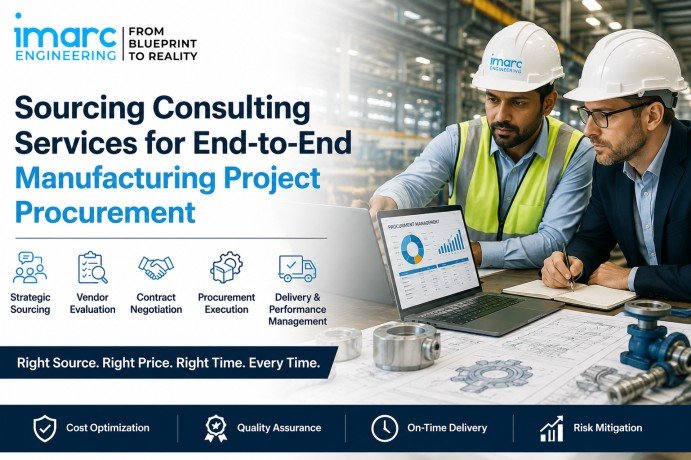
Sourcing Consulting Services
Setting up or expanding a manufacturing facility involves dozens of procurement decisions that directly shape whether a project finishes on time, within budget, and performs as designed. Sourcing the right equipment, materials, and vendors is rarely as simple as collecting three quotations and picking the cheapest one. For companies executing greenfield plants, brownfield expansions, or capacity upgrades, procurement needs to work as an extension of engineering and project planning , not as an isolated purchasing task.
This is where sourcing consulting services come in: helping manufacturers identify qualified suppliers, evaluate technical and commercial fit, control total project cost, and keep procurement aligned with construction, installation, and commissioning timelines.
Why Manufacturing Projects Need a Structured Sourcing Approach
A manufacturing project typically requires sourcing across many categories at once , process equipment, utilities, electrical systems, automation, instrumentation, HVAC, material handling, packaging lines, laboratory equipment, and spare parts. Each category carries its own technical requirements, lead times, and risk profile.
When sourcing is handled reactively , requesting quotes only when a need becomes urgent , projects tend to run into predictable problems:
- Suppliers selected on price alone that later cause delays or quality issues
- Long-lead equipment ordered too late, holding up construction or commissioning
- Specifications too vague for suppliers to quote accurately
- No visibility into whether a supplier can actually meet the delivery schedule
- Limited backup options if a chosen supplier fails to deliver
- Procurement decisions made without regard to installation or site-readiness requirements, creating conflicts once equipment arrives
A structured sourcing strategy addresses these risks before they affect the project, not after.
What “End-to-End” Procurement Actually Covers
End-to-end procurement means the sourcing process is connected from the first requirement definition through to installation and commissioning support. In practice, this spans:
Requirement Definition → Supplier Identification → Qualification → RFQ Preparation → Technical Evaluation → Commercial Evaluation → Negotiation → Purchase Order → Expediting → Inspection/FAT → Logistics → Delivery → Installation and Commissioning Support
Skipping any one of these stages usually shows up later as a delay, a cost overrun, or a quality dispute.
Selecting the Right Suppliers , and Verifying Them
Finding a supplier is easy. Finding one who can actually deliver against the project’s requirements is harder. A sound qualification process checks suppliers against several dimensions, and just as importantly, defines how each is verified:
Technical capability , Verified through technical datasheets, reference installations at similar scale, and evidence of in-house engineering resources rather than relying purely on a sales proposal.
- Manufacturing capacity , Verified by checking current production load, available delivery slots, and dependence on critical subcontractors that could affect timelines.
- Quality systems , Verified through documented QA/QC procedures, inspection and test plans, calibration records, and a review of past non-conformance history.
- Commercial strength , Reviewed through pricing structure, payment terms, warranty conditions, and after-sales support commitments.
- Financial and operational stability , Assessed to confirm the supplier can sustain production and support through the life of the contract, not just at the point of quoting.
A supplier that looks strong on paper can still create project risk if any one of these areas is weak or unverified.
Evaluating Quotations Without Starting From Price
A common procurement mistake is comparing quotations by price before checking technical compliance. A more reliable sequence looks like this:
- Technical compliance: Does the offer meet mandatory specifications at all?
- Deviation review: Where does the supplier differ from what was asked for , capacity, materials, automation level, delivery terms?
- Commercial comparison: Based on technically acceptable or clearly qualified bids, with any deviations explicitly accounted for before final price evaluation.
- Risk assessment: Single-source dependency, lead-time exposure, and after-sales support all factor into the final decision.
A weighted scoring approach , covering technical fit, commercial terms, delivery, quality, experience, and risk , gives a more defensible basis for supplier selection than ranking by price alone.
Why Total Cost Matters More Than the Lowest Quote
It helps to distinguish two related ideas. Total Cost of Procurement (TCP) covers acquisition and project-related costs , freight, installation, modifications, and schedule exposure. Total Cost of Ownership (TCO) goes further, adding operating, maintenance, and lifecycle costs over the equipment’s working life.
Consider two illustrative supplier offers for the same equipment package:
- Supplier A: Lower equipment price, but higher freight, installation, and modification costs, plus exposure to a possible commissioning delay , pushing the effective project cost above the quoted figure.
- Supplier B: Slightly higher equipment price, but lower freight and installation costs and minimal schedule risk , resulting in lower total project exposure despite the higher headline price.
This is a simplified illustration, not an industry benchmark, but it points to a real pattern: freight, installation, modifications, spare parts, and schedule-related costs can materially change the economics of a supplier decision. Total cost , not the invoice price , should be the basis for comparison.
Managing Supplier Risk Before the Purchase Order Is Issued
Supplier risk is easier to manage before a commitment is made than after. Categories worth checking in advance include:
- Single-source risk , no viable alternative exists for a critical component
- Capacity risk , the supplier’s production schedule cannot absorb the order in time
- Quality risk , inconsistent manufacturing processes or a weak inspection history
- Financial risk , signs of financial stress that could affect delivery
- Geographic and logistics risk , transport routes or customs exposure that could delay shipment
- Sub-tier risk , the supplier depends on another vendor for a critical input
- Technology and obsolescence risk , particularly relevant for automation, controls, and specialized electronics, where a supplier can deliver successfully but the technology later becomes unsupported
For genuinely critical equipment packages, it’s worth asking whether a second qualified supplier should be developed in parallel, rather than relying on a single source for something the whole project depends on.
Sourcing Long-Lead and Custom-Engineered Equipment Early
Some equipment simply takes longer to design, manufacture, and deliver , specialized process equipment, large electrical systems, custom automation, or imported machinery. These items should be identified during early engineering and, where specifications are sufficiently mature, released for procurement early enough to protect the project schedule.
Not every procurement package carries the same schedule importance. A useful way to prioritize is by category and by position on the critical path:
| Procurement Category | Priority |
| Long-lead / imported equipment | Immediate |
| Critical process equipment | High |
| Custom-engineered systems | High |
| Site-dependent equipment | Medium–High |
| Standard equipment | Medium |
| Consumables and routine spares | Planned |
Late procurement of long-lead equipment can become a major and often avoidable source of project delay , one worth flagging during the earliest engineering reviews.
Speak With An Expert: https://www.imarcengineering.com/contact?service=sourcing
Keeping Procurement Aligned With the Project Schedule
Procurement should move in step with engineering and construction, not independently of them. Expediting , actively tracking drawing approvals, production progress, and inspection status , keeps this visible, especially for equipment sitting on the project’s critical path.
Before dispatch, critical equipment often benefits from inspection calibrated to its risk level, which may include dimensional inspection, material verification, functional and performance testing, Factory Acceptance Testing (FAT), calibration verification, and documentation review , rather than applying identical checks to every purchase.
Key Deliverables from Sourcing Consulting
A structured engagement typically produces:
- Procurement requirement matrix and supplier longlist
- Supplier qualification matrix
- RFQ package and technical bid comparison
- Commercial comparison and total-cost analysis
- Supplier risk assessment and recommended shortlist
- Procurement tracking and expediting status reports
- Inspection and delivery coordination records
A Simple Procurement Decision Matrix
| Factor | Key Question |
| Technical | Does the supplier meet the specification? |
| Quality | Can it consistently meet required quality? |
| Capacity | Can it deliver within the required window? |
| Commercial | What is the actual total procurement cost? |
| Logistics | Can the equipment reach the site on schedule? |
| Risk | What happens if this supplier fails? |
| Support | What happens after installation? |
How IMARC Engineering Supports End-to-End Manufacturing Project Procurement
IMARC Engineering supports sourcing across requirement planning, supplier identification and qualification, RFQ and bid evaluation, supplier finalization, and vendor expediting through inspection and delivery. This covers greenfield plant setup, brownfield expansion, capacity enhancement, and modernization projects across process equipment, utilities, electrical and automation systems, and specialized engineering packages , helping clients make sourcing decisions that support reliable, on-time execution rather than short-term cost savings alone.
Conclusion
Reliable manufacturing project outcomes depend on sourcing decisions made with the same rigor as engineering design. Prioritizing total cost over quoted price, verifying supplier capability before commitment, planning long-lead equipment early, and keeping procurement aligned with the project schedule together reduce delay and quality risk. Treating sourcing as an integrated part of project execution ,not a standalone purchasing task ,gives manufacturers a stronger foundation for on-time, on-budget plant setup, expansion, or modernization.
Frequently Asked Questions
1. What are sourcing consulting services for manufacturing projects?
They involve identifying, qualifying, and coordinating suppliers of equipment, materials, and services from initial specification through delivery and installation.
2. How is this different from routine purchasing?
Routine purchasing deals with repeat, standard items. Project sourcing deals with engineered, often one-off equipment where specification accuracy and schedule alignment directly affect outcomes.
3. How are suppliers evaluated beyond quotation price?
Through technical compliance, deviation analysis, capacity checks, quality history, and total-cost comparison rather than headline price alone.
4. Why is total cost more important than the lowest quotation?
Because freight, installation, modifications, and schedule risk can materially change the real cost of a decision.
5. Do sourcing consultants conduct vendor audits?
Yes, particularly for critical or high-value equipment, verifying facilities, capacity, and quality systems beyond written proposals.
Contact Us:
IMARC Engineering
Phone: +91-120-433-0800
Email: sales@imarcengineering.com
India: C-130, Sector 2, Noida, Uttar Pradesh 201301
LinkedIn: https://www.linkedin.com/showcase/imarc-engineering/
About the Author