Introduction
A single ambiguous line in an equipment specification, a missing tolerance, an unclear material grade, an omitted duty condition, can quietly cost an industrial project far more than the paperwork suggests. It shows up months later as a rejected shipment, a redesigned foundation, or a vendor claim that nobody budgeted for.
India’s major infrastructure and industrial projects carried a cumulative cost overrun of roughly ₹5.65 lakh crore as of April 2026, according to official government monitoring data, and design-stage errors, specifications chief among them, remain one of the most consistently cited drivers behind that number.
Sponsors who bring structured technical specification consulting services in before procurement is finalised are addressing the single largest controllable variable in that overrun figure, because unlike site conditions or currency swings, specification quality is entirely within the project team’s control.
What Actually Counts as a Technical Specification Error?
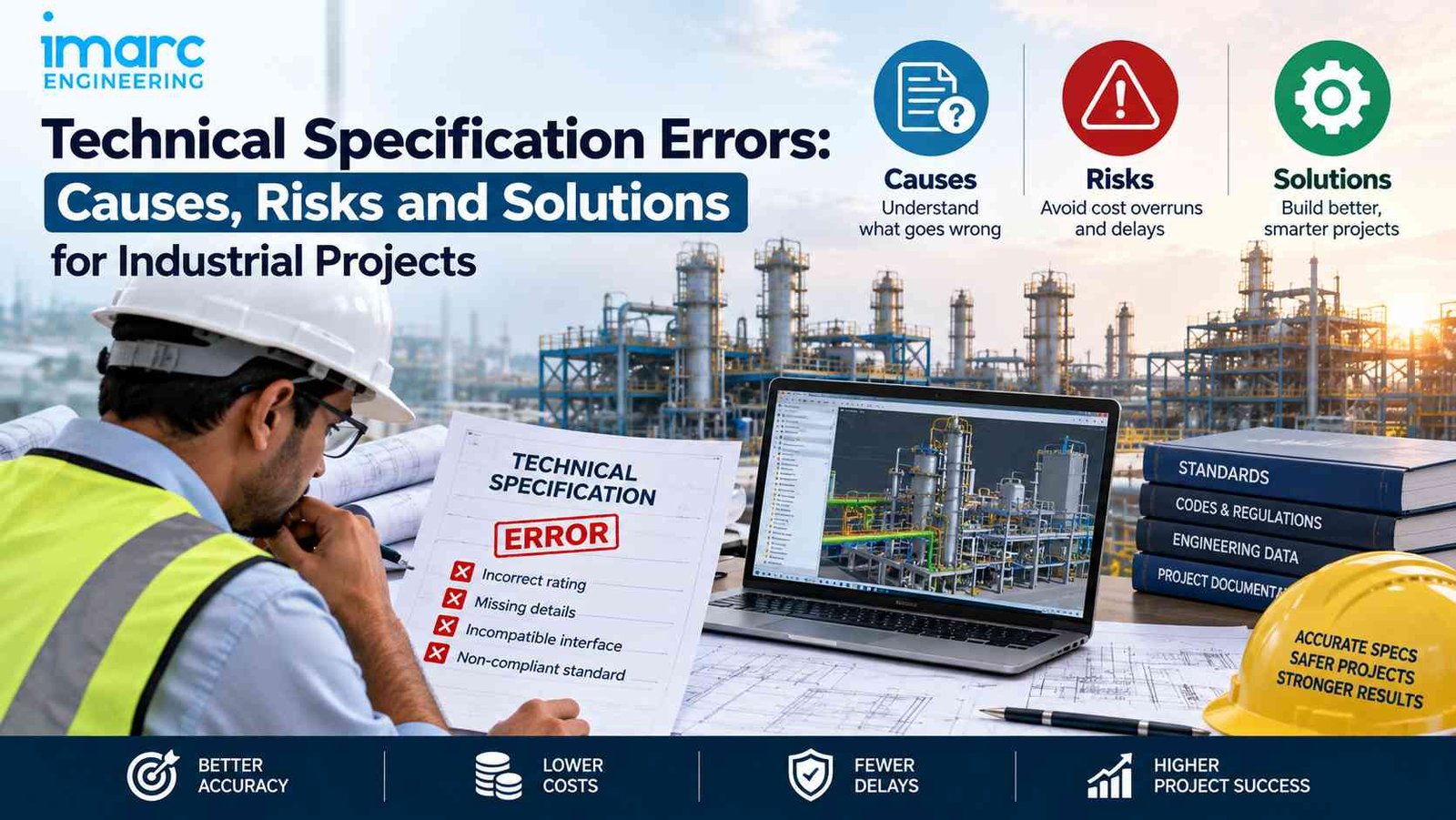
A specification error is not limited to a typo in a datasheet. It covers any gap between what the document says and what the equipment or process actually needs:
- Ambiguous performance parameters — ranges stated loosely enough that two vendors legitimately interpret the requirement differently
- Missing duty and environmental conditions — no mention of ambient temperature range, altitude, dust loading, or duty cycle that materially affects equipment selection
- Incomplete interface data — inlet/outlet dimensions, foundation loads, or utility connection points left undefined until fabrication
- Outdated or mismatched standards references — citing a superseded code revision or a standard that does not apply to the actual operating environment
- Conflicting cross-references — the mechanical spec says one thing, the electrical spec assumes another, and neither document flags the conflict
Why Do These Errors Keep Happening?
Long-standing rework research from the Construction Industry Institute found that design-stage deviations, specifications included, account for roughly 80% of total rework cost on industrial capital projects, with the remaining share attributable to construction-phase deviations. The recurring causes behind that pattern are consistent across projects:
- Compressed drafting timelines that leave engineers writing specifications faster than they can fully validate them against process and site conditions
- Reused templates from a different project scope carried forward without adjusting the parameters that actually differ this time
- Fragmented ownership, where mechanical, electrical, and process teams each draft their section independently with no structured cross-check
- Under-specified tolerance and testing criteria, leaving vendors to fill the gap with their own default assumptions
- No independent technical review before the specification goes out for vendor quotation
What Are the Real Risks When a Specification Is Wrong?
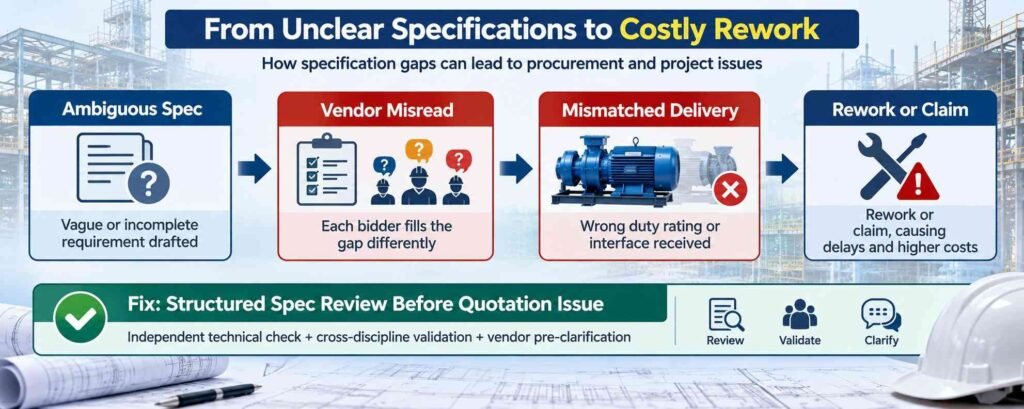
The consequences of a defective specification compound as the project moves downstream, and the cost of fixing the same error rises sharply at each later stage:
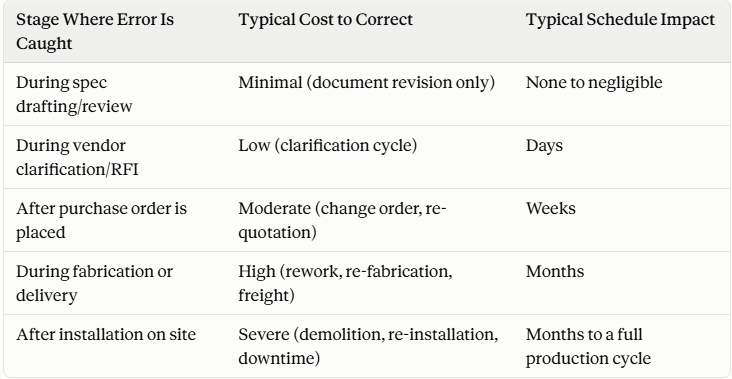
Beyond direct cost, an unclear specification routinely triggers vendor disputes over scope, since a supplier who delivered exactly what an ambiguous document said, technically, can still argue they met the contract even when the equipment does not fit the actual process need.
How Do Specification Errors Show Up Across the Project Lifecycle?
- At vendor bidding stage: wide quote variance between bidders because each one is pricing a slightly different interpretation of the same requirement
- At purchase order stage: last-minute clarification cycles that delay order placement and compress the fabrication schedule that follows
- At fabrication/delivery stage: equipment that technically matches the written spec but does not match the actual site conditions, triggering rejection or field modification
- At installation stage: interface mismatches, wrong foundation loads, or missing utility connections discovered only when the equipment physically arrives
- At commissioning stage: performance shortfalls traced back to a duty condition that was never explicitly stated in the original document
What Solutions Actually Reduce Specification Errors?
- Independent technical review before issue for quotation. A second qualified engineer, not the original author, reviewing the document against actual process and site data catches a materially higher share of ambiguities than self-review alone.
- Standardised specification templates with mandatory fields. Locking duty conditions, environmental parameters, and interface data as required fields rather than optional notes prevents the most common omission category.
- Structured vendor pre-clarification. Running a formal Q&A round with shortlisted vendors before finalising the specification surfaces ambiguity while it is still cheap to fix.
- Cross-discipline sign-off. Requiring mechanical, electrical, and process leads to jointly sign off the interface sections closes the gap where fragmented ownership usually creates conflicts.
- Version control and change tracking. Every specification revision logged and cross-checked against downstream documents prevents an update in one discipline’s document from silently breaking an assumption in another.
How IMARC Engineering’s Expertise Can Help in Technical Specification
- Independent technical review of draft specifications before vendor quotation is issued
- Standardised, field-complete specification templates matched to equipment category and duty conditions
- Structured vendor pre-clarification and RFI management to surface ambiguity early
- Cross-discipline coordination between mechanical, electrical, and process specification sections
- Specification version control and change-log discipline through procurement and fabrication
- Root-cause review of specification-driven claims and rework on active projects
Consult With Our Team: https://www.imarcengineering.com/contact?service=equipment-selection-and-technical-specs-drafting
Conclusion
Technical specification errors are one of the few cost overrun drivers a project team can fully control, because they originate on paper before a single vendor is engaged. Catching an ambiguity during drafting costs a document revision; catching the same ambiguity after installation costs months and a claim. Structured specification review is consistently the cheapest insurance available on an industrial project, and the sponsors who build it in early are the ones who avoid paying for it the expensive way later.
Contact Us:
IMARC Engineering
Phone: +91-120-433-0800
Email: sales@imarcengineering.com
India: C-130, Sector 2, Noida, Uttar Pradesh 201301
LinkedIn: https://www.linkedin.com/showcase/imarc-engineering/
About the Author