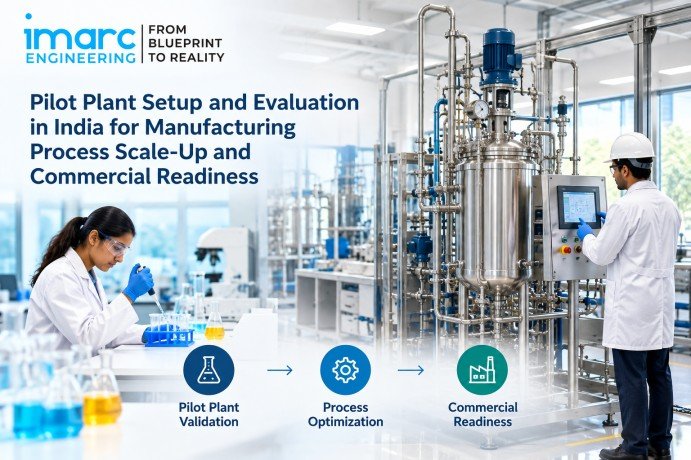
Pilot Plant Setup and Evaluation in India for Manufacturing Process
If you’ve proven a process works in the lab, the next question is unavoidable: will it perform the same way at production scale? That gap , between a beaker and a full manufacturing line , is exactly what a pilot plant is built to close.
Pilot plant setup is not required for every manufacturing project, but it becomes a critical intermediate stage when significant scale-up, process, safety, quality, or commercial uncertainties remain. Done well, it determines whether a promising process can be translated into a technically and commercially viable manufacturing operation. Done poorly, or skipped entirely, it leaves those uncertainties to surface later , when they’re far more expensive to fix.
This guide covers what a pilot plant setup and evaluation consulting needs to prove, how to set one up correctly, and how to evaluate whether a process is genuinely ready for commercial investment.
Why Laboratory Success Doesn’t Guarantee Commercial Success
A process that performs well in a 5-liter flask doesn’t automatically behave the same way in a 5,000-liter reactor. As equipment gets larger, the underlying physics shifts:
- Heat generated by a reaction has less surface area to escape through, relative to volume
- Mixing that was near-instant at small scale can take significantly longer at larger scale
- Mass-transfer behavior, pressure drop, fluid velocities, and residence-time distribution can change significantly with scale
- Fouling, corrosion, and solids-handling issues that never appeared in the lab can become serious production constraints
These changes are not random , they can often be anticipated through appropriate scale-up analysis , but the relationships involved can become complex quickly. That’s precisely why simply enlarging lab equipment tends to fail, and why a pilot stage exists to catch these issues before capital is committed to a full commercial facility.
What Is a Pilot Plant?
A pilot plant is an intermediate-scale facility designed to generate the process, engineering, safety, quality, and economic data needed to support decisions before full commercial manufacturing.
There’s no universal “correct” pilot size , the right scale depends on what needs to be proven:
- Reaction kinetics studies may need only modest equipment
- Mixing or heat-transfer evaluation requires equipment large enough to reflect those scale-dependent behaviors
- Customer trial material may demand significantly higher capacity
- If pilot-scale data will support regulatory, validation, or technology-transfer activities, representative equipment, controls, testing, and documentation may become important
When Does a Project Need Pilot Testing?
Projects moving from concept or laboratory development toward commercial scale should consider pilot testing when significant technical, scale-up, quality, safety, or economic uncertainties remain , particularly when:
- The process has only been demonstrated at bench or lab scale
- Heat transfer, mixing, or mass transfer carry meaningful scale-up risk
- Capital approval depends on validated performance data
- Regulatory pathways (pharmaceuticals, food, specialty chemicals) require representative process evidence
- Commercial plant design depends on data that doesn’t yet exist
Pilot Plant Setup: A Seven-Stage Methodology
1. Define what the pilot must prove. Establish target production rates, high-risk unit operations, and whether the pilot serves process development, regulatory support, or customer trials. Skipping this step can result in pilot data that doesn’t adequately answer the commercial questions the project needs to resolve.
2. Assess the existing process and technology. Review process flow diagrams, material and energy balances, reaction chemistry, and prior trial data to separate what’s proven from what still needs evidence.
3. Define scale-up criteria. Depending on the process, relevant criteria may include geometric similarity, residence time, mixing time or power per unit volume, heat and mass-transfer performance, flow regime, pressure drop, superficial velocity, and particle suspension. The appropriate criterion depends on the dominant physical and chemical phenomena involved , no single parameter applies universally.
4. Select and engineer equipment. Reactors, mixers, heat exchangers, filtration and drying systems, material handling, instrumentation, and utilities should be chosen based on the process function being validated, not equipment availability.
5. Install, commission, and run structured trials. A sound trial sequence typically moves through baseline, sensitivity, optimization, repeatability, and confirmation runs , the last of these validating performance under the proposed operating window, rather than relying on a single successful batch.
6. Document results and transfer scale-up knowledge. Structured documentation of process knowledge, operating limits, and lessons learned is what makes the next stage possible.
7. Convert findings into a commercial readiness plan. Pilot data becomes the basis for commercial equipment sizing, utility requirements, process controls, and cost estimates.
How Pilot Data Becomes Commercial Plant Design
Pilot trial data → mass balance → energy balance → equipment sizing → utility load calculation → instrumentation requirements → control philosophy → CAPEX/OPEX inputs → commercial plant design basis → procurement and execution.
This chain is what separates a pilot program that generates isolated R&D observations from one that produces usable engineering inputs.
What Should a Pilot Plant Measure?
| Evaluation Area | What to Track |
| Productivity | Output rate, cycle time, batches per day |
| Yield & Quality | Conversion, purity, specification compliance |
| Energy | Consumption per unit of product |
| Materials | Raw-material use, waste generation |
| Reliability | Repeatability, downtime, interruptions |
| Safety | Hazard controls, pressure/temperature limits |
| Economics | Estimated manufacturing cost per unit |
Commercial Readiness: The Questions That Matter
A process that only answers “does it work?” still carries substantial scale-up uncertainty. A fuller readiness assessment addresses:
| Readiness Area | Key Question |
| Process | Can performance be achieved consistently? |
| Quality | Can specifications be met repeatedly? |
| Equipment | Can pilot behavior translate to commercial equipment? |
| Utilities | Are commercial utility requirements understood? |
| Safety | Have scale-related hazards been identified and controlled? |
| Economics | Can CAPEX/OPEX assumptions be developed? |
| Regulatory | Are applicable approvals and compliance requirements understood? |
| Operations | Are procedures, staffing, and maintenance defined? |
These should be answered to the level of confidence needed for the project’s next investment decision , not all at once, and not with false certainty.
Consult With An Expert: https://www.imarcengineering.com/contact?service=pilot-plant-setup-and-evaluation
Common Pilot Plant Scale-Up Mistakes
- Treating scale-up as simple multiplication of volume
- Sizing the pilot by desired output alone, rather than the phenomena needing evaluation
- Ignoring heat-transfer limits, which often become the real bottleneck
- Using equipment that doesn’t represent the intended commercial setup
- Stopping after one successful run without testing repeatability
- Underestimating utility requirements
- Treating safety review as a final step instead of a design input
- Starting trials without defining what data is actually required
- Overlooking downstream operations , a successful reaction doesn’t guarantee successful filtration, drying, or waste handling
When a Dedicated Pilot Plant May Not Be Necessary
A standalone pilot facility isn’t always justified , for instance, when existing commercial equipment is already representative, the process is well established with adequate historical data, scale-up risk is genuinely low, or a contract manufacturer can provide representative trial capacity instead.
Safety and Regulatory Considerations in India
Scale-up can introduce hazards absent at lab scale , pressure buildup, exothermic reactions, flammable or toxic material handling, and utility-failure risks among them. India does not have one universal approval framework that applies identically to every pilot plant; applicable requirements depend on the industry, process, substances handled, facility characteristics, and location. Depending on the project, these may include factory-related approvals, environmental and pollution-control consents, fire and safety requirements, hazardous-chemical regulations, electrical or pressure-system requirements, and sector-specific standards. Pharmaceutical, food, biotechnology, and other regulated-sector projects may carry additional quality, hygiene, validation, or documentation requirements depending on the product and its intended use.
India’s technology-development institutions, including DSIR and the Technology Development Board, recognize pilot-stage work as part of the bridge between R&D and commercialization , supporting activities such as pilot-plant setup, equipment development, and trial evaluation.
How IMARC Engineering Can Help
IMARC Engineering supports manufacturers across the full pilot-to-commercial journey: process and technology assessment, scale-up criteria definition, equipment and utility engineering, installation and commissioning coordination, trial planning, and commercial-readiness evaluation. We translate pilot findings into actionable commercial plant inputs , equipment sizing, utility planning, CAPEX/OPEX estimation, and technology-transfer documentation , helping you move from validated concept to confident commercial investment with fewer surprises along the way.
Conclusion
A pilot plant isn’t a smaller version of your commercial facility , it’s a structured way to answer the questions that determine whether that facility should be built at all. Its value lies not in proving a process works once, but in generating the engineering, safety, and economic evidence a commercial investment decision actually depends on.
Seen this way, a pilot plant is less a physical facility and more a decision-support system. Its output isn’t just product , it’s the mass and energy balances, equipment sizing data, utility requirements, safety assessments, and cost estimates that determine whether moving to full-scale manufacturing is actually justified, and if so, what that commercial plant needs to look like.
Contact Us:
IMARC Engineering
Phone: +91-120-433-0800
Email: sales@imarcengineering.com
India: C-130, Sector 2, Noida, Uttar Pradesh 201301
LinkedIn: https://www.linkedin.com/showcase/imarc-engineering/
About the Author