Setting up a pharmaceutical glass manufacturing plant in 2026 requires clarity on a few core variables: feedstock choice, production capacity, capital investment, operating cost structure, and profitability under prevailing policy conditions. This feasibility study covers the pharmaceutical glass plant setup cost in india, and the machinery and raw materials needed, driven by regulatory requirements for sterile, tamper-evident, and high-performance primary packaging that continue to encourage innovation across the industry.
This business plan report covers what capacity to target, which raw materials to secure, what machinery and site conditions are required, how capital and operating costs break down, and what profitability and regulatory factors determine commercial viability for a pharmaceutical glass manufacturing plant. It draws on IMARC Group’s Pharmaceutical Glass Manufacturing Plant Project Report 2026, which benchmarks a facility with an annual production capacity of 20,000-1,00,000 MT. North America is the largest regional market, accounting for 35% of global share.
Minimum Cost Required to Set Up a Pharmaceutical Glass Plant
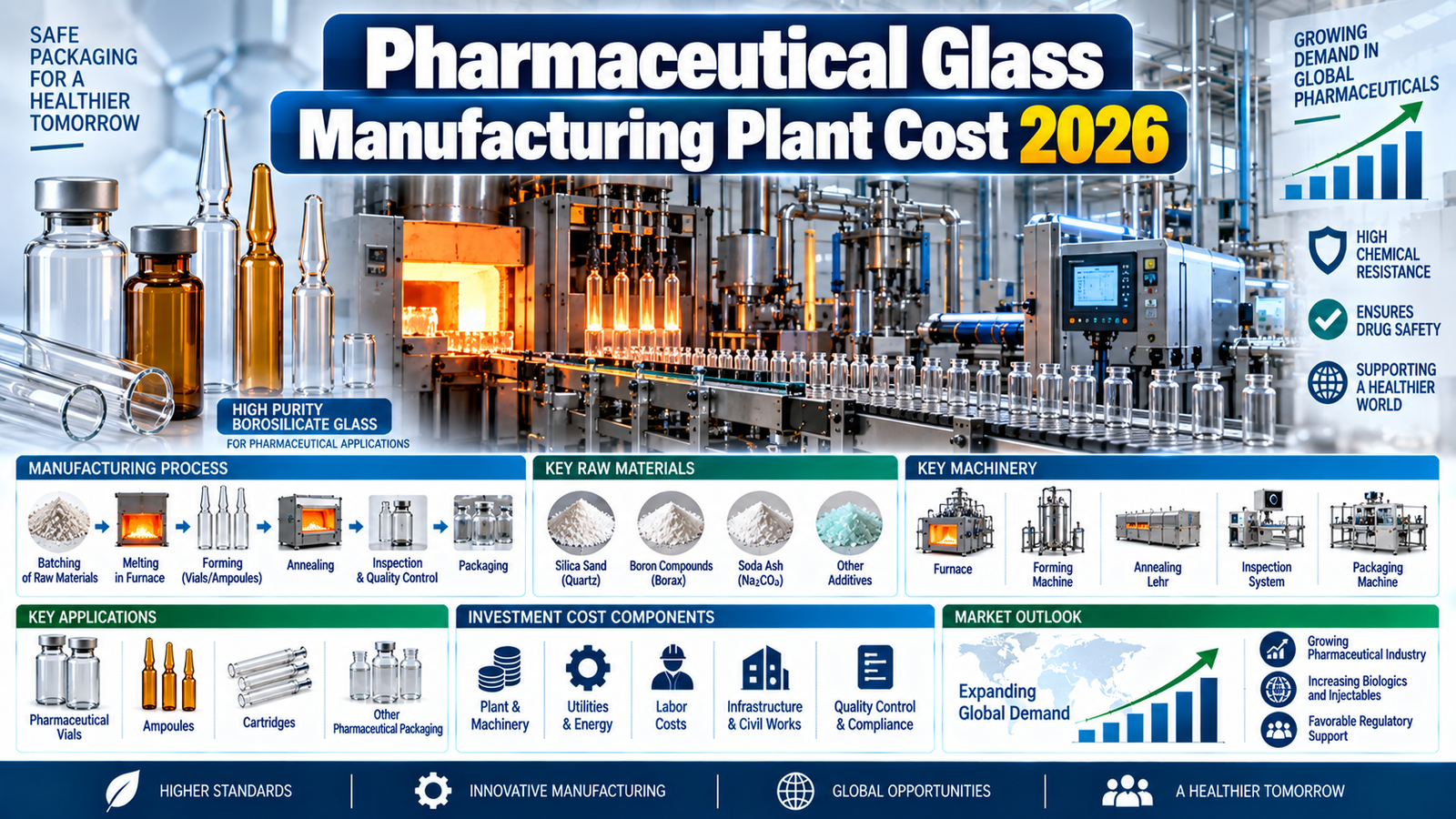
Industry cost benchmarking for pharmaceutical glass manufacturing points to a minimum entry investment of roughly USD 25-40 million for a smaller-scale facility near the lower end of the benchmarked capacity band (around 20,000-30,000 MT/year), reflecting the cost of raw material batching systems, high-temperature glass melting furnaces, refining chambers, forming machines, annealing lehrs, inspection and finishing systems, packaging equipment, and quality-control infrastructure required for pharmaceutical-grade glass production. Capital requirements scale from there, reaching around USD 50-80 million for mid-sized plants (approximately 40,000-60,000 MT/year), and exceeding USD 100 million for large-scale, export-oriented facilities at the upper end of the capacity range (80,000-100,000 MT/year and above), where larger furnace systems, multiple forming lines, advanced inspection and automation, specialized borosilicate glass processing, expanded utilities, environmental controls, and stringent quality-assurance infrastructure significantly increase total investment. IMARC’s 2026 project report benchmarks the proposed facility capacity at 20,000-100,000 MT/year and identifies melting, refining, forming, annealing, inspection, and finishing as key manufacturing stages.
1. Why Pharmaceutical Glass Manufacturing Matters in 2026
Pharmaceutical glass manufacturing sits at the intersection of advanced materials science and patient safety. Rising global pharmaceutical production, growing biologics and injectable drug demand, and increasing investment in vaccine manufacturing and biotechnology continue to drive demand for pharmaceutical glass across vials, ampoules, cartridges, and prefilled syringes worldwide. Growing regulatory momentum around sterile, tamper-evident primary packaging keeps pharmaceutical glass an essential material choice across pharmaceuticals, biotechnology, and diagnostics – a demand pattern that directly stimulates melting, forming, and finishing capacity across the supply chain.
Expanding self-administered injectable therapies, growing chronic disease prevalence, and an aging global population further support pharmaceutical glass deployment, since the material delivers total chemical inertness and an impermeable barrier against moisture, oxygen, and ultraviolet light, preserving product sterility and shelf life. Continuous innovation in borosilicate glass formulations, precision forming processes, and all-electric melting furnace technology is enhancing product performance and creating new opportunities for manufacturers entering the sector now.
Request Sample: https://www.imarcgroup.com/pharmaceutical-glass-manufacturing-plant-project-report/requestsample
Regional Insights
Pharmaceutical glass manufacturing plant costs vary across regions, influenced by the availability and pricing of glassmaking raw materials, energy-intensive melting operations, pharmaceutical manufacturing capacity, specialised glass-forming technology, labour, logistics, and regulatory requirements. IMARC’s 2026 analysis covers a plant capacity of 20,000–100,000 MT annually and identifies raw material and utility consumption as major operating-cost components.
● Asia Pacific (China, India, Japan, South Korea, Australia, Indonesia, Thailand, Malaysia, Vietnam, Philippines, Singapore) Strong pharmaceutical and biotechnology manufacturing bases, established glass-processing industries, and expanding demand for vials, ampoules, cartridges, syringes, and other primary packaging support pharmaceutical glass plant development. China, India, Japan, and South Korea offer established pharmaceutical and advanced-manufacturing ecosystems, while Australia and Southeast Asian markets provide opportunities linked to growing healthcare and pharmaceutical production.
● North America (U.S., Canada, Mexico) A well-developed pharmaceutical, biotechnology, healthcare, and medical-packaging ecosystem supports demand for high-quality pharmaceutical glass. IMARC reports that North America accounted for 35% of the global pharmaceutical glass market in 2026. Advanced manufacturing infrastructure and quality-control capabilities support plant development, while energy-intensive melting, labour, construction, and regulatory-compliance costs can significantly influence overall project economics.
● Europe (Germany, U.K., France, Italy, Spain, Netherlands, Belgium, Poland, Sweden, Norway, Denmark, Switzerland) A mature pharmaceutical and specialty-glass manufacturing base, advanced forming technologies, and strong demand from pharmaceutical and biotechnology companies support pharmaceutical glass production. Stringent quality, environmental, energy-efficiency, and workplace-safety requirements can add to capital and operating costs, while established industrial clusters provide advantages in specialised labour, suppliers, and logistics.
● Latin America (Brazil, Argentina, Mexico, Colombia, Chile, Peru, Paraguay, Uruguay, Ecuador) Expanding pharmaceutical manufacturing, healthcare infrastructure, and demand for injectable medicines and primary pharmaceutical packaging are creating opportunities for pharmaceutical glass production. Plant economics are influenced by access to high-quality silica and other glassmaking inputs, imported machinery and technology, energy costs, transportation infrastructure, and proximity to pharmaceutical manufacturing centres.
● Middle East & Africa (Saudi Arabia, UAE, Qatar, Kuwait, Oman, Israel, Egypt, South Africa, Nigeria, Morocco, Algeria, Kenya, Ethiopia, Tanzania, Ghana) Growing healthcare infrastructure, pharmaceutical localisation initiatives, and investment in biotechnology and medical manufacturing are supporting opportunities for pharmaceutical glass production. Project costs can vary according to raw-material sourcing, availability of specialised glass-forming technology, energy and utilities, skilled labour, logistics, and environmental infrastructure.
Cost structure: IMARC estimates that raw materials account for approximately 30–42% of operating expenditure, while utilities account for around 30–38%. Key inputs include silica sand, boron trioxide, soda ash, alumina, potassium oxide where applicable, and recycled cullet. Major equipment includes batching and mixing systems, glass-melting furnaces, refining chambers, forming machines, annealing lehrs, cutting and finishing equipment, washing systems, inspection systems, and packaging machinery.
Why Invest in Pharmaceutical Glass Manufacturing?
Five factors make pharmaceutical glass manufacturing a comparatively attractive materials investment:
- Crucial pharmaceutical packaging component: Pharmaceutical glass is a fundamental packaging material for vials, ampoules, cartridges, syringes, and infusion bottles, providing chemical stability, product protection, and compatibility with sensitive drugs.
- Moderate but justifiable entry barriers: Stringent quality standards, precise glass-forming processes, dimensional accuracy, chemical resistance, and prolonged pharmaceutical customer approvals create entry hurdles favoring experienced producers.
- Megatrend alignment: The rapid growth of biologics, vaccines, injectable drugs, specialty pharmaceuticals, and advanced drug-delivery systems is driving consistent demand for high-quality pharmaceutical glass packaging.
- Policy and healthcare infrastructure push: Government investments in pharmaceutical manufacturing, vaccine production, and healthcare infrastructure are indirectly supporting demand for pharmaceutical glass and localized packaging production.
- Localization and dependability in supply chains: Pharmaceutical manufacturers and contract drug producers are favoring local, dependable packaging suppliers to shorten lead times and ensure regulatory compliance, opening doors for regional producers.
2. What is Pharmaceutical Glass and Where is It Used
Pharmaceutical glass is a specialized, high-purity material engineered specifically for packaging, storing, and protecting sensitive medications, vaccines, and biological products. Unlike ordinary commercial glass, this medical-grade material complies with strict international standards to ensure total chemical inertness, meaning it will not react with or leach harmful substances into liquid or powder drugs. Its dense, impermeable structure blocks moisture, oxygen, and ultraviolet light, preserving product sterility and extending shelf life. Commercial production generally involves batching and mixing raw materials, melting and refining the glass, forming it into vials, ampoules, or tubing, annealing to relieve internal stress, and inspecting and finishing the product:
- Pharmaceutical packaging: Used for vials, ampoules, cartridges, and glass bottles for medicines and injectable drugs.
- Biotechnology and healthcare: Used as containers for vaccines, biologics, diagnostic reagents, and laboratory products.
- Medical and laboratory applications: Used for test tubes, culture tubes, sample containers, and specialized laboratory glassware.
- Drug delivery: Used for prefilled syringes, cartridges, and glass containers for parenteral and other drug delivery systems.
3. Pharmaceutical Glass Manufacturing Process
Pharmaceutical glass manufacturing follows a defined sequence of unit operations:
- Raw material batching – silica sand, boron trioxide, soda ash, alumina, and cullet (or the soda-lime equivalent mix) are weighed and batched to precise formulation.
- Mixing – batched raw materials are homogenized ahead of melting.
- Glass melting – the batch is melted at high temperature in a continuous melting furnace.
- Refining – the molten glass is refined to remove bubbles and achieve homogeneity.
- Forming – the refined glass is formed into tubing, vials, or ampoules using tube-forming or blow-and-blow processes.
- Annealing – formed glass is passed through an annealing lehr to relieve internal stress.
- Inspection and finishing – finished containers undergo visual inspection, dimensional testing, washing, and packaging.
A comprehensive quality management system should be implemented across all stages of operations, with appropriate testing, monitoring, and validation processes established to evaluate performance, safety, reliability, and compliance, supported by documentation and traceability mechanisms for regulatory and pharmaceutical customer requirements.
4. Raw Materials and Sourcing
Reliable feedstock supply is the single most important operating input for a pharmaceutical glass manufacturing plant, given that raw materials account for a substantial share of operating expenses (more on this in Section 8). Core raw material and process inputs include:
- Silica sand (SiO2) – primary glass-forming oxide, around 70% of batch by weight
- Boron trioxide (B2O3) – 10-20% for Type I borosilicate glass, the primary modifier for thermal resistance and chemical durability
- Soda ash (Na2CO3) – 5-8%, flux/melting point reducer
- Alumina (Al2O3) – 3-5%, improves strength and chemical resistance
- Potassium oxide (K2O) – optional, improves workability
- Limestone (CaCO3) – used with soda ash and silica for Type II/III soda-lime glass
- Cullet (recycled glass) – 20-30% of batch, improves energy efficiency and meltability
Sourcing strategy should prioritize reliable suppliers of these materials to ensure consistent manufacturing quality, alongside minimizing transportation costs by selecting nearby suppliers. Sustainability and supply chain risks should be assessed as part of supplier selection, and long-term contracts should be negotiated to stabilize pricing and secure a steady supply, since feedstock price volatility flows directly into margin.
Speak to an Analyst: https://www.imarcgroup.com/request?type=report&id=17867&flag=C
5. Site Selection and Plant Layout
Site selection for a pharmaceutical glass manufacturing business should prioritize:
- Proximity to raw materials – easy access to silica sand, boron trioxide, soda ash, alumina, cullet, and other formulation inputs.
- Proximity to target markets – minimizing distribution costs for the finished product, especially given fragile, high-value glass containers.
- Infrastructure robustness – reliable transportation, utilities, and waste management systems, given the continuous, energy-intensive nature of glass melting.
- Regulatory fit – compliance with local zoning laws and environmental regulations, with particular attention to furnace emissions.
- Plant layout should be optimized to enhance workflow efficiency and safety while minimizing material handling, with clearly separated areas for raw material storage, melting and forming, annealing, quality control, and finished goods storage.
- Sponsors should also incorporate space for future expansion, since pharmaceutical glass plants – like most materials manufacturing facilities – tend to scale capacity over their operating life rather than remain static.
6. Machinery and Equipment Requirements
Key equipment categories for a pharmaceutical glass manufacturing plant include:
- Raw material weighing and batching systems, batch mixers
- Glass melting furnaces and refining chambers
- Cullet handling systems
- Glass forming machines, including tube-forming or blow-and-blow equipment
- Annealing lehrs
- Cutting and finishing machines
- Washing systems, visual inspection units, and dimensional testing equipment
- Packaging machines
All machinery must be corrosion-resistant, precision-calibrated, and comply with industry standards for safety, efficiency, and reliability – a material consideration given the high-temperature, continuous-process nature of glass melting and the dimensional-accuracy requirements of pharmaceutical containers. Equipment selection and automation level are also the primary determinants of machinery cost, which represents the largest single component of capital expenditure.
7. Capital Investment (CapEx) for a Pharmaceutical Glass Plant
Total capital investment for a pharmaceutical glass plant depends on plant capacity, technology selection, and location, and covers land acquisition, site preparation, and necessary infrastructure. IMARC’s cost analysis breaks CapEx into four categories:
Land and Site Development Costs: Land registration, boundary development, and related site-preparation charges
Civil Works Costs: Construction of production halls, storage, and supporting civil infrastructure
Machinery Costs: Batching and mixing systems, glass melting furnaces, refining chambers, forming machines, annealing lehrs, cutting and finishing machines, inspection equipment, and packaging machines
Other Capital Costs: Pre-operative expenses and miscellaneous capital items
Machinery costs account for the largest portion of total capital expenditure, while land and site development costs – covering registration, boundary development, and related charges – form a substantial part of the overall investment as well.
Because the exact split varies significantly with capacity, technology, and location, sponsors evaluating a specific project should work from a capacity- and location-specific cost model rather than a generic industry average.
8. Operating Cost (OpEx) Structure
Operating expenditure for a pharmaceutical glass plant is dominated by feedstock and utility cost, reflecting the energy-intensive nature of continuous glass melting. Based on IMARC’s analysis:
- Raw Materials (silica sand, boron trioxide, soda ash, alumina, cullet): 30-42% of total OpEx
- Utilities: 30-38% of total OpEx
- Transportation, Packaging, Salaries & Wages, Depreciation, Taxes, Other Expenses: Remaining balance of total OpEx
This cost structure has a direct strategic implication: unlike many materials manufacturing plants where raw materials alone dominate OpEx, pharmaceutical glass production carries a comparatively heavy utility cost burden from continuous furnace operation, making energy efficiency and furnace technology – including all-electric melting – an equally important lever for OpEx control alongside raw material procurement strategy. In the first year of operations, operating costs cover raw materials, utilities, depreciation, taxes, packing, transportation, and repairs and maintenance; by the fifth year, total operational cost is expected to rise materially due to inflation, market fluctuations, and potential increases in the cost of key materials, alongside supply chain disruptions and shifts in the global economy.
Buy Now: https://www.imarcgroup.com/checkout?id=17867&method=2175
9. Profitability and Financial Outlook
A pharmaceutical glass manufacturing plant demonstrates healthy profitability potential under normal operating conditions, supported by stable demand and value-added applications:
- Gross Profit Margin: 20-30%
- Net Profit Margin: 7-13%
Financial projections for a specific project should be developed from realistic assumptions on capital investment, operating costs, capacity utilization, pricing trends, and demand outlook, and should incorporate ROI, net present value (NPV), payback period, and a full profit-and-loss analysis rather than relying on the industry-average margins above as a substitute. These averages are useful for feasibility screening, not for financing-stage decisions.
10. Regulatory and Policy Landscape
Project sponsors evaluating a pharmaceutical glass manufacturing plant should plan for:
Business registration and factory licensing
- Environmental clearances
- Fire and industrial safety certifications, with particular attention to high-temperature furnace operation
- Effluent and emissions treatment and compliance systems
- Pharmaceutical primary-packaging quality certifications and customer qualification requirements
Industry-specific permits, which vary by local, state, and national jurisdiction
Advanced monitoring systems to detect leaks or process deviations should be installed alongside these compliance measures, and government incentives – capital subsidies, tax exemptions, reduced utility tariffs, export benefits, or interest subsidies – may also be available depending on the region and should be factored into project financing.
11. Latest Industry Developments
December 2025: Nippon Electric Glass Co., Ltd. announced it would begin the world’s first mass production of pharmaceutical-grade glass tubing using an all-electric melting furnace, a development that points to growing industry investment in lower-emission, energy-efficient furnace technology for pharmaceutical glass production.
12. Leading Pharmaceutical Glass Producers
The global pharmaceutical glass industry is led by companies with extensive manufacturing capacities and diversified application portfolios, including:
- SCHOTT AG
- Gerresheimer AG
- Stevanato Group S.p.A.
- SGD Pharma
- Nipro Corporation
These companies collectively serve end-use sectors spanning pharmaceuticals, biotechnology, healthcare, diagnostics, hospitals, and laboratory applications.
Frequently Asked Questions
1. How much capital is required to start a pharmaceutical glass manufacturing plant?
Capital requirements generally include land acquisition, construction, equipment procurement (batching and mixing systems, glass melting furnaces, refining chambers, forming machines, annealing lehrs, cutting and finishing machines, inspection equipment, packaging machines), installation, pre-operative expenses, and initial working capital. The total amount varies with capacity, technology, and location.
2. How do I start a pharmaceutical glass manufacturing business?
Starting a pharmaceutical glass manufacturing business requires a market feasibility study, securing required licenses, arranging funding, selecting suitable land, procuring equipment, recruiting skilled labor, and establishing a supply chain and distribution network for key raw materials.
3. What raw materials are required for pharmaceutical glass manufacturing?
Pharmaceutical glass manufacturing primarily uses silica sand, boron trioxide, soda ash, alumina, and cullet for Type I borosilicate glass, or silica sand, soda ash, limestone, and alumina for Type II/III soda-lime glass, with cullet used across both to improve energy efficiency and meltability.
4. What machinery and equipment are required to start a pharmaceutical glass factory?
A pharmaceutical glass factory typically requires raw material weighing and batching systems, batch mixers, glass melting furnaces, refining chambers, cullet handling systems, glass forming machines, tube-forming or blow-and-blow equipment, annealing lehrs, cutting and finishing machines, washing systems, and inspection equipment.
5. What are the biggest challenges in starting a pharmaceutical glass manufacturing business?
High capital requirements, securing regulatory and pharmaceutical customer approvals, ensuring a consistent raw material and energy supply, competition, skilled manpower availability, and managing the operational risks associated with continuous, high-temperature furnace operation.
6. Who are the top pharmaceutical glass producers in the world?
SCHOTT AG, Gerresheimer AG, Stevanato Group S.p.A., SGD Pharma, and Nipro Corporation.
About Us:
IMARC Group is a global management consulting firm that helps the world’s most ambitious changemakers create a lasting impact. The company excels in understanding its clients’ business priorities and delivering tailored solutions that drive meaningful outcomes. IMARC Group provides a comprehensive suite of market entry and expansion services, including market assessment, greenfield plant feasibility study, company incorporation assistance, factory setup support, regulatory approvals and licensing navigation, branding, marketing and sales strategies, competitive landscape and benchmarking analyses, pricing and cost research, and procurement research.
Contact Us:
IMARC Group
134 N 4th St. Brooklyn, NY 11249, USA
Email: sales@imarcgroup.com
Tel No: (D) +91 120 433 0800
United States: (+1-201-971-6302)
About the Author