Water treatment is the single largest recurring cost centre in a packaged drinking water plant, and it is also the one most sponsors size once at commissioning and never revisit. That is an expensive habit. Energy, membrane consumables, reject water, and compliance testing all compound month after month, and small design or operating choices at this stage carry years of downstream cost impact.
India’s own water economics make this urgent. The country holds 18% of the world’s population but only 4% of its freshwater, and NITI Aayog projects that national water demand will be twice the available supply by 2030, an imbalance expected to require close to INR 20 lakh crore in water infrastructure investment over the coming decade. For a bottling plant, that macro pressure shows up directly as rising input-water cost and tightening discharge norms, both of which push treatment cost optimization from a nice-to-have into an operating necessity.
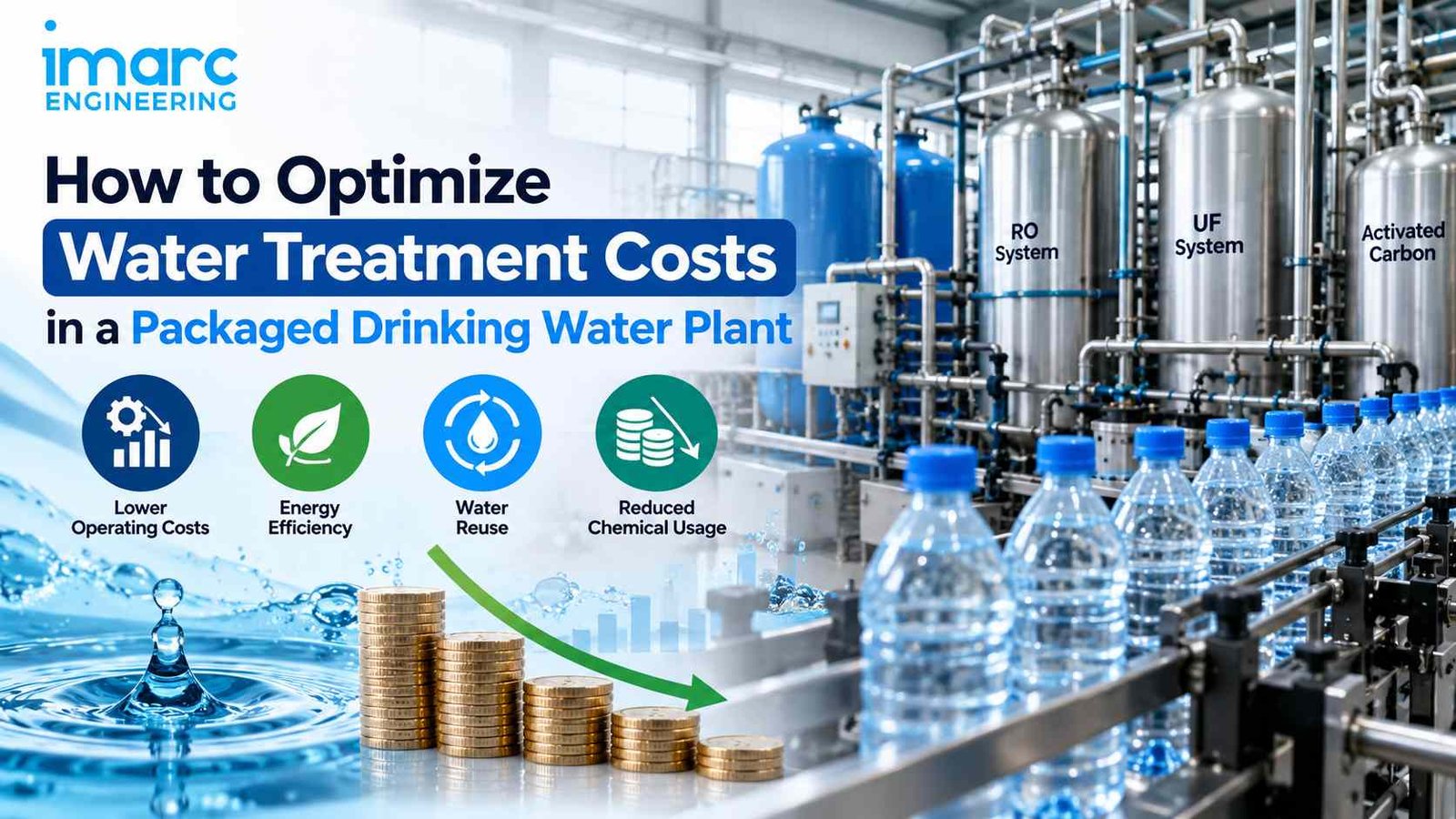
For manufacturers evaluating water treatment cost optimization for packaged drinking water plant operations, the levers that matter most sit across four areas: treatment train sizing, energy consumption, reject water handling, and consumable lifecycle management. Each is examined below with the numbers that should drive the decision.
Right-Size the Treatment Train to the Actual Source Water
The single biggest avoidable cost in packaged water treatment is running full RO treatment on water that does not need it.
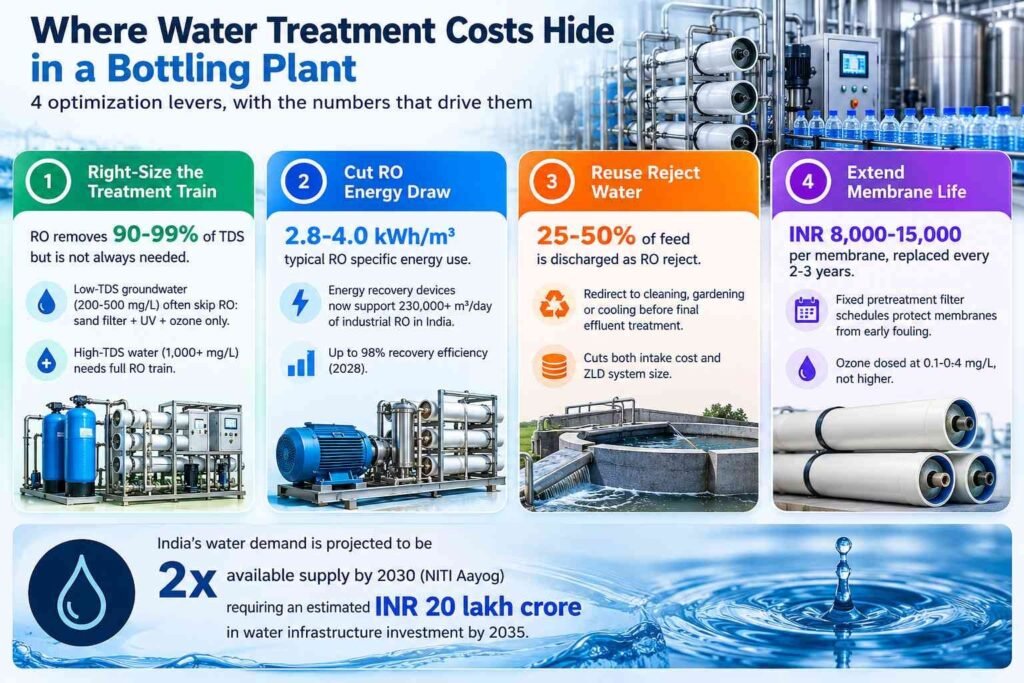
- Low-TDS groundwater (200-500 mg/L) with acceptable microbial quality often needs only sand filtration, activated carbon, UV, and ozonation, skipping RO entirely
- High-TDS or hard water (1,000+ mg/L) genuinely needs RO for TDS reduction, since RO typically removes 90-99% of TDS, hardness, and dissolved impurities
- Iron-rich source water needs oxidation-filtration ahead of any membrane stage, or fouling accelerates membrane replacement cost
- Municipal water frequently needs only residual chlorine removal and polishing, not a full membrane train
- Over-engineering the treatment train inflates both CAPEX and ongoing energy/chemical OPEX without any compliance benefit; under-engineering fails IS 14543 finished-water limits and the FSSAI Scheme of Testing
A proper raw-water characterisation study, run across pre-monsoon, monsoon, and post-monsoon seasons, is the cheapest cost-optimization step available and should always precede equipment selection.
Optimize Energy Consumption Across the Treatment Train
Energy is typically the largest variable cost in water treatment, and RO pumping is where most of it goes.
- Benchmark specific energy consumption for RO systems runs from roughly 3.5-4.0 kWh/m³ on older configurations down toward 2.8-3.2 kWh/m³ on efficiently designed medium and large systems
- Small commercial RO units draw 800-1,500 watts at 100 LPH capacity, so power costs scale directly and predictably with daily run hours
- Energy recovery devices, which capture pressure energy from the RO reject stream and return it to the feed pump, are now being deployed at scale across Indian industrial RO plants, with over 230,000 m³/day of capacity supported by pressure-exchanger technology in the country as of mid-2026, at efficiencies up to 99%
- High-pressure feed pumps and compressors should be scheduled and sized against actual run-hour load, not nameplate capacity, since idle high-pressure systems waste a disproportionate share of daily power draw
- UV and ozone disinfection stages are comparatively low energy consumers and should not be the target of energy-saving redesigns; the pumping and membrane stages are
Treat Reject Water as a Cost Recovery Opportunity, Not Waste
RO reject water typically runs 25-50% of total feed volume, and in most plants this is simply discharged, which means paying to treat water twice: once to purify it, and once to dispose of the concentrate.
- Reject water can be redirected to cleaning, gardening, cooling, or wet scrubber applications where quality permits, cutting net freshwater intake
- Backwash water from sand and carbon filters is typically low-strength and can often be recycled into pretreatment rather than sent to effluent treatment
- Zero Liquid Discharge (ZLD) is increasingly required by State Pollution Control Boards in water-stressed regions, and reusing reject water reduces the load and cost of the ZLD system itself
- CIP (Clean-in-Place) effluent, which contains detergents and sanitisers, cannot be reused directly and needs dedicated effluent treatment, so it should be kept segregated from reusable reject streams to avoid contaminating an otherwise recoverable water source
Manage the Membrane and Consumable Lifecycle Actively
Membrane replacement is a recurring cost that responds directly to how the system is operated, not just how it is designed.
- Commercial RO membranes typically need replacement every 2-3 years, with replacement cost for small systems running INR 8,000-15,000 per unit; poor pretreatment shortens this cycle materially
- Activated carbon and micron cartridge filters ahead of the RO stage protect membrane life and should be replaced on a fixed schedule rather than run to failure
- Ozone dosing at 0.1-0.4 mg/L residual is sufficient for storage and bottling disinfection; over-dosing increases chemical cost without improving shelf-life outcomes
- CIP frequency should be based on actual fouling indicators (differential pressure, flux decline) rather than a blanket calendar schedule, since both over-cleaning and under-cleaning carry cost penalties
Treat Compliance Testing as a Cost Line, Not an Afterthought
The FSSAI Scheme of Testing, effective 1 January 2026, replaced the earlier one-time BIS certification model with a continuous testing regime, and this changes the ongoing cost structure of quality control.
- In-house physico-chemical and microbiological testing capability reduces dependence on external NABL-accredited labs for routine parameters, cutting per-batch testing cost
- Data logging at critical treatment points (TDS, pH, ORP for ozone, flow) supports Scheme of Testing compliance and reduces the risk of costly non-conformance disposal
- CGWA NOC-linked digital telemetry, now mandatory for groundwater abstraction, carries a modest INR 10,000 application fee but avoids far larger penalties tied to non-compliant abstraction
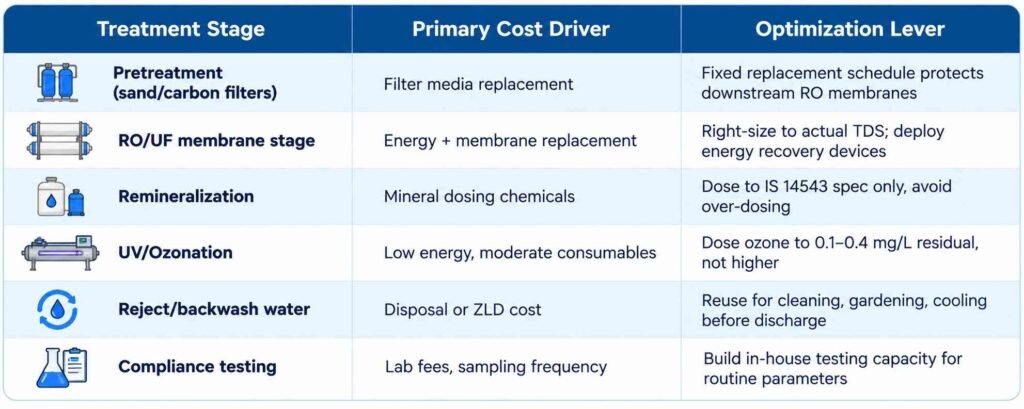
Treatment Stage Cost Optimization at a Glance
How IMARC Engineering’s Expertise Can Help in Water Treatment Cost Optimization
- Structuring raw-water characterisation studies that right-size the treatment train instead of defaulting to full RO
- Sizing energy recovery integration and pump scheduling against actual daily run-hour load
- Designing reject water reuse loops that reduce net freshwater intake and ZLD system size
- Building CIP and membrane replacement schedules around fouling data rather than fixed calendars
- Structuring in-house QC lab capability aligned with FSSAI Scheme of Testing requirements from January 2026
Get in Touch With Our Team: https://www.imarcengineering.com/contact-us
Conclusion
Water treatment cost optimization in a packaged drinking water plant is not a one-time design decision, it is an ongoing discipline across sizing, energy, reject reuse, and consumable management. With India’s water economics tightening toward 2030, plants that treat these levers as fixed costs will fall behind those that actively manage them.
Contact Us:
IMARC Engineering
Phone: +91-120-433-0800
Email: sales@imarcengineering.com
India: C-130, Sector 2, Noida, Uttar Pradesh 201301
LinkedIn: https://www.linkedin.com/showcase/imarc-engineering/
About the Author