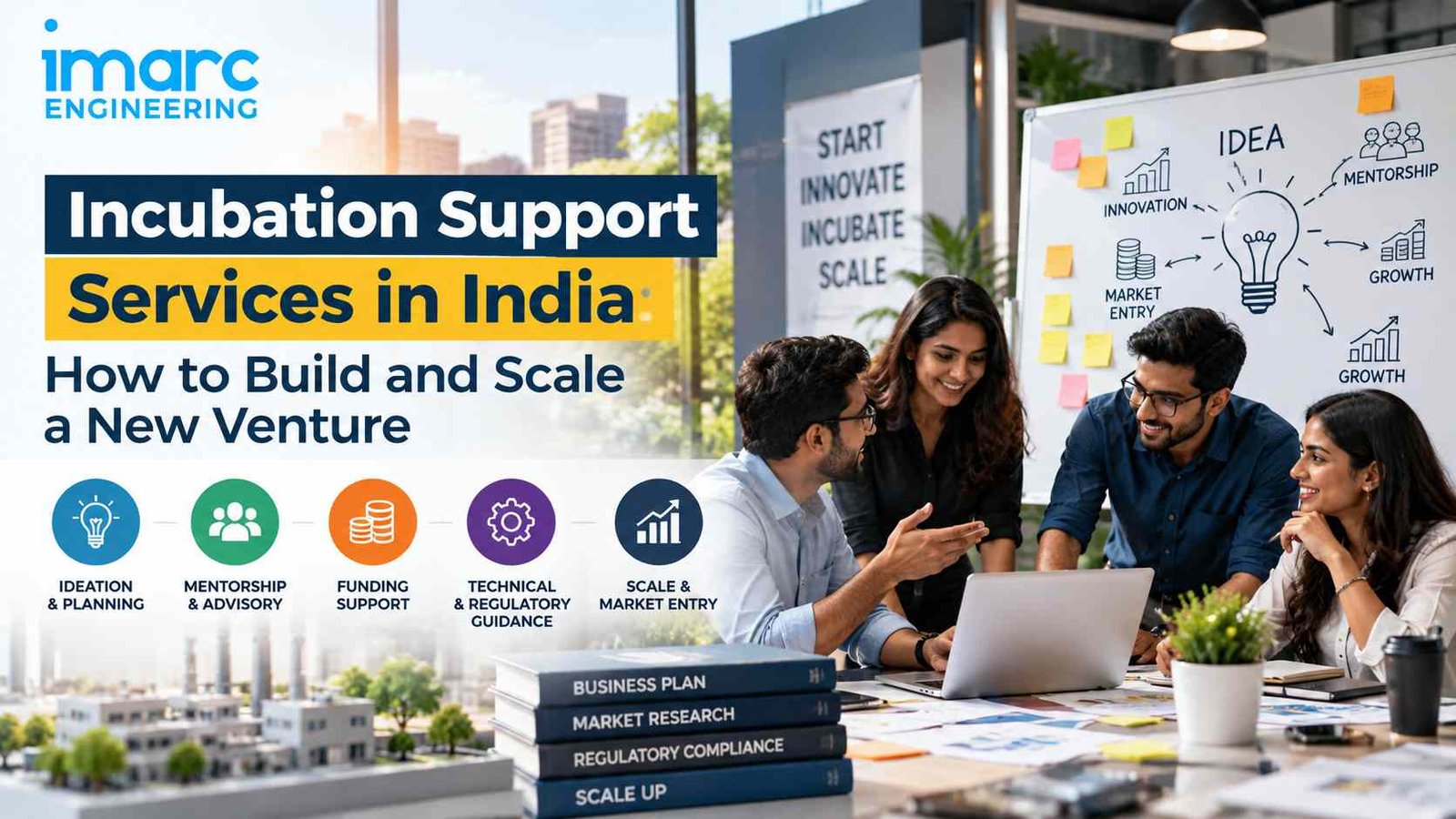
India had 2,12,283 DPIIT-recognised startups as of 31 January 2026, and over 55,200 were recognised in FY 2025-26 alone, according to PIB data. Most of these ventures are asset-light. Manufacturing ventures face a harder road, because a working prototype and a saleable product are separated by pilot production, testing, and regulatory approval.
The policy backdrop shifted in 2026. DPIIT raised the turnover ceiling for startup recognition from ₹100 crore to ₹200 crore and created a deep tech category with a 20-year window and a ₹300 crore ceiling. A ₹10,000 crore Startup India Fund of Funds 2.0 was notified in April 2026. Meanwhile, the Startup India Seed Fund Scheme closed to new applications on 31 May 2026, so founders need a current funding plan.
That is where incubation support services in India add value. Structured programmes validate the product, guide pilot production, plan approvals, and line up capital in the right sequence. This article explains how to build and scale a new venture with that support.
What Are Incubation Support Services?
Incubation support services are structured programmes that help early-stage ventures move from idea to commercial operation through technical validation, infrastructure access, mentoring, regulatory guidance, and funding linkage. For manufacturing ventures, they also include prototyping labs, pilot production support, and design for manufacturability review.
A complete programme typically covers:
- Feasibility and validation: technical, market, and manufacturing checks before capital is committed
- Prototype and testing access: 3D printing, CNC machining, PCB fabrication, and environmental and electrical safety testing
- Pilot production: small-batch runs that reveal process variability
- Regulatory planning: approval pathways identified at concept stage
- Funding linkage: grants, credit guarantees, angel and venture capital introductions
- Market linkage: pilot customers, lighthouse buyers, and distributor introductions
How Is Manufacturing Incubation Different from Software Incubation?
Hardware ventures need more time, more capital, and more engineering support than software or service startups.
- Timeline: manufacturing incubation typically runs 18-36 months, against 6-18 months for generic startup programmes
- Capital: prototypes typically cost ₹5-25 lakh, pilot lines ₹25 lakh-5 crore, and commercial scale-up ₹1-50 crore depending on sector
- Infrastructure: prototyping laboratories, pilot production areas, and testing facilities replace shared desks
- Expertise: mechanical, electrical, materials, process, and quality engineering replace pure business mentoring
- Regulation: BIS, CDSCO, FSSAI, and sector approvals add months to the critical path
What Are the Stages of Building and Scaling a Manufacturing Venture?
Successful ventures progress through six gated stages. Each stage answers one question before the next stage commits more capital.
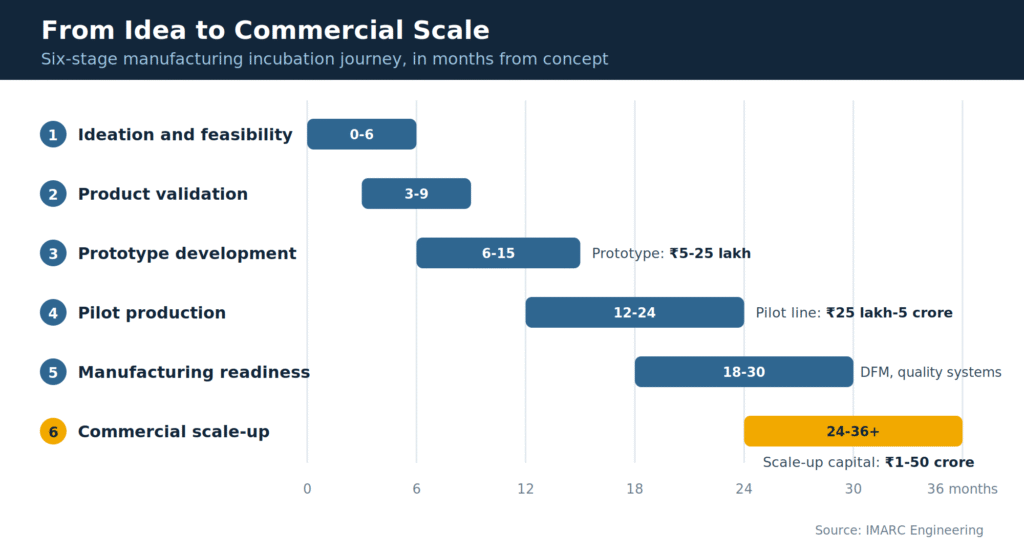
- Sequence readiness: progress through Technology Readiness Levels and Manufacturing Readiness Levels with defined gate criteria
- Apply design for manufacturability early: it typically reduces manufacturing cost by 20-40% versus retrofitting after design freeze
- Run real pilot batches: batches of 100-10,000 units, depending on the product, expose variability that prototypes never show
- Optimise during the pilot: unit economics typically improve 15-30% versus first-pilot performance
- Consider contract manufacturing: it gives faster market entry and lower capital burn, at the cost of margin and production control
How Does Early Regulatory Planning Speed Up Launch?
Approvals often become the real critical path to launch. Planning them from the concept stage typically saves 6-12 months compared with reacting after a design freeze. Typical timelines are:
- Medical devices: 12-36 months (CDSCO, ISO 13485)
- Automotive components: 6-18 months (ARAI, iCAT)
- Electronics: 4-12 months (BIS CRS, WPC)
- Food and beverage: 3-9 months (FSSAI)
- Toys: 3-6 months (BIS ISI)
What Funding Is Available to New Ventures in 2026?
Founders should plan around what is actually open today. Several older guides still list schemes that have closed.
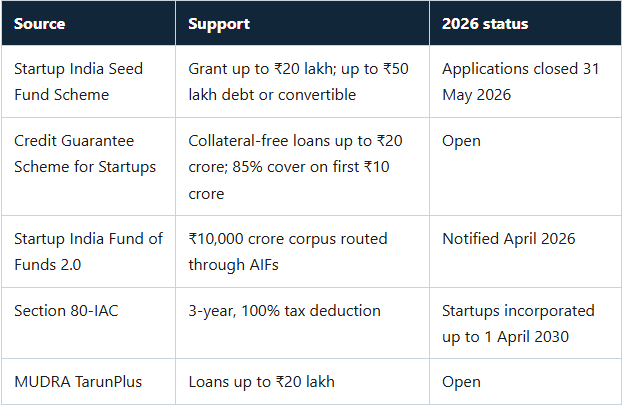
- Equity stack: angel and seed tickets typically run ₹25 lakh-5 crore, and Series A ₹10-100 crore
- Milestone-based release: align each tranche with a readiness gate
- Recognition: the DPIIT certificate unlocks the schemes above and is free to obtain
How Should Founders Choose an Incubation Partner?
- Check physical infrastructure: confirm labs, pilot lines, and testing match your product category
- Verify sector expertise: generic mentors cannot advise on tolerance stack-up or process scale-up
- Ask about regulatory support: the partner should map your approval path early
- Test funding linkage: look for grant, credit, and investor pipelines that are currently open
- Review track record: ask for outcomes with similar ventures
Avoid the common mistakes: skipping product validation, over-investing in prototypes, deferring regulatory planning, and under-scoping capital.
Read our detailed analysis here: https://www.imarcengineering.com/blog/incubation-services-for-manufacturing-startups-india
How IMARC Engineering’s Expertise Can Help in Incubation Support
IMARC Engineering supports founders and product innovators from concept to commercial scale:
- Feasibility studies and product validation frameworks
- Design for manufacturability review and prototype planning
- Pilot production design and manufacturing readiness assessment
- Regulatory pathway mapping and testing plans
- Contract manufacturer evaluation
- Capital stack design and grant application support
Consult With Our Team: https://www.imarcengineering.com/contact?service=incubation
Conclusion
Building a manufacturing venture is a sequence, not a leap: validate, prototype, pilot, certify, then scale. Incubation support services shorten that path by aligning engineering, regulation, and capital at each gate. With Fund of Funds 2.0 live, deep tech recognition extended to 20 years, and seed grants closed, founders who plan capital by milestone and choose partners with real manufacturing infrastructure will reach commercial scale faster and with fewer costly surprises.
Frequently Asked Questions
What do incubation support services include?
They include technical validation, prototyping and testing access, mentoring, regulatory guidance, and funding and market linkage.
How long does manufacturing incubation take?
Typically 18-36 months from concept to commercial scale-up, and longer for regulated products such as medical devices.
Is the Startup India Seed Fund Scheme still open?
No. The last date for startups to apply was 31 May 2026.
How much capital does a manufacturing startup need?
Typically ₹5-25 lakh for prototypes, ₹25 lakh-5 crore for a pilot line, and ₹1-50 crore for commercial scale-up.
Do I need my own factory to commercialise?
Not necessarily. Contract manufacturing offers production capacity and quality systems without full facility investment.
Contact Us:
IMARC Engineering
Phone: +91-120-433-0800
Email: sales@imarcengineering.com
India: C-130, Sector 2, Noida, Uttar Pradesh 201301
LinkedIn: https://www.linkedin.com/showcase/imarc-engineering/
About the Author