A global brand shortlists Indian manufacturers, compares quotations, signs a partner and starts production. Months later, the cracks appear. Quoted capacity turns out not to be dependable capacity. Much of the supplier’s output is already committed. Freight changes the economics, compliance was underestimated, and scaling up is harder than expected, with few alternative suppliers to fall back on.
India is not the problem. According to the Press Information Bureau (PIB), manufacturing FDI grew 18% in FY 2024–25 to USD 19.04 billion, from USD 16.12 billion in FY 2023–24. The problem is entering with a supplier list but no view of the market behind it.
Finding a manufacturer answers one question: who can make this? It does not show whether the market can support your volume, cost target and timeline. That missing layer is Contract Manufacturing Market Intelligence the analysis between locating suppliers and making a commercially informed manufacturing decision.
Why Global Brands Misjudge Indian Contract Manufacturing
Why do global brands need contract manufacturing market intelligence in India? Because a quotation describes one factory, not the market around it. Without the wider view, brands can misjudge capacity, cost, concentration, compliance and scalability. Here, “fail” refers to avoidable manufacturing decisions or setbacks caused by gaps in market intelligence—not to every brand entering India.
Availability is not suitability. A long supplier list says little about how many can run your process, tolerances or batch sizes.
Installed capacity is not dependable capacity. What if the supplier has capacity on paper but not when your volume arrives? The RBI’s quarterly Order Books, Inventories and Capacity Utilisation Survey tracks production against installed capacity, illustrating why installed capacity and actual utilisation should not be treated as the same measure. Shifts, labour, utilities and other customers’ orders all narrow what is actually available.
Lowest conversion cost is not lowest landed cost. What if the cheapest supplier sits far from your raw-material ecosystem? Inbound materials, outbound freight and port distance can erase a quotation advantage.
Regional concentration. Suppliers in one cluster can share inputs, subcontractors and infrastructure, creating concentration risk even when multiple suppliers appear available.
Compliance is product-specific. What if requirements surface after supplier selection? Rework follows.
Scale-up is a separate test. What if your supplier can handle the pilot volume but cannot scale?
What Contract Manufacturing Market Intelligence Actually Covers
What is contract manufacturing market intelligence? It is a structured analysis of a manufacturing landscape—demand, suppliers, capacity, capabilities, clusters, costs, compliance rules and risks—completed before supplier selection. It shows what the market can realistically offer, so shortlists rest on evidence rather than availability.
What should companies analyse before choosing Indian contract manufacturers? These ten areas:
| Intelligence Area | What to Analyse | Why It Matters |
|---|---|---|
| Market demand | Domestic and export demand for the product category | Shows who else competes for the same capacity |
| Supplier landscape | Number, size and type of relevant manufacturers | Reveals real choice, not listed names |
| Manufacturing capacity | Installed, utilised and available capacity | Separates paper capacity from usable capacity |
| Manufacturing capability | Equipment, technology, testing, quality systems | Confirms process fit |
| Geographic clusters | Where suppliers and inputs concentrate | Shapes cost, lead time and risk |
| Cost structure | Conversion, materials, tooling, MOQ, freight | Exposes total cost, not quotation price |
| Competitive landscape | Customer concentration and sector exposure | Indicates bargaining position |
| Compliance environment | Product- and market-specific approvals | Prevents late rework |
| Supply risk | Input dependence, subcontractors, disruptions | Tests resilience |
| Scalability | Expansion room and second-source options | Supports growth beyond the pilot |
How to Conduct Contract Manufacturing Market Intelligence in India
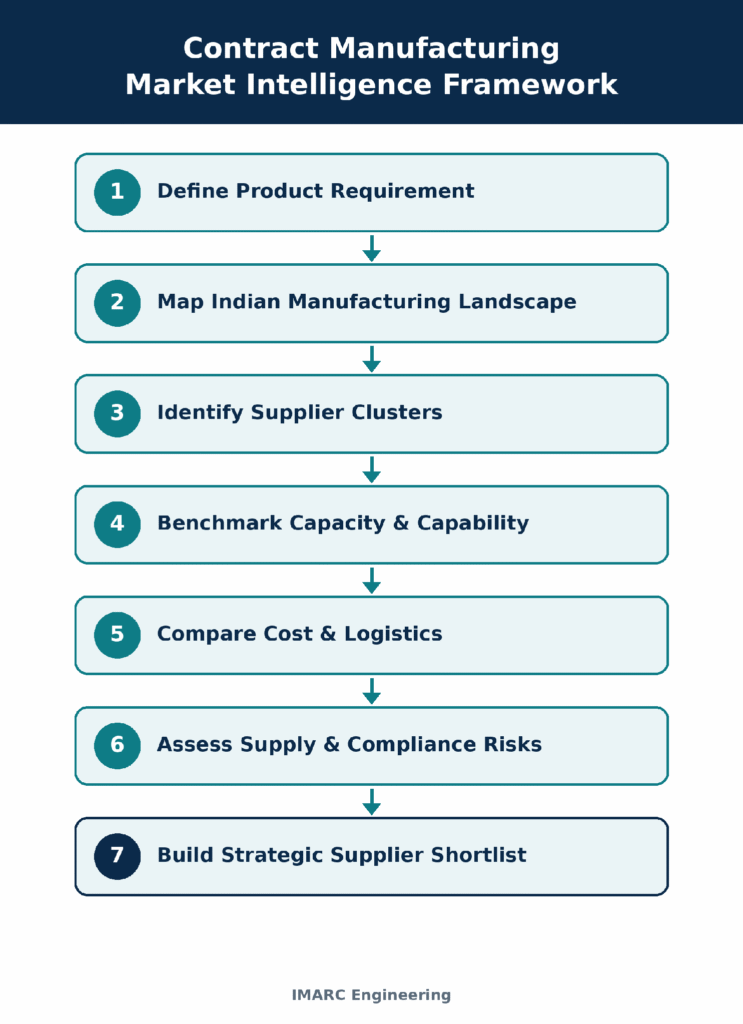
How do you evaluate India’s contract manufacturing landscape? Define the product precisely, map the ecosystem, then test capacity, capability, logistics, cost and compliance in sequence. Each step narrows the field using evidence.
Step 1 — Define Product and Manufacturing Requirements
Document specifications, expected volume, quality requirements, packaging, target market, process technology, and initial and future capacity. Vague requirements produce quotations that cannot be compared: one supplier prices a pilot batch, another a full-scale line, and neither matches your specification.
Step 2 — Map the Indian Manufacturing Ecosystem
Identify relevant industries, clusters, states, raw-material ecosystems, logistics access and supplier concentration. The output is a shortlist of clusters, not yet of suppliers. Official sources help: MoSPI’s Annual Survey of Industries for industrial structure, and DPIIT’s PM GatiShakti and National Logistics Policy for logistics context.
Step 3 — Analyse Supplier Capacity
Separate installed capacity, actual production, current utilisation, available capacity and shift structure. Then look for bottlenecks and expansion capability. Request evidence such as shift patterns and current order-book visibility. Installed machinery does not automatically equal available manufacturing capacity. A line may be constrained by tooling, utilities or a single shift.
Step 4 — Benchmark Manufacturing Capabilities
Compare equipment, technology, automation, testing facilities, quality systems, product experience, engineering capability and export capability against your requirement, not against each other in the abstract. Ask what each supplier has already produced in comparable products, not what its equipment could theoretically make.
Step 5 — Analyse Regional and Logistics Economics
Location affects inbound raw-material logistics, finished-goods freight, ports, warehouses, labour, supplier ecosystem and lead time. The lowest factory quotation may not produce the lowest total supply-chain cost; a slightly higher price near inputs and ports can win overall.
Step 6 — Benchmark Cost
Compare like with like: conversion cost, raw-material assumptions, tooling, MOQ, packaging, freight, testing and quality costs, payment terms and inventory implications. Differing assumptions behind quotations often matter more than the headline figure. Ask suppliers to state assumed material prices, yields and volumes so quotations can be normalised before totals are compared. Payment terms and MOQ also shape working capital, which a unit price never shows.
Step 7 — Assess Regulatory and Certification Requirements
Requirements vary by product category and target market. BIS certification is voluntary by default but compulsory for products covered by Quality Control Orders, so not every product needs it. Pharmaceuticals and medical devices, for instance, fall under CDSCO oversight. Confirm applicability through official BIS and CDSCO sources before shortlisting.
Supplier Concentration: The Hidden Risk
What if several apparently independent suppliers depend on the same regional ecosystem? A company may find many suppliers yet carry concentrated risk if they share a raw-material region, rely on the same subcontractors, operate in one cluster, offer limited scalable capacity or lack required certifications.
Supplier count is not supply resilience. Ten suppliers with one shared input source behave more like one. Intelligence work traces these dependencies before commitment, so a second source is genuinely independent. For example, suppliers in one cluster may all buy a key input from the same upstream region; a disruption there reaches every one of them at once.
Market Intelligence vs Supplier Due Diligence
What is the difference? Market intelligence examines the landscape before any supplier is chosen. Due diligence tests whether one selected supplier can deliver. They are sequential, not interchangeable.
| Stage | Main Question |
|---|---|
| Market Intelligence | What does India’s manufacturing landscape look like? |
| Supplier Mapping | Who could potentially manufacture the product? |
| Benchmarking | How do potential suppliers compare? |
| Due Diligence | Can the selected supplier actually deliver? |
| Contracting | How should commercial risk be allocated? |
What Happens When Market Intelligence Is Skipped
Not every brand experiences these outcomes, but skipping the landscape view makes them more likely. The shortlist suffers first: suitable suppliers are missed and unsuitable ones included. Capacity assumptions go unchallenged, so launches slip. Landed cost exceeds plan, late compliance discovery forces rework, and inventory builds when minimum orders outpace demand. Without benchmarks, negotiation is weak and single-source dependency forms by default. When volumes grow, scale-up stalls, and some brands end up switching suppliers in an emergency, with little leverage. The cost is rarely one large failure; it is several smaller ones compounding.
India’s Manufacturing Context: Why Opportunity Raises the Stakes
Policy has opened the door. According to DPIIT’s year-end review published by PIB, 100% FDI under the automatic route was allowed in contract manufacturing in 2019, and Production Linked Incentive schemes across 14 sectors carry an outlay of ₹1.97 lakh crore. Growing interest can mean more brands seeking the same qualified capacity. The opportunity is visible; usable capacity in the right cluster still has to be established.
Planning Contract Manufacturing in India?
Before approaching individual suppliers, understand the manufacturing landscape, available capacity, regional clusters, cost factors and supplier alternatives.
IMARC Engineering is an engineering and project advisory company supporting manufacturing decisions in India. It provides contract manufacturing market intelligence, manufacturing landscape analysis, supplier and market mapping, capacity and capability intelligence, and strategic inputs before major manufacturing commitments. To discuss your product and volume requirements, contact IMARC Engineering. For commercial models, see its guide to contract manufacturing in India.
Talk to IMARC Engineering for Contract Manufacturing Market Intelligence and partner identification support: https://www.imarcengineering.com/contact?service=contract-manufacturer-identification
Conclusion
India offers a broad manufacturing ecosystem, but a supplier list alone cannot reveal whether the market fits a brand’s product, volume, cost and scale-up requirements. Contract manufacturing market intelligence brings those factors together before major commitments are made. It also gives brands firmer footing in negotiation and a realistic path from pilot to scale, before commitments become difficult to reverse.
Watch Our Related Video : https://youtu.be/KwbREwhDxZk?si=eso3wDCMGo4dY96K
Contact Us:
IMARC Engineering
Phone: +91-120-433-0800
Email: sales@imarcengineering.com
India: C-130, Sector 2, Noida, Uttar Pradesh 201301
LinkedIn: https://www.linkedin.com/showcase/imarc-engineering/
About the Author