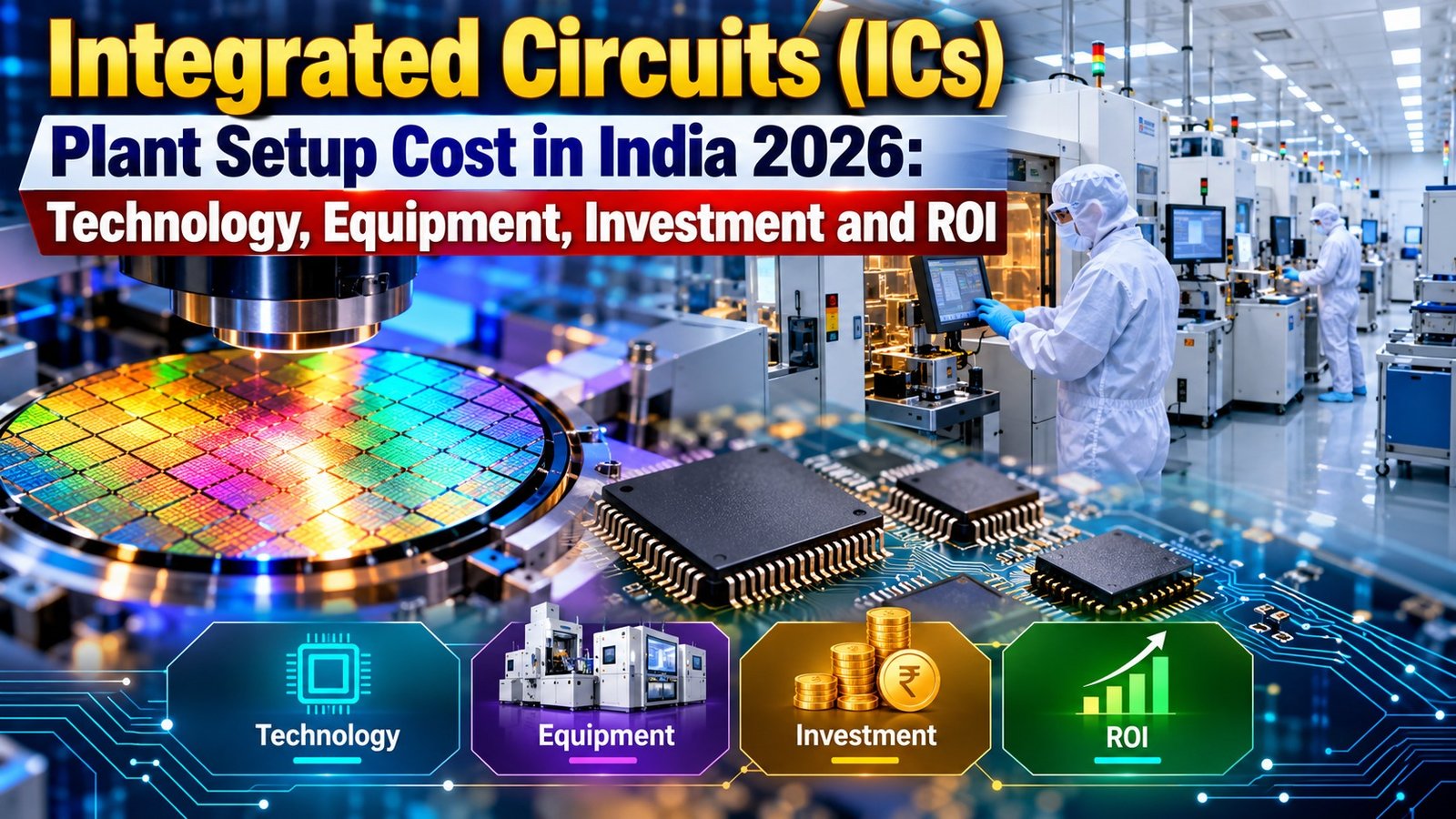
Setting up an integrated circuits manufacturing plant in India presents a compelling investment case for investors targeting the digital economy. Demand is driven by consumer electronics, automotive, telecommunications, industrial automation, healthcare and medical devices, aerospace and defense, data centers, and renewable energy. Integrated circuits, commonly called microchips, act as the brain and building blocks of modern electronics, which makes them critical to India’s economy.
India offers clear advantages for this type of investment. Rising urbanisation, expanding infrastructure, and the Make in India initiative support domestic electronics manufacturing, while the India Semiconductor Mission and production-linked incentives (PLI) are accelerating investment in chip fabrication and packaging. Growing electronics demand and supply chain localisation make India a strategically sound base for semiconductor production.
The investment case rests on policy support, a fast-growing domestic market, and demand from AI, automotive, and telecom sectors. Gross margins of 35–55% and net margins of 12–25% indicate healthy profitability, and break-even viability improves at higher capacity utilisation.
What is Integrated Circuits (ICs)?
An Integrated Circuit (IC), commonly called a microchip, is a miniature electronic circuit built directly onto a tiny, flat piece of semiconductor material, usually silicon. It packs hundreds to billions of microscopic components, such as transistors, resistors, and capacitors, together to perform complex tasks. ICs make computers and smartphones faster, more reliable, and highly affordable.
Products range from simple timers and amplifiers to complex microprocessors, memory chips, analog and mixed-signal ICs, and power management devices. Production follows wafer fabrication through oxidation, photolithography, thin-film deposition, ion implantation, etching, chemical mechanical planarization (CMP), metallization, wafer testing, dicing, packaging, and final testing. The end-use industries served include consumer electronics, automotive, telecommunications, industrial automation, healthcare and medical devices, aerospace and defense, data centers, and renewable energy.
Cost of Setting Up an Integrated Circuits Manufacturing Plant in India
The total cost of an integrated circuits manufacturing plant depends on capacity, technology, location, automation, and regulatory compliance.
1. Capital Expenditure (CapEx)
Land and site development covers land registration, boundary development, and related charges, and investors can compare SEZ and industrial estate options for infrastructure access. Civil works include the production building, laboratory, storage areas, and administrative block. Machinery accounts for the largest share of CapEx, and the scale of manufacturing and level of automation determine its total cost. Key machinery required includes:
- Oxidation furnaces
- Photolithography steppers/scanners
- CVD/PVD deposition systems
- Ion implanters
- Plasma etchers
- CMP systems
- Wafer inspection and metrology tools
- Wafer probers
- Dicing machines
- Die bonders
- Wire bonders
- Molding systems
- Package testing equipment
- Cleanroom facilities
Other capital costs include effluent treatment, pre-operative expenses, commissioning, and import duties where equipment is sourced abroad.
Request a Sample Report for In-Depth Market Insights: https://www.imarcgroup.com/integrated-circuits-manufacturing-plant-project-report/requestsample
2. Operational Expenditure (OpEx)
Raw materials account for 35–45% of total operating expenses. The requirement covers silicon wafers, ultra-pure process gases (silane, nitrogen trifluoride, chlorine, and others), photoresist, CMP slurries, and deionized water, and long-term supplier contracts help stabilise pricing and secure steady supply. Utilities such as electricity, water, and steam account for 15–22% of OpEx. Other operating costs include transportation, packaging, salaries and wages, repairs and maintenance, depreciation, and taxes. By the fifth year, total operating costs are expected to rise substantially because of inflation, market fluctuations, supply chain disruptions, and higher material costs.
3. Plant Capacity
The proposed facility is designed for an annual manufacturing capacity of 20,000–100,000 wafers per month, balancing economies of scale with operational flexibility. Capacity can be customised to investor requirements, and profitability improves with higher capacity utilisation.
4. Profit Margins and Financial Projections
Financial projections are built on realistic assumptions for capital investment, operating costs, capacity utilisation, pricing trends, and demand outlook. The project shows gross profit margins of 35–55% and net profit margins of 12–25%. Investors can assess viability through ROI, NPV, IRR, payback period, and the profit and loss account, which together show long-term sustainability.
Why Set Up an Integrated Circuits Manufacturing Plant in India?
Foundation of the Digital Economy. Integrated circuits enable computing, communication, power management, sensing, and automation across virtually all modern electronic devices. This makes IC manufacturing indispensable to technological advancement.
Megatrend Alignment. Artificial intelligence, electric vehicles, 5G networks, IoT devices, cloud computing, data centers, and robotics are driving sustained demand for advanced semiconductor chips. India’s integrated circuits market was valued at USD 33.5 Billion in 2025.
Policy and Regulatory Tailwinds. Governments worldwide are promoting domestic semiconductor manufacturing through incentive programs, fabrication subsidies, and supply chain resilience initiatives. Programs such as the India Semiconductor Mission and PLI are accelerating investments in IC manufacturing and packaging capabilities.
Cost-Competitive Manufacturing. Land, construction, utility, and labour costs shape the economics, so site selection near raw material sources and target markets keeps distribution costs low. High entry barriers, including substantial capital, cleanroom facilities, and long qualification cycles, favour technologically advanced manufacturers.
Active Industry Investment. In June 2026, Sivers Semiconductors AB announced a USD 8.2M production order for 2027 from ALL.SPACE for multi-beam Ka-band beamforming integrated circuits. The order underscores growing momentum in defense and commercial satellite communications.
Local Supply Chain Preference. Electronics manufacturers and OEMs are diversifying semiconductor sourcing and strengthening regional supply chains to reduce geopolitical risks, improve supply security, and shorten lead times. This creates opportunities for domestic producers with reliable capabilities.
Manufacturing Process – Step by Step
The IC manufacturing process uses wafer fabrication as the primary production method:
- Oxidation: Oxidation furnaces grow the oxide layer on silicon wafers.
- Photolithography: Steppers and scanners transfer circuit patterns onto the wafer.
- Thin-Film Deposition: CVD/PVD deposition systems add thin material layers.
- Ion Implantation: Ion implanters introduce dopants into the wafer.
- Etching: Plasma etchers remove material to form circuit features.
- CMP: CMP systems planarize wafer surfaces using CMP slurries.
- Metallization: Metal layers connect the circuit components.
- Wafer Testing: Inspection and metrology tools and wafer probers verify quality.
- Dicing: Dicing machines separate wafers into individual dies.
- Packaging: Die bonders, wire bonders, and molding systems package the dies.
- Final Testing: Package testing equipment confirms performance before dispatch to end-use industries.
Key Applications
Integrated circuits serve four broad industry groups:
- Consumer Electronics: Smartphones, laptops, tablets, wearables, smart TVs, and home appliances.
- Automotive: ADAS, infotainment systems, electric vehicles, battery management systems, and engine control units.
- Telecommunications: 5G infrastructure, networking equipment, data transmission systems, routers, switches, and communication modules.
- Industrial & Computing: Industrial automation, robotics, IoT devices, data centers, cloud computing servers, medical devices, and aerospace and defense electronics.
Leading Manufacturers
The global integrated circuits industry includes several multinational players with extensive manufacturing capacities and diverse application portfolios:
- Taiwan Semiconductor Manufacturing Company (TSMC)
- Intel Corporation
- Samsung Electronics Co., Ltd.
- Qualcomm Incorporated
- Broadcom Inc.
- Texas Instruments Incorporated
Timeline to Start the Plant
- Feasibility study and project report preparation
- Land acquisition and site development
- Regulatory approvals and environmental clearances
- Factory licence and fire safety compliance
- Machinery procurement and installation
- Raw material supplier agreements and supply chain setup
- Trial production and quality testing
- Commercial production launch
Licences and Regulatory Requirements
Starting an integrated circuits manufacturing plant in India requires several approvals:
- Business registration (Proprietorship, LLP, or Pvt Ltd)
- Factory Licence under the Factories Act
- Environmental Clearance from State Pollution Control Board
- GST Registration
- Fire Safety NOC
- Hazardous/chemical compliance for process gases
- Effluent Treatment Plant (ETP) operational clearance
- Occupational Health and Safety compliance
Key Challenges to Consider
- High Capital Requirements: Advanced fabrication technologies and cleanroom facilities demand substantial upfront investment.
- Raw Material Price Volatility: Silicon wafers, process gases, photoresist, CMP slurries, and deionized water drive costs, and long-term contracts help manage price swings.
- Regulatory Compliance: Zoning, environmental, emission, and safety rules must be met.
- Technology or Innovation Pressure: Smaller process nodes, advanced packaging, and chiplet architectures require continuous technology upgrades.
- Competition: Established players such as TSMC, Intel, Samsung Electronics, Qualcomm, Broadcom, and Texas Instruments set a high benchmark.
- Skilled Manpower: Fabrication demands intellectual property expertise and a skilled workforce.
Frequently Asked Questions
1. How much does it cost to set up an integrated circuits manufacturing plant in India?
Cost depends on capacity, technology, and location. Machinery forms the largest share of CapEx, and the detailed breakdown is in the report.
2. Is IC manufacturing profitable in India in 2026?
The project shows gross margins of 35–55% and net margins of 12–25% under normal operating conditions.
3. What machinery is required for an ICs plant in India?
Oxidation furnaces, photolithography steppers/scanners, CVD/PVD deposition systems, ion implanters, plasma etchers, CMP systems, inspection and metrology tools, wafer probers, dicing machines, die and wire bonders, molding systems, package testing equipment, and cleanroom facilities.
4. What licences and approvals are required to start an ICs plant in India?
Business registration, Factory Licence, environmental clearance, GST registration, Fire Safety NOC, chemical compliance, ETP clearance, and occupational safety compliance.
5. What raw materials are needed for IC manufacturing?
Silicon wafers, ultra-pure process gases, photoresist, CMP slurries, and deionized water.
6. What are the environmental compliance requirements for an ICs plant in India?
Effluent treatment systems, adherence to emission standards, and compliance with local zoning and environmental regulations.
7. What is the best location to set up an ICs plant in India?
A site with easy access to key raw materials and target markets, backed by reliable transport, utilities, and waste management.
8. What is the break-even period for this type of plant in India?
It depends on capacity utilisation and costs, and the report’s payback analysis covers the timeline in detail.
9. What government incentives are available for manufacturers in India?
Programs such as the India Semiconductor Mission and production-linked incentives (PLI) support domestic semiconductor manufacturing.
Key Takeaways for Investors
An integrated circuits manufacturing plant investment draws on demand from consumer electronics, automotive, telecommunications, data centers, and industrial automation. Financial viability holds across capacities of 20,000–100,000 wafers per month, with 35–55% gross margins and 12–25% net margins. India’s integrated circuits market is expected to reach USD 115.4 Billion by 2034 at a CAGR of 14.29%, while the global semiconductor market is expected to exceed USD 1.5 Trillion by 2035, as per NITI Aayog. With AI, electric vehicles, and 5G continuing to expand, demand for integrated circuits looks set to remain durable.
About the Author