“Quick answer: Buyers should run a 30-year title trace, verify encumbrances and revenue records, confirm land-use conversion and zoning, review allotment or lease terms, map environmental and forest approvals, search courts and tribunals independently, and complete a site visit. A structured review takes 6 to 12 weeks and typically costs 0.5% to 1.5% of project value.”
Land is where most industrial projects either succeed or quietly fail. Property and land matters make up roughly 66% of all civil litigation in India, and about 7.3 million property cases were pending in early 2026, according to National Judicial Data Grid based compilations. A title defect found after capital is committed can trigger litigation lasting 5 to 10 years.
That is why serious buyers now treat legal due diligence services in India as a pre-commitment discipline rather than a closing formality. Verification of title, permissibility and approvals before the sale deed is signed is far cheaper than any remedy afterwards.
This guide explains why the exercise matters, which checks to complete, how environmental approvals affect a land purchase, and which mistakes to avoid.
Why Does Legal Due Diligence Matter Before Buying Industrial Land?
Industrial land carries risks that residential purchases rarely face, because the plot must also be legally permissible for manufacturing and approvable for clearances. The numbers explain the stakes:
- Cost versus loss: Diligence costs about 0.5% to 1.5% of total project cost, yet it routinely prevents losses of 10% to 50% of that cost from problems that surface after commitment.
- Litigation duration: Land-title defects discovered after capital expenditure can lock a project into disputes of 5 to 10 years, and in extreme cases the site is lost.
- Prior clearance rule: On 29 July 2026, a three-judge Supreme Court Bench in Vanashakti v. Union of India confirmed that prior environmental clearance is the rule and barred fresh applications under the quashed 2021 Office Memorandum.
- State-level variation: State land laws, conversion rules and stamp duty regimes drive an estimated 30% to 50% of actual compliance risk, so a uniform national template misses much of it.
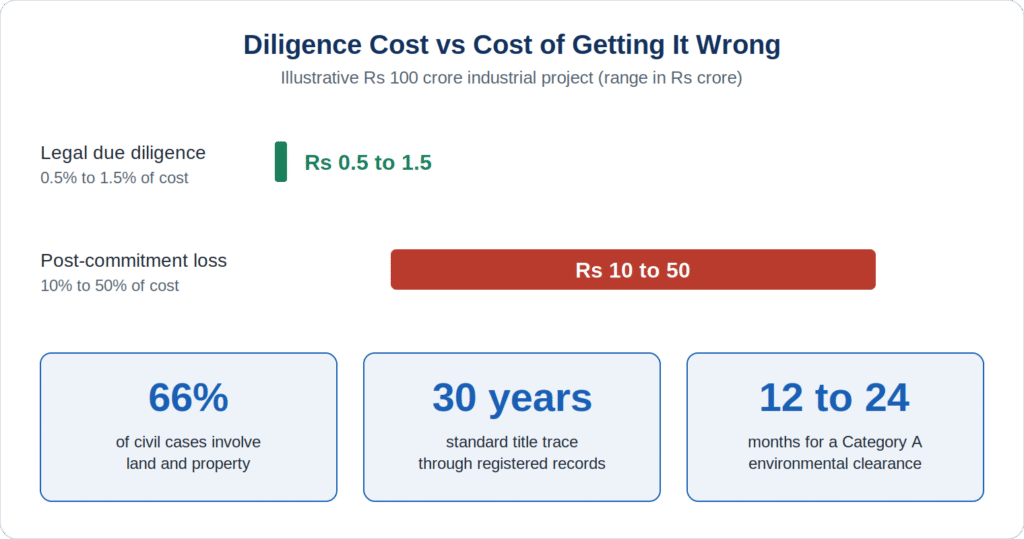
Source: IMARC Engineering analysis of diligence cost and loss ratios; National Judicial Data Grid based compilations (2026); EIA Notification 2006 timelines. Rupee values are illustrative applications of the stated percentages.
Which Route Are You Using to Acquire Industrial Land?
The route determines the diligence profile, so identify it first:
- State industrial development corporation allotment: Land in notified estates usually comes as a long-term lease, commonly 99 years. Title risk is lower, but the lease deed, allotment conditions, outstanding dues, transfer consent and reversion clauses must still be verified.
- Direct purchase from private owners: Governed by the Transfer of Property Act 1882 and state land laws. This route carries the highest title risk and needs the full 30-year trace.
- Government acquisition under the RFCTLARR Act 2013: Diligence focuses on procedural integrity, including the Social Impact Assessment, consent thresholds, rehabilitation plan and compensation under Schedule I, since defects can be challenged years later.
Watch the video for more insights:
What Legal Checks Should Buyers Complete?
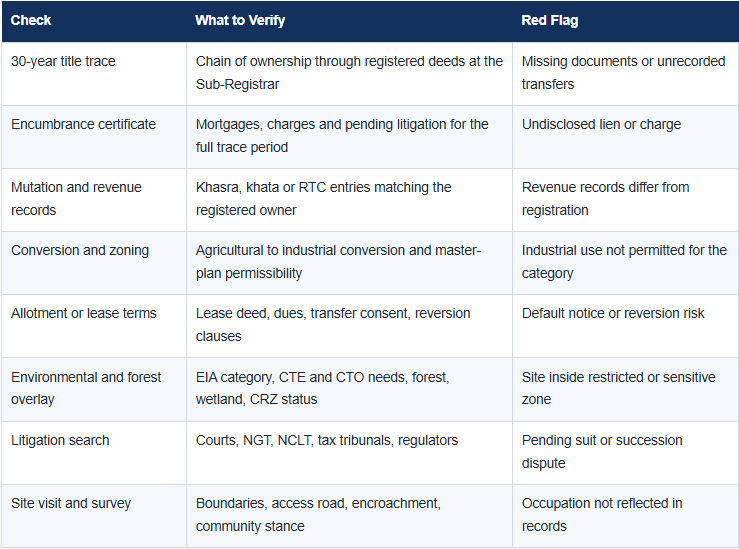
Every industrial land purchase should clear the eight checks below. The table pairs each check with the red flag that should pause the deal.
How Do Environmental Approvals Affect a Land Purchase?
Clean title on land that cannot be cleared for the intended activity is a project-stopper. Environmental approvals in India should therefore be mapped before payment, not after:
- Category and timeline: The EIA Notification 2006 covers over 40 project categories. A Category A project typically needs 12 to 24 months from Terms of Reference issuance, making clearance the longest gating item.
- Processing speed: The central average for grant of EC was about 57 days in FY2025-26, though this measures ministry processing and excludes study and hearing stages.
- Public consultation: A 30-day notice period precedes the public hearing, and stakeholder feedback must be built into the EIA.
- Adjacent consents: CTE and CTO from the State Pollution Control Board, hazardous waste authorisation, forest clearance and CRZ permissions may also apply.
- Brownfield sites: Historical EC compliance, monitoring reports and any NGT or pollution board notices should be verified against the tightened prior-clearance position.
What Is the Step-by-Step Process for Legal Due Diligence?
- Define scope: Classify the project as greenfield, brownfield or hybrid, and set the review calendar against the financing timeline, typically 6 to 12 weeks.
- Issue an information request list: Collect deeds, revenue extracts, approvals and allotment papers through a data room.
- Run the title trace: Verify 30 years of registered transfers, mutation entries and encumbrances.
- Confirm permissibility: Check conversion status, zoning, local NOCs and state industrial policy conditions.
- Map approvals: Establish the EIA category, CTE and CTO route, and any forest or coastal restrictions.
- Search litigation independently: Do not rely on the seller’s disclosure schedule alone.
- Visit the site: Match boundaries and occupation on the ground with the records.
- Consolidate a risk register: Rank findings by severity and link each to a remedy, such as an indemnity, escrow or condition precedent.
What Mistakes Should Buyers Avoid?
- Compressing the timeline: Cutting a 6 to 12 week review to 2 or 3 weeks usually surfaces missed liabilities 12 to 24 months after closing.
- Choosing the lowest quote: Templated reports lack sector depth and primary verification.
- Skipping the site visit: Desk reviews miss encroachments, access disputes and local opposition.
- Trusting seller disclosures: Treat them as a starting point, never the final verification source.
- Ignoring state overlays: State-specific rules account for a large share of real compliance risk.
How IMARC Engineering’s Expertise Can Help with Legal Due Diligence Services
- 30-year title trace, encumbrance review and revenue record verification
- Conversion, zoning and permissibility assessment for the intended industrial category
- Review of allotment letters, lease deeds and reversion exposure for estate land
- Environmental, forest and regulatory approval mapping with realistic timelines
- Independent litigation searches across courts, tribunals and regulators
- Integrated risk register with remedies feeding deal documents and financing packages
Consult With Our Team: https://www.imarcengineering.com/contact?service=land-acquisition-legal-due-diligence
Conclusion
Legal due diligence is the cheapest protection an industrial buyer can purchase. At 0.5% to 1.5% of project cost, it guards against losses many times larger and protects financing, schedules and approvals. With prior clearance firmly mandatory and property litigation dominating civil dockets, buyers who verify title, permissibility and approvals before committing capital secure sites that can actually be built, financed and operated without surprises, while keeping lenders and investors confident throughout.
Contact Us:
IMARC Engineering
Phone: +91-120-433-0800
Email: sales@imarcengineering.com
India: C-130, Sector 2, Noida, Uttar Pradesh 201301
LinkedIn: https://www.linkedin.com/showcase/imarc-engineering/
About the Author