Introduction
A pressure vessel can meet its manufacturer’s design code in every respect and still raise a question at the Indian border: is Indian statutory approval in place? Design-code compliance and Indian statutory permission answer different questions, and the difference matters to anyone planning to import a pressure vessel in India.
In plant projects, the question usually surfaces late. The vessel is built, the shipment is booked, and only then does someone ask whether PESO permission for pressure vessel import applies. Documents must then be chased from the OEM and its inspection agency, drawings may need revision, and installation waits. For manufacturers and project teams dealing with such requirements, PESO regulatory approval services in India can provide support with regulatory assessment, documentation preparation, application filing and authority coordination.
Not every high-pressure machine needs PESO permission. Where a vessel does fall under the SMPV(U) Rules, however, no person may import it without prior approval of the Chief Controller of Explosives (SMPV(U) Rules, 2016, Rule 4(4)). Pressure vessel import approval in India should therefore be planned before shipment.
Reading note: bracketed references are statutory sources; “Practical note” items are recommendations.
What Is PESO Permission for Pressure Vessel Import?
PESO, the Petroleum and Explosives Safety Organisation, administers the Static and Mobile Pressure Vessels (Unfired) Rules, 2016 (SMPV(U) Rules), made under the Explosives Act, 1884. They cover storage and transport of compressed gases, including cryogenic liquids, in static and mobile vessels (PESO SOP for SMPV(U) Rules, 2016).
“Permission to import a pressure vessel”, or PESO import permission in India, is the Chief Controller’s prior approval, sought in Form AS-3 (SMPV(U) Rules, Rules 4(5)(a), 50(i)(c)). It is not interchangeable with other instruments under the Rules:
- Import permission: approval to bring a specific vessel into India (Rule 4(4)).
- Storage licence: authority to store compressed gas in vessels at a premises (Rule 45).
- Transport licence: authority to transport compressed gas by vehicle (Rule 48).
- Fabrication and design approval: approval of an Indian fabricator’s workshop and designs (Rule 4(2)–(3)).
When Is PESO Permission Required for an Imported Pressure Vessel?
Assess applicability before preparing the application. The Rules define a pressure vessel as a closed metal container for storage and transport of compressed gas, under internal pressure, with water capacity above 1,000 litres (SMPV(U) Rules, Rule 2(xxxvii)). Review these factors:
- Pressure boundary and capacity: which components form the vessel, and does water capacity exceed 1,000 litres?
- Contents: compressed gas means a permanent gas, liquefiable gas or cryogenic liquid above one atmosphere (gauge) at maximum working temperature (Rule 2(ix)).
- Excluded equipment: the definition excludes heat exchangers, evaporators, air receivers, autoclaves, reactors and calorifiers (Rule 2(xxxvii)).
- Processing-plant exemption: Rule 3 exempts vessels forming part of a processing plant, as defined there, subject to conditions on process use and gas inventory.
- Configuration and use: static or mobile, standalone or integrated into larger equipment. We found no separate provision for vessels inside packaged machines, so start with the OEM’s boundary drawing and seek PESO clarification where doubt remains.
Practical note: The equipment description alone does not determine regulatory applicability. The pressure-containing boundary, design parameters, contents and intended use should be assessed against the applicable SMPV(U) requirements.
Form AS-3 for Pressure Vessel Import
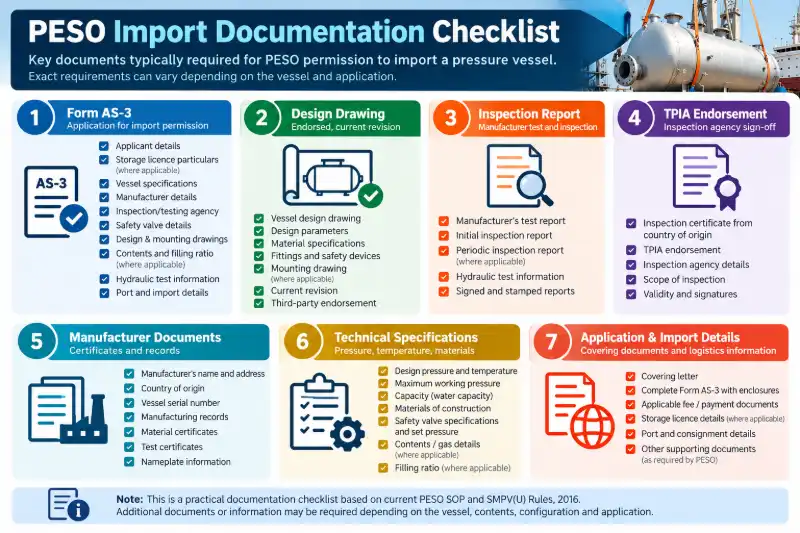
Form AS-3 is the prescribed application for permission to import a pressure vessel. Each entry should match the OEM dossier. Confirm the field list against the current form on PESO’s website.
| Requirement | What should be checked |
|---|---|
| Applicant details | Legal name and contacts match the importing entity. |
| Storage licence particulars (where applicable) | Licence number, validity and capacity, if the vessel is for a licensed installation. |
| Vessel specifications | Design pressure, temperature, capacity, material and serial number match drawing and certificates. |
| Manufacturer/fabricator | Name and country identical across drawing, nameplate and certificates. |
| Inspection/testing agency | Named agency matches the signed reports and endorsements. |
| Safety valve and set pressure | Set pressure reconciles with design pressure; Rule 18 caps it at 110% of design or maximum working pressure. |
| Design and mounting drawings | Current revision, endorsed; mounting drawing only where applicable. |
| Contents and filling ratio | True gas name; filling ratio where a liquefiable gas applies. |
| Hydraulic test information | Test pressure and date match the test certificate. |
| Port and import details | Port and consignment details match shipping documents. |
Documents Required for PESO Permission to Import a Pressure Vessel
PESO documentation for pressure vessel imports starts with what the Rules name. Gaps here can hold up PESO approval for imported pressure vessels.
Documents specifically identified by PESO
- Duly filled Form AS-3 (Rule 4(5)(a)).
- Manufacturer’s test and inspection report, plus an inspection certificate endorsed by the inspecting agency of the country of origin (Rule 4(5)(b)).
- Two copies of the design drawing showing design details, fittings and material specifications, endorsed by a third-party inspecting agency (Rule 4(5)(c)).
- Scrutiny fee under Schedule I(B), paid as Rule 11 provides (Rule 4(5)(d)).
- For imported vessels, the initial inspection certificate with the periodic inspection certificate issued by the country-of-origin TPIA is stated to be applicable (PESO SOP).
- Online submission of documents and drawings (SMPV(U) (Amendment) Rules, 2025, Rule 11A).
Supporting documents that may be required depending on the equipment/application
These are not listed in Rule 4(5) and are not universal. The Chief Controller may call for any document or drawing needed to check compliance (PESO SOP). Examples: covering letter, design calculations, material test certificates, safety-valve sizing, P&ID and mounting drawing. PESO’s ISO tank container checklist, a different vessel category, asks for TPIA-vetted calculations, safety-valve sizing and P&ID, which shows the technical backup PESO may expect. This list is not exhaustive.
Step-by-Step PESO Import Permission Process
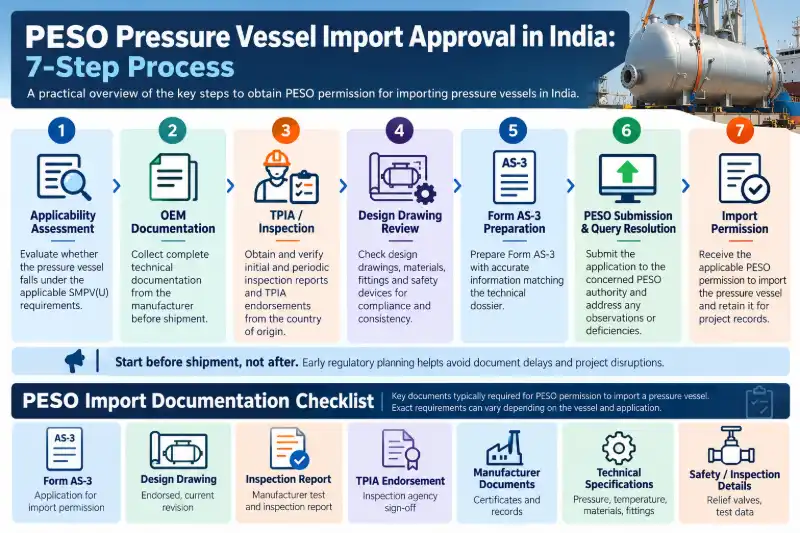
Step 1: Assess PESO Applicability
Test the vessel against the definitions, exclusions and Rule 3 above.
Step 2: Collect OEM Documentation
Obtain the complete dossier before shipment planning.
Step 3: Review Technical Documentation
Check design parameters, pressure and temperature, materials, fittings, safety devices, serial numbers, manufacturer information and drawing revision.
Step 4: Verify Inspection/TPIA Documentation
TPIA pressure vessel inspection records should be complete: inspection reports, country-of-origin endorsements and test certificates. A TPIA under the Rules is an agency recognised by the Chief Controller (Rule 2(xl-a)).
Step 5: Prepare Form AS-3
Populate every field from the verified dossier.
Step 6: Prepare and Submit Application
Submit the application, documents and scrutiny fee online (Rule 11A; PESO Online, online.peso.gov.in).
Step 7: Respond to PESO Observations
Observations may need input from the OEM, TPIA, importer and engineering team. Practical note: assign each query an owner and track replies in one register.
Step 8: Obtain Applicable Import Permission
PESO approval for pressure vessel import may end in approval, approval with conditions, or further queries. Approval and timelines cannot be guaranteed.
Step 9: Maintain Project Documentation
Keep the permission, AS-3 and dossier with the equipment records. They support later steps such as the certificate of safety (Rule 33) and periodic testing (Rule 19).
Common OEM Documentation Problems That Delay Import Approval
- Outdated design drawings or an incorrect drawing revision
- Serial numbers that differ between drawing, nameplate and certificates
- Inconsistent manufacturer names
- Pressure or temperature values that differ across documents
- Missing material specifications
- Incomplete inspection reports or missing TPIA endorsement
- Incomplete safety-valve details
- Application information that does not match OEM documents
Practical note: Many documentation problems are easier and cheaper to resolve before shipment than after the equipment has entered the project logistics chain.
ASME / International Certification vs PESO Permission
Rule 13 accepts ASME Section VIII Division 1 or 2, IS 2825, PD 5500, EN 13458, EN 13530 and AD 2000, or another code the Chief Controller accepts (Rule 13(1)). International certification is relevant, but it serves a different purpose from Indian statutory approval.
| Item | What it shows | Role in an Indian import |
|---|---|---|
| ASME/code compliance | Design and construction to a recognised code | Supports design basis (Rule 13) |
| Manufacturer certification | Manufacturer’s own certification | Part of the dossier |
| TPIA inspection | Independent inspection | Endorsements needed (Rule 4(5)(b)–(c)) |
| Test certificates | Vessel test results | Test and inspection report (Rule 4(5)(b)) |
| Design documentation | Drawings, fittings, materials | Endorsed drawing (Rule 4(5)(c)) |
| PESO import permission | Indian statutory approval | Required before import where the Rules apply (Rule 4(4)) |
PESO Permission Within a Manufacturing Plant Project
PESO compliance for pressure vessels belongs inside the project sequence:
Equipment Selection → Procurement → OEM Technical Documentation → Regulatory Applicability Review → TPIA/Inspection → PESO Application → Import → Site Receipt → Installation → Commissioning
Practical note: raise applicability during technical clarification and write vessel documents and endorsements into the purchase order. Early review reduces document delays; it does not replace PESO’s decision.
Manufacturing Project Example: Tata Semiconductor Jagiroad
PIB reports that the Tata Semiconductor Assembly and Test unit at Morigaon, Assam (Jagiroad) involves an investment of ₹27,000 crore and is expected to produce up to 48 million chips per day. This is industry context only; we make no claim about PESO applicability for any equipment. Large advanced-manufacturing projects often import complex process equipment, so early regulatory and document planning matters.
Common Project-Level Mistakes When Planning PESO Import Permission
- Starting regulatory review after the purchase order or shipment is already planned.
- Treating the equipment name alone as proof of PESO applicability.
- Failing to include required technical-document deliverables in the OEM purchase scope.
- Assuming international design-code compliance removes the need for Indian statutory approval.
- Not assigning a clear owner for coordination between the importer, OEM, TPIA and engineering team.
- Treating PESO review as a standalone regulatory task instead of integrating it into the equipment procurement schedule.
- Not retaining the final approved documentation with the equipment and project records.
PESO Pressure Vessel Import Checklist
This is a practical pre-application checklist. Exact requirements vary with the vessel and application.
Applicant
- Legal entity and contact details
- Applicable licence or approval details
Vessel/OEM
- Manufacturer and country of origin
- Vessel identification/serial number
- Technical specifications, pressure/temperature data, contents, capacity
Design
- Design drawing and revision
- Design parameters and materials
- Fittings and safety devices
Inspection & Testing
- Initial inspection report; periodic report where applicable
- TPIA documentation and test/inspection certificates
- Hydraulic test information where applicable
Application
- Covering letter and Form AS-3
- Supporting documents
- Applicable fee/payment
- Import and port details
IMARC Engineering Support
Planning to import pressure-containing equipment for a manufacturing project in India? IMARC Engineering can support regulatory applicability assessment, technical-document review, PESO application preparation, authority coordination and response to observations within the agreed scope.
Speak With Our Expert Team: https://www.imarcengineering.com/contact?service=regulatory-approval-and-licensing
FAQs
1. What is PESO permission for importing a pressure vessel in India?
It is the Chief Controller’s prior approval to import a vessel under Rule 4(4), applied for in Form AS-3. It is separate from storage and transport licences.
2. Is Form AS-3 required for pressure vessel import?
Yes, where the Rules apply; it is the prescribed import application (Rules 4(5)(a), 50(i)(c)).
3. What documents are required for PESO pressure vessel import?
Rule 4(5) lists Form AS-3, the manufacturer’s test and inspection report with origin-country inspection certificate, a third-party-endorsed design drawing and the scrutiny fee.
4. Can a pressure vessel be imported before obtaining applicable PESO permission?
Rule 4(4) says no person shall import a vessel without prior approval. Confirm with PESO and legal advisers before shipment.
5. Does ASME certification replace PESO approval in India?
No. ASME Section VIII supports the design basis under Rule 13, but prior approval under Rule 4(4) is separate.
Contact Us:
IMARC Engineering
Phone: +91-120-433-0800
Email: sales@imarcengineering.com
India: C-130, Sector 2, Noida, Uttar Pradesh 201301
LinkedIn: https://www.linkedin.com/showcase/imarc-engineering/
About the Author