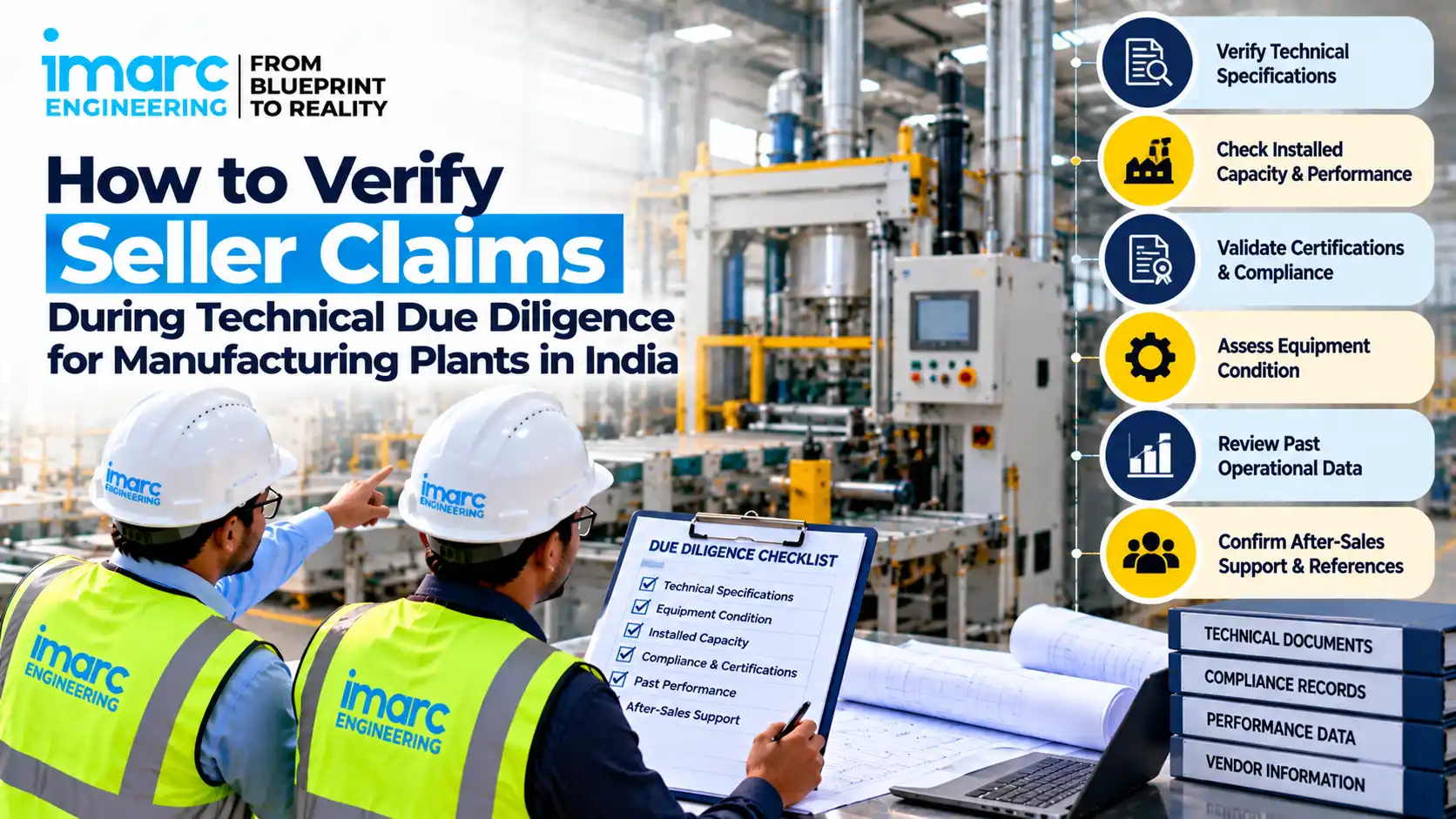
A seller’s presentation can make any plant look ready to deliver. Installed capacity, annual production, machinery condition, utility availability, maintenance status, technology and expansion potential are usually stated as settled facts. In Technical Due Diligence for Manufacturing Plants in India, none should be accepted at face value. They are claims that need to be tested against evidence.
Each claim has to be reconciled with documents, physical inspection, operating records and engineering evidence. That is the purpose of Technical Due Diligence for Investors in India: an independent, engineering-led check of whether a plant can support the revenue and CapEx assumptions in the deal model.
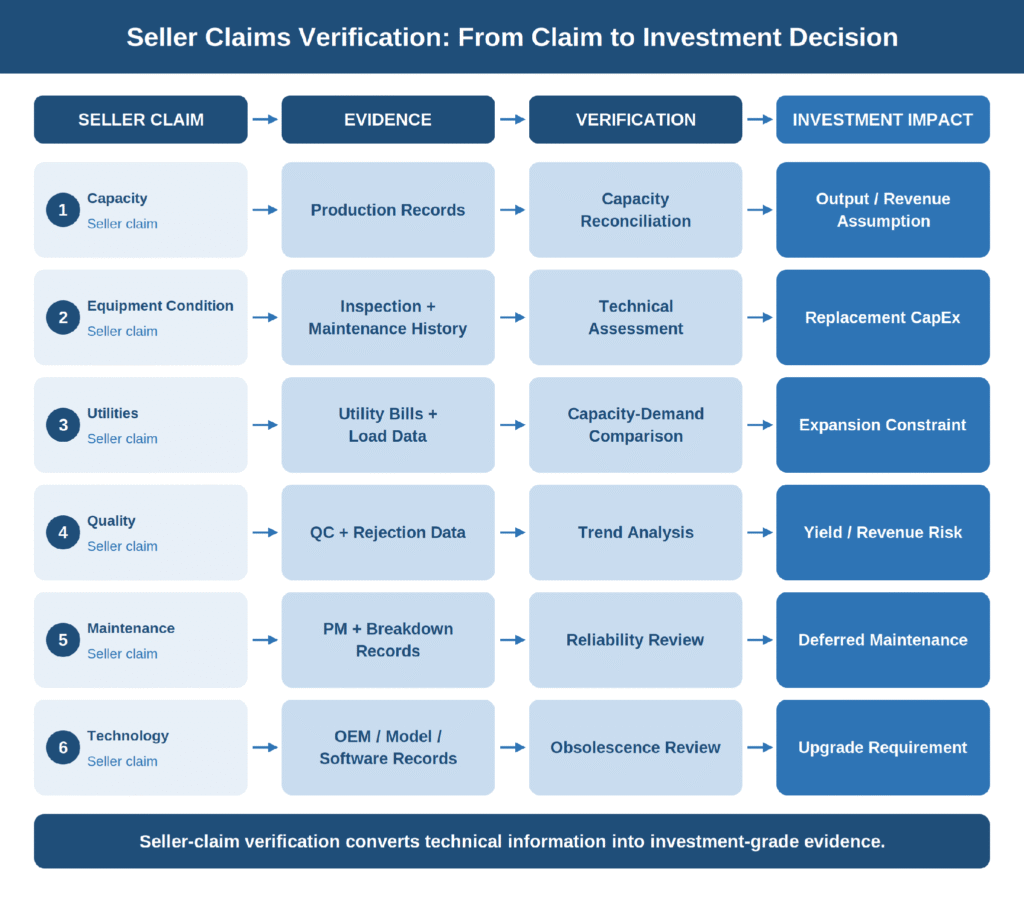
IMARC Engineering approaches this as one chain: seller claim, evidence, verification, investment impact.
Why Seller Claims Need Independent Verification
Seller presentations carry high-level figures that are often incomplete. Five gaps appear repeatedly:
- Installed capacity is not sustainable output. Nameplate capacity reflects design conditions, not month-after-month delivery.
- Utilities can cap production. Power, steam or compressed air may not support full-rated operation.
- Maintenance backlog is hidden CapEx. Postponed overhauls become the buyer’s cost after closing.
- Quality losses reduce saleable output. Rejection and rework shrink what can actually be invoiced.
- Obsolete technology creates future investment. Unsupported controls or discontinued models eventually need replacing.
What to Verify in Technical Due Diligence for Manufacturing Plants in India
This quick map matters because each row links a seller statement to a figure the buyer will rely on for revenue, price or capital budget.
| Seller Claim | What to Verify | Evidence to Check |
|---|---|---|
| Installed capacity | Actual/effective capacity | Production records, equipment data |
| Production output | Sustained historical output | Monthly production records |
| Equipment condition | Current operating condition | Physical inspection, maintenance history |
| Equipment age | Remaining useful life | Asset register, OEM records |
| Utility capacity | Actual available capacity | Electricity, water, steam, compressed-air data |
| Maintenance status | Deferred maintenance | Maintenance logs, breakdown history |
| Technology capability | Current technology relevance | OEM documentation, process review |
| Quality performance | Rejection/rework levels | QC records, customer complaints |
| Expansion potential | Technical constraints | Site/layout/utilities assessment |
| Future CapEx | Required upgrades/replacements | Engineering assessment |
Step-by-Step Seller Claims Verification Framework
4.1 Build a Seller Claims Register
Record every material seller statement, wherever it appears, so each claim stays traceable. Columns can include: seller claim, source, supporting document, verification method, site evidence, verification status and risk if the claim is incorrect.
4.2 Verify Production Capacity
Use terms precisely. Nameplate capacity is the manufacturer’s stated rating. Installed capacity is what is physically in place. Rated capacity is achievable under defined conditions. Actual production is what was made; sustainable production is what can be repeated without strain.
The gap between installed capacity and actual production depends on utilisation, operating pattern, bottlenecks, downtime and product mix, so it must be explained, not assumed. Test the claim against production records, operating hours, shifts, product mix, bottlenecks, downtime, equipment availability and quality or rejection losses.
4.3 Verify Equipment Condition
Confirm age, OEM and model on the machine itself, not just the asset register. Review operating history, maintenance and refurbishment records, breakdown frequency, critical spares, obsolete components, inspection records and OEM support. Worn or poorly supported equipment brings replacement CapEx and reliability risk early in ownership.
4.4 Verify Utility and Infrastructure Claims
Check electrical load, transformers and substations, water, steam, compressed air, HVAC, cooling systems, fire protection and waste treatment against actual demand. Equipment may look sufficient on paper while utilities become the real bottleneck, which also limits expansion.
4.5 Verify Maintenance and Reliability Claims
Ask for preventive maintenance records, breakdown history, backlog, critical equipment failures, major repairs, replacement requirements and spare-parts availability. Where reliable history exists, derive reliability indicators from it; where it does not, treat the gap as a finding.
4.6 Verify Quality and Process Performance
Volume alone proves little. Gross production includes material later scrapped, reworked or returned; saleable production is what customers accept. Review rejection, rework, scrap, complaints, returns, process deviations, QC and testing records over time.
4.7 Verify Technology and Obsolescence Risk
Assess technology generation, OEM support, spare availability, control-system and software support, obsolete components, replacement lead times, compatibility and upgrade requirements. Obsolescence raises future CapEx and threatens continuity when a critical part cannot be sourced.
4.8 Cross-Check Documents Against Site Reality
Work through four layers in order: documents, physical assets, actual operations, historical records. For example:
- Asset register vs physical machines
- Production reports vs actual production records
- Maintenance reports vs physical inspection
- Utility data vs installed utility capacity
- Seller presentation vs historical operating data
Seller Claims Verification: From Claim to Investment Decision
How to Handle Conflicting Seller Data
Illustratively, a seller presentation states 100,000 units a year while production records show 72,000. This is not automatically misrepresentation. Check the reporting period, installed versus actual capacity, shift pattern, product mix, shutdown periods, bottlenecks, downtime, rejection or rework and utility limitations. Then classify the claim:
- Verified: evidence supports the claim; use it in the assessment.
- Partially verified: only part is supported, such as a rate reachable but not sustainable. Use the supported value.
- Not verified: evidence is insufficient. Keep it out of base-case assumptions until proven.
- Contradicted: evidence conflicts with the claim. Correct the assumption and flag the risk.
Red Flags During Seller Claims Verification
These are indicators that need further investigation, not proof of wrongdoing.
- Capacity supported only by nameplate data
- Large unexplained gap between installed and actual output
- Old equipment with limited OEM support
- Repeated unexplained breakdowns
- High rejection or rework
- Utility capacity based only on old design data
- Recent major repairs not disclosed
- Critical equipment missing from the asset register
- Future CapEx requirements not quantified
- Conflicting information between documents and site inspection
How Verification Findings Affect the Investment Decision
Findings flow into purchase price discussions, valuation assumptions, acquisition CapEx, production forecasts, integration planning, deal conditions, warranty and indemnity discussions, and post-acquisition improvement plans. A partially verified capacity enters the forecast only at the verified level.
The result is a documented technical basis that the deal team can use when reviewing valuation assumptions, CapEx requirements, negotiations and transaction conditions.
India Manufacturing Context: What Official Data Shows
According to the Ministry of Commerce & Industry, via PIB, as of 31 March 2026, PLI schemes across 14 sectors had resulted in actual investment of over ₹2.40 lakh crore and generated over 14.15 lakh direct and indirect jobs. Cumulative exports reported under the PLI schemes had also exceeded ₹15.2 lakh crore. These figures cover PLI-supported sectors rather than the entire manufacturing industry, but they indicate the scale of manufacturing investment and capacity expansion in India.
Practical Seller Claims Verification Checklist
- Seller claims are documented and traceable.
- Installed and actual capacity are separately verified.
- Production records are reconciled with claimed output.
- Critical equipment is physically inspected.
- Equipment age and maintenance history are verified.
- Utility capacity is checked against actual demand.
- Quality and rejection data are reviewed.
- Technology obsolescence risks are assessed.
- Deferred maintenance is quantified and its potential cost is estimated.
- Required future CapEx is identified.
- Contradictory seller information is investigated.
- Findings are linked to investment and valuation decisions.
How IMARC Engineering Can Help
IMARC Engineering works as an engineering and technical partner for manufacturing investment decisions. Its technical due diligence support covers:
- Independent technical assessment
- Seller-claim verification
- Equipment and capacity assessment
- Operational review
- Utility and infrastructure assessment
- Technical risk identification
- Future CapEx identification
- Acquisition decision support
If you are evaluating an existing manufacturing plant for acquisition, IMARC Engineering can support the technical assessment, seller-claim verification and identification of equipment, utility and future CapEx risks.Explore Technical Due Diligence for Investors : https://www.imarcengineering.com/contact?service=technical-due-diligence-for-investors
Conclusion
Seller claims are inputs to be verified, not final technical evidence. Sound Technical Due Diligence for Manufacturing Plants in India establishes what the plant can actually deliver, what condition its assets are in, what constraints exist, and what additional investment may be required.
Frequently Asked Questions
What is seller claims verification in technical due diligence?
It tests seller statements on capacity, output, equipment, utilities, maintenance, quality and technology against documents, site inspection and operating records. Each claim is then classed as verified, partially verified, not verified or contradicted, showing which figures are safe to use in valuation, which are only partly reliable and which need further work.
How do you verify manufacturing plant production capacity?
Reconcile nameplate and installed capacity with monthly production records, operating hours, shifts, product mix, downtime, bottlenecks and rejection losses. Compare the result with equipment availability and utility limits. The outcome is an effective, sustainable capacity figure, not a rated one, which can then support revenue forecasts and capacity-based valuation assumptions.
What documents are checked during technical due diligence of a manufacturing plant?
Typically the asset register, production and dispatch records, maintenance logs, breakdown history, OEM documents, utility bills and load data, QC and rejection records, customer complaints, plant layout and CapEx history. The list varies by sector and is always matched against what is physically found on site.
Why is equipment condition important during plant acquisition?
Equipment condition determines output reliability and near-term CapEx. Ageing machines, deferred maintenance or weak OEM support can mean replacement spending soon after closing. Finding this early lets the buyer adjust price, forecasts or deal conditions instead of absorbing unexpected costs after the transaction closes and the plant is operating.
How does technical due diligence affect manufacturing plant acquisition decisions?
Technical due diligence for manufacturing plants in India turns seller claims into tested findings. These can change the price, revenue forecast, CapEx budget, deal conditions and warranty or indemnity terms, or support a decision to proceed unchanged or withdraw. It reduces reliance on seller-supplied numbers and gives negotiations a documented technical basis.
Contact Us:
IMARC Engineering
Phone: +91-120-433-0800
Email: sales@imarcengineering.com
India: C-130, Sector 2, Noida, Uttar Pradesh 201301
LinkedIn: https://www.linkedin.com/showcase/imarc-engineering/
About the Author