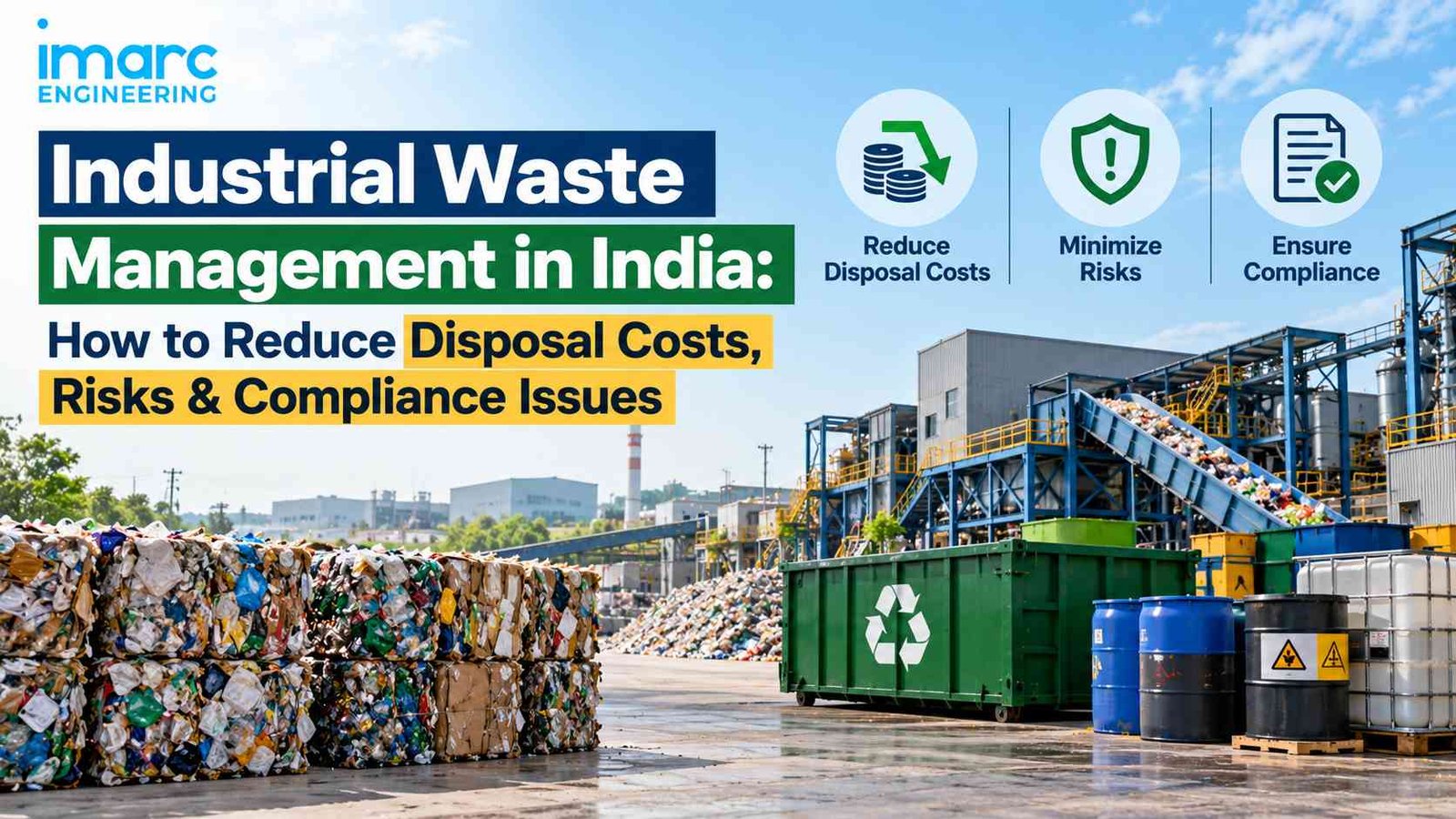
For Indian manufacturers, waste is no longer a back-of-plant concern. It is a cost line, a compliance line and a closure risk at the same time. The 2026 rulebook has tightened all three: the Hazardous and Other Wastes Amendment Rules, 2025 took effect on 1 April 2026 with a CPCB online portal for registration, returns and EPR certificates, and the Plastic Waste Management (Amendment) Rules, 2026 were notified on 31 March 2026.
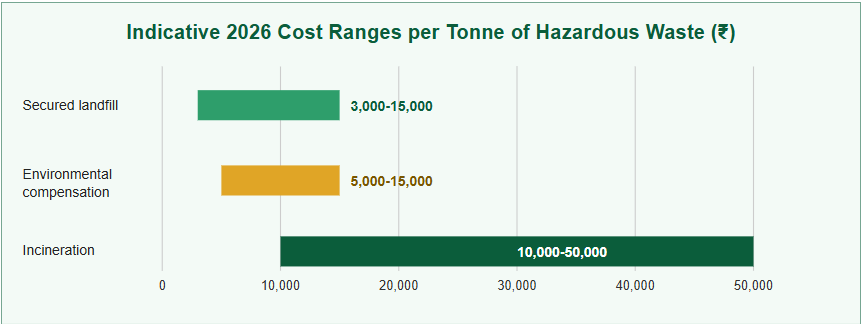
Disposal economics deserve equal attention. Indicative 2026 charges at common facilities run from ₹3,000 to ₹15,000 per tonne for secured landfill and ₹10,000 to ₹50,000 per tonne for incineration. Systems retrofitted after commissioning typically cost 2-4 times their design-integrated equivalent, so late decisions are expensive decisions.
A planned approach to industrial waste management in India addresses all three pressures together. This guide explains what drives disposal costs, how to reduce them and which compliance rules apply today.
What Drives Industrial Waste Disposal Costs?
Disposal costs are driven mainly by how waste is classified, mixed and routed, not only by how much is generated.
- Poor characterisation: unmeasured streams lead to over-specified plants or non-compliant ones.
- Stream mixing: blending hazardous and non-hazardous waste turns a cheap stream into an expensive one.
- Route choice: incineration costs up to 3-4 times more per tonne than secured landfill at the upper end of the range.
- Late design: waste systems added after process design is frozen need larger footprints and higher capex.
- Penalties: CPCB environmental compensation for unaccounted hazardous waste is indicatively ₹5,000-15,000 per tonne.
How Can Manufacturers Reduce Waste Disposal Costs?
The most reliable savings come from decisions made before the plant is built, not from negotiating disposal rates afterwards. IMARC Engineering’s 2026 planning guidance notes that design-stage sustainability choices typically yield 15-30% lower lifecycle costs than compliance-only approaches.
- Characterise first: allow 4-8 weeks to measure flow, BOD, COD, TSS, TDS and hazard class for every stream.
- Segregate at source: keep hazardous residues separate so only the smallest volume reaches costly disposal routes.
- Prefer recovery routes: co-processing in cement kilns and CPCB-authorised recycling can turn disposal cost into recovered value.
- Reuse treated water: well-designed Zero Liquid Discharge systems recover 90-98% of water.
- Use shared infrastructure: CETPs and CTSDFs in organised estates lower individual facility costs.
- Recover by-products: metals, chemicals and sludge value offset operating costs.
Shared infrastructure deserves a closer look for smaller generators. Common treatment facilities spread capital and operating cost across many units, which suits plants whose volumes do not justify a dedicated incinerator or secured landfill. Even then, the generator remains accountable for accurate classification, manifests and authorised transporters, so contracts with common operators should be reviewed as carefully as the technology itself.
Which Compliance Rules Apply to Industrial Waste in 2026?
Industrial waste sits under material-specific rules, not under one law. The Solid Waste Management Rules, 2026, effective 1 April 2026, replaced the 2016 rules but continue to exclude industrial and hazardous waste, which stay under their own regimes.
- Hazardous waste: authorisation under Rule 6 from the State Pollution Control Board, storage limited to 90 days and annual Form 4 returns due by 30 June.
- Sector standards: CPCB has notified standards for 17 categories of highly polluting industries, and ZLD is mandatory for several, including distilleries and textile dyeing.
- EPR: plastic, e-waste and battery producers register with CPCB, and in September 2026 CPCB called on companies covered by the plastic rules to register on the common EPR portal.
- Monitoring: CEMS and CEQMS are mandatory in many sectors, with data transmitted to CPCB.
- Approvals: Environmental Clearance, Consent to Establish and Consent to Operate come before and after construction.
What Does Each Waste System Cost and Require?
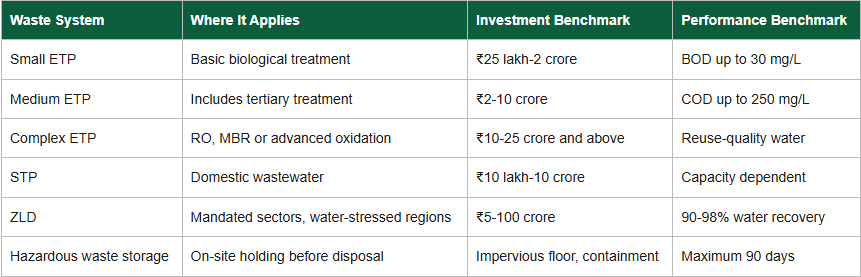
Planning stages also need calendar space. Basic engineering takes 8-14 weeks, detailed engineering 16-24 weeks, and approvals plus construction 18-36 months.
How Should Plants Plan the Waste System Step by Step?
A structured sequence keeps cost and compliance decisions in the right order. IMARC Engineering’s planning workflow runs from measurement to approvals, and each stage feeds the next.
- Waste characterisation (4-8 weeks): quantify streams, volumes, composition and hazards.
- Regulatory mapping (3-6 weeks): list applicable rules, standards and authorisations.
- Technology selection (6-10 weeks): compare treatment pathways, redundancy and footprint on a techno-commercial basis.
- Engineering and approvals: integrate waste streams into process flow diagrams, then sequence CTE, CTO and hazardous waste authorisation.
Selection should weigh waste concentration, regulatory targets, site constraints, capex against opex, operator skill and reliability under Indian operating conditions. Defaulting to a familiar technology is a common source of both overspending and non-compliance.
What Compliance Risks Should Plants Avoid?
Non-compliance is far costlier than prevention. Closure directions under Section 5 of the Environment Protection Act, revocation of consent, criminal proceedings against directors and heavy tribunal action are the main exposures.
- Deferring design: starting waste engineering after process design is frozen.
- Assumed data: sizing plants on estimated rather than measured waste characteristics.
- Untrained operators: well-built systems underperform without trained staff and written SOPs.
- Reactive compliance: waiting for inspection notices instead of monitoring beyond statutory minimums.
- Ignoring value: treating waste only as a cost and missing reuse and recovery.
Monitoring discipline also protects cost. Daily checks, monthly analytical testing and online monitoring for critical parameters let operators correct drift before a discharge breach becomes a notice. Digital tracking of manifests and annual returns reduces administrative effort and gives plants an audit-ready record when SPCB or CPCB inspectors visit.
How IMARC Engineering’s Expertise Can Help in Industrial Waste Management
- Waste characterisation and regulatory mapping for wastewater, solid, hazardous and air streams.
- ETP, STP and ZLD technology selection matched to sector norms and site constraints.
- Hazardous waste planning, including authorisation, storage design and TSDF routes.
- Coordination of Environmental Clearance, CTE, CTO and EPR registrations.
- Commissioning support and ongoing compliance advisory for greenfield and brownfield plants.
Connect With Our Team: https://www.imarcengineering.com/contact?service=waste-management-system-planning
Conclusion
Lower disposal costs and stronger compliance come from the same discipline: measure waste early, design the system alongside the process and route every stream to its cheapest lawful pathway. With the 2026 rules now in force and CPCB moving registrations online, documentation gaps are visible faster than before. Manufacturers that treat waste as an engineered asset, not an afterthought, protect margins and licences together.
Frequently Asked Questions
What is industrial waste management?
It is the planned handling of wastewater, solid, hazardous and air waste from a plant, covering characterisation, segregation, storage, treatment and disposal under CPCB and SPCB rules.
How can a plant reduce hazardous waste disposal costs?
Segregate streams at source, prefer recycling or co-processing over incineration, reuse treated water and design the system during basic engineering.
How long can hazardous waste be stored on site?
A maximum of 90 days from generation before disposal or authorised transfer.
When is Zero Liquid Discharge mandatory?
For several CPCB-notified sectors, including distilleries, textile dyeing and specific chemical processes. It recovers 90-98% of water.
Contact Us:
IMARC Engineering
Phone: +91-120-433-0800
Email: sales@imarcengineering.com
India: C-130, Sector 2, Noida, Uttar Pradesh 201301
LinkedIn: https://www.linkedin.com/showcase/imarc-engineering/
About the Author