Incorporating a Manufacturing Company
Company incorporation gives a manufacturing venture its legal identity, but it does not make the underlying project ready. A promoter can complete incorporation and still have unresolved questions about the product, ownership, factory location, approvals, capital requirement, utilities, equipment, or workforce.
For a manufacturing business, these decisions are connected. The product influences the process. The process influences equipment and utilities. Capacity affects the site and capital requirement. Location affects approvals, logistics and operating costs. Ownership and funding influence the appropriate company structure.
Planning company incorporation for manufacturing business ventures takes far less time than planning, building and commissioning a factory. This guide covers eight connected decisions to work through first: product, process, capacity, location, approvals, capital, organisation, and company structure.
Define What You Will Manufacture
Your product shapes regulations, equipment, utilities, and site needs. A food processor, a chemical producer, and an electronics assembler can all be private limited companies, yet their plants have little in common.
- What exactly will you make, and by what process?
- Will you manufacture in-house, outsource, or use contract manufacturers?
- Will you sell domestically, export, or both?
Define the activity clearly enough that your MOA objects and NIC code accurately match your intended business. MCA’s incorporation guidance requires consistency between the SPICe+ information, the MOA objects, and the NIC classification.
Estimate the Production Capacity You Actually Need
Capacity is one of the most consequential manufacturing decisions, yet it is often left vague. It drives the chain of equipment → building → utilities → manpower → CAPEX → working capital → site → approvals.
Work out the capacity you need at launch and the capacity you may need after expansion. A plant planned for today’s volume only can become a constraint within a few years.
Settle Ownership, Funding and Investment Plans
Shareholding. Agree who the shareholders are, what each contributes, and what happens if investors join later. Founders, promoter groups, strategic investors, and JV partners expect different levels of control, and casual percentages are hard to unwind once capital arrives.
Share capital is not project funding. A rough project requirement looks like this:
Land + building + plant and machinery + utilities + installation + pre-operative expenses + working capital + contingency
The incorporation documents establish the company’s capital structure; they do not, by themselves, establish whether the manufacturing project is adequately funded.
Foreign involvement. Foreign investment in manufacturing is generally permitted up to 100% under the automatic route, subject to the applicable FDI policy, sector-specific conditions and FEMA requirements. Check your specific activity before finalising the ownership structure.
View Related Insight
Choose a Company Structure for the Next 3–5 Years
Instead of asking “Private Limited or LLP?”, ask what the business will need as it grows.
- Founder-funded, modest capital: a simpler structure may be enough.
- Multiple promoters: you need clear ownership and exit mechanics.
- Outside investors or institutional lenders: assess the ownership, governance and financing structure they are likely to require.
- Foreign partners: check FDI and FEMA requirements first.
- Planned expansion: consider how future equity or debt will come in.
Don’t choose a structure just to qualify for MSME benefits. Udyam classification is based on the applicable investment and turnover criteria, so check the current thresholds and calculation rules on the official Udyam portal before relying on MSME status for planning. A chartered accountant or company secretary should confirm the final choice.
Separate the Registered Office From the Factory Site
The registered office serves a corporate and legal function, while the manufacturing site must satisfy operational, infrastructure and location-specific requirements.
The registered office handles official communication, records and administration, and it must be verified within 30 days of incorporation under the Companies Act. MCA’s guidance highlights common problems:
- Address mismatch
- Incomplete utility bills
- Missing NOC from the property owner
- Inconsistent rent or lease documents
The plant site is a separate decision, covered next.
Evaluate the Manufacturing Site Before Committing
Assess the factory location on engineering grounds:
- Land: industrial zoning, clear title, lease versus purchase
- Power: connected load, reliability, tariff
- Water: process and utility demand
- Effluent and waste: treatment and disposal routes
- Logistics: highway access, raw-material inflow, dispatch
- Labour: availability of skilled and unskilled workers
Cheap land can become expensive if power is unreliable, water is scarce, or trucks struggle to reach it.
A useful site-selection test
If production doubles five years from now, can the same site support the expansion?
Check for room for additional building area, power capacity, utility expansion, material movement, storage, effluent treatment capacity, fire systems, and future equipment.
View Related Insight: https://www.imarcengineering.com/blog/how-to-register-a-foreign-company-in-india
Map Regulatory Approvals Before Project Execution
Required approvals depend on your product, process, location, capacity, utilities, workforce, and environmental impact. There is no universal sequence.
The objective at this stage is not to obtain every approval. It is to identify which approvals are likely to affect your site, plant design, project schedule or operating model.
India’s National Single Window System offers a Know Your Approvals tool that gives an indicative list of central and state approvals, and it separates pre-establishment from pre-operation approvals. NSWS itself notes that the list is guidance, so verify applicability independently.
| Area | Ask before incorporating |
| Corporate | Which entity type fits the plan? |
| Factory and labour | Which factory and labour rules apply? |
| Environment | Are pollution consents or clearances needed? |
| Fire | What is the NOC pathway? |
| Power and water | What load, source, and permissions are required? |
| Product standards | Do BIS, FSSAI, or other rules apply? |
| Import/export | Is an Importer Exporter Code needed? |
Product choice can affect plant design. BIS notes that certification is generally voluntary, but Quality Control Orders make it mandatory for certain products, and manufacturers must show suitable infrastructure, process controls, and testing capability.
Build a Preliminary Project Cost and Feasibility Model
The aim here is not a final DPR or lender-ready financial model. It is to determine whether the manufacturing concept is commercially and operationally viable enough to proceed.
- CAPEX: land, site development, building, machinery, utilities, electrical, HVAC, effluent treatment, installation, engineering, contingency
- OPEX: raw materials, labour, power, fuel, water, maintenance, packaging, logistics, testing
- Working capital: inventory, receivables, payables, cash buffer
- Revenue assumptions: capacity utilisation, selling price, product mix, domestic versus export split
If the numbers don’t work on paper, it is far cheaper to find out before the company and site are committed.
Plan Production, Quality, Utilities and Workforce
Production concept. Work through the chain in order: product → process → capacity → equipment → layout → utilities → manpower. Incorporation sits alongside these decisions, not above them.
Quality. Decide what testing, incoming inspection, traceability, and calibration your sector demands. For regulated sectors such as food manufacturing, licensing requirements can extend into facility layout, equipment, process and water-quality documentation.
Workforce. Estimate production, engineering, quality, and support roles early. Also account for the labour compliance framework applicable to your establishment. India’s four Labour Codes took effect on 21 November 2025, rationalising 29 central labour laws, and specific obligations still depend on the establishment, workforce and applicable rules.
Imports. If the business will import machinery, raw materials or components, check IEC requirements early. An IEC is generally required for import/export activities, subject to specified exemptions. Allow for customs, duties, lead times, and supplier qualification.
Seven Mistakes to Avoid Before Incorporating
- Incorporating before defining the manufacturing activity
- Choosing a site on land price alone
- Treating the registered office and plant as one decision
- Agreeing shareholding casually
- Writing generic MOA objects
- Skipping sector-specific approval checks
- Treating incorporation as the entire project plan
The last one matters most. Incorporation creates the legal entity. It does not answer whether the product, process, site, utilities, approvals, funding and plant design are viable.
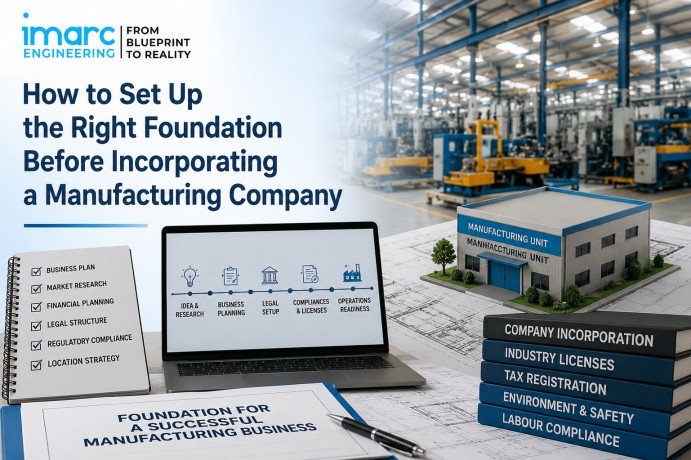
Pre-Incorporation Manufacturing Readiness Checklist
- Product, process, and capacity defined
- Business objects and proposed NIC classification aligned with the intended activity
- Promoters and shareholding agreed
- Funding requirement estimated
- Registered office and plant site shortlisted
- Power, water, and logistics checked
- Future expansion requirement considered
- Approvals mapped for your product and state
- CAPEX, OPEX, and working capital estimated
- Quality and manpower needs outlined
- Import/export needs identified
How IMARC Engineering Can Help
IMARC Engineering helps entrepreneurs align company incorporation with the wider requirements of a manufacturing project. Our team supports feasibility assessment, site evaluation, process-flow and plant-layout planning, utility assessment, preliminary CAPEX estimation, regulatory mapping, equipment planning and vendor identification. For projects moving into execution, we also support greenfield setup and brownfield expansion.
Speak With An Expert: https://www.imarcengineering.com/contact?service=company-incorporation
Conclusion
Incorporation gives your venture a legal identity, but the plant is what the company exists to run. The better sequence is to define the manufacturing project first, identify the decisions that affect the entity, and then incorporate a company that can support the project as it grows. Work through the checklist, verify current sector and state requirements, and take professional advice on decisions that are hard to reverse.
Contact Us:
IMARC Engineering
Phone: +91-120-433-0800
Email: sales@imarcengineering.com
India: C-130, Sector 2, Noida, Uttar Pradesh 201301
LinkedIn: https://www.linkedin.com/showcase/imarc-engineering/
About the Author