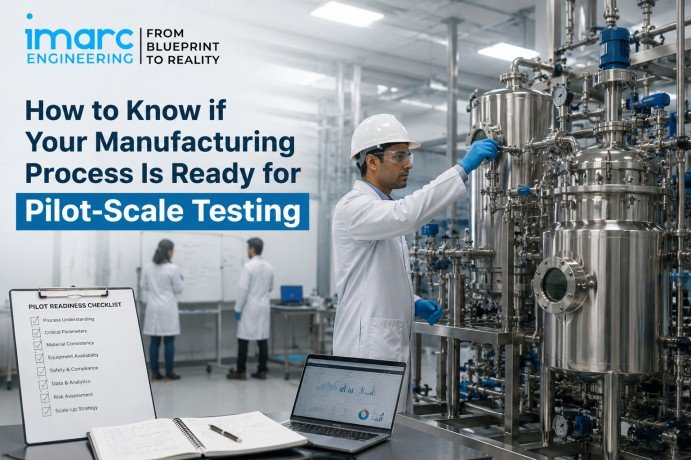
Pilot-Scale Testing Readiness
A process produces the expected product at 5 litres. Yield is acceptable, quality meets the required specification, and the R&D team believes the process is ready to scale. Yet several questions remain open. Will heat removal still work in a larger vessel? Will mixing remain effective? What happens when raw material quality varies?
Laboratory success proves that a process can work. Readiness for pilot-scale testing is different: it means you understand the process well enough to use a pilot trial for learning, not for discovering whether the process works at all. This guide helps you judge which side of that line your process sits on.
What Does Ready for Pilot-Scale Testing Mean?
A process is ready when the pilot is designed to answer defined questions rather than to find out whether the basic route works. The chemistry, formulation, or manufacturing route should already be demonstrated. What remains uncertain should be clearly identified, whether it involves scale-dependent behaviour such as heat and mass transfer, mixing and residence time, or questions around utilities, raw material variability and process robustness.
Readiness does not require perfection. It requires that your unknowns are identified, so the pilot can be planned to resolve them. No universal threshold, such as a fixed number of successful batches or a minimum yield, applies to every process. Readiness is process-specific and risk-based.
Start With the Question the Pilot Must Answer
Before assessing readiness, write down why the pilot is being built. Useful objectives are specific:
- Can reaction temperature be controlled at larger volume?
- How does mixing performance change with vessel size?
- What are the actual steam, cooling water, and power requirements?
- What limits throughput?
- How much does input quality affect output quality?
Define the decision the results will support. A pilot may determine whether the process is ready for detailed engineering, whether further development is required, or whether commercial equipment assumptions need to change. If you cannot list such questions and decisions, your objective is probably just “scale-up”, which is too vague to guide equipment choices, measurements, or go/no-go decisions.
Agree go/no-go criteria in advance. For example, decide what temperature deviation, yield loss, or cycle time would trigger further laboratory work before the next trial. Setting these limits early prevents results from being interpreted to fit expectations.
Eight Signs Your Process Is Ready
1. The Basic Process Works Repeatably
The process route, main steps, operating conditions, preliminary yield, known failure modes, and a basic material balance should be documented. Documenting where the process fails is as valuable as documenting where it succeeds. One successful experiment is not enough. The team should know why it worked and which conditions reproduce it. The key question is whether you are scaling a known process or still trying to make it work.
2. Success Is Defined in Measurable Terms
Set acceptance criteria before the trial: purity, moisture, particle size, viscosity, yield, cycle time, and energy use, as relevant to your product. “The batch worked” is not a criterion. A batch can meet product specifications while the underlying process remains poorly understood or sensitive to operating variation, so define process performance targets alongside product quality targets.
3. You Know Which Parameters Matter
Temperature, pH, feed rate, agitation, and residence time do not matter equally in every process. The team should have a preliminary view of which inputs materially change outputs, and which key or potentially critical process parameters need tighter control. Knowing that a process runs at 80°C is not the same as knowing it performs reliably between 75°C and 85°C.
4. Raw Material Variability Has Been Considered
Laboratory work often uses consistent, carefully selected materials. Commercial supply can vary by supplier, lot, moisture, particle size, purity, or impurities, depending on the material. This matters especially for manufacturers sourcing from several suppliers. If variability is not yet understood, include it as a deliberate pilot objective rather than discovering it during commercial start-up.
5. Scale-Dependent Behaviour Has Been Identified
Scaling volume is not the same as scaling a process. A small vessel can have a more favourable surface-area-to-volume relationship for heat removal; as vessel size increases, that relationship changes and heat-transfer requirements can become more demanding. Likewise, increasing agitator speed proportionally does not guarantee identical mixing. Identify what physically controls your process, whether mixing, heat transfer, mass transfer, or drying rate, because the right scale-up criterion depends on it.
6. Your Analytical Methods Can Tell Good Batches From Bad
If your measurements cannot reliably detect differences in quality, pilot results become hard to interpret. Confirm that test methods are sufficiently repeatable, reliable, and sensitive to detect meaningful changes in product or process performance. A pilot run produces expensive data, and unreliable measurement wastes it.
7. Equipment and Utility Questions Are Defined
Ask which utility requirements are uncertain enough that the pilot should measure them: steam, cooling water, electricity, compressed air, nitrogen, vacuum, and waste handling. Also confirm that pilot equipment represents the relevant physical conditions of the commercial plant, not merely a smaller volume. It does not need to be geometrically identical to commercial equipment; it needs to reproduce the conditions relevant to the scale-up question, such as mixing regime, heat-transfer behaviour, residence time, or drying conditions. Relevant safety risks should be identified at this stage too.
8. There Is a Plan to Use the Data
Know in advance where results will go: material and energy balances, equipment sizing, utility loads, control philosophy, and CAPEX and OPEX estimates. Plan the analysis before the first run, not after it. If the project team cannot explain how pilot data will influence the commercial design, the objectives need refinement.
View Related Insight: https://www.imarcengineering.com/blog/how-to-set-up-pilot-plant-in-india
The Readiness Criteria Depend on the Process
Readiness is not identical across industries. Consider what matters most in each case:
- Chemical processes: reaction kinetics, heat removal, mixing, residence time.
- Food processing: formulation consistency, thermal treatment, viscosity, hygiene.
- Pharmaceuticals: critical quality attributes, analytical methods, material variability, GMP requirements.
- Bioprocessing: oxygen transfer, agitation, shear, mass transfer, biological performance.
- Drying operations: moisture profile, drying rate, airflow.
Warning Signs That Your Process Is Not Yet Pilot-Ready
- “It worked once in the lab.” A single result says nothing about variability or reproducibility.
- The objective is simply “scale-up”. Replace it with measurable questions.
- Commercial equipment is already specified. Sizing equipment before generating scale-up data means designing around assumptions.
- No operating window exists. Only one set-point is known.
- Analytical methods are unproven. Batch differences cannot be detected reliably.
- Raw materials are laboratory-grade only. Real supply conditions have not been considered.
- Safety hazards are unidentified. Exothermic behaviour, pressure build-up, or hazardous by-products have not been reviewed.
A Quick Pre-Pilot Checklist
Answer these honestly before committing budget:
- Has the process demonstrated sufficiently repeatable performance at bench scale?
- Are product specifications and pilot success criteria defined?
- Are the main process variables and likely key parameters identified?
- Has raw material variability been considered?
- Are scale-dependent phenomena identified?
- Are preliminary utility requirements and relevant safety risks identified?
- Will pilot equipment answer the questions being asked?
- Is there a plan for analysing and applying the data?
A “no” does not mean stop. It identifies a knowledge gap to resolve beforehand or to include as a pilot objective.
What a Pilot Trial Should Establish
A well-planned pilot produces more than a successful batch. It should establish:
- Process behaviour: whether performance stays predictable and repeatable at larger scale.
- Product quality and yield: whether specifications and yield remain acceptable across repeated runs.
- Equipment performance: whether the selected equipment performs its intended function.
- Utility demand: measured steam, cooling water, power, and gas consumption.
- Sensitivity: how strongly raw material and operating variation affect results.
- Constraints: what limits throughput, and what must change in the commercial plant.
If the pilot cannot produce these answers, the trial design, not only the process, deserves review.
Pilot-Ready Does Not Mean Commercial-Ready
Readiness for a pilot is only one stage in a longer path: laboratory success, pilot readiness, pilot validation, manufacturing readiness, and commercial production. A successful pilot does not automatically prove commercial viability. It shows how the process behaves at intermediate scale and generates the evidence needed for the next decision, such as equipment selection, investment approval, or further development. Commercial readiness also depends on factors such as production economics, supply-chain reliability, regulatory requirements, facility design, and the ability to operate the process consistently at the intended production rate.
How IMARC Engineering Can Help
IMARC Engineering helps manufacturers determine whether a process is ready for pilot-scale testing and plan trials around clearly defined engineering questions. Our team supports process assessment, pilot objectives and test planning, equipment selection, pilot plant engineering, commissioning, and trial evaluation. We assess process performance, yield, energy and utility requirements, equipment behaviour, and scale-up constraints, then translate the findings into inputs for commercial plant design. This includes equipment sizing, utility requirements, CAPEX and OPEX considerations, and recommendations for further process development.
Speak With An Expert: https://www.imarcengineering.com/contact?service=pilot-plant-setup-and-evaluation
Conclusion
A process is ready for pilot-scale testing when it is understood well enough for the pilot to be a controlled learning exercise rather than an expensive experiment. The goal is not a larger batch. It is reliable evidence about process behaviour, variability, equipment performance, utilities, and product quality that supports the next investment decision. Gaps simply need closing. Define the questions first, design the pilot around them, and use the results to make the next engineering decision with greater confidence.
Contact Us:
IMARC Engineering
Phone: +91-120-433-0800
Email: sales@imarcengineering.com
India: C-130, Sector 2, Noida, Uttar Pradesh 201301
LinkedIn: https://www.linkedin.com/showcase/imarc-engineering/
About the Author