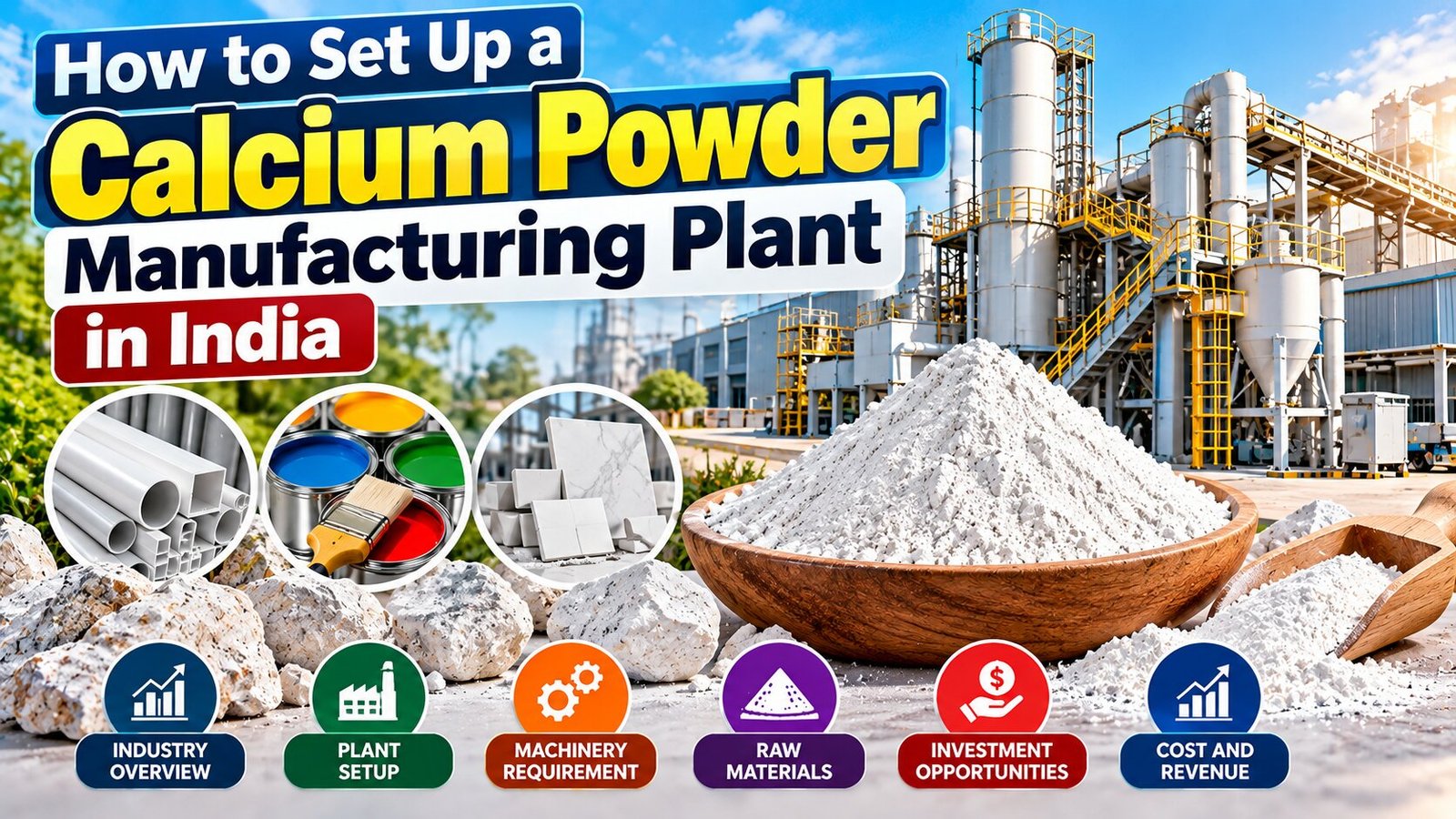
Setting up a calcium powder manufacturing plant in India presents a compelling investment case, driven by demand from the construction, agriculture, animal feed, plastics & rubber, water treatment, and pharmaceuticals industries. Calcium powder is a critical input across food processing, nutraceuticals, and industrial applications, which makes it important to India’s agricultural productivity, healthcare, and infrastructure growth.
India’s urbanisation, infrastructure growth, and the Make in India initiative, together with food fortification programmes and growing domestic chemical production, support local mineral processing, with Gujarat and Maharashtra among the key manufacturing states. Dependable local supply, rising nutritional awareness, and accessible production technology make India a strategically sound base for this type of production.
A calcium powder manufacturing plant in India is backed by policy support, cost-competitive limestone sourcing, and diverse demand across agriculture, construction, and pharmaceuticals. With gross margins of 30–40%, net margins of 15–22%, and break-even typically within 3 to 6 years, the project remains financially viable at 10,000–50,000 MT capacity.
What is Calcium Powder?
Calcium powder, primarily calcium carbonate, is a fine, odorless, white mineral substance derived from limestone, chalk, or marble, or produced synthetically. It serves as a concentrated source of calcium, commonly used as a dietary supplement to strengthen bones, aid nerve transmission, and manage muscle function. Beyond health, it is widely used as a filler in plastics, paint, and paper to improve durability, texture, and brightness, as an antacid, in agriculture to adjust soil pH, and in food production as a stabilizer and calcium fortifier.
Production follows crushing, classification, surface coating, and packaging, serving the construction, agriculture, animal feed, plastics & rubber, water treatment, and pharmaceuticals industries. Key uses include a filler in plastic and rubber products, a soil pH regulator, a calcium supplement in animal feed, industrial wastewater neutralization, and a raw material for pharmaceutical manufacturing.
Cost of Setting Up a Calcium Powder Manufacturing Plant in India
The cost depends on capacity, technology, location, automation, and regulatory compliance.
1. Capital Expenditure (CapEx)
Land and site development form a foundational part of the investment for a calcium powder manufacturing plant, with industrial estates and SEZs offering ready infrastructure. Costs cover land registration, boundary development, and site preparation, ideally close to limestone supply. Civil works include the production shed, quality control lab, raw material and finished goods storage, and the administrative block. Machinery accounts for the largest share of capital expenditure, and key machinery required includes:
- Crushers
- Grinding mills
- Air classifiers
- Fine powder separators
- Cyclone collectors
- Sieving machines
- Packaging units
Other capital costs include pre-operative expenses, commissioning, installation, an effluent treatment plant (ETP), and import duties where equipment is sourced from overseas.
Request a Sample Report for In-Depth Market Insights: https://www.imarcgroup.com/calcium-powder-manufacturing-plant-project-report/requestsample
2. Operational Expenditure (OpEx)
Raw material cost is the largest component of OpEx for a calcium powder manufacturing plant, accounting for approximately 50–60% of total operating expenses, driven mainly by limestone/calcium carbonate. Other inputs include marble, dolomite, and precipitated calcium carbonate, plus water, purification agents, and fuel for calcination or drying, and long-term supplier contracts help stabilise pricing. Utility costs, covering electricity, water, and steam, account for 25–30% of OpEx. Other operating costs include transportation, packaging, salaries, maintenance, depreciation, and taxes, and total operational costs are projected to increase substantially by the fifth year due to inflation and rising material costs.
3. Plant Capacity
The proposed facility is designed for an annual capacity ranging between 10,000–50,000 MT, enabling economies of scale while maintaining operational flexibility. The capacity of a calcium powder plant can be customised to investor requirements, and profitability improves with higher capacity utilisation.
4. Profit Margins and Financial Projections
Financial projections rest on realistic assumptions covering capital investment, operating costs, capacity utilisation, pricing trends, and demand outlook, and include ROI, net present value (NPV), internal rate of return (IRR), and payback period analysis. Gross profit margins typically range between 30–40%, while net profit margins range between 15–22%.
Why Set Up a Calcium Powder Plant in India?
Fundamental Industrial and Nutritional Input: Calcium powder is a critical raw material across food processing, pharmaceuticals, nutraceuticals, animal feed, construction materials, plastics, paper, and agriculture, making it essential for both health-related and industrial applications.
Strong Market Growth: The global market was valued at USD 54.05 Billion in 2025 and, according to IMARC Group estimates, is expected to reach USD 92.91 Billion by 2034, exhibiting a CAGR of 6.21% from 2026 to 2034. According to FICCI, the Indian packaged food and beverage industry is expected to grow from USD 33.7 Billion in 2023 to USD 46.3 Billion in 2028.
Policy and Regulatory Tailwinds: Government initiatives promoting nutritional security, fortified foods, livestock productivity, pharmaceutical manufacturing, and domestic chemical production, including those aligned with Make in India and food fortification programmes, indirectly stimulate demand for calcium-based ingredients.
Cost-Competitive Manufacturing: Easy access to limestone, proximity to target markets, and nearby suppliers minimise transportation and distribution costs, while accessible production technology keeps entry moderate for a well-located calcium powder plant.
Active Industry Investment: In May 2025, MIDROC Investment Group inaugurated the first phase of its coated calcium carbonate production plant in Awash 7 Kilo, Afar Region, Ethiopia, with an annual capacity of 18,000 tons. In March 2025, TotalEnergies ENEOS and Imerys deployed a 1 MWp solar rooftop PV system at Imerys’ facility in Ipoh, Malaysia.
Local Supply Chain Preference: Food processors, pharmaceutical companies, and agricultural input manufacturers increasingly prefer dependable local suppliers to ensure consistent quality, reduce logistics costs, and maintain stable supply, creating opportunities for regional calcium powder producers.
Manufacturing Process — Step by Step
The calcium powder manufacturing process uses crushing, classification, surface coating, and packaging as the primary production method.
- Raw Material Sourcing: Limestone or marble is mined and transported to the plant.
- Crushing: Raw material is crushed into smaller, uniform particles.
- Grinding: Material is ground using ball mills or pulverizers.
- Classification: Powder is classified to the desired micron size range.
- Calcination: Material is calcined in rotary kilns if a high-purity grade is required.
- Cooling and Homogenization: Processed powder is cooled, mixed, and homogenized.
- Surface Coating: Powder is surface coated as required.
- Quality Testing: Chemical composition and fineness are tested for quality control.
- Packaging and Dispatch: Finished product is packaged and stored for dispatch to end-use industries.
Key Applications
Calcium powder serves a wide range of health-related and industrial applications.
- Agriculture: Soil amendment to neutralize acidity and improve crop yield.
- Construction: Cement and mortar additive, whitewash, and building materials.
- Water Treatment: pH adjustment and removal of impurities in water purification systems.
- Food & Pharmaceutical: Dietary supplements and mineral fortification in food products.
Leading Manufacturers
Leading manufacturers in the global calcium powder industry include several multinational companies with diverse application portfolios.
- Omya AG
- Imerys
- Minerals Technologies Inc.
- Sibelco
- Huber Engineered Materials
- Mississippi Lime Company
Timeline to Start the Plant
- Feasibility study and project report preparation
- Land acquisition and site development
- Regulatory approvals and environmental clearances
- Factory licence and fire safety compliance
- Machinery procurement and installation
- Raw material supplier agreements and supply chain setup
- Trial production and quality testing
- Commercial production launch
Licences and Regulatory Requirements
Starting a calcium powder manufacturing unit in India requires several approvals:
- Business registration (Proprietorship, LLP, or Pvt Ltd)
- Factory Licence under the Factories Act
- Environmental Clearance from State Pollution Control Board
- GST Registration
- Fire Safety NOC
- Effluent Treatment Plant (ETP) operational clearance
- Occupational Health and Safety compliance
Key Challenges to Consider
High Capital Requirements: Land acquisition, construction, equipment, installation, and initial working capital together demand significant upfront investment.
Raw Material Price Volatility: Limestone/calcium carbonate, marble, and dolomite are exposed to price fluctuations, making long-term supplier contracts important.
Regulatory Compliance: Securing environmental clearances, factory licences, and fire safety certifications, along with food and pharma grade compliance, requires careful coordination.
Technology or Innovation Pressure: Strict purity standards, controlled particle size distribution, and contamination-free processing mean the calcium powder manufacturing process demands strong process control.
Competition: Established players such as Omya AG, Imerys, Minerals Technologies Inc., Sibelco, Huber Engineered Materials, and Mississippi Lime Company compete on quality and supply reliability.
Skilled Manpower: Particle size control and quality testing demand skilled operators, so recruiting and training talent is essential for any calcium powder plant.
Frequently Asked Questions
1. How much does it cost to set up a calcium powder manufacturing plant in India?
Costs depend on capacity, technology, location, and automation, covering land, civil works, machinery, and working capital.
2. Is calcium powder manufacturing profitable in India in 2026?
Gross margins of 30–40% and net margins of 15–22% are typical, improving with higher capacity utilisation.
3. What machinery is required for a calcium powder plant in India?
Key machinery includes crushers, grinding mills, air classifiers, fine powder separators, cyclone collectors, sieving machines, and packaging units.
4. What licences and approvals are required to start a calcium powder plant in India?
Requirements include business registration, factory licence, environmental clearance, GST registration, and fire safety NOC.
5. What raw materials are needed for calcium powder manufacturing?
Limestone or marble, dolomite, and precipitated calcium carbonate are the main inputs, with water, purification agents, and fuel for calcination or drying.
6. What are the environmental compliance requirements for a calcium powder plant in India?
Environmental Clearance from the State Pollution Control Board and an operational effluent treatment system are required.
7. What is the best location to set up a calcium powder plant in India?
Sites with easy access to limestone, proximity to target markets, and robust infrastructure, such as in Gujarat and Maharashtra, suit best.
8. What is the break-even period for this type of plant in India?
Break-even typically ranges from 3 to 6 years, depending on scale, compliance costs, raw material pricing, and market demand.
9. What government incentives are available for manufacturers in India?
Incentives may include capital subsidies, tax exemptions, reduced utility tariffs, export benefits, and interest subsidies.
Key Takeaways for Investors
A calcium powder manufacturing plant in India offers a strong investment opportunity backed by demand from agriculture, construction, water treatment, food, and pharmaceutical sectors. Financial viability holds across capacities of 10,000–50,000 MT, with gross margins of 30–40% and net margins of 15–22%. The global market is projected to grow from USD 54.05 Billion in 2025 to USD 92.91 Billion by 2034 at a CAGR of 6.21%. With rising demand for dietary supplements, fortified foods, animal nutrition, and infrastructure materials, demand for locally produced calcium powder is set to remain strong.
About the Author