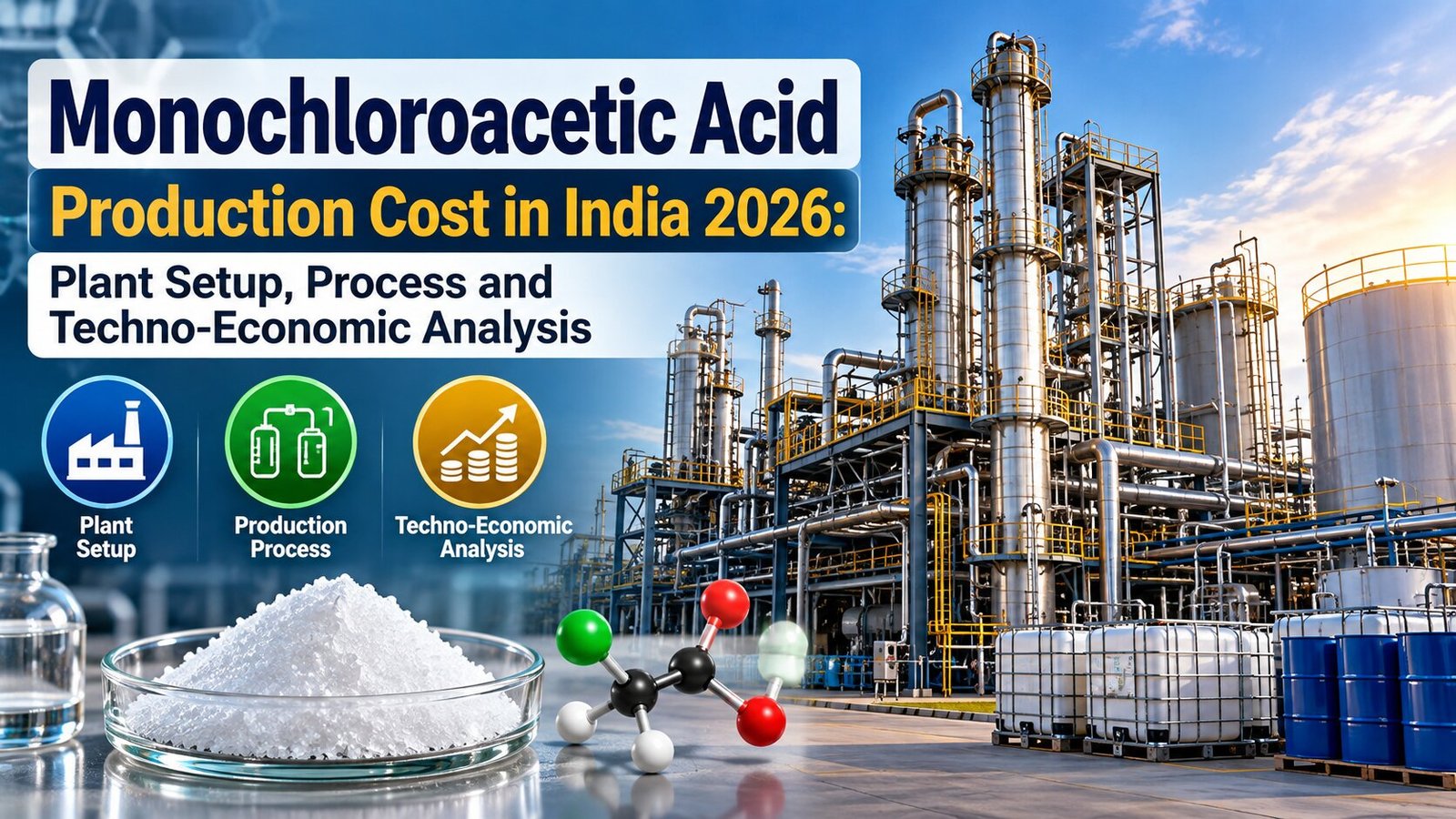
Setting up a monochloroacetic acid production plant in India presents a compelling investment case, driven by demand from the agrochemicals, personal care & cosmetics, pharmaceuticals, oil & gas, textiles, and food processing industries. Monochloroacetic acid is a versatile intermediate used extensively in industrial organic synthesis, which makes it critical to India’s agrochemical, pharmaceutical, and specialty chemical value chains.
India’s urbanisation, industrial infrastructure growth, and the Make in India initiative, together with PLI schemes and a focus on agrochemical self-reliance, support domestic chemical production, with Gujarat and Maharashtra among the key manufacturing states. Reduced import dependency makes India a strategically sound base for this type of production.
The investment case rests on policy support through Make in India and PLI schemes, cost-competitive local supply of a critical intermediate, and demand across agrochemicals, pharmaceuticals, and personal care. With gross margins of 30–40%, net margins of 15–22%, and break-even typically within 3 to 5 years, the project remains financially viable at 20,000–50,000 tons capacity.
What is Monochloroacetic Acid?
Monochloroacetic acid (MCA or MCAA) is an organochlorine compound and a colorless, crystalline solid that is highly soluble in water. It is a strong carboxylic acid and a versatile intermediate, acting as an alkylating agent crucial for creating dyes, pesticides, and surfactants. Industrially, it is produced by chlorinating acetic acid or hydrolyzing trichloroethylene.
Major applications include carboxymethyl cellulose (CMC), herbicides such as glyphosate, pharmaceuticals, and cosmetics, along with thioglycolic acid, vitamins, and pharmaceutical intermediates. Production follows carboxylation (carbonylation), hydrolysis, and purification, serving the agrochemicals, personal care & cosmetics, pharmaceuticals, oil & gas, textiles, and food processing industries.
Cost of Setting Up a Monochloroacetic Acid Production Plant in India
The cost depends on capacity, technology, location, automation, and regulatory compliance.
1. Capital Expenditure (CapEx)
Land and site development form a foundational part of the investment for a monochloroacetic acid production plant, with industrial estates and SEZs offering ready infrastructure. Costs cover land registration, boundary development, and site preparation, ideally close to acetic acid and chlorine supply. Civil works include the production shed, quality control lab, raw material and finished goods storage, and the administrative block. Corrosion-resistant machinery accounts for the largest share of capital expenditure, and key machinery required includes:
- Reactors
- Distillation columns
- Crystallizers
- Centrifuges
- Drying units
- Purification systems
- Packaging machines
Other capital costs include pre-operative expenses, commissioning, installation, safety and pollution control systems, an effluent treatment plant (ETP), and import duties where equipment is sourced from overseas.
Request a Sample Report for In-Depth Market Insights: https://www.imarcgroup.com/monochloroacetic-acid-manufacturing-plant-project-report/requestsample
2. Operational Expenditure (OpEx)
Raw material cost is the largest component of OpEx for a monochloroacetic acid production plant, accounting for approximately 60–70% of total operating expenses, driven mainly by acetic acid. Other inputs include chlorine and catalysts, and long-term supplier contracts help stabilise pricing. Utility costs, covering electricity, water, and steam, account for 15–20% of OpEx. Other operating costs include transportation, packaging, salaries, maintenance, depreciation, and taxes, and total operational costs are projected to increase substantially by the fifth year due to inflation and rising material costs.
3. Plant Capacity
The proposed facility is designed for an annual capacity ranging between 20,000–50,000 tons, enabling economies of scale while maintaining operational flexibility. The capacity of a monochloroacetic acid plant can be customised to investor requirements, and profitability improves with higher capacity utilisation.
4. Profit Margins and Financial Projections
Financial projections rest on realistic assumptions covering capital investment, operating costs, capacity utilisation, pricing trends, and demand outlook, and include ROI, net present value (NPV), internal rate of return (IRR), and payback period analysis. Gross profit margins typically range between 30–40%, while net profit margins range between 15–22%.
Why Set Up a Monochloroacetic Acid Plant in India?
Critical Chemical Intermediate: Monochloroacetic acid is a key building block for carboxymethyl cellulose (CMC), agrochemicals, pharmaceuticals, surfactants, and dyes, making it essential for sectors from food and oil drilling to personal care and crop protection.
Strong Market Growth: The global market was valued at USD 983.16 Million in 2025 and, according to IMARC Group estimates, is expected to reach USD 1,308.82 Million by 2034, exhibiting a CAGR of 3.23% from 2026 to 2034. IBEF indicates that the Indian pharmaceutical market is slated to grow 7–9% in FY26, fuelled by robust domestic demand, new product innovation, and expansion into Europe.
Policy and Regulatory Tailwinds: Government initiatives supporting domestic chemical manufacturing, agrochemical self-reliance, and specialty chemical exports, including Make in India and PLI schemes, indirectly boost demand for a critical upstream intermediate.
Cost-Competitive Production: Easy access to acetic acid, chlorine, and catalyst, together with proximity to target markets, helps minimise transportation and distribution costs, while backward integration supports margins for a well-located monochloroacetic acid plant.
Active Industry Investment: The market is being shaped by innovations in production processes focused on efficiency and sustainability, with companies investing in greener technologies.
Local Supply Chain Preference: Increasing focus on reducing import dependency is pushing downstream manufacturers to source locally, creating opportunities for regional producers with strong process control and safety standards.
Production Process – Step by Step
The monochloroacetic acid production process uses carboxylation (carbonylation), hydrolysis, and purification as the primary production method.
- Raw Material Sourcing: Acetic acid, chlorine, and catalysts are sourced.
- Chlorination Reaction: Acetic acid is chlorinated in reactors using catalysts such as acetic anhydride or UV light.
- Cooling and Separation: The reaction mixture is cooled and separated.
- Purification: Distillation columns and crystallizers purify the product.
- Drying: Drying units remove residual moisture.
- Quality Control and Storage: Chemical quality is tested before storage.
- Packaging and Dispatch: Packaging machines prepare finished product for dispatch to end-use industries.
Key Applications
Monochloroacetic acid serves a wide range of chemical, agricultural, and consumer applications.
- Chemical Manufacturing: A key intermediate in the production of carboxymethyl cellulose (CMC), herbicides, and surfactants.
- Agrochemicals: A precursor in the synthesis of pesticides, insecticides, and plant growth regulators.
- Pharmaceuticals: Used in the manufacture of active pharmaceutical ingredients and drug intermediates.
- Personal Care & Detergents: Applied in surfactants, betaines, and ingredients for soaps, shampoos, and cleaning products.
Leading Producers
Leading producers in the global monochloroacetic acid industry include several multinational companies with diverse application portfolios.
- Nouryon
- CABB Group GmbH
- PCC Group
- Denak Co. Ltd.
- Shandong Minji New Material Technology Co., Ltd.
- Archit Organosys
- Meridian Chem Bond Pvt. Ltd.
- Niacet Corporation (Kerry Group plc)
- PCC Rokita SA
Timeline to Start the Plant
- Feasibility study and project report preparation
- Land acquisition and site development
- Regulatory approvals and environmental clearances
- Factory licence and fire safety compliance
- Machinery procurement and installation
- Raw material supplier agreements and supply chain setup
- Trial production and quality testing
- Commercial production launch
Licences and Regulatory Requirements
Starting a monochloroacetic acid production unit in India requires several approvals:
- Business registration (Proprietorship, LLP, or Pvt Ltd)
- Factory Licence under the Factories Act
- Environmental Clearance from State Pollution Control Board
- GST Registration
- Fire Safety NOC
- Hazardous/Chemical compliance for the handling of chlorine
- Effluent Treatment Plant (ETP) operational clearance
- Occupational Health and Safety compliance
Key Challenges to Consider
High Capital Requirements: Land acquisition, construction, corrosion-resistant equipment, installation, and initial working capital together demand significant upfront investment.
Raw Material Price Volatility: Acetic acid, chlorine, and catalyst are exposed to price fluctuations, making long-term supplier contracts important.
Regulatory Compliance: Controlled chlorination, strict handling of hazardous materials, and environmental compliance require careful coordination.
Technology or Innovation Pressure: With companies investing in greener technologies, the monochloroacetic acid production process must keep pace on efficiency and sustainability.
Competition: Established players such as Nouryon, CABB Group GmbH, PCC Group, Denak Co. Ltd., and Shandong Minji New Material Technology Co., Ltd. compete on purity.
Skilled Manpower: Controlled chlorination and consistent purity standards demand skilled operators, so recruiting and training talent is essential for any monochloroacetic acid plant.
Frequently Asked Questions
1. How much does it cost to set up a monochloroacetic acid production plant in India?
Costs depend on capacity, technology, location, and automation, covering land, civil works, machinery, and working capital.
2. Is monochloroacetic acid production profitable in India in 2026?
Gross margins of 30–40% and net margins of 15–22% are typical, improving with higher capacity utilisation.
3. What machinery is required for a monochloroacetic acid plant in India?
Key machinery includes reactors, distillation columns, crystallizers, centrifuges, drying units, purification systems, and packaging machines.
4. What licences and approvals are required to start a monochloroacetic acid plant in India?
Requirements include business registration, factory licence, environmental clearance, GST registration, and fire safety NOC.
5. What raw materials are needed for monochloroacetic acid production?
Acetic acid, chlorine, and catalysts such as acetic anhydride or UV light are the core inputs.
6. What are the environmental compliance requirements for a monochloroacetic acid plant in India?
Environmental Clearance from the State Pollution Control Board and an operational effluent treatment system are required.
7. What is the best location to set up a monochloroacetic acid plant in India?
Sites with easy access to acetic acid and chlorine, proximity to markets, and robust infrastructure, such as in Gujarat and Maharashtra, suit best.
8. What is the break-even period for this type of plant in India?
Break-even typically ranges from 3 to 5 years, depending on scale, market demand, raw material costs, and operational efficiency.
9. What government incentives are available for manufacturers in India?
Incentives may include capital subsidies, tax exemptions, reduced utility tariffs, export benefits, and PLI schemes.
Key Takeaways for Investors
A monochloroacetic acid production plant in India offers a strong investment opportunity backed by demand from agrochemicals, pharmaceuticals, personal care, oil & gas, textiles, and food processing. Financial viability holds across capacities of 20,000–50,000 tons, with gross margins of 30–40% and net margins of 15–22%. The global market is projected to grow from USD 983.16 Million in 2025 to USD 1,308.82 Million by 2034 at a CAGR of 3.23%. With CMC, herbicide, and pharmaceutical consumption expanding, demand for locally produced intermediates is set to remain steady.
About the Author