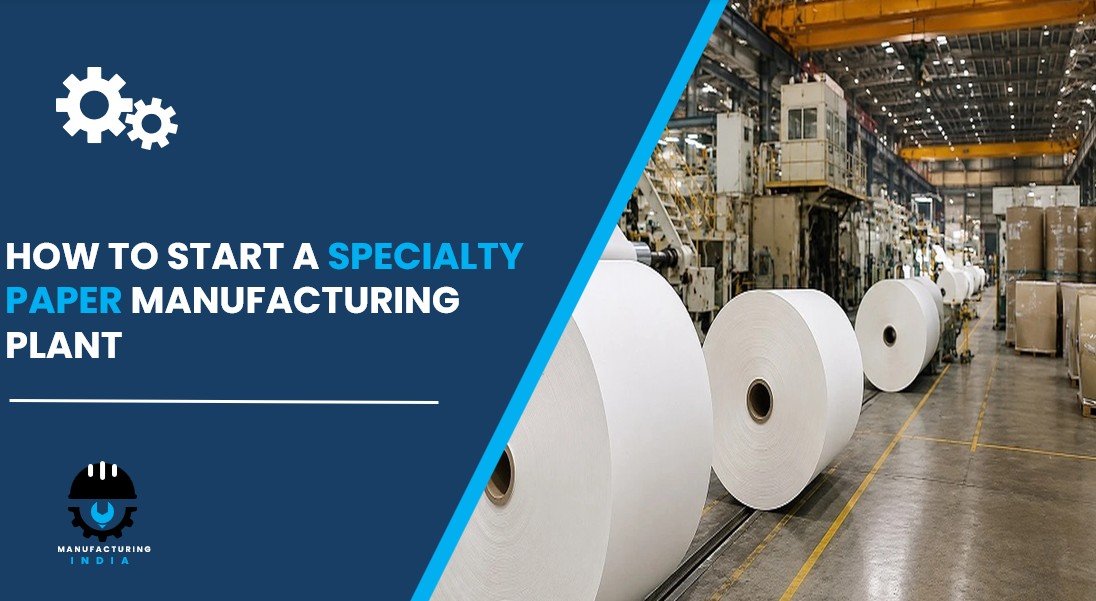
Setting up a specialty paper manufacturing plant is driven by growing demand for value-added paper products across packaging, labeling, printing, hygiene, and industrial applications, along with rising preference for sustainable, functional, and customized paper solutions. The global specialty paper market size was volumed at 37.86 Billion Metric Tons in 2025. According to IMARC Group estimates, the market is expected to reach 50.14 Billion Metric Tons by 2034, exhibiting a CAGR of 3.2% from 2026 to 2034. This feasibility report covers a comprehensive market overview to micro-level information such as unit operations involved, raw material requirements, utility requirements, infrastructure requirements, machinery and technology requirements, manpower requirements, packaging requirements, and transportation requirements, along with a detailed setup cost covering project economics, capital investments (CapEx), operating expenses (OpEx), income and expenditure projections, and financial analysis.
What is Specialty Paper?
Specialty paper refers to a broad category of paper products engineered to deliver specific functional, aesthetic, or performance characteristics beyond conventional printing and writing papers. These papers are designed for targeted applications such as packaging, labeling, security, medical, food contact, filtration, décor, and industrial uses. Specialty papers may offer properties such as high strength, moisture resistance, grease resistance, heat resistance, printability, barrier performance, or chemical resistance. They are often produced using customized pulp blends, coatings, additives, and surface treatments. Due to their application-specific nature, specialty papers command higher value and are critical enablers in advanced packaging, hygiene, and industrial processing sectors. For entrepreneurs planning to enter this industry, evaluating the specialty paper plant setup cost in India is essential for estimating capital investment, machinery requirements, raw material expenses, operational costs, and overall project feasibility.
Minimum Cost Required to Set Up a Specialty Paper Manufacturing Plant:
Industry cost benchmarking for specialty paper manufacturing indicates a minimum entry investment of approximately USD 15–25 million for a smaller-scale facility with a capacity of around 10,000 MT/year, covering essential equipment such as pulping and stock preparation systems, paper machines, pressing and drying sections, coating and sizing units, calenders, finishing equipment, slitting machines, and automated packaging lines. Capital requirements can increase to around USD 30–50 million for mid-sized plants with capacities of approximately 20,000–30,000 MT/year, while larger and highly automated facilities can require USD 60–100 million or more for capacities approaching 50,000 MT/year, particularly where advanced coating technology, specialized surface-treatment systems, process automation, wastewater treatment, utilities, and quality-control laboratories are incorporated. IMARC’s 2026 report specifies a proposed production capacity of 10,000–50,000 MT annually and identifies pulping, sheet formation, pressing, drying, coating or impregnation, calendering, finishing, slitting, cutting, and packaging as key production stages
Key Investment Highlights
- Process Used: Raw material selection, pulping and stock preparation, sheet formation, pressing and drying, surface sizing, coating, or impregnation, calendering and finishing, slitting, cutting, and packaging.
- End-use Industries: Packaging and labeling, food and beverage, healthcare and hygiene, printing and publishing, and industrial and technical applications.
- Applications: Flexible and rigid packaging, labels and release liners, medical and hygiene products, security and specialty printing, and filtration and industrial uses.
Request Sample: https://www.imarcgroup.com/specialty-paper-manufacturing-plant-project-report/requestsample
Specialty Paper Plant Capacity
The proposed manufacturing facility is designed with an annual production capacity ranging between 10,000–50,000 MT, enabling economies of scale while maintaining operational flexibility.
Specialty Paper Plant Profit Margins
The project demonstrates healthy profitability potential under normal operating conditions. Gross profit margins typically range between 30–40%, supported by stable demand and value-added applications.
- Gross Profit: 30–40%
- Net Profit: 12–20%
Specialty Paper Plant Cost Analysis
The operating cost structure of a specialty paper manufacturing plant is primarily driven by raw material consumption, particularly pulp (wood/cotton), which accounts for approximately 55–65% of total operating expenses (OpEx).
- Raw Materials: 55–65% of OpEx
- Utilities: 20–30% of OpEx
Financial Projection
The financial projections for the proposed project have been developed based on realistic assumptions related to capital investment, operating costs, production capacity utilization, pricing trends, and demand outlook. These projections provide a comprehensive view of the project’s financial viability, ROI, profitability, and long-term sustainability.
Major Applications
- Packaging and Labeling: Specialty papers are used in food wraps, corrugated liners, sachets, labels, and release papers where barrier properties, print quality, and strength are required.
- Food and Beverage: Used for greaseproof papers, baking papers, tea and coffee filter papers, and food-contact packaging with safety and performance requirements.
- Healthcare and Hygiene: Applied in medical papers, sterilization wraps, diagnostic strips, tissue-based hygiene products, and disposable medical supplies.
- Printing and Publishing: Used in decorative papers, thermal papers, security papers, and high-end printing applications.
- Industrial Applications: Includes electrical insulation papers, abrasive backing papers, filtration media, and laminating base papers.
Why Specialty Paper Manufacturing?
- High value-added product segment: Specialty papers deliver customized performance attributes, enabling higher margins compared to commodity paper grades.
- Expanding sustainable packaging demand: Paper-based alternatives are increasingly replacing plastics, driving demand for functional and barrier specialty papers.
- Diverse end-use industries: Applications span packaging, healthcare, food, and industrial sectors, ensuring diversified and resilient demand.
- Scope for innovation and customization: Manufacturers can differentiate through coatings, fiber blends, and functional additives tailored to customer needs.
- Regulatory and environmental alignment: Paper-based solutions align with sustainability regulations and circular economy goals worldwide.
Speak to an Analyst: https://www.imarcgroup.com/request?type=report&id=27497&flag=C
Specialty Paper Industry Outlook 2026
The specialty paper market is driven by the rapid growth of packaging, food service, healthcare, and hygiene sectors, along with increasing demand for sustainable and recyclable materials. For instance, India’s extensive packaging base of over 22,000 units (85% SMEs) and a strong paper manufacturing ecosystem of more than 850 mills (526 operational) producing nearly 25 million tons annually provide a solid foundation for specialty paper demand. With paper and paperboard capacity utilization above 95% and installed capacity of about 5 million tons, the sector’s scale and efficiency are directly supporting growth in value-added specialty paper production for packaging and industrial applications. Healthcare expansion and higher hygiene awareness are increasing consumption of medical and tissue-based specialty papers. Technological advancements in coatings, fiber engineering, and barrier solutions are enabling paper to replace plastics in several applications. Additionally, demand for high-quality printing, labeling, and industrial papers continues to support steady growth across global markets.
Leading Specialty Paper Manufacturers
Leading manufacturers in the global specialty paper industry include several multinational companies with extensive production capacities and diverse application portfolios. Key players include:
- UPM-Kymmene Oyj
- Glatfelter Corporation
- Mondi
- Domtar Corporation
- Stora Enso
- International Paper
- Ahlstrom-Munksjo
- Sappi Ltd.
All of the above serve end-use sectors such as packaging and labeling, food and beverage, healthcare and hygiene, printing and publishing, and industrial and technical applications.
How to Setup a Specialty Paper Manufacturing Plant?
Setting up a specialty paper manufacturing plant requires evaluating several key factors, including technological requirements and quality assurance. Some of the critical considerations include:
Detailed Process Flow
The manufacturing process is a multi-step operation that involves several unit operations, material handling, and quality checks. Below are the main stages involved in the specialty paper manufacturing process flow:
- Unit Operations Involved
- Mass Balance and Raw Material Requirements
- Quality Assurance Criteria
- Technical Tests
- Site Selection: The location must offer easy access to key raw materials such as pulp (wood/cotton), specialty chemicals, fillers, and coatings. Proximity to target markets will help minimize distribution costs. The site must have robust infrastructure, including reliable transportation, utilities, and waste management systems. Compliance with local zoning laws and environmental regulations must also be ensured.
- Plant Layout Optimization: The layout should be optimized to enhance workflow efficiency, safety, and minimize material handling. Separate areas for raw material storage, production, quality control, and finished goods storage must be designated. Space for future expansion should be incorporated to accommodate business growth.
- Equipment Selection: High-quality, corrosion-resistant machinery tailored for specialty paper manufacturing must be selected. Essential equipment includes pulping and stock preparation systems, paper machines, press and drying sections, coating and sizing machines, calenders and finishing equipment, slitting, cutting, and packaging machines. All machinery must comply with industry standards for safety, efficiency, and reliability.
- Raw Material Sourcing: Reliable suppliers must be secured for raw materials like pulp (wood/cotton), specialty chemicals, fillers, and coatings to ensure consistent production quality. Minimizing transportation costs by selecting nearby suppliers is essential. Sustainability and supply chain risks must be assessed, and long-term contracts should be negotiated to stabilize pricing and ensure a steady supply.
- Safety and Environmental Compliance: Safety protocols must be implemented throughout the manufacturing procedure of specialty paper. Advanced monitoring systems should be installed to detect leaks or deviations in the process. Effluent treatment systems are necessary to minimize environmental impact and ensure compliance with emission standards.
- Quality Assurance Systems: A comprehensive quality control system should be established throughout production. Analytical instruments must be used to monitor product concentration, purity, and stability. Documentation for traceability and regulatory compliance must be maintained.
Project Economics
Establishing and operating a specialty paper manufacturing plant involves various cost components, including:
- Capital Investment: The total capital investment depends on plant capacity, technology, and location. This investment covers land acquisition, site preparation, and necessary infrastructure.
- Equipment Costs: Equipment costs, such as those for pulping and stock preparation systems, paper machines, press and drying sections, coating and sizing machines, calenders and finishing equipment, slitting, cutting, and packaging machines, represent a significant portion of capital expenditure. The scale of production and automation level will determine the total cost of machinery.
- Raw Material Expenses: Raw materials, including core ingredients like pulp (wood/cotton), specialty chemicals, fillers, and coatings, are a major part of operating costs. Long-term contracts with reliable suppliers will help mitigate price volatility and ensure a consistent supply of materials.
- Infrastructure and Utilities: Costs associated with land acquisition, construction, and utilities (electricity, water, steam) must be considered in the financial plan.
- Operational Costs: Ongoing expenses for labor, maintenance, quality control, and environmental compliance must be accounted for. Optimizing processes and providing staff training can help control these operational costs.
- Financial Planning: A detailed financial analysis, including income projections, expenditures, and break-even points, must be conducted. This analysis aids in securing funding and formulating a clear financial strategy.
Capital Expenditure (CapEx) and Operational Expenditure (OpEx) Analysis
Capital Investment (CapEx): Machinery costs account for the largest portion of the total capital expenditure. The cost of land and site development, including charges for land registration, boundary development, and other related expenses, forms a substantial part of the overall investment. This allocation ensures a solid foundation for safe and efficient plant operations.
Operating Expenditure (OpEx): In the first year of operations, the operating cost for the specialty paper manufacturing plant is projected to be significant, covering raw materials, utilities, depreciation, taxes, packing, transportation, and repairs and maintenance. By the fifth year, the total operational cost is expected to increase substantially due to factors such as inflation, market fluctuations, and potential rises in the cost of key materials. Additional factors, including supply chain disruptions, rising consumer demand, and shifts in the global economy, are expected to contribute to this increase.
Latest Industry Developments
- January 2026: The Kerala Paper Products Limited (KPPL) at Velloor is set to undergo significant expansion and diversification after the State government approved a ₹741 crore investment project. The initiative is aimed at tapping into the rising demand for specialty paper grades, high-quality packaging paper, and writing, printing, and copier papers, driven by the rapid growth of e-commerce, retail, food delivery services, and the education sector, as well as the continued ban on single-use plastics.
- June 2025: BiOrigin Specialty Products (BSP), a prominent North American producer and converter of sustainable specialty papers, announced the launch of a new oil and grease resistant (OGR) paper. The innovative BioGuard paper is made using a 100% food-safe OGR solution that prevents oil and grease from seeping through foodservice wrappers and bags, while also offering improved processing efficiency for OGR paper converters.
Frequently Asked Questions:
1. How much capital is required to start a specialty paper manufacturing plant?
The capital required to establish a specialty paper manufacturing plant depends on production capacity, plant location, automation level, manufacturing technology, and the type of specialty paper being produced. Major investment components include land acquisition, site development, building construction, machinery procurement, installation, utilities, quality-control facilities, environmental management systems, and pre-operative expenses. Working capital must also be allocated for raw materials, wages, maintenance, packaging, and transportation.
2. How do I start a specialty paper manufacturing business?
Starting a specialty paper manufacturing business involves conducting a feasibility study, identifying target markets, selecting a suitable location, arranging financing, obtaining regulatory approvals, and procuring appropriate machinery. Entrepreneurs should also establish reliable supply agreements for pulp, specialty chemicals, fillers, and coating materials while recruiting experienced production, maintenance, and quality-control personnel.
3. What raw materials are required for specialty paper manufacturing?
The primary raw materials used in specialty paper manufacturing include wood pulp, cotton pulp, specialty chemicals, fillers, pigments, sizing agents, and coating materials. Depending on the intended application, manufacturers may also require functional additives that improve strength, smoothness, printability, moisture resistance, grease resistance, barrier performance, or other specialized properties. Packaging materials are needed to protect the finished paper during storage and transportation.
4. What machinery and equipment are required to start a specialty paper manufacturing plant?
A specialty paper manufacturing plant requires equipment for pulp preparation, sheet formation, drying, surface treatment, finishing, and packaging. Essential machinery includes pulping systems, stock-preparation equipment, refiners, paper machines, pressing and drying sections, surface-sizing machines, coating systems, calenders, slitting machines, cutting equipment, and packaging units.
5. What are the biggest challenges in starting a specialty paper manufacturing business?
Major challenges include fluctuations in pulp and chemical prices, maintaining consistent raw-material quality, managing high energy and water consumption, and achieving the required functional properties for different paper grades. Specialty paper production may also require precise control over coating uniformity, thickness, strength, surface finish, moisture resistance, and printability.
6. Who are the top specialty paper manufacturers in the world?
Prominent companies operating in the specialty paper industry include Mondi Group, Ahlstrom, Sappi Limited, Stora Enso, and Nippon Paper Industries Co., Ltd. These manufacturers serve various end-use sectors, including packaging, labeling, food and beverage, healthcare, printing, filtration, and industrial applications.
Buy the full Specialty Paper Manufacturing Plant Cost report: https://www.imarcgroup.com/checkout?id=27497&method=2175
Contact Us
IMARC Group
134 N 4th St. Brooklyn, NY 11249, USA
Email: sales@imarcgroup.com
Tel No: (D) +91 120 433 0800
United States: (+1-201-971-6302)
About the Author