
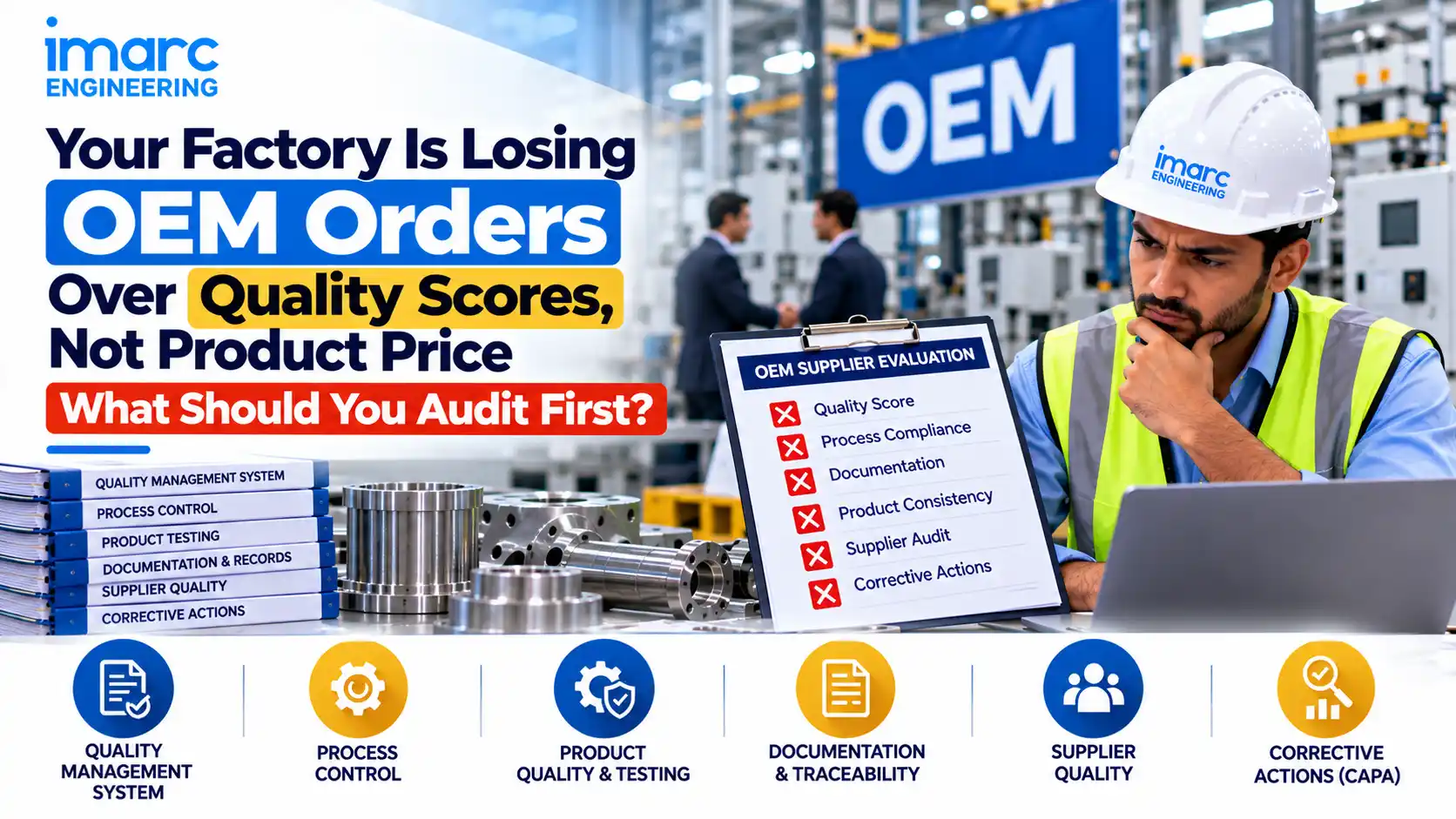
A component manufacturer quotes competitively and ships on schedule, yet repeat OEM business is thinning out. Rejections have crept up, a customer scorecard has slipped, and nobody can say with certainty whether quality performance is why orders are shrinking. (This scenario is illustrative.)
The useful first question is not “how do we fix quality?” but “what should we audit first?” This article shows how to use the customer’s own scorecard and real process evidence to prioritise investigations, whether you are weighing quality audit consulting services in India or building the capability in-house. In short: start with the indicators that fell, then trace each one to the process, records and corrective actions behind it. quality audit consulting services in India or building the capability in-house. In short: start with the indicators that fell, then trace each one to the process, records and corrective actions behind it.
Why Competitive Pricing Cannot Compensate for Every Quality Problem
Depending on the OEM, quality performance can influence supplier evaluations, corrective-action demands and confidence in future sourcing. The rules are not uniform. IATF Global Oversight publishes customer-specific requirements OEM by OEM, lists separate scorecard guides for several of them, and shows some OEMs’ documents as still under development [1][2]. Automotive requirements do not automatically apply to other sectors.
That variation matters for diagnosis. A lost order is a fact; its cause is only a hypothesis until the customer’s feedback, supplier quality scorecard or sourcing communication confirms it. Price, delivery, capacity, engineering-change handling and quality can all play a part. Before fixing anything, gather the documented evidence: the scorecard criteria, the reporting period and what the customer actually said.
What Should You Audit First When Your OEM Quality Score Drops?
Treat the seven areas below as a diagnostic menu, not a universal ranking. Your scorecard, contract, severity and evidence decide the order. Each area works as a focused manufacturing quality audit.
1. Customer Scorecard and Performance Trends
- Business problem: The score has dropped, but nobody has mapped which indicator moved or when.
- Evidence to inspect: Current and earlier scorecards, scoring criteria, reporting periods and customer correspondence.
- What the audit should establish: Which indicators underperform, and how the trend compares with the requirements this customer has actually set.
- Next step: Build a one-page indicator-by-period trend. Use thresholds only where the customer has published them.
2. Customer PPM, Rejections and Defect Escapes
- Business problem: Complaints repeat, or defects reach the customer despite final inspection. PPM (parts per million) expresses the number of rejected or defective parts per million parts, but the exact calculation, reporting period and treatment of rejected parts depend on the OEM’s published supplier-quality requirements. Confirm the applicable definition before comparing scorecards or calculating trends.[3].
- Evidence to inspect: Complaint logs, rejection reports, defect categories and your internal inspection records for the same batches.
- What the audit should establish: Whether defects recur, where they escape, and how customer-reported data compares with internally recorded defects.
- Next step: Trace three to five recent complaints back to their production batches.
3. Production Process Controls
- Business problem: Approved documents describe one process while the shopfloor runs another.
- Evidence to inspect: Control plans, inspection plans, work instructions, process records, and change records for tooling, material, equipment or method.
- What the audit should establish: Whether actual practice matches documentation, and whether a change preceded the defect trend.
- Next step: Observe a live shift against the documents and log every deviation.
4. Corrective Actions and Root-Cause Analysis
- Business problem: Actions are closed, yet the defect returns.
- Evidence to inspect: Corrective-action reports (8D or CAPA, meaning corrective and preventive action), root-cause records, customer responses and later production data.
- What the audit should establish: Whether root cause analysis in manufacturing found the underlying cause or only the immediate defect, and whether effectiveness was verified.
- Next step: Re-open any action closed without evidence from later production. Illustrative example: a recurring bore-diameter defect is “closed” by sorting parts, while the worn tooling behind it stays on its old change schedule.
5. Supplier Quality and Incoming Material
- Business problem: Defects originate upstream, or a material or subcontractor change slipped through uncontrolled.
- Evidence to inspect: Incoming inspection results, supplier rejection trends, change approvals and supplier corrective-action replies.
- What the audit should establish: Whether changes were controlled and supplier actions verified. A supplier’s certificate alone does not demonstrate consistent product quality.
- Next step: Rank suppliers by share of rejections and review the top supplier’s latest change record.
6. Traceability, Containment and Customer Response
- Business problem: A complaint arrives and nobody can quickly say which lots are affected. Containment means isolating suspect product so it does not reach the customer.
- Evidence to inspect: Lot and batch records, containment logs, response timelines and the corrective-action submissions actually sent.
- What the audit should establish: How fast affected lots can be identified, and whether submissions are complete and supported by evidence. Weak traceability widens sorting and delays investigations. OEMs may specify deadlines for containment, initial response and root-cause reporting. Check the applicable supplier manual or customer-specific requirements for the actual deadlines, and ensure the response process assigns an owner and tracks each submission to completion. [3].
- Next step: Run a timed mock trace of one finished lot back to material and forward to shipment.
7. Ownership, Follow-Up and Management Review
- Business problem: Findings sit without owners and issues quietly return.
- Evidence to inspect: Action registers, overdue items, recurring issues and management review minutes.
- What the audit should establish: Every finding has an owner, due date and escalation path, and quality trends reach the right management level.
- Next step: List overdue and recurring items and escalate each with a named owner and date.
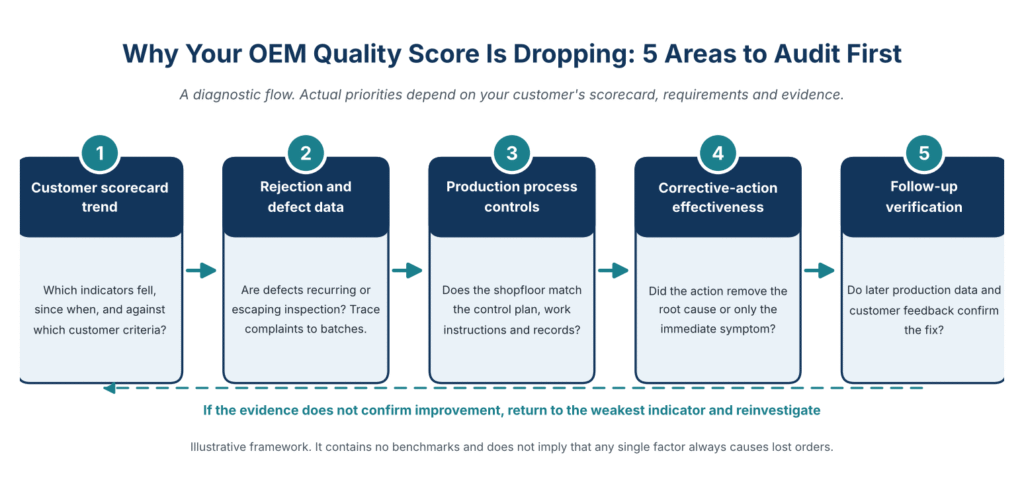
How to Prioritise the Audit Without Wasting Time
Work in this sequence:
- Obtain the actual customer scorecard and relevant requirements.
- Identify the weakest documented indicators.
- Map each indicator to the relevant process and supporting records.
- Investigate the highest-impact verified gaps first.
- Assign corrective actions, owners and completion dates.
- Verify improvement using subsequent process data or customer feedback.
Priority comes from customer requirements, severity, recurrence and evidence, not assumptions.
What Evidence Should You Prepare Before the Next OEM Review?
Think of this as customer audit preparation. Gather:
- Recent customer scorecards and documented feedback
- Rejection and complaint trends
- Relevant inspection and production records
- Approved process documentation and change records
- Root-cause investigations and corrective-action reports
- Traceability and containment evidence
- Supplier-related quality records, where relevant
- Effectiveness verification and action ownership
The exact evidence depends on the OEM’s requirements and the audit scope, so confirm both first.
How to Verify Whether Corrective Actions Are Working
Closing an action is not the same as proving the problem is gone. Take a recurring dimensional defect (illustrative). Sorting the affected parts protects the customer today but fixes nothing upstream. Correcting the process cause, such as replacing worn tooling and adding a tool-life check, addresses the source. Reviewing later production evidence, such as inspection data across subsequent batches and any new complaints, shows whether the defect has stayed away. Only then is the action demonstrably effective. Even so, no single action guarantees a better scorecard or returning orders; the customer decides how it scores and sources.
TABLE PLACEMENT (one only): insert after the “How to Verify Whether Corrective Actions Are Working” section. Title: “OEM Quality Scorecard: What to Check Before You Lose More Orders.”
OEM Quality Scorecard: What to Check Before You Lose More Orders
| Scorecard signal | Evidence to inspect | Investigation area | Corrective-action direction |
|---|---|---|---|
| Rejections rising over consecutive reporting periods | Complaint log, rejection reports, internal inspection data for the same batches | Customer PPM, rejections and defect escapes | Trace to batches, test whether final inspection catches the defect, correct the process cause |
| Same defect category keeps recurring | Earlier corrective-action reports, tooling and maintenance logs, change records | Production process controls; corrective actions | Re-open root-cause analysis; confirm closure had effectiveness evidence |
| Late or incomplete corrective-action responses | Complaint receipt dates, submission dates, report completeness, customer feedback | Traceability, containment and customer response | Set an internal response clock, owner and pre-submission review |
| Affected lots hard to identify quickly | Lot records, containment logs, timed mock-trace result | Traceability, containment and customer response | Close record gaps; define a standard containment procedure |
| Rejections linked to bought-in material | Incoming inspection data, supplier corrective actions, change approvals | Supplier quality and incoming material | Raise supplier corrective action; verify with subsequent lots |
| Overdue actions or repeat findings | Action register, management review minutes | Ownership, follow-up and management review | Escalate with named owners and dates; track to verified closure |
How Quality Audit Consulting Can Help Manufacturers
Plants under customer quality pressure often have the data but lack the time or an independent view to connect scorecard signals to process reality. Structured, evidence-based quality audit consulting services in India examine both the documented system and what actually happens on the floor; IMARC Engineering’s published audit services describe assessing the documentation framework and the substance of process control together [5]. Relevant support areas include:
- Reviewing documented processes and identifying implementation gaps
- Assessing quality records and process controls
- Supporting root-cause investigations and corrective-action planning
This is diagnostic and planning support. It cannot by itself improve an OEM scorecard, restore a lost customer or guarantee future orders. When choosing a quality audit consultant in India, ask how findings will trace back to your scorecard indicators and records.
If your OEM quality scorecard is declining or corrective actions are not resolving recurring issues, contact IMARC Engineering to discuss an evidence-based review of your manufacturing operations: http://imarcengineering.com/services/vendor-audits-and-compliance-checks
Conclusion
The right audit starts with the customer’s actual requirements and verified performance gaps, not with assumptions about why orders were lost. Investigate the processes behind the weak indicators, put appropriate corrective actions in place, and verify the results with later evidence before treating the problem as solved.
Contact Us:
IMARC Engineering
Phon:e +91-120-433-0800
Email: sales@imarcengineering.com
India: C-130, Sector 2, Noida, Uttar Pradesh 201301
LinkedIn: https://www.linkedin.com/showcase/imarc-engineering/
About the Author